“The Department of the Interior today announced the start of a phased plan to establish the Marine Minerals Administration, bringing together the functions of the Bureau of Ocean Energy Management and the Bureau of Safety and Environmental Enforcement. This action is intended to improve coordination and increase efficiencies across offshore leasing, permitting, inspections and environmental oversight, while maintaining all existing regulatory protections and rigorous safety standards.Â
This streamlined approach reflects the evolution of offshore energy development and the need for a more integrated approach to managing conventional and emerging resources such as critical minerals. By aligning planning, leasing and oversight functions, the Department is positioning the agency to better meet current and future energy demands.“
This is an excellent step that many OCS program veterans have been advocating. In addition to the inefficiencies associated with overlapping and intertwined BOEM and BSEE responsibilities, the associated regulatory fragmentationis a significant safety risk factor.
Companies seeking to acquire OCS leases are not only competing with each other, they are also competing with BOEM’s tract evaluations. In that regard, the bidders fared well at Sale BBG1. Only 3 of the 181 high bids were rejected by BOEM.and those rejections appear to be warranted.
MROV=Mean of the Range-of-Value; LBCI=Lower Bound Confidence Interval; KUSA=Karoon (Australia) Energy USA; EW=Ewing Bank; MC=Mississippi Canyon
LLOG submitted 9 other high bids (alone or with partners) that were accepted. KUSA did not submit any other bids. We’ll see if the rejected bids for these blocks are exceeded in future sales.
Nine other high bids (table below) were less than the MROV, but all were greater than the LBCI. Those bidders “beat the house,” acquiring leases for <MROV. In that regard, Equinor led the pack with no rejections even though 3 of their 7 bids were below MROV. Similarly, 2 of Beacon’s 4 bids were <MROV, with no rejections.
Block No.
Company
no. of bids
bid
MROV
LBCI
GC 345
Beacon
1
$5,302,358
$5,400,000
$4,200,000
GC 346
Beacon
1
$1,102,358
$1,500,000
$900,000
GC 547
Equinor
1
$3,200,067
$4,500,000
$2,600,000
GC 549
Equinor
1
$899,967
$1,500,000
$576,000
AT 64
LLOG
1
$7,997,018
$8,300,000
$6,700.000
KC 386
Oxy
2
$3,000,505
$3,500,000
$2,800,000
KC 429
Oxy
1
$600,505
$910,000
$470,000
KC 431
Woodside
1
$904,547
$1,200,000
$840,000
WR 56
Equinor
1
$904,547
$1,200,000
$576,000
MROV=Mean of the Range-of-Value; LBCI=Lower Bound Confidence Interval; AT=Atwater Valley, GC=Green Canyon, KC=Keathley Canyon, WR=Walker Ridge
Perhaps most interesting were the blocks that were highly valued by industry, but not by BOEM. Each of these blocks (table below) received multiple bids and high bids >$10 million. Conversely, BOEM valued the blocks at only $576,000, which (per the terms of the sale) equates to the minimum acceptable bid of $100/acre.
Block No.
high bidder
high bid
other bids
MROV
GC 845
Beacon
$11,802,358
LLOG: $613,008
$576,000
KC 25
Chevron
$18,592,086
BP: $11,507,770 Shell: $753,029
$576,000
WR 443
Woodside
$15,204,547
Chevron $1,596,189
$576,000
WR444
Woodside
$12,204,547
BP: $4,593,770 Chevron $1,482,378
$576,000
MROV=Mean of the Range-of-Value; LBCI=Lower Bound Confidence Interval; GC=Green Canyon, KC=Keathley Canyon, WR=Walker Ridge
All of this demonstrates yet again that:
the govt is leasing exploration and development opportunities, not confirmed resources,
commercial discoveries are far from certain,
informed assessments differ (I.e. great minds, and their computers, don’t always think alike đ),
corporate priorities differ, and
exploration strategies evolve.
Superstition, tactic, AI, coded or subliminal message? đ
All 58 BP bids end with 770. Examples: $1,707,770 and $807,770. (At Sale BBG2, all 5 BP bids ended with 990.)
All 18 Shell bids ended with 029. (At Sale BBG2, all 6 Shell bids ended with 240.)
13 of 15 Anadarko bids ended with 505, the other 2 ended with 101.
For 40 years, challenges associated with bankruptcies (or the threat thereof), a divided offshore industry, political pressure, hurricane damage, and unresolved legal issues have hindered initiatives to better protect the public from decommissioning liabilities. Nonetheless, regulators and industry were able to prevent taxpayers from incurring any decommissioning costs. Unfortunately that is no longer the case.
For the first time in history, the govt has funded decommissioning on the OCS (and bragged about it – photo below).
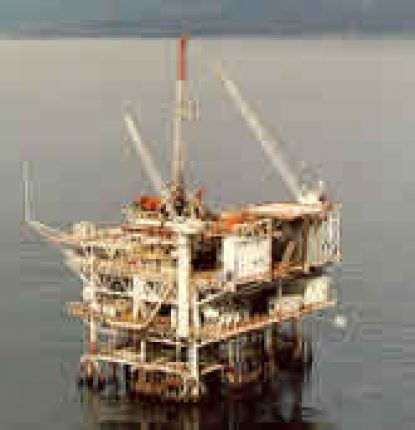
Federally funded decommissioning operation in the Matagorda Area of the Gulf.
BOEM’s proposed revisions to the decommissioning regulations (attached) would facilitate the transfer of aging structures to companies with limited assets, and in some cases, poor or undemonstrated safety records.
The proposal would reduce or eliminate the supplemental financial assurance requirement if a predecessor lessee has a strong credit rating. For that strategy to work, related decommissioning issues must be addressed. and clarifications and boundaries provided to ensure taxpayers are protected from decommissioning liabilities.
Predecessor liability, which is important because it helps prevent companies from assigning leases for the purpose of avoiding decommissioning obligations, was not established in the regulations until much of the OCS infrastructure was already installed. In a final rule that was effective on 8/20/1997,my office (thanks to the perseverance of Gerry Rhodes, John Mirabella, and Dennis Daugherty) codified the joint and several liability principle in 30 CFR 250.110 as follows:
(b) Lessees must plug and abandon all well bores, remove all platforms or other facilities, and clear the ocean of all obstructions to other users. This obligation: (1) Accrues to the lessee when the well is drilled, the platform or other facility is installed, or the obstruction is created; and (2) Is the joint and several responsibility of all lessees and owners of operating rights under the lease at the time the obligation accrues, and of each future lessee or owner of operating rights, until the obligation is satisfied under the requirements of this part.
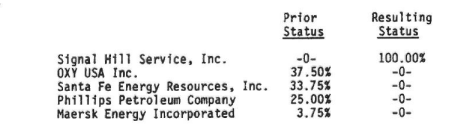
Prior to the that rule, the official policy of the Dept. of the Interior, as expressed in a 1988 letter from the Director of the Minerals Management Service (see excerpt pasted below), was that lease assignors would NOT be held accountable should their successors fail to fulfill their decommissioning responsibilities.
A major unanswered question regarding decommissioning obligations is thus the extent to which predecessor liability applies to leases assigned prior to the 1997 regulation. According to BOEM data, 771 remaining platforms were installed at least 10 years before the rule change, and 504 were installed at least 20 years prior. For assets transferred prior to the rule change, do the predecessors retain liability? BOEM should explain its position on this issue.
Other predecessor liability questions that need to be answered:
Now that the reverse chronological guidance has been scrapped, what will be the process for determining which predecessors will be held responsible?
If the govt doesn’t ensure that the new lessees fulfill their performance obligations (e.g. funding escrow accounts, well plugging, insurance, etc.), are predecessors still liable?
What if the structures were poorly maintained by the new lessees, complicating decommissioning and increasing the costs
Should a predecessor several transfers removed from operating the facilities still be held responsible?
Two examples of what can happen (and has happened):
Example 1: Big AAA Oil assigns a lease to Proud Production, a reputable independent. After years of operations, Proud can no longer profitably produce from the lease. Proud assigns the lease to CCC Oil & Gas, a small and highly efficient operator. After the lease is no longer profitable, even for a company with a low cost structure, CCC assigns the lease to Elmer’s E&P, a sketchy, barely solvent operating company with a poor compliance record. Elmer rather predictably neglects maintenance and declares bankruptcy after a decline in oil prices. Should Big AAA Oil, which had no say in the last 2 transfers in the assignment chain, be financially responsible for decommissioning the facilities?
Example 2: Big AAA Oil assigns a lease to DDD Development Company. Per the terms of the assignment, DDD establishes an Abandonment Escrow Account, as provided for in 30 CFR 556.904. BOEM allows DDD to withdraw funds from the account for purposes not authorized in the regulations. Should Big AAA Oil be liable for decommissioning costs after DDD is no longer solvent? (See “The troubling case of Platforms Hogan and Houchin.”)
For predecessor liability to be fairly and effectively implemented, and survive legal challenges, BOEM should:
Before approving lease assignments, verify that the assignors and assignees have contractually specified, to BOEM’s satisfaction, how the decommissioning of assigned assets will be funded.
Not approve subsequent lease assignments until the predecessor that is being held financially responsible has approved a funding agreement with the new lessees.
Attached are proposed revisions to BOEM’s marine minerals regulations as published today in the Federal Register. As advertised, the revisions appear to be largely administrative in nature and do not substantively change the marine minerals program.
The proposal does require BOEM to act on unsolicited lease sale requests within 28 days (currently 45 days), which may prove to be a challenge. See the excerpt pasted below.
G. Revise 30 CFR 581.11(b) âUnsolicited request for a lease saleâ
The requirement for the BOEM Director to decide âwithin 45 daysâ of receipt of a lease request is not based on a statutory requirement. BOEM proposes to replace this 45-day timeframe with 28 days to ensure timely processing of such requests.
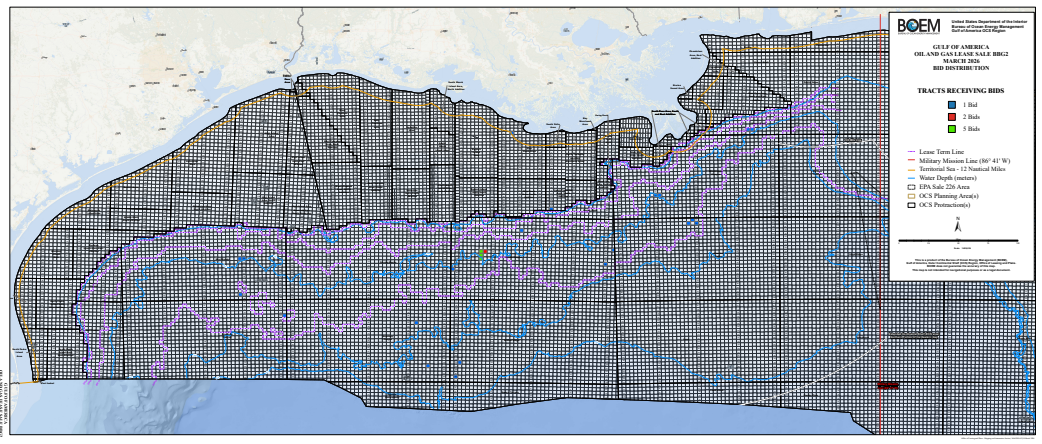
No bids were accepted during BBG1’s Phase 1 review. This means that none of the tracts receiving bids were determined to be nonviable as was the case for the 199 tracts that were improperly acquired for carbon disposal purposes in Sales 257, 259, and 261. (Unsurprisingly, neither of the acquiring companies has submitted an exploration plan for any of these CCS leases. The leases will likely expire without activity. Much to the dismay of the large and diverse group of opponents, the carbon disposal industry is focusing on onshore locations along the Gulf Coast.)
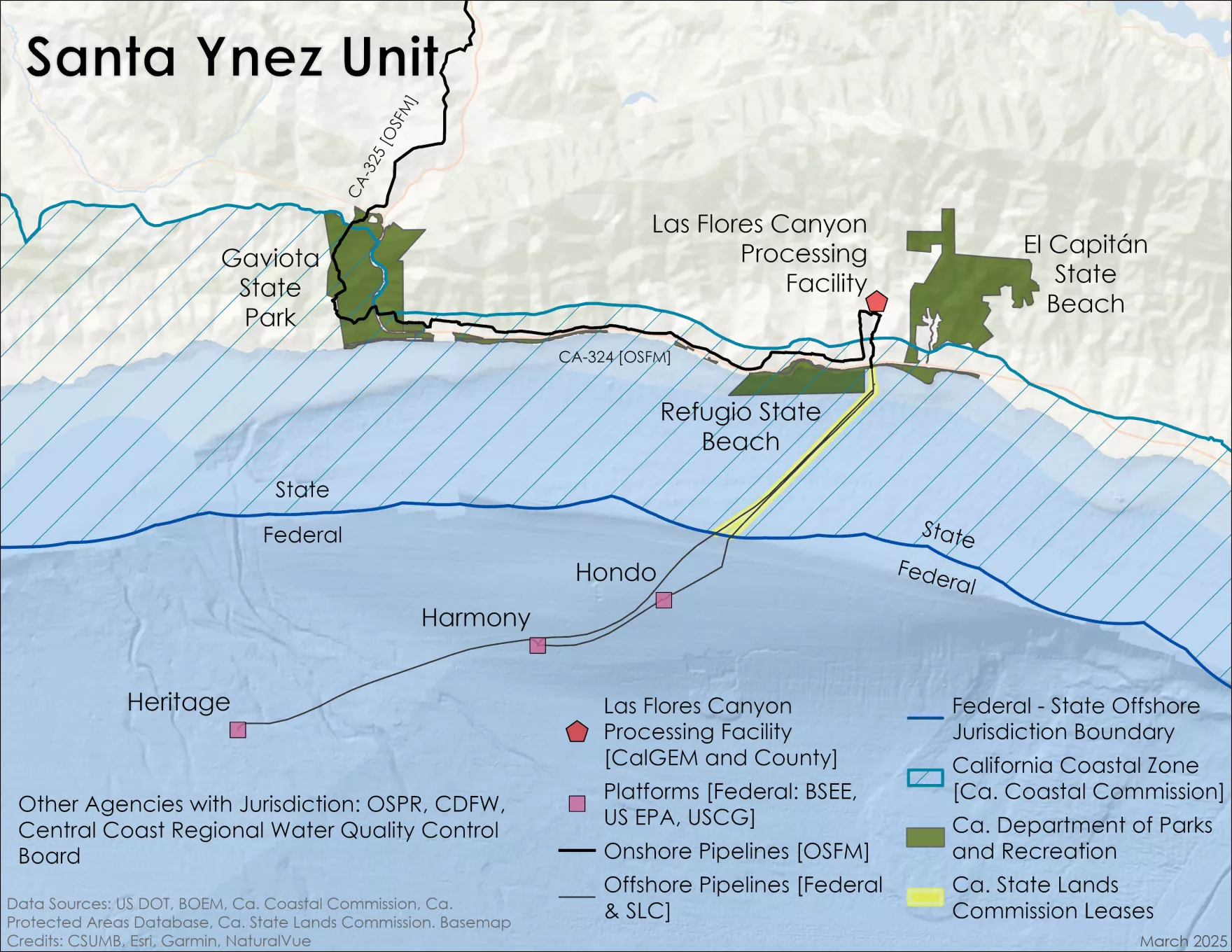
Pasted below are excerpts from Sable’s Prospectus Supplement. Is Sable serious about pursuing a Santa Ynez Unit strategy that employs a production and treatment vessel 3.5 miles from shore ala the development option that was reluctantly approved by the Federal govt in 1974, two decades before the onshore infrastructure was in place?
The OS&T option is inferior to onshore treatment and pipeline transportation in every way – spill risks, air emissions, economics, ultimate oil recovery, transportation to market, natural gas utilization, and public benefit.
This blogger supports a resumption of Santa Ynez Unit production. However, the only responsible path forward is to do the right thing and continue to pursue the onshore pipeline approvalsadministratively and legally. It is far better to defend a good project than a contrived workaround.Â
When will BOEM share Sable’s proposed “update”(actually a massive revision) to the SYU Development and Production Plan, as they are obligated to do?
Evaluation of the revised plan will require a detailed environmental review.
Operationally, BSEE and the Coast Guard will need to carefully consider vessel integrity, treatment capabilities, mooring and offloading plans, transportation schemes, gas utilization/injection, and many other technical details.
Meanwhile, does Exxon, the previous (and future?) owner, remain on the sidelines when the OS&T permitting circus begins in earnest?
On September 29, 2025, Sable announced that it is evaluating and pursuing an offshore storage and treating vessel (âOS&Tâ) strategy to provide access to domestic and global markets via shuttle tankers for federal crude oil produced from the SYU in the Pacific Outer Continental Shelf Area (the âOS&T Strategyâ). Continued delays related to the Santa Ynez Pipeline System have prompted Sable to evaluate and pursue the OS&T Strategy. On October 9, 2025, Sable submitted a Development and Production Plan update for the SYU to the Bureau of Ocean Energy Management (âBOEMâ). Prior to implementation of the OS&T Strategy, regulatory authorizations are required, including clearance from BOEM.
Preparations for the OS&T Strategy include the acquisition of a suitable OS&T vessel, certain refitting and upgrades to the vessel and the SYU equipment, transportation of the vessel to SYU, and related installation. In connection with implementation of the OS&T Strategy, the Company expects to opportunistically acquire an existing OS&T in the first quarter of 2026, with delivery of the vessel to SYU expected in the third quarter of 2026. Following the acquisition of the vessel, and vessel and platform upgrades and installation, Sable would expect to begin sales from all SYU platforms in the fourth quarter of 2026, with expected comprehensive oil production rates of over 50,000 barrels of oil per day, utilizing the OS&T within the SYU federal leases, provided the Company receives regulatory clearances. Sable estimates that the total capital required to execute the OS&T Strategy is approximately $475.0Â million. The Company has already incurred a small portion of such capital expenditures, with the vast majority of such capital expenditures remaining, provided the Company receives regulatory clearances. See âRisk FactorsâRisks Associated with Our OperationsâIn order to commence operations pursuant to an OS&T offtake strategy, we will require clearances and permitting, including from BOEM.â
âWe have not been finding enough new fields.â Thatâs William DeMis, president of Richelle Court, LLC, who said that, in addition to not finding enough, we keep erecting new ways to export what weâre not finding.
The way, he said, to avert the coming shortage is for people to find new sources of gas outside of Haynesville field, which for years, considering its proximity to the Gulf Coast, and the petrochemical plants of Southwest Louisiana, as well as pipelines, made it a swing producer for natural gas.
âBut I can tell you from bitter experience over the last three years that finding people to fund greenfield exploration is darn near impossible. There is scant capital to drill natural gas wildcats in the U.S.â said DeMis.
“The Bureau of Ocean Energy Management (BOEM) is initiating the first steps that could potentially lead to a lease sale for minerals on the Outer Continental Shelf (OCS) offshore Alaska by publishing this request for information and interest (RFI).”
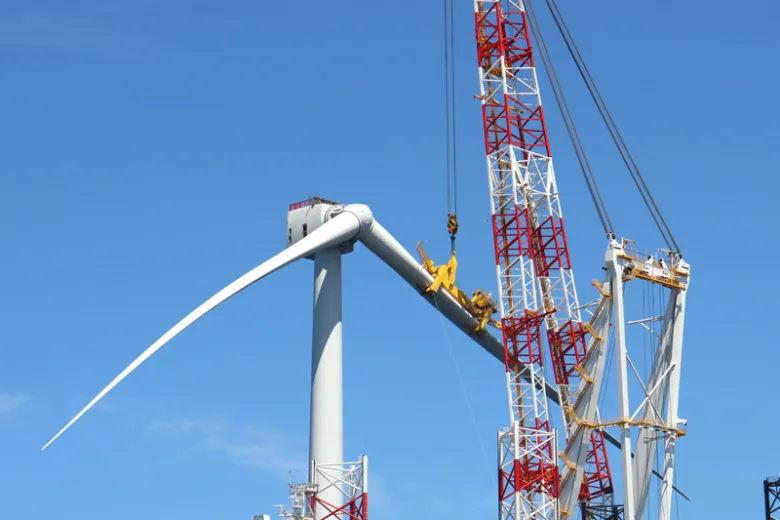
Attached is the supplemental complaint in the lawsuit Revolution Wind, LLC v. United States Department of the Interior, Case No. 1:25-cv-02999-RCL, filed in the U.S. District Court for the District of Columbia.
Summary: “BOEMâs order sets forth no rational basis, cannot be reconciled with BOEMâs own regulations and prior issued lease terms and approvals, is arbitrary and capricious, is procedurally deficient, violates the Outer Continental Shelf Lands Act (âOCSLAâ), and infringes upon constitutional principles that limit actions by the Executive Branch. This Court must therefore vacate the Order and enjoin BOEM from taking further action with respect to that Order.”
Key points raised by Dominion:
Dominion Energy Virginia (DEV) has spent approximately $8.9 billion to develop CVOW to date, which is over two-thirds of the total projected cost of $11.2 billion.
BOEM and Interior afforded DEV no advance warning or due process regarding the Order for CVOW.
The Order alleges no CVOW violation or deficiency.
The Order points to unnamed ânational security threatsâ based on a November 2025 âadditional assessment regarding the national security implications of offshore wind projectsâ by DoD, âincluding the rapid evolution of relevant adversary technologies and the resulting direct impacts to national security from offshore wind projectsâ generally.
The Order deems this information ânewâ and âclassifiedâ without any justification or detail. Moreover, as BOEM and DoD should know, certain DEV officials have security clearances to receive and review classified information, yet never were afforded such an opportunity prior to issuance of the Order.
DEV is suffering more than $5 million per day in losses solely for costs relating to vessel services associated with the Order. DEV is also incurring losses related to additional storage costs for the significant amount of equipment, idle workforce, contractual penalties, and additional costs.
Agencies are required to consider costs and benefits in their decision-making
Agencies are required to consider alternatives in their decision-making.
The CVOW Order unlawfully deprives DEV of a property interest without due process.
Dominion’s weakest argument follows (bad State legislation shouldn’t dictate Federal energy policy):
CVOW is critical to Virginiaâs legislative clean energy directive and DEVâs commitment to achieving net-zero emissions. The VCEA requires the transition of Virginiaâs electric grid to 100 percent non-carbon producing energy generation by 2045. Va. Code § 56-585.5. The VCEA also states that the construction of Virginia offshore wind facilities is in the public interest. Va. Code § 56-585.1:11 (C)(1).