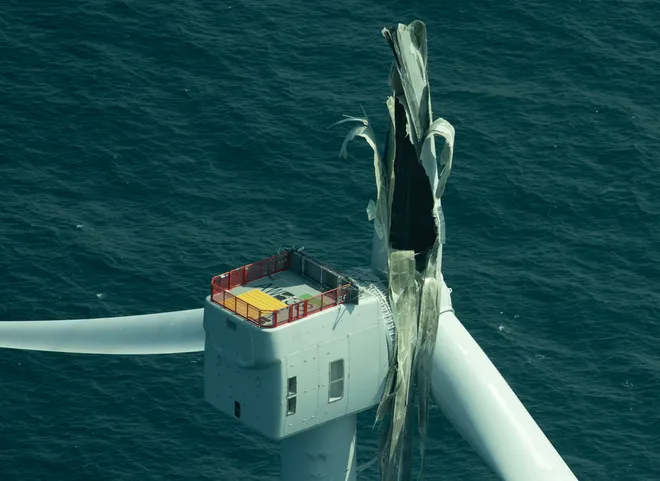
Excerpt from p.3 of Vineyard Wind’s suit against GE Renewables (attached):
“As was widely reported in national and local news, in July 2024, one of the GER offshore blades collapsed and fell into the waters off Nantucket, necessitating a massive environmental cleanup, and a six-month construction hiatus during which GER performed a “root cause” analysis. That analysis concluded that 68 of the 72 GER blades installed at the Project (nearly all manufactured by GER in Gaspé, Canada) were also defective because they were inadequately bonded together, and were so poorly made that they were beyond repair. GER’s remediation plan required it to remove all of the blades and to replace all Gaspé blades with others manufactured at a different facility in Cherbourg, France.
Regulatory issues of concern:
- Nearly 2 years after the blade failure, all Vineyard Wind (VW) turbine blades have been installed, yet BSEE has still not issued their investigation report. The primary purpose of independent Federal investigations is to prevent recurrences at this or other projects in the US and worldwide. The investigation should assess the extraordinary VW blade defect rate.
- A global assessment of turbine blade failures should be considered. These failures are far too common.
- DNV was the Certified Verification Agent (CVA) for the VW project, and was thus required to verify the design, fabrication, and installation procedures. When will we hear from them?
- BOEM waived the requirement that the Facility Design Report (FDR) and Fabrication and Installation Report (FIR) be “received and offered no objections to” before beginning the fabrication of facilities. They did so to “allow Vineyard Wind to adhere to its construction schedule, maintain its qualification for the Federal Investment Tax Credit, and meet its contractual obligations under the Power Purchase Agreements with Massachusetts distribution companies.” Did BOEM’s commitment to promoting offshore wind and accelerating development influence their regulatory decisions?
- Dr. Edgar Gunter, founder of the University of Virginia’s Rotor Dynamics Lab, suggested the cause of the Vineyard Wind blade failure was not a material bonding problem, but rather “a classical torsional fatigue failure of the blade at the base.” Is there any merit to this assertion?
- Is the fragmented turbine blade symbolic of the regulatory regime?
 Bud's Offshore Energy (BOE)