John Hancock Tower (pictured) is now named for its address, 200 Clarendon St
In the attached complaint, BP Hancock LLC alleges Vineyard Offshore, a Vineyard Wind parent company, is delinquent in paying rent for its space in the famous John Hancock Tower (now known as 200 Clarendon Street) in Boston.
Vineyard Wind had leased 28,370 square feet of space, constituting the entire eighteenth floor of the tower.
Per the complaint:
As of the date of this Complaint, Tenant owes Landlord $824,338.99 in Rent, Additional Rent, and late fees.
Furthermore, Tenant remains obligated to replenish the Security Deposit in the full amount of $386,810.00 as provided under Section 16.26 of the Lease.
As many of you know, Vineyard Wind is engaged in an ugly dispute with its primary contractor, GE Vernova, which was ordered to continue work on the project even though Vineyard Wind stopped making payments.
Pointing to the potential financial implications for GE Vernova, Recharge News cites this serious fraud accusationby Vineyard Wind (VW):
“This exceptional misconduct includes [GE Vernova’s] intentional scheme to falsify critical quality assurance data… and to intentionally misrepresent the quality of those blades to [Vineyard Wind] in a brazen fraudulent, and willful breach of the TSA, ultimately resulting in the catastrophic blade failure…”
Recharge also discusses the findings of the Project Engineer appointed by VW to resolve claims between parties. Under the terms of the contract, the engineer’s determinations are binding unless overturned in arbitration.
The engineer determined that GE Vernova was liable for project delays, blade defects, vessel costs, and a $185m rescission of previously certified payments.
The damage claims issued by the project engineer total $853m.
On the basis of those determinations, VW withheld 100% of the outstanding invoices issued by GE Vernova. Even netted against sums allegedly owed to GE Vernova, VW says the turbine maker owes around $545m.
Per the contract, there are no limitations on liability in cases of “fraud, gross negligence, deliberate default or willful misconduct.”
My take: VW’s charges against GE Vernova will be resolved in the courts. However, VW is the lessee and operator, and is thus the party responsible to the Federal govt for project safety and environmental protection.
Operator responsibility is a fundamental tenet of the OCS regulatory program. As lessee/operator, VW bears ultimate responsibility for project safety and environmental protection.
VW is responsible for contractor selection, management, and oversight.
If a contractor violates a regulation, the violation notice is given to the operator. If a contractor causes pollution, the operator is responsible for the cleanup.
DNV, the Certified Verification Agent (CVA) hired by VW, was required to verify the design, fabrication, and installation procedures. Did they raise any issues to VW and the regulators?
Did the division of responsibilities between BOEM and BSEE weaken regulatory oversight? BOEM, ostensibly just the leasing bureau, should not have been authorized to grant departures that could affect structural integrity and operational safety.
It’s surprising that VW has not been cited for civil penalties resulting from the blade failure and the resulting environmental damage.
How can a judge prevent a contractor from stopping work for an operator that has filed serious fraud allegations against the contractor, has stopped making payments, and has, along with the Governor, declared the project to be complete?
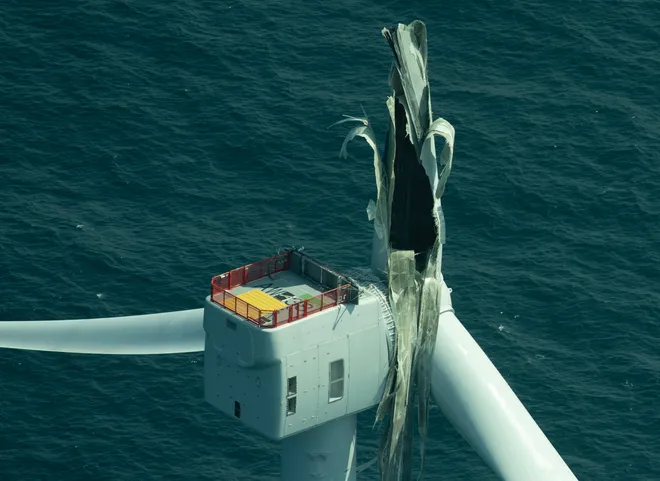
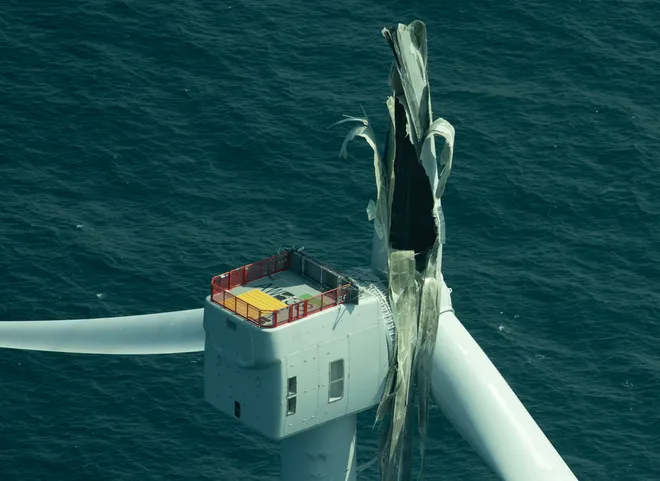
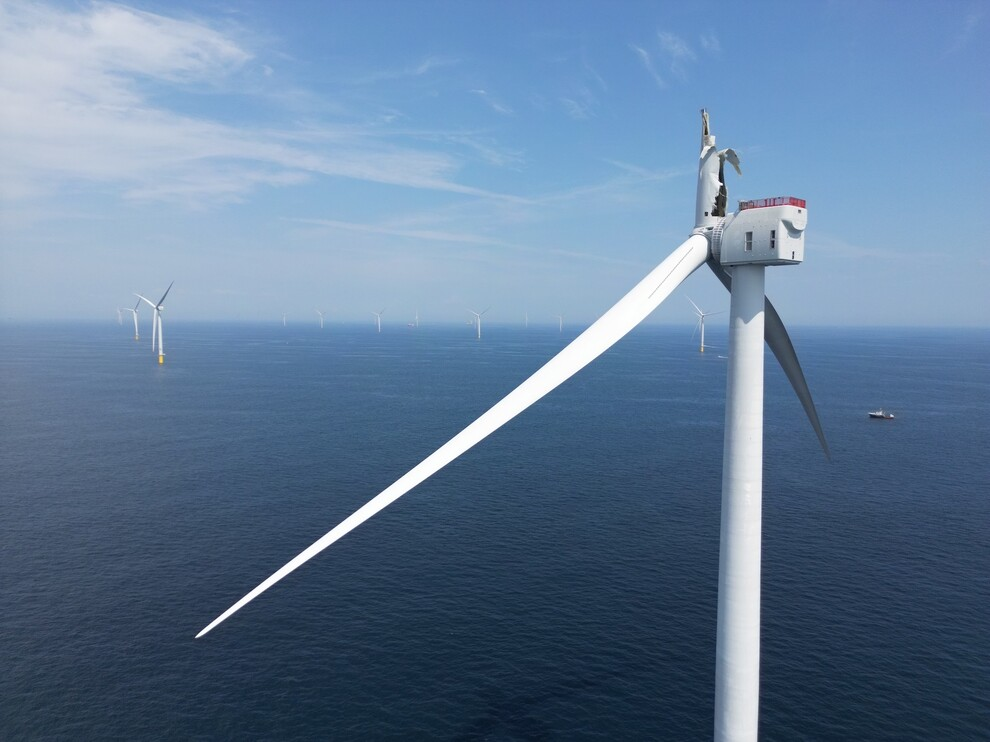
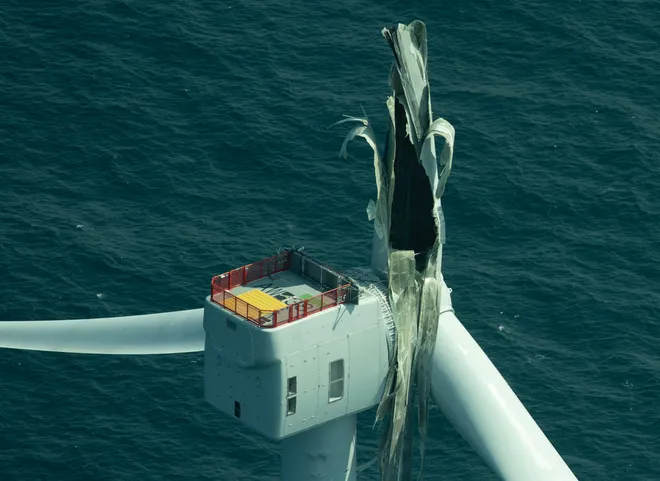
damaged Vineyard Wind turbine – Cape Cod Times photo
Massachusetts Judge Peter Krupp confirms that GE Rewables (GER) can’t quit now, but must continue working on the Vineyard Wind (VW) project! As we approach the 2 year anniversary of the blade failure, this ugly legal dispute among the responsible parties is another black eye for the troubled project.
Judge Krupp: In discussing irreparable harm in the April Memorandum, I found that the project “is at a critical phase,” that GER’s termination “would set the project back immeasurably and threaten VW’s financing,” that the requirements “to bring the project into commercial viability is highly dependent on GER’s capabilities, personnel and technology,” and that “[t]o pretend that VW could go out and hire one or more contractors to finish the installation and troubleshoot and modify GER’s proprietary design without GER’s specialized knowledge is fanciful.” Nothing has been brought to my attention that would alter any of these conclusions.
Project completion declarations by VW and Gov. Healey did not reflect the reality of the project (expected grandstanding, nothing to see there 😉):
Moreover, the fact that VW declared the COD (Commercial Operation Date) – or that Gov. Healey and VW’s parent commented on it – does not change the reality on the ground. It does not change the fact that the Project requires GER’s expertise and proprietary know-how to bring the turbines up to operational capacity.
Gas turbine business soarswind turbine business slumps
Steve Milloy, National Center for Public Policy Research: GE Vernova is losing money on wind turbines and will continue to lose money for the foreseeable future. Wind losses are real and guided to persist at ~$400 million in 2026.
On the other hand, GE Vernova’s gas turbine business is booming. The gas turbine backlog and slot reservations surged from 83 GW to 100 GW in Q1, with a target of at least 110 GW by year-end. There is strong demand for reliable, dispatchable power to support data centers and grid stability. This segment is a major profit driver.
Milloy is asking GE Vernova shareholders to support the following resolution:
RESOLVED: Shareholders request that the Board of Directors of GE Vernova Inc. publish a report within the next year—prepared at reasonable cost and omitting proprietary or competitively sensitive information—assessing the extent to which the Corporation’s sustainability goals have been authorized and maintained on the basis of net-present-value and return-on-investment calculations.
damaged Vineyard Wind turbine – Cape Cod Times photo
Excerpt from p.3 of Vineyard Wind’s suit against GE Renewables (attached):
“As was widely reported in national and local news, in July 2024, one of the GER offshore blades collapsed and fell into the waters off Nantucket, necessitating a massive environmental cleanup, and a six-month construction hiatus during which GER performed a “root cause” analysis. That analysis concluded that 68 of the 72 GER blades installed at the Project (nearly all manufactured by GER in Gaspé, Canada) were also defective because they were inadequately bonded together, and were so poorly made that they were beyond repair. GER’s remediation plan required it to remove all of the blades and to replace all Gaspé blades with others manufactured at a different facility in Cherbourg, France.
Regulatory issues of concern:
Nearly 2 years after the blade failure, all Vineyard Wind (VW) turbine blades have been installed, yet BSEE has still not issued their investigation report. The primary purpose of independent Federal investigations is to prevent recurrences at this or other projects in the US and worldwide. The investigation should assess the extraordinary VW blade defect rate.
DNV was the Certified Verification Agent (CVA) for the VW project, and was thus required to verify the design, fabrication, and installation procedures. When will we hear from them?
BOEM waived the requirement that the Facility Design Report (FDR) and Fabrication and Installation Report (FIR) be “received and offered no objections to” before beginning the fabrication of facilities. They did so to “allow Vineyard Wind to adhere to its construction schedule, maintain its qualification for the Federal Investment Tax Credit, and meet its contractual obligations under the Power Purchase Agreements with Massachusetts distribution companies.” Did BOEM’s commitment to promoting offshore wind and accelerating development influence their regulatory decisions?
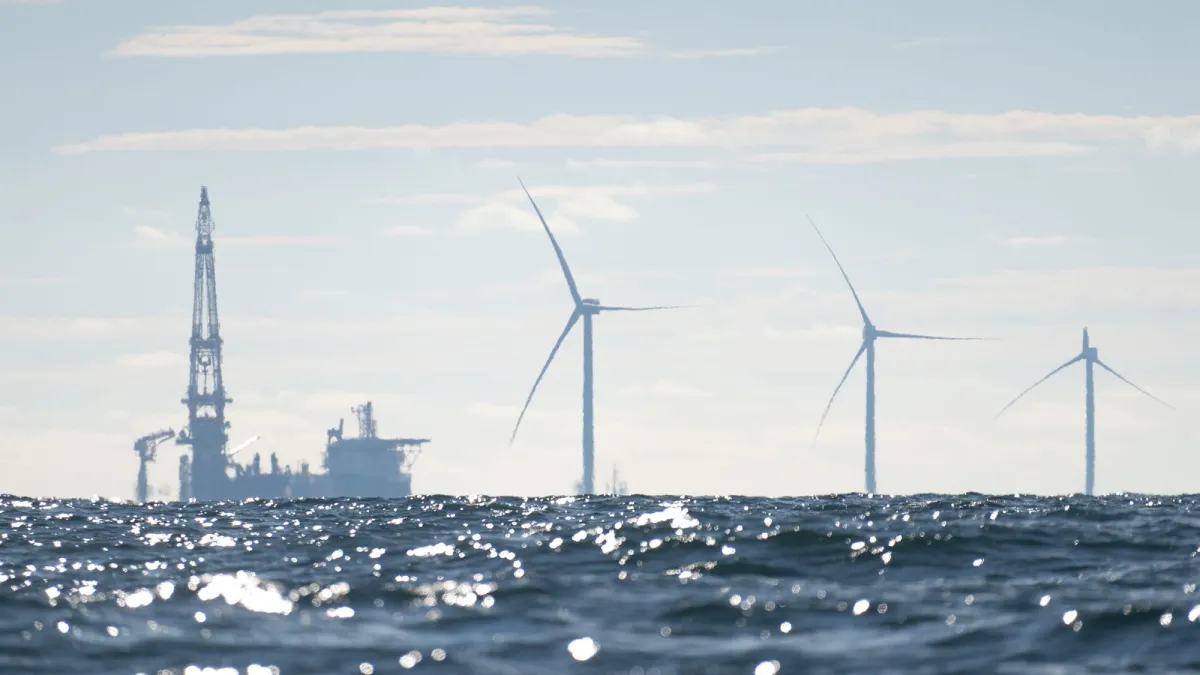
Three wind turbines, including one with a damaged blade, at the Vineyard Wind offshore site in November 2024. Credit: Eleonora Bianchi / The New Bedford Light.
New Bedford Light:Vineyard Wind on Wednesday sued its turbine supplier, GE Renewables, in civil court in Boston, alleging GE is breaching its contract and planning to abandon the project by April 28 — during the critical final stage of coming fully online.
According to the complaint, GE filed a termination notice with Vineyard Wind in late February for its contracts to supply wind turbines and service and maintain them, citing more than $300 million in claims unpaid by Vineyard Wind.
If GE exits, Vineyard Wind says, the project “will likely fail, leaving the windfarm stranded.”
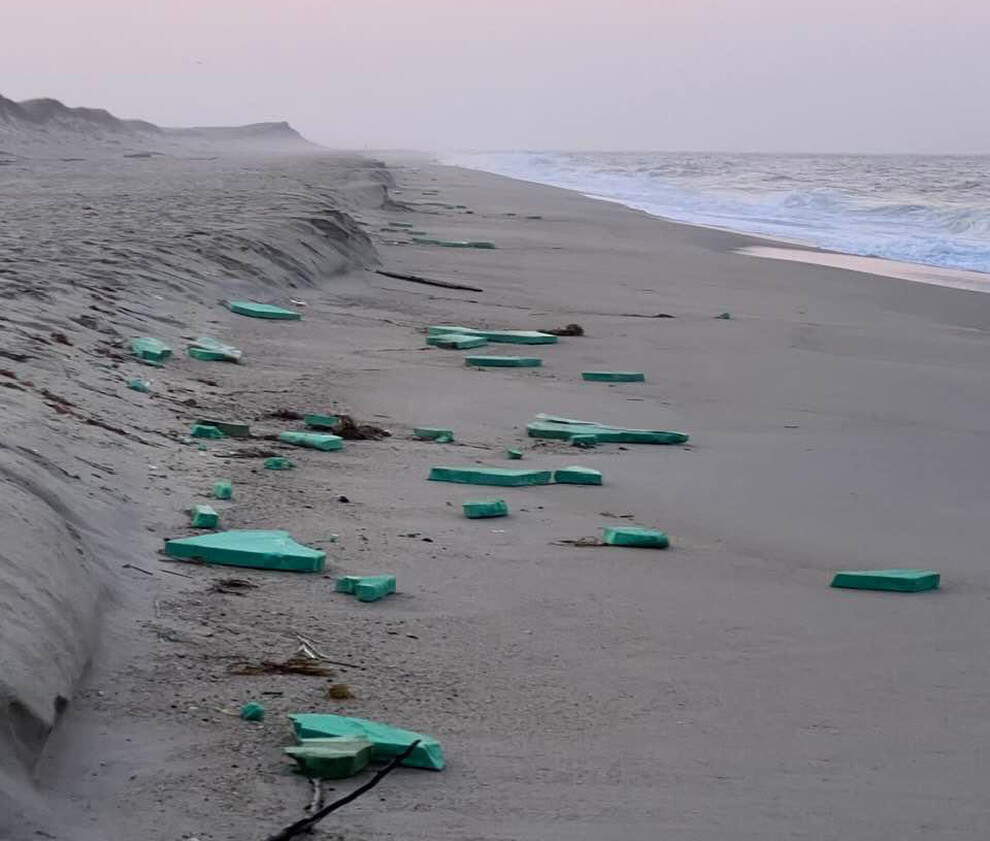
Debris from the failed Vineyard Wind blade littering the south shore of Nantucket in July 2024. Nantucket Current photo.
Nantucket reached a settlement agreement (attached) with turbine manufacturer GE Vernova (GEV), praising that company while criticizing Vineyard Wind (VW), the lessee and operator:
“The Town of Nantucket commends GE Vernova for its leadership in reaching this agreement. By contrast, the Town has found Vineyard Wind wanting in terms of its leadership, accountability, transparency, and stewardship in the aftermath of the blade failure and determined that it would not accept Vineyard Wind as a signatory to the settlement,”the town stated Friday morning.
Comments:
For a relatively modest sum ($10.5 million) paid by the contractor (GEV), the agreement further limits the Town’s ability to hold Vineyard Wind, the lessee and operating company, accountable. See sections 4, 5(a), and 9 of the agreement.
The Town’s ability to challenge the project was already compromised by their unpopular “Good Neighbor Agreement.”
What ever happened to operator responsibility? This fundamental tenet of the OCS oil and gas program also applies to offshore wind. Vineyard Wind should be the party that is fully accountable for the damages associated with their project. VW can seek compensation from GEV, but VW is the accountable party.
Can you imagine if BP had attempted to stay on the sidelines while Transocean and other contractors settled claims associated with the Macondo blowout? Unthinkable!
Nantucket should have insisted on VW’s participation, rather than excluding them.
What does the lessor, the Federal govt, have to say about damage compensation? Are civil penalties forthcoming? When will we finally see the BSEE investigation report!
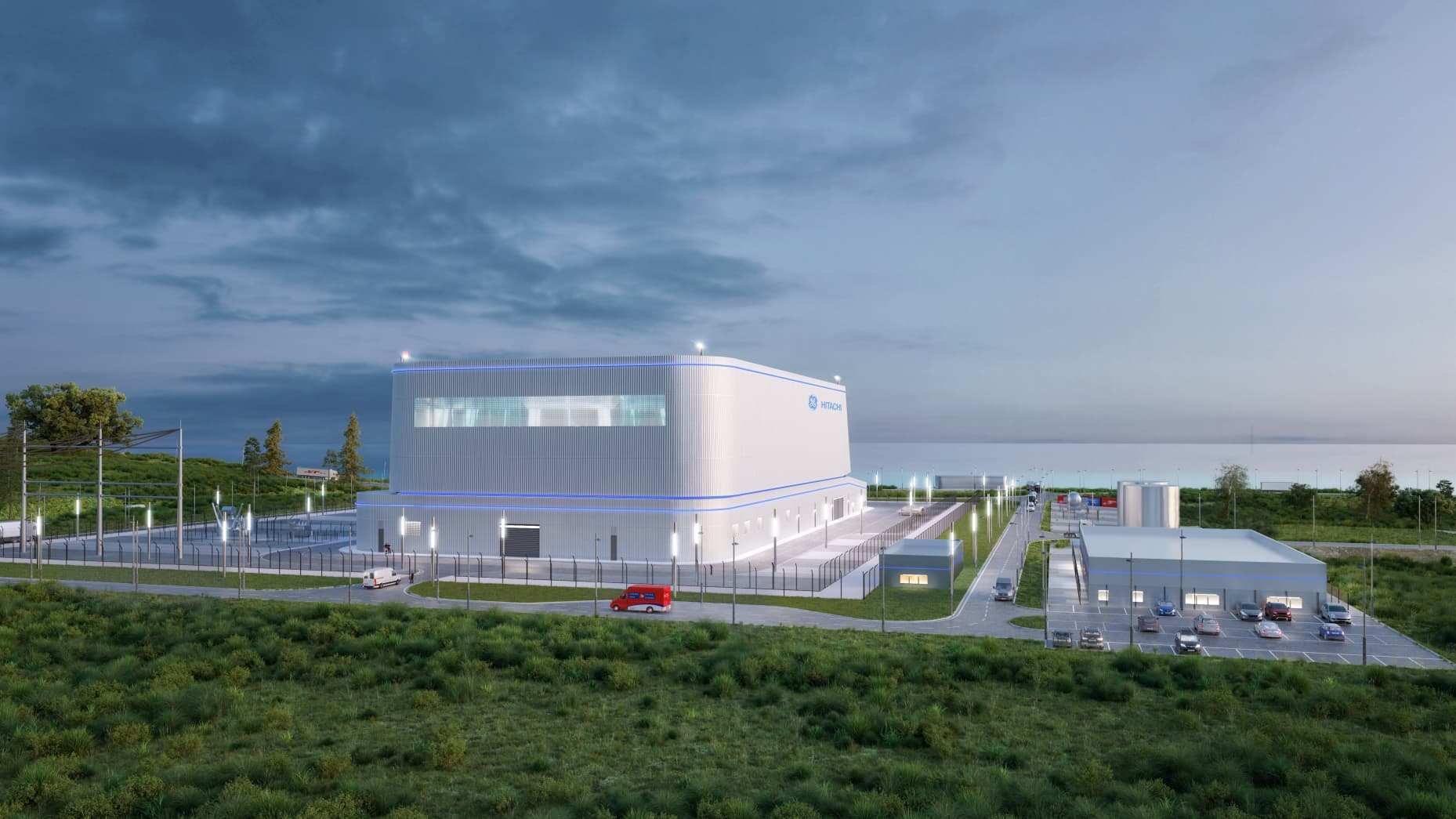
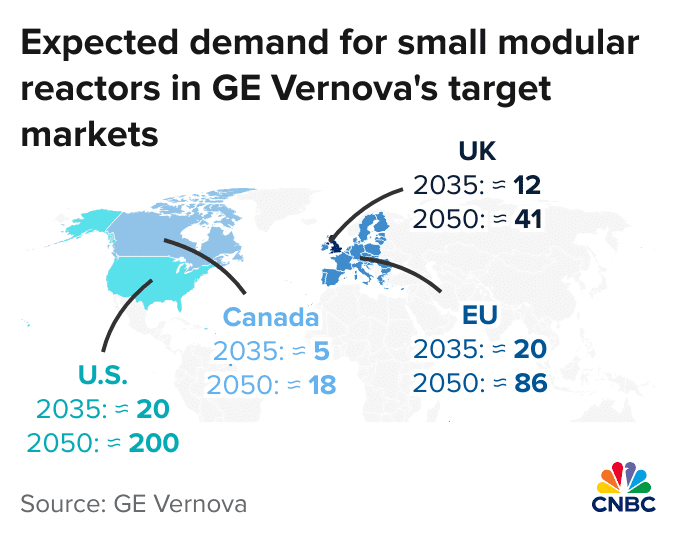
“GE Vernova is aiming to deploy small nuclear reactors across the developed world over the next decade, staking out a leadership position in a budding technology that could play a central role in meeting surging electricity demand and reducing carbon dioxide emissions.“
LM/GE Vernova turbine blade plant. Photo credited by the New Bedford Light to Jean-Philippe Thibault/Journal Gaspésie Nouvelles.
On Oct. 24, Radio Gaspesie reported serious data falsification allegations related to the manufacturing GE Vernova turbine blades at their Gaspé, Quebec facility. GE Vernova’s delay in commenting on those charges is surprising given their economic and legal implications in both Canada and the US.
GE Vernova has informed the New Bedford Light that they have taken corrective actions at their blade facility in Gaspé after an extensive internal review of their blade manufacturing and quality assurance program. However, they have yet to comment on the data falsification allegations.
Actions speak louder than words, and the Light reports that GE Vernova laid off nine managers and suspended 11 unionized floor workers at the Gaspé factory. A representative for the union informed the Light that the production manager has been dismissed and the general manager has resigned.
Neither Vineyard Wind nor BSEE, the Federal safety regulator for the Vineyard Wind project, has commented on the matter. BSEE’s investigation of the blade failure is still pending and has seemingly gotten more complicated as a result of the manufacturing issues.
In addition to legal proceedings in Quebec, GE Vernova and Vineyard Wind are subject to possible civil and criminal penalties in the US. Civil penalties, which are administered by BSEE, seem likely given the extensive pollution from turbine blade fragments.
Criminal penalties, which are possible if the data falsification charges are proven true, are imposed by the Dept. of Justice. The applicable criminal penalties statute is pasted below.
Any person who knowingly and willfully (1) violates any provision of this subchapter, any term of a lease, license, or permit issued pursuant to this subchapter, or any regulation or order issued under the authority of this subchapter designed to protect health, safety, or the environment or conserve natural resources, (2) makes any false statement, representation, or certification in any application, record, report, or other document filed or required to be maintained under this subchapter, (3) falsifies, tampers with, or renders inaccurate any monitoring device or method of record required to be maintained under this subchapter, or (4) reveals any data or information required to be kept confidential by this subchapter shall, upon conviction, be punished by a fine of not more than $100,000, or by imprisonment for not more than ten years, or both. Each day that a violation under clause (1) of this subsection continues, or each day that any monitoring device or data recorder remains inoperative or inaccurate because of any activity described in clause (3) of this subsection, shall constitute a separate violation.
See the translated excerpts below from a Radio Gaspesie report. This is a massive scandal if true.
“Yesterday, the vice-president of global operations at GE Vernova reportedly addressed all employees at the Gaspé plant to provide an update on the situation.
The investigation, led by GE Vernova’s lawyers, reportedly revealed that employees were asked by senior company executives to falsify quality control data. Data associated with a well-made blade was then associated with poorly made blades. Our sources indicate that this is a widespread practice in the industry.
The senior management of the Gaspé plant also allegedly implemented a points system that encouraged employees to skip verification steps, thus prioritizing production quantity over quality.
Our sources say the points system allegedly involved tight management oversight that bordered on intimidation of employees.
The oversized 107m blades that were produced in Gaspé for the construction of marine parks are said to be affected. The integrity of the entire production of the longest blades in America is currently being called into question.“