Feeds:
Posts
Comments

Archive for the ‘Offshore Energy – General’ Category

The Piper Alpha fire (July 6, 1988) was the worst disaster in the history of offshore oil and gas operations and sent shock waves around the world. Eight months later another interactive pipeline-platform fire killed 7 workers at the South Pass 60 “B” facility in the Gulf of Mexico. A US Minerals Management Service task group reviewed the investigation reports for both fires and recommended regulatory changes with regard to:

  1. the identification and notification procedures for out-of-service safety devices and systems,
  2. location and protection of pipeline risers,
  3. diesel and helicopter fuel storage areas and tanks,
  4. approval of pipeline repairs, and
  5. location of ESD valves on pipelines.

Paul Schneider and I wrote a paper on the task group’s findings and that paper was published in Offshore Operations Post Piper Alpha (Institute of Marine Engineers,1991). The proposed regulations that followed summarized these findings and can be be found at this Federal Register link.

Lord Cullen’s comprehensive inquiry into the Piper Alpha tragedy challenged traditional thinking about regulation and how safety objectives could best be achieved, and was perhaps the most important report in the history of offshore oil and gas operations. Per Cullen:

Many current safety regulations are unduly restrictive because they impose solutions rather than objectives. They also are out of date in relation to technological advances. Guidance notes lend themselves to interpretations that discourage alternatives. There is a danger that compliance takes precedence over wider safety considerations and that sound innovations are discouraged.

Cullen advocated management systems that describe the safety objectives, the system by which those objectives were to be achieved, the performance standards to be met, and the means by which adherence to those standards was to be monitored. He called for safety cases that describe major hazards on an installation and provide appropriate safety measures. Per Cullen, each operator should be required in the safety case to demonstrate that the safety management systems of the company and the installation are adequate to assure that design and operation of the platform and its equipment are safe.

Full Piper Alpha Inquiry – 2 parts.

Read Full Post »

Per the preliminary EIA data for April, Gulf of America OCS facilities produced an average of 2.107 million bopd in April. This surpasses the previous record of 2.060 million bopd set in January.

Meanwhile, the Sable bump is now evident in the EIA’s Pacific OCS production data with a ~50% March-April increase from January-February. A bigger increase should be apparent when the May numbers are posted. How will Sable fare in the upcoming court battles?

Read Full Post »

Part 1

Gulf of America flaring and venting data for 2019-2025 are summarized in the attached table. The preferred performance indicators are the percentages of produced gas that are flared and vented both for oil-well gas (OWG, also known as associated or casinghead gas) and gas-well gas (GWG or non-associated gas).

The flaring and venting table was compiled using monthly data submitted to the Office of Natural Resources Revenue (ONRR). This is the best data source because reporting is mandatory and strictly enforced, and flaring and venting are accounted for separately. All volumes are in millions of cubic feet (MMCF).

The venting and flaring volumes are segmented for both OWG and GWG production. Venting produced gas (mostly methane) is a more significant environmental concern from both air quality and greenhouse gas (GHG) perspectives.

Observations and Comments:

  • The total volume of gas flared and vented in 2025 was 9.7 bcf (chart 1). 80% of that volume was flared, leaving 20% vented. OWG flaring (chart 5) reached a new high of 7.785 bcf in 2025, a near record oil production year for the Gulf.
  • Total venting and flaring in 2025 increased by 819 million cubic feet vs. 2024. However, the 7-year trend line remains favorable (chart 1).
  • Thinking that 2019, a record year for total flaring and venting, may have biased the trend line, I extended the chart back to 2015, the first year for which I have ONRR data. As you can see in chart 2, the overall trend is still favorable.
  • The % of produced gas that was flared or vented remains persistently above the historical 1.0% target (chart 3). Flared/vented volumes were below 1% of production prior to 2018.
  • The higher flaring/venting % may be because most gas production is now from oil wells, which typically have higher flaring rates associated with processing upsets.
  • The flaring and venting gap between GWG and OWG has narrowed, largely because of an increase in GWG flaring/venting. The combined rate for GWG more than doubled over the 7 year period, rising to 0.81% vs. 1.34% for OWG. (chart 3)
  • Total venting rose to 1.7 bcf in 2025, the highest venting volume in 3 years.
  • The % of GWG being vented doubled over the past 5 years to over 0.50% (chart 4). The growth in venting warrants further investigation.
  • The % of OWG vented increased slightly to 0.20%. Further reduction in OWG venting had been expected given that OWG production is increasingly from deepwater facilities with modern flaring systems.
  • A 2020 Univ. of Michigan study found “Large, older facilities situated in shallow waters tended to produce episodic, disproportionally high spikes of methane emissions. These facilities, which have more than seven platforms apiece, contribute to nearly 40% of emissions, yet consist of less than 1% of total platforms.” 
  • Platform specific data would be helpful in further assessing flaring/venting sources and trends.
chart 1
chart 2
chart 3
chart 4
chart 5

Read Full Post »

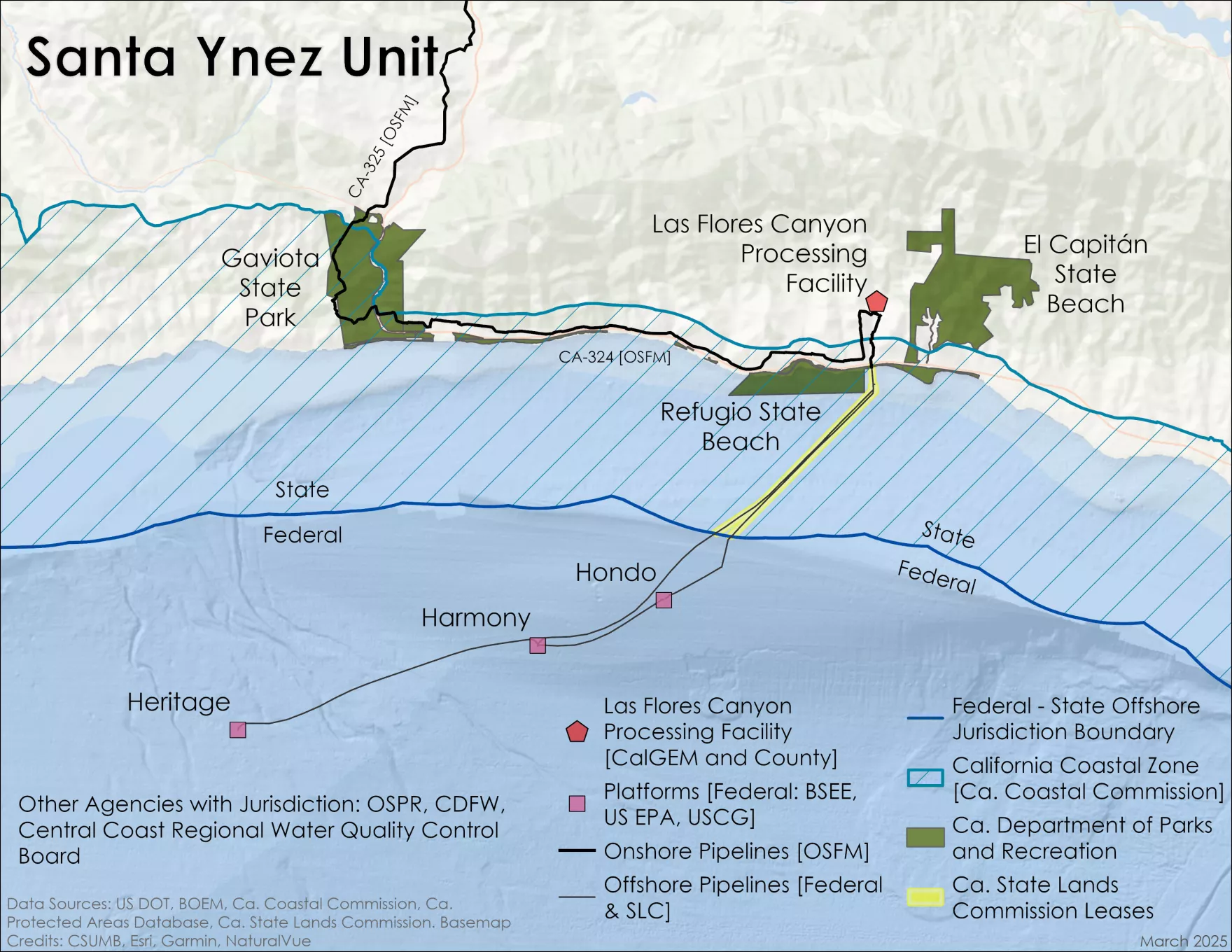
Sable Offshore began ramping up production at Platform Harmony last May delivering oil and gas to their Los Flores Canyon Processing Facility. In March, they resumed transportation to the Pentland pipeline segments and achieved first sales.

Below are BOEM production data for Harmony through March 2026. Harmony production was expected to increase to 22,000 bopd in May. Similarly, Sable forecasted Heritage production of 30,000 bopd for that month. The actual production numbers should be available in a month or two.

Nothing in the March production data for Harmony is particularly surprising. The gas-oil ratio (GOR) of ~1000 cu ft/bbl is rather typical for oil production in the region, as is the water cut, although less water production would be preferred. Produced water is not discharged from the platform, but is injected subsurface through disposal wells.

Read Full Post »

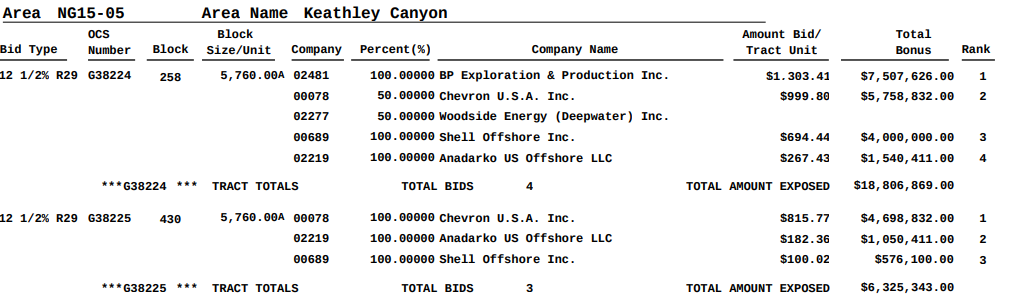
The Buckskin field (LLOG) is located in Keathley Canyon blocks 785, 828, 829, 830, 871, and 872 in 6,800 ft (2,073 m) of water. The KC 828 lease expired last year and LLOG’s bid for that block at the BBG2 sale was rejected.

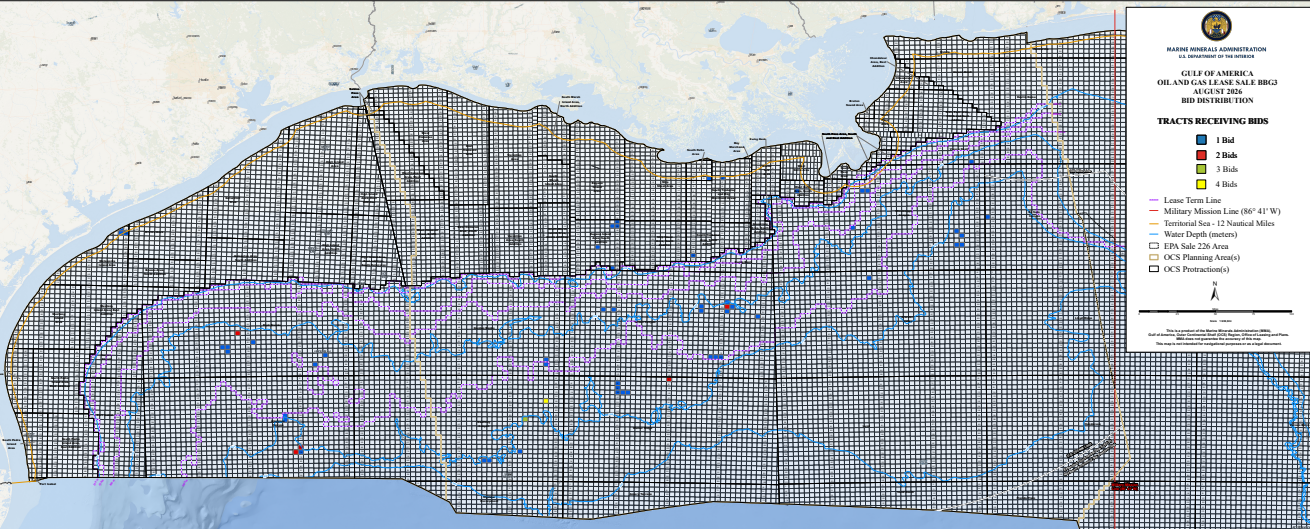
BOEM’s Decision Information Matrix for Sale BBG2 is attached. As previously noted, 2 of the 25 high bids were rejected: Keathley Canyon Block 828 ($1,101,202) and Atwater Valley Block 63 ($650,018).

The rejected bids were significantly below both BOEM’s Mean of the Range-of-Value and Lower Bound Confidence Interval for these single bid tracts (table below).

Block No.Companyno. of bidsbidMROVLBCI
AT 63LLOG1$650,018$2,400,000$1,800,000
KC 828LLOG1$1,101,202$24,000,000$23,000,000
MROV=Mean of the Range-of-Value; LBCI=Lower Bound Confidence Interval

In the case of Keathley Canyon 828, BOEM’s valuation is more than 20 times the high bid. BOEM valued this block far higher than any other block in the sale.

KC 828 had been previously leased and that lease expired on 9/3/2025. The lease block was part of LLOG’s Buckskin field. Apparently, the lease expired due to inactivity given that the last well reached total depth more than a year prior to the expiration date. LLOG wanted the lease back. BOEM’s rejection sends a message that the price went up (by a lot 😉).

Finally, why didn’t any other company bid on KC 828, a block that has been publicly reported as being part of the Buckskin field?

Read Full Post »

My colleague Keith Meekins shared an informative AAPG article about the importance of Miocene reservoirs in offshore oil and gas production worldwide.

“The Miocene delivered a significant amount of sand with excellent reservoir characteristics around the world,” noted Erik Scott, exploration geologist and consulting geologist/sedimentologist.

“Generally, hydrocarbons are coming from deeper, older rock – the Cretaceous, the Jurassic. By the time these source rocks get to the (hydrocarbon) generation window, the Miocene reservoirs are in place,” Scott said.

Generally, the Miocene deposits are surrounded by fine-grained muds that produced sealing potential,” he noted.

More:

  • Miocene reservoirs account for more than 40 percent of established hydrocarbon reserves in the deepwater Gulf. The Bureau of Ocean Energy Management identifies more than 9 billion barrels of undiscovered, technically recoverable Miocene resources.
  • Recently, Eni found a giant Miocene natural gas accumulation in the Kutei Basin offshore Indonesia with an estimated 5 trillion cubic feet of gas and 300 million barrels of condensate in place.
  • Azule Energy, equally owned by Eni and BP, made a recent Miocene oil discovery with an estimated 500 million barrels of crude offshore Angola.

Keith points to RTM (reverse-time migration) as an important factor in helping to unlock Miocene resources. RTM produces dramatically improved images below salt bodies and in areas of complex overburden. Per AAPG, Talos Energy used reprocessed RTM seismic to identify a bypassed Miocene fault-block closure in the Green Canyon Area of the Gulf. This structure had previously been invisible.

Read Full Post »

Norwegian Minister of Petroleum and Energy, Terje Aasland, officially opened Johan Sverdrup Phase 2 – Equinor photo

JL Daeschler shared an interesting opinion piece. He and I are in general agreement with the author, Steve Sasanow. Key points:

  • Steve finds Equinor’s recent comment that the days of big offshore finds are over to be disingenuous. He correctly notes that this view has been echoed for decades. (Although the end of Gulf of America oil production has been predicted for 40 years, 2025 was a near record year.)
  • Offshore Norway, it was only in 2010 that the giant Johan Sverdrup field was ‘found’ by Equinor. Two super-majors – Exxon and Total – missed the reservoir and abandoned further exploration in the area. (How many times have we heard similar stories in the oil patch?) Equinor, then Statoil, made a relatively small find in the middle of the reservoir and was planning a limited subsea development. Geophysicists from partner Lundin created a better picture of what was in place – nearly 3 billion barrels with peak production of 750,000 b/d three years ago. Just this week, Equinor announced Phase 4 of production through further subsea development.
  • Who heard much about Guyana a decade ago?
  • How about the major new discoveries offshore Brazil? See the video below.
  • New production offshore Namibia, South Africa, and Mozambique looms. Finds off Indonesia and Timor Leste, and even the Falklands, await development.
  • “So guys, stop making out that life is tough. It might be challenging, but it has always been thus. Big risks and big rewards.”
  • On BP’s announcement that they were reorganizing into upstream and downstream divisions: “Wow – what a great idea! How come no one ever thought of this before? Imagine this scenario – oil companies making money on both sides of the price cycle – upstream when the price of oil is high and downstream when it is lower. Amazing – NOT!” 😉

Read Full Post »

The oil patch is known for booms, busts, mergers, and acquisitions. Hess is now among the once important offshore operators that no longer exist as separate companies. Others include Amoco, Arco, Texaco, Getty, Gulf, Unocal, Sun, Anadarko, BHP, Mobil, Phillips, Noble Energy, Pennzoil, Kerr-McGee, Superior, Nexen, and Newfield.

Hess would probably not have been a Chevron target had they not taken a chance in 2014 when they obtained a 30% position in Exxon’s Stabroek block offshore Guyana. The rest is history, and Stabroek is now the world’s most prized offshore block. Hess had other nice assets in the Gulf, Bakken Shale, and elsewhere, but Stabroek was Chevron’s primary target.

Paying the price for the Hess acquisition are up to 8,000 employees who will be axed by the end of 2026, starting with 575 cuts at the former Hess Tower in Houston on September 26 and matched reductions in Texas, California and North Dakota. The cuts also have to be disappointing to the Federal, Texas and North Dakota governments, given their strong support for oil and gas production. Mass layoffs don’t equate to energy dominance.

Why is the loss of Hess is significant:

  • Hess was a safety compliance leader in both 2023 and 2024.
  • Hess was an active participant in pre-merger lease sales.
  • The combined company is unlikely to be greater than the sum of the parts in terms of US lease acquisition, exploration, and development.
  • Combining companies limits the diversity of geological assessments and exploration strategies.
  • Consolidation limits participation on committees engaged in assessing technology and developing standards. Declining industry participation in these activities, which are critical to offshore safety, has been a historical concern of OCS program leadership.

When the merger was announced, Chevron’s CEO Mike Wirth was quoted as saying “We’ve got too many CEOs per BOE, so consolidation is natural.” That comment makes sense from the perspective of an acquiring CEO. Employees of the companies being acquired have a somewhat different view. They would prefer increasing exploration and production rather than reducing employees.

Read Full Post »

Lars Herbst saw this “beauty” while sitting at a rooftop “establishment” in Pensacola. Reminded him of our temporary Pensacola office and Destin Dome drilling. Lars had visions of returning to work as Pensacola District Manager! 😉

Upon returning to his senses, Lars reports that it’s the Borr jack-up rig Odin purchased from Noble’s fleet. The rig was brought from Mexico to Pensacola for modifications, and will be under contract to Cantium to drill in the GOA, but not the Eastern GOA!

Read Full Post »

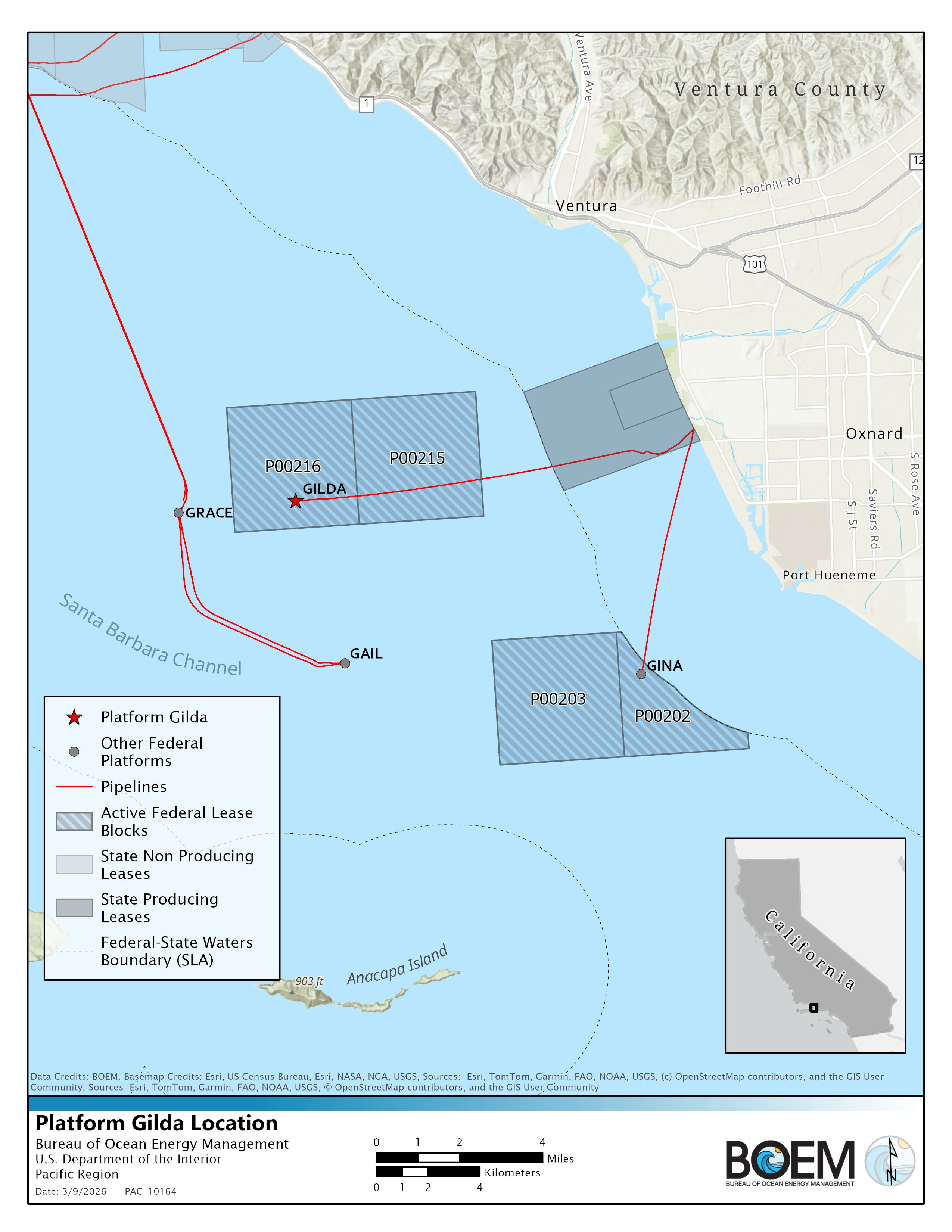
Meanwhile, the California Coastal Commission notified Sable Offshore that it intends to issue a cease and desist order aimed at shutting down crude oil extraction in the Santa Barbara Channel.

Sable responds: “Sable Offshore Corp. (“Sable”) through its subsidiary, Pacific Pipeline Company (“PPC”), continues to lawfully operate through its existing coastal development permits which were issued in 1986.”

California cage fight! Who ya’ got?

Read Full Post »

« Newer Posts - Older Posts »