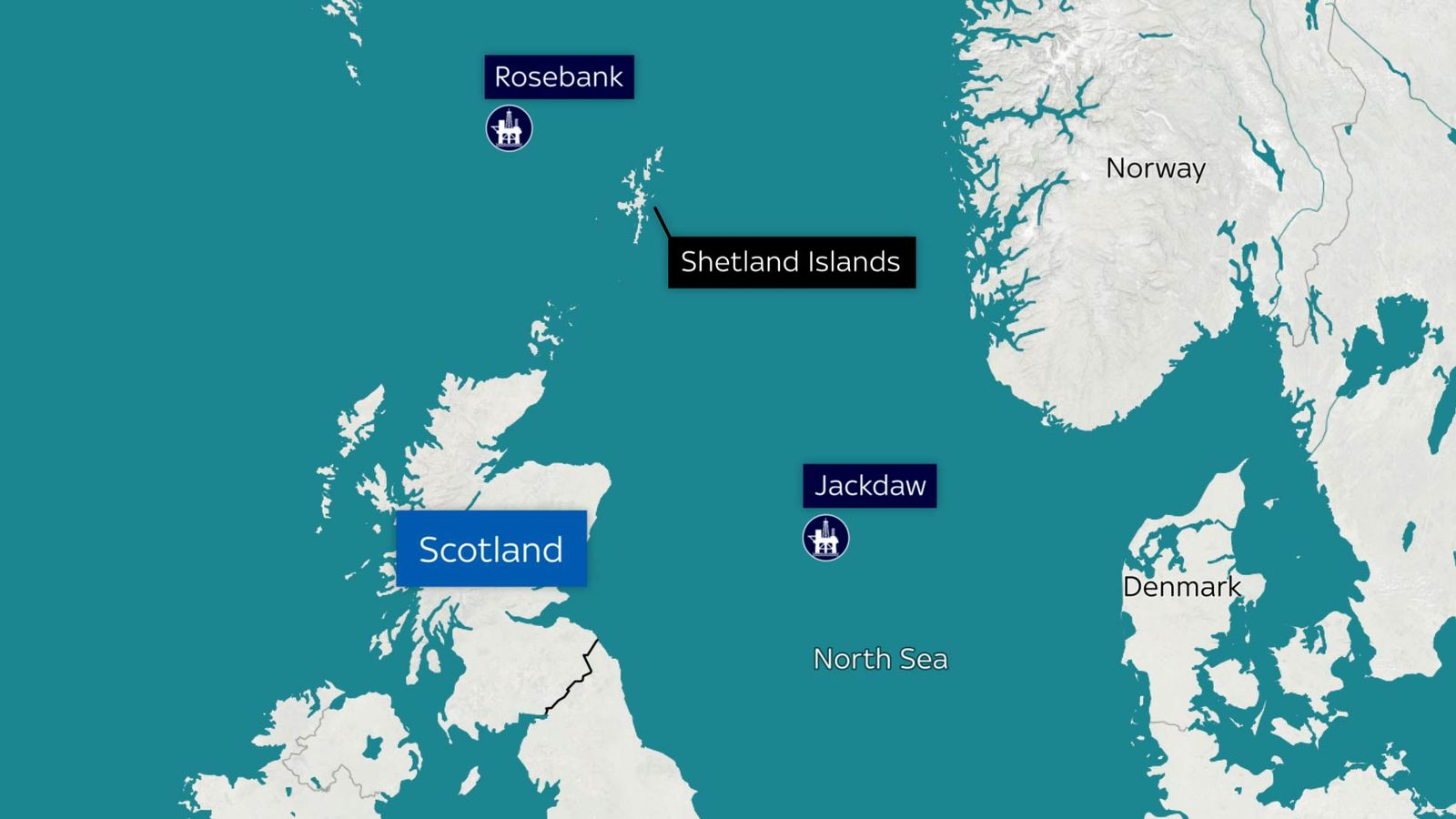
Rosebank and Jackdaw are operated by Adura, an Equinor-Shell joint venture. Much of the infrastructure for Jackaw is already in place, and gas production could begin this winter when it may be badly needed. Production at Rosebank, which is primarily an oil field, could begin in the first half of 2027.
“The question will be: is the UK investable in the future? I hope it will not come to that.”
“It’s a political choice.The North Sea oil and gas industry started on the UK side. We learned from the UK and it’s actually the same geology on both sides of the border – several fields actually cross it.”
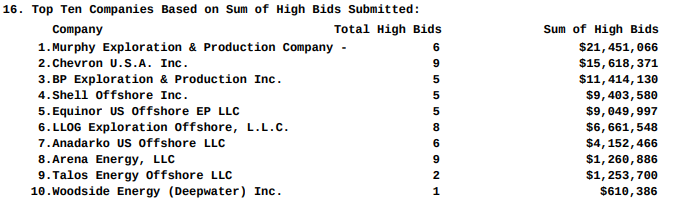
Gulfwide, Chevron was high bidder for 9 of the 10 blocks they sought vs. 6 of 9 for Oxy, 5 of 8 for Shell, 5 of 6 for BP, and 5 of 5 for Equinor.
US supermajors and historically important Gulf producers, Exxon Mobil and ConocoPhillips, were no-shows once again.
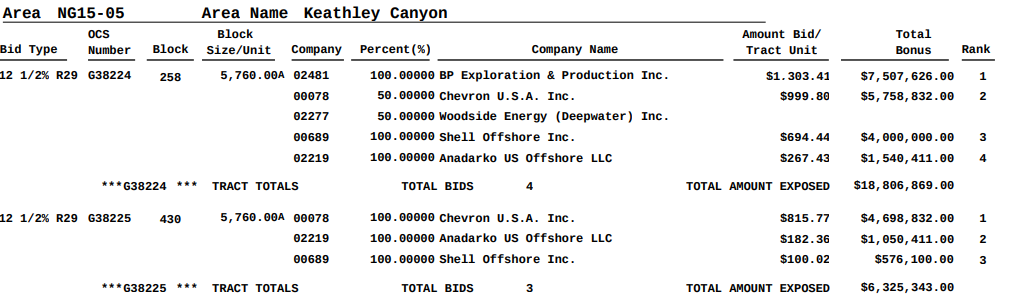
Bidding was spirited among the “big dogs” for KC Block 258, with BP taking the prize (assuming their $7.5 million bid is accepted). Chevron rebounded by taking KC 430, outbidding Oxy and Shell. (See below)
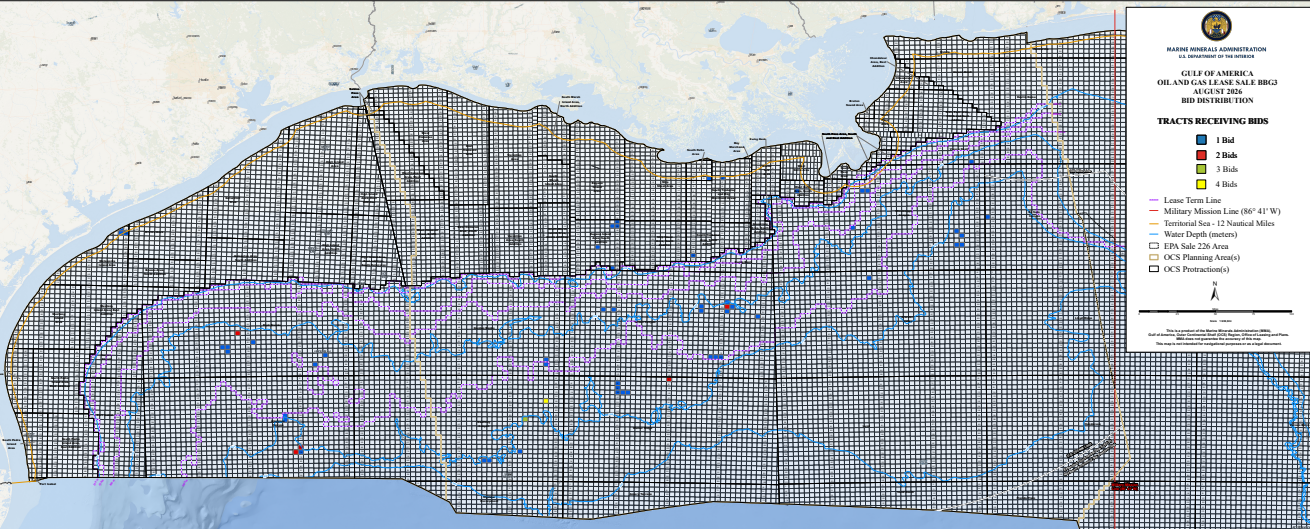
Among the large independents, LLOG batted 8 for 8, Murphy 6 for 8 (including the sale’s highest bid of $7.7 million), Talos 2 for 2, and Woodside 1 for 2. Our favorite tribal corporation, Red Willow Offshore (Southern Ute Tribe), partnered with LLOG, Navitas, Houston Energy, and CL&F Offshore on the high bid for Atwater Valley Block 63.
Murphy was the top $$$ bidder among all participating companies (see below). In 2025, Murphy was the Gulf’s 5th leading oil producer, trailing only Shell, BP, Chevron, and Oxy.
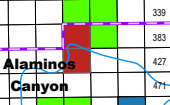
The sale’s highest bid ($7.7 million) was for Alaminos Canyon Block 380. The block was previously leased to LLOG, and exploratory drilling was conducted in 2019. LLOG’s lease expired on 12/20/2025, and complete well data were released on 4/24/2026. Murphy must have liked what they saw.
The absence of other bidders for AC 380 reminds us that interpretations and strategies differ. Murphy has had a pretty good track record in the Gulf. We’ll see what happens.
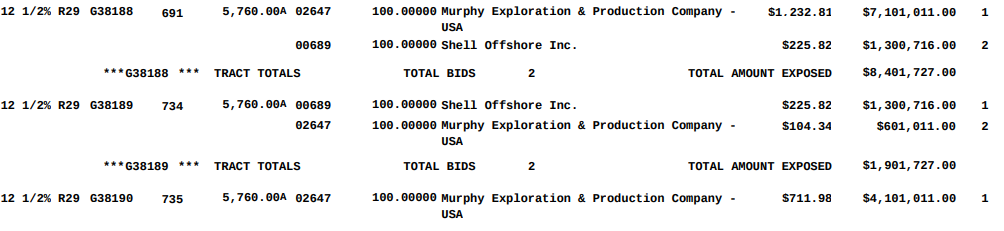
Murphy and Shell valued and competed for 2 other Alaminos Canyon blocks as the summary below indicates, and Murphy was the lone bidder ($4.1 million) for another.
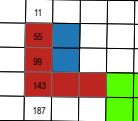
“L” for the “W”? All 5 of Equinor’s high bids (red) formed an “L” in the Walker Ridge area. Equinor was the lone bidder for each (see below). Existing blocks WR 56 and 100 (blue) are Equinor leases. Prior lessee Anadarko drilled on block 143 in 2014
We’ll see how this all worked out in about 10-20 years! 😀
Thankfully, from the standpoint of those of us whose primary concerns are the integrity of the OCS program and protecting taxpayers from decommissioning liabilities, the API comments (attached), along with those submitted by Shell and Chevron, have exposed the folly of eliminating financial assurance whenever there is a financially strong company somewhere in the lease chain of custody.
Mindful of ongoing and anticipated decommissioning liability battles, API effectivelychallenges the BOEM proposal on legal grounds. API also demonstrates why revisions intended to improve regulatory efficiency and increase production would do exactly the opposite. Excerpts from the API comments (emphasis added):
Further, foisting financial assurance obligations on predecessors will not achieve BOEM’s stated aims of financial “savings” and increased OCS oil and gas production; it more likely will do the opposite. The Proposed Rule would just shift financial assurance burdens to financially stronger predecessors, many of which remain engaged in the majority of leasing and production across the OCS and are far more likely to be future investors in increased OCS development and production. By contrast, nothing ensures that entities standing to benefit from the Proposed Rule will reinvest saved financial assurance premium dollars into OCS production; in fact, such entities largely do not explore or increase reserves, but merely buy pre-discovered reserves and produce them to a lower economic limit.
Nor would the Proposed Rule promote or save costs for future OCS transactions since, in the absence of any option for BOEM-demanded financial assurance from current interest holders, assignors will demand financial assurance at sufficiently conservative levels to address the risk of residual liability if assignees default on their obligations.
Even more problematically, the Proposed Rule would retroactively impose this new regulatory burden on entities that divested their OCS property interests years (or decades) earlier—in reliance on BOEM’s regulations that required their assignees to provide any supplemental financial assurance. Such entities are no longer in privity with BOEM, and have no control over current operations on those OCS properties. The Proposed Rule would reach back even to impose these obligations on predecessors that divested their interests before the 1997 regulatory imposition of joint and several liability for assignors (a time period on which the Proposed Rule is silent).
This novel and misguided approach allows, and even encourages, current interest holders to eschew their lease and grant obligations, and instead freely operate on the backs of predecessors and taxpayers. Meanwhile, current interest holders could choose to allocate little or no funding for end-of-life obligations like decommissioning whenever they desire to conclude production, file for bankruptcy, and leave BOEM to eventually issue decommissioning orders to predecessors that have not operated the grants and leases for years or even decades. This would create higher administrative and financial burdens for the government and system as a whole, including where no viable predecessor had accrued liability for decommissioning all facilities present on the lease or grant, and potential operational impacts that a predecessor has no obligation to cure.
This new proposed obligation on predecessors is arbitrary and capricious and unlawful on multiple grounds. It violates the rule against retroactivity by creating new federal liability stemming from already-completed transactions. It violates the agency change in position doctrine, particularly given that BOEM on multiple occasions has rejected precisely the same approach as in the Proposed Rule. It is unsupported, as it overstates the burdens under the discretionary Existing Rule, disregards repeated U.S. Government Accountability Office (“GAO”) and BOEM findings calling for more robust financial assurance by current interest holders, cites only anecdotal prior comments while ignoring the bulk of countervailing comments detailing reality on the OCS, and identifies no means by which BOEM can compel collect, and assess adequate financial information for all predecessor entities. And it is self contradictory, including by tying up more capital among entities producing the vast majority of oil and natural gas on the OCS.
Chevron points to their potential liability balance of ~ $2 billion for satisfying the decommissioning obligations of default owners:
John Smith and I do not agree with the industry support for the use of reserves as financial assurance. The margin of error in reserve, oil price, and decommissioning cost estimates, not to mention the potential for facility damage, the ever-changing political environment, and the administration challenges, present an unacceptably high risk for taxpayers. If companies want to guarantee decommissioning based on reserves, let them do so. Shell makes a good point about why it is especially important to prohibit the use of reserve estimates on a company-wide basis:
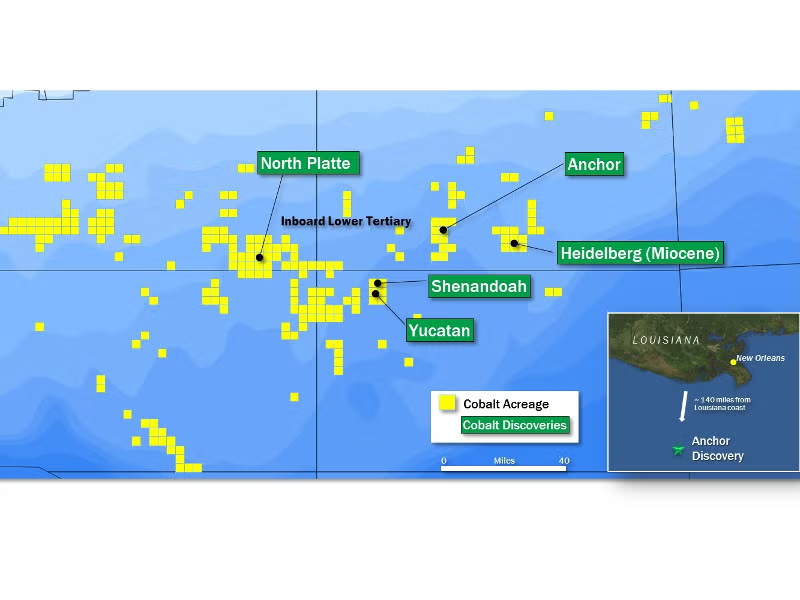
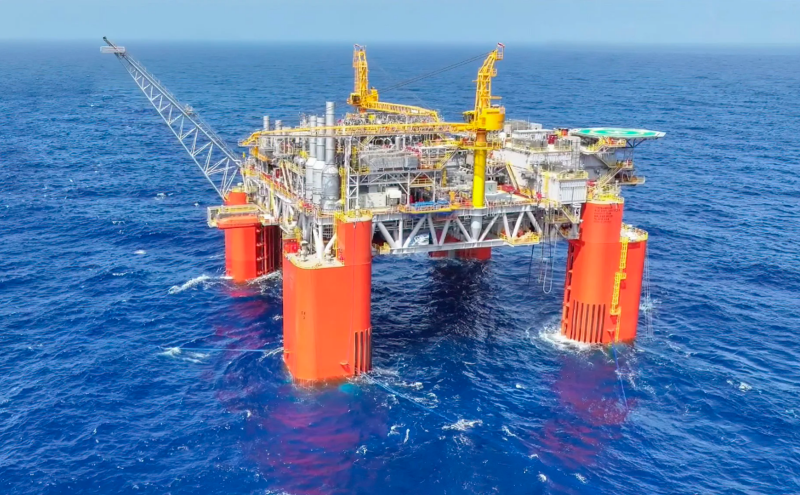
If Beacon and HEQ are willing sellers of their majority share in the impressive Shenandoah field, as appears to be the case (per Reuters), the big dogs are interested in buying. And why wouldn’t they be? Production began last July and the targeted rate of 100,000 bopd has already been achieved from just four phase-one wells.
Reuters reports that Total, Shell, BP, Repsol, and Chevron are interested in Beacon and HEQ’s 51% stake. More about Shenandoah:
located in Walker Ridge blocks 51, 52, and 53
~150 miles off the coast of Louisiana
floating production unit (FPU) in 5800′ of water in WR block 52
Investment companies like Beacon (owned by Blackstone) are positive, and increasingly necessary, contributors to the offshore program. These companies bring capital and new exploration strategies that increase development and production. They must, of course, be committed to safety excellence, which seems to be the case for Beacon.
It’s noteworthy that Anadarko and Conoco Phillips, Shenandoah’s major original partners holding 33% and 30% interest respectively, withdrew from the project in 2018 citing unsatisfactory appraisal results and weak commodity prices. Evaluation mistakes like this are common, which is why broad and diverse industry participation is needed. With mergers reducing the number of US majors (remember Amoco, Arco, Sun, Texaco, Getty, Mobil, Phillips, Marathon, Unocal, Superior, Hess, etc.), investment companies play an increasingly important role in OCS development.
Shenandoah, WR 51, 52, 53 (center blocks); green=active leases prior to Sale 261; blue=leased issued after Sale 261
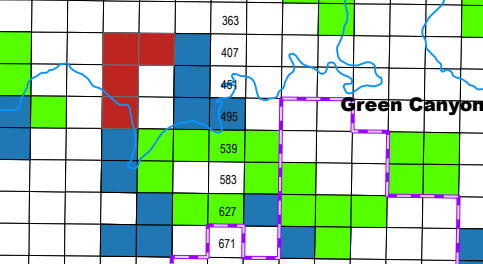
red=blocks receiving bids at BBG2; blue=BBG1 and Sale 261 leases; green=active leases issued prior to Sale 261
Although bidding at Sale BBG2 was rather subdued, Gulf heavyweights BP, Chevron, Shell, and Oxy/Anadarko, along with increasingly important Woodside Energy, competed for the 4 red blocks in the Green Canyon area (map above and table below). These elephant hunters presumably see excellent Paleogene (Wilcox) prospectivity in those blocks.
17 of the sale’s 38 bids (45%) and $32.8 milion of the sale’s $47 million in high bids (70%) were for these 4 blocks. BP’s $21 million bid for GC 404 was by far the sale’s highest bid.
Green Canyon Block No.
No. of bidders
High Bidder
Bid
404
5
BP
$21,009,990
405
2
BP
$885,99
448
5
Chevron
$4,967,067
492
5
Chevron
$5,887,188
At this time, the high costs and technical complexities (e.g. deepwaterand high pressure/high temperature reservoirs) limit Wilcox development to major oil companies and well financed, technically savvy independents. Expect some of the international majors that did not participate in BBG2 to acquire lease interest at a later date, which will again raise questions about the merits of joint bidding restrictions.
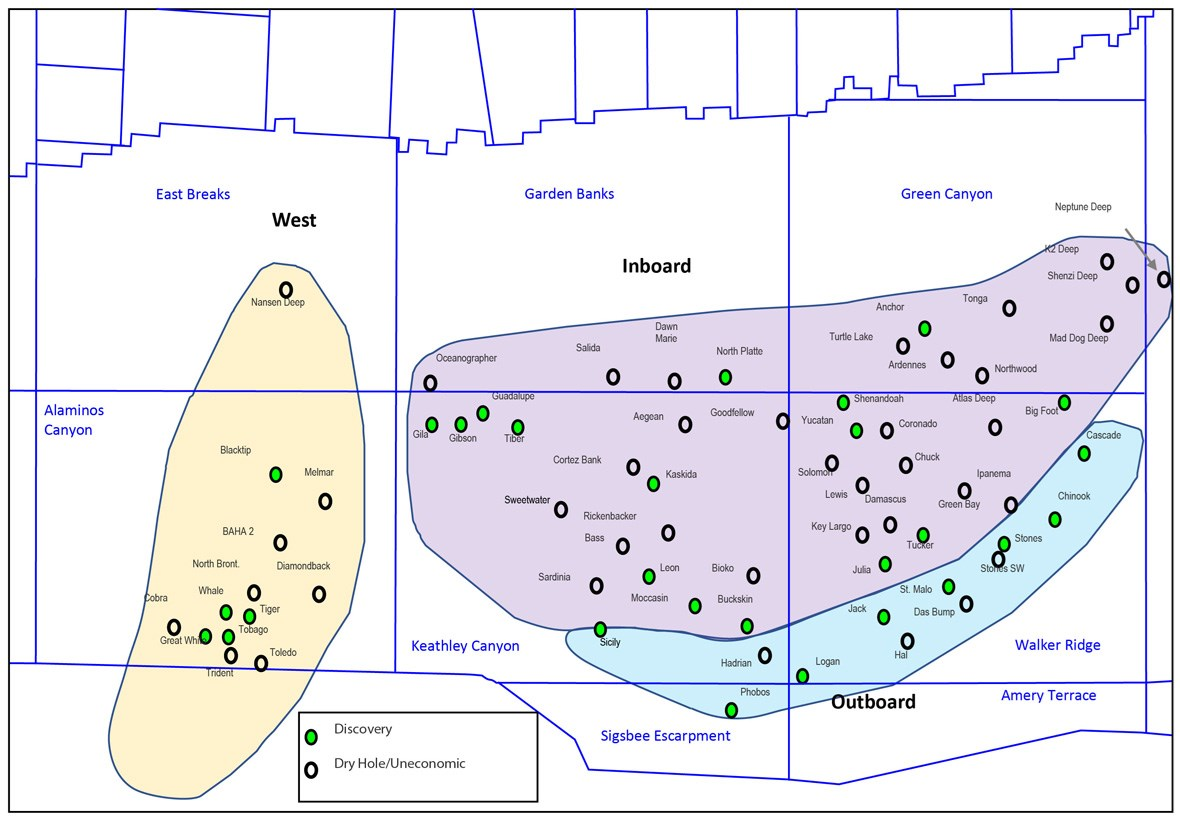
From AAPG graphic-Wilcox trend map. Eastern area can be subdivided into an outboard and inboard trend, with wells in the latter area showing variable thickness due to salt tectonics contemporaneous with deposition (From Zarra et al. 2019’s AAPG Search and Discovery article).
Imbedded below is a good presentation on the Paleogene Wilcox by Dr. Mike Sweet, Univ. of Texas:
Although no one was expecting a barnburner only 3 months after the previous sale, BBG2 was historically weak for a Gulf-wide sale. The table below compares BBG2 with the previous 4 Gulf sales, none of which were particularly impressive.
However, the sale was not without highlights. There was some spirited bidding for tracts in the Green Canyon area. BP’s bid was the highest of 5 for GC Block 404. BP bid $21 million for the block, 45% of the high bids sum for the entire sale. The BP bid was also $20 million higher than the next highest bid for that tract (ouch!).
Also interesting was Chevron edging Shell $5,887,188.00 to $5,501,240.00 to acquire GC Block 492.
Sale No.
257
259
261
BBG1
BBG2
date
11/17/2021
3/29/2023
12/20/2023
12/10/2025
3/11/2026
companies participating
33
32
26
30
13
total bids
2233
2842
3161
219
38
tracts receiving bids
2143
2442
2751
181
25
sum of all bids $millions
198.5
309.8
441.9
371.9
69.9
sum of high bids ($millions)
101.7
263.8
382.2
279.4
47.0
highest bid company block
$10,001,252 Anadarko AC 259
$15,911,947 Chevron KC 96
$25,500,085 Anadarko MC 389
$18,592,086 Chevron KC 25
$21,009,990 bp GC 404
most high bids company sum ($millions)
46 bp 29.0
75 Chevron 108.0
65 Shell 69.0
50 bp 61.0
6 Anadarko (Oxy) 4.0
sum of high bids ($millions) company
47.1 Chevron
108 Chevron
88.3 Hess
61.0 bp
22.6 bp
most high bids by independent
14-DG Expl.
13-Beacon 13-Red Willow
22-Red Willow
14-Murphy
5-LLOG
1excludes 36 leases improperly acquired for carbon disposal purposes; 2excludes 69 leases improperly acquired for carbon disposal purposes; 3excludes 94 leases improperly acquired for carbon disposal purposes
For historical comparison purposes, Gulf Sale 206 drew $3.7 billion ($5.6 billion in today’s dollars) in 2008. Twenty-siz sales between 1972 and 2013 garnered more than $1 billion in high bids.
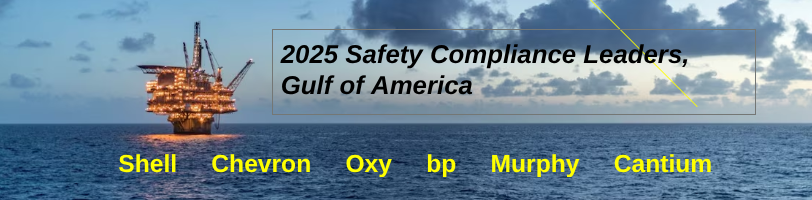
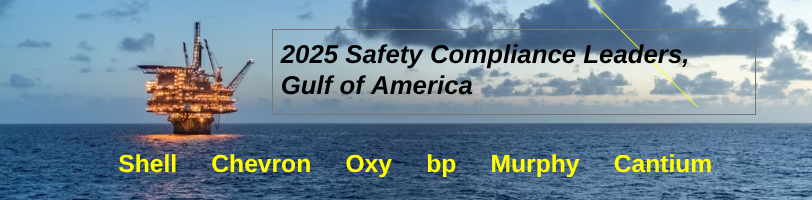
The 2025 Gulf of America Safety Compliance Leaders are ranked below according to the number of incidents of non-compliance (INCs) per facility inspection. To be ranked, a company must:
operate at least 2 production platforms
have drilled at least 2 wells during the year
average <1 INC for every 5 facility inspections (0.20 INCs/facility inspection). This is a higher standard (fewer INCs) than in previous years.
average <1 INC for every 10 inspections (0.1 INCs/inspection). Note that each facility inspection may include multiple types of inspections (e.g. production, pipeline, pollution, Coast Guard, site security, etc). In 2025, there were on average 3.2 inspections for every facility inspection.
operator
W
CSI
FSI
total INCs
facility insp
INCs/ fac insp
insp
INCs/ insp
Shell
3
8
1
12
231
0.05
557
0.02
Chevron
10
8
0
18
260
0.07
772
0.02
Oxy
2
6
1
9
133
0.07
325
0.03
BP
8
2
0
10
122
0.08
304
0.03
Murphy
6
2
0
8
70
0.11
177
0.05
Cantium
5
7
4
16
121
0.13
488
0.03
Gulf-wide 2025
815
445
84
1344
3179
0.42
10218
0.13
Gulf-wide 2024
957
398
109
1464
3133
0.47
10664
0.14
Notes: Numbers are from published BSEE data; INC=incident of non-compliance; W=warning INC; CSI=component shut-in INC; FSI=facility shut-in INC; INCs/fac insp= INCs issued per facility inspection; each facility-inspection may include multiple types of inspections (e.g. production, pipeline, pollution, Coast Guard, site security, etc), in 2025, there were on average 3.2 inspections for every facility inspection
Criteria: This ranking is based solely on BSEE’s published compliance data. The absence of timely public information on safety incidents (e.g. injuries, fires, pollution, gas releases, property damage) precludes inclusion of these data. Although Panel Investigations are conducted for fatalities, serious injuries, and significant pollution events, the last panel report was for an incident on 3/25/2022, and no information is available for any ongoing investigations. BSEE District offices investigate the more significant incidents that don’t qualify for panel investigations. These District Investigation reports are more timely, but some are not issued within 90 days of the incident. The District reports will be reviewed later in the year. Note that there were no occupational fatalities in 2025.
Observations:
The overall inspection and INC results for 2025 were similar to those for 2024.
The top companies performed better in 2025 than in 2024. In 2024, only 2 companies had INC/facility inspection ratios of <0.10 and only 3 had ratios <0.15. In 2025, all 6 of the performance leaders had ratios <0.15.
Shell’s total INCs and INCs/facility inspection decreased by 73% and 78% respectively vs. 2024
Cantium, which operates 85 shallow water platforms, has demonstrated that a shelf operator can be an outstanding safety performer. Cantium’s total INCs and INCs/facility inspection decreased by 50% vs. 2024
Should fewer inspections be conducted at facilities that have such low INC rates? On the one hand, fewer inspections would reduce regulatory costs and transportation risks. On the other hand, there are benefits from BSEE inspection visits besides compliance enforcement. These include direct communication with offshore workers (including contractors) regarding regulatory policies and safety practices, witnessing safety tests, evaluating new technology, and assessing management system implementation and corporate culture at the facility level.
Absent specific details on the violations, no attempt was made to weight the INCs. Although shut-in INCs are generally considered to be more significant than warnings, that is not always the case. For example, a component shut-in INC for a safety device that is marginally out of tolerance and is corrected on the spot may be less serious than a warning that is indicative of structural deterioration, poor maintenance, or organizational shortcomings.
Not meeting one of the activity level requirements, but nonetheless noteworthy, were the compliance records of LLOG and BOE Exploration & Production (younger than and unrelated to the BOE blog 😀). See their impressive results below:
Will the oil and gas lease sale boldly named Big Beautiful Gulf 1 (BBG1) live up to its grand name? Given the more favorable lease terms and the 2 year gap since the last sale, BBG1 should surpass the previous 3 sales (table below). Questions:
Which majors will be the most active bidders? Chevron? Shell? BP? Oxy/Anadarko?
Will former Gulf of Mexico stalwarts Exxon and Conoco Phillips participate for the first time in years? Probably not, but US super-majors should participate in the US offshore program.
How many companies will submit bids? Would like that to be a number >35.
How many tracts will receive bids? A number >300 would be very encouraging.
Will the total high bids exceed $400 million?
Will we see an increase in shelf interest?
Which independents will be the most active?
After the not-so-clever carbon disposal acquisitions in the last 3 sales, will the number of carbon disposal bids be zero? For the first time ever, the Federal government felt compelled to stipulate the obvious (see the proposed notice for OCS Sale 262) – that an Oil and Gas Lease Sale is only for oil and gas exploration and development.
See the summary data below for the last 3 Gulf lease sales. We’ll fill in the blanks next week.
Sale No.
257
259
261
BBG1
date
11/17/2021
3/29/2023
12/20/2023
12/10/2025
companies participating
33
32
26
total bids
2233
2842
3161
tracts receiving bids
2143
2442
2751
sum of all bids $millions
198.5
309.8
441.9
sum of high bids ($millions)
101.7
263.8
382.2
highest bid company block
$10,001,252.00 Anadarko AC 259
$15,911,947 Chevron KC 96
$25,500,085 Anadarko MC 389
most high bids company sum ($millions)
46 bp 29.0
75 Chevron 108.0
65 Shell 69.0
sum of high bids ($millions) company
47.1 Chevron
108 Chevron
88.3 Hess
most high bids by independent
14-DG Expl.
13-Beacon 13-Red Willow
22-Red Willow
1excludes 36 leases improperly acquired for carbon disposal purposes; 2excludes 69 leases improperly acquired for carbon disposal purposes; 3excludes 94 leases improperly acquired for carbon disposal purposes







Restart seems likely for decommissioning financial assurance rule
Posted in Regulation, decommissioning, energy policy, tagged Chevron, Shell, decommissioning, BOEM, API, financial assurance, comments, NEFSA, proposed regulation on May 18, 2026| Leave a Comment »
Thankfully, from the standpoint of those of us whose primary concerns are the integrity of the OCS program and protecting taxpayers from decommissioning liabilities, the API comments (attached), along with those submitted by Shell and Chevron, have exposed the folly of eliminating financial assurance whenever there is a financially strong company somewhere in the lease chain of custody.
Mindful of ongoing and anticipated decommissioning liability battles, API effectively challenges the BOEM proposal on legal grounds. API also demonstrates why revisions intended to improve regulatory efficiency and increase production would do exactly the opposite. Excerpts from the API comments (emphasis added):
Further, foisting financial assurance obligations on predecessors will not achieve BOEM’s stated aims of financial “savings” and increased OCS oil and gas production; it more likely will do the opposite. The Proposed Rule would just shift financial assurance burdens to financially stronger predecessors, many of which remain engaged in the majority of leasing and production across the OCS and are far more likely to be future investors in increased OCS development and production. By contrast, nothing ensures that entities standing to benefit from the Proposed Rule will reinvest saved financial assurance premium dollars into OCS production; in fact, such entities largely do not explore or increase reserves, but merely buy pre-discovered reserves and produce them to a lower economic limit.
Nor would the Proposed Rule promote or save costs for future OCS transactions since, in the absence of any option for BOEM-demanded financial assurance from current interest holders, assignors will demand financial assurance at sufficiently conservative levels to address the risk of residual liability if assignees default on their obligations.
Even more problematically, the Proposed Rule would retroactively impose this new regulatory burden on entities that divested their OCS property interests years (or decades) earlier—in reliance on BOEM’s regulations that required their assignees to provide any supplemental financial assurance. Such entities are no longer in privity with BOEM, and have no control over current operations on those OCS properties. The Proposed Rule would reach back even to impose these obligations on predecessors that divested their interests before the 1997 regulatory imposition of joint and several liability for assignors (a time period on which the Proposed Rule is silent).
This novel and misguided approach allows, and even encourages, current interest holders to eschew their lease and grant obligations, and instead freely operate on the backs of predecessors and taxpayers. Meanwhile, current interest holders could choose to allocate little or no funding for end-of-life obligations like decommissioning whenever they desire to conclude production, file for bankruptcy, and leave BOEM to eventually issue decommissioning orders to predecessors that have not operated the grants and leases for years or even decades. This would create higher administrative and financial burdens for the government and system as a whole, including where no viable predecessor had accrued liability for decommissioning all facilities present on the lease or grant, and potential operational impacts that a predecessor has no obligation to cure.
This new proposed obligation on predecessors is arbitrary and capricious and unlawful on multiple grounds. It violates the rule against retroactivity by creating new federal liability stemming from already-completed transactions. It violates the agency change in position doctrine, particularly given that BOEM on multiple occasions has rejected precisely the same approach as in the Proposed Rule. It is unsupported, as it overstates the burdens under the discretionary Existing Rule, disregards repeated U.S. Government Accountability Office (“GAO”) and BOEM findings calling for more robust financial assurance by current interest holders, cites only anecdotal prior comments while ignoring the bulk of countervailing comments detailing reality on the OCS, and identifies no means by which BOEM can compel collect, and assess adequate financial information for all predecessor entities. And it is self contradictory, including by tying up more capital among entities producing the vast majority of oil and natural gas on the OCS.
Chevron points to their potential liability balance of ~ $2 billion for satisfying the decommissioning obligations of default owners:
John Smith and I do not agree with the industry support for the use of reserves as financial assurance. The margin of error in reserve, oil price, and decommissioning cost estimates, not to mention the potential for facility damage, the ever-changing political environment, and the administration challenges, present an unacceptably high risk for taxpayers. If companies want to guarantee decommissioning based on reserves, let them do so. Shell makes a good point about why it is especially important to prohibit the use of reserve estimates on a company-wide basis:
Lastly, kudos to the New England Fisherman’s Stewardship Association for raising the concern about financial assurance for decommissioning offshore wind facilities
Read Full Post »