As noted in previous posts, the Cox legacy of non-compliance has continued under new ownership. In 2026 YTD, Array Petroleum accounted for 52% of Gulf of America Incidents of Non-Compliance (INCs) while operating only 12% of the platforms, and producing only 0.06% of the oil and 0.17% of the gas (2025 production data). Their 2026 YTD INCs/inspection ratio is 7.55 times the Gulf average and 14.6 times the Gulf average if Array inspections are excluded.
The only platform operated directly by NRW was cited for 3 INCs on 2 inspections.
Per MMA data, W&T operates 117 platforms in the Gulf. The number of platforms that were included in the acquisition of the 6 Cox fields is unknown. W&T’s INC/inspection ratio in 2023, the year before the Cox acquisition, was 0.72 (80/111), which was better than their 2026 performance (0.94), but worse than the Gulf-wide 2023 average of 0.57. So W&T’s compliance relative to other Gulf operators was about the same before and after the acquisition.
According to the borehole file, neither Array, NRW, nor W&T conducted any drilling operations in 2026 YTD.
Kudos to the MMA inspectors for their diligence in identifying INCs and issuing citations. The 2026 YTD data table is below.
W
CSI
FSI
total INCs
facility insp
INCs/isp
Array
403
115
4
522
88
5.93
NRW
1
2
0
3
2
1.50
W&T
38
46
4
88
94
0.94
GoA total
653
296
56
1005
1280
0.785
Notes: Numbers are from published BSEE data (7/21/2026 inquiry); INC=incident of non-compliance; W=warning INC; CSI=component shut-in INC; FSI=facility shut-in INC; INCs/insp= INCs issued per facility inspection; each facility-inspection may include multiple types of inspections (e.g. production, pipeline, pollution, Coast Guard, site security, etc)
In 2025, NRW/Array operations accounted for 486 incidents of non-compliance (INCs), 36.2% of the Gulf of America total. Array and NRW had INC/facility inspection rates of 2.1 and 7.0 respectively, well above the Gulf average of 0.42 and the top performers’ rates of 0.05 to 0.13.
In Array’s defense, their violations declined sharply in the second half of 2025. However, the number of inspections of their facilities declined even more sharply, so the INCs/facility inspection ratio actually increased in the second half.
For the 2025 data in the table below:W=warning, CSI=component shut-in, FSI=facility shut-in. The 3 numbers for Array in each box are full year 2025 data (top), first half 2025 (middle), and second half 2025 (bottom)
operator
W
CSI
FSI
total INCs
Facility Insp.
INCs/isp
Array
352 311 41
93 46 47
6 6 0
451 363 88
218 184 34
2.1 2.0 2.6
NRW
10
24
1
35
5
7.0
Three other companies had more than 10 shelf platforms and INC/facility inspection ratios >1.0: Greyhound Energy (23 platforms), Renaissance (21 platforms) and Sanare Energy (38 platforms).
operator
W
CSI
FSI
total INCs
facility insp
INCs/ fac. insp
Greyhound Energy
32
1
0
33
23
1.4
Renaissance Offshore
26
19
3
47
44
1.1
Sanare Energy
60
20
2
82
75
1.1
The table below provides 2025 oil and gas production through Oct (with Gulf of America rank) for the 5 companies mentioned in this post. In determining rankings, subsidiaries and affiliates were counted as a single company (e.g. Chevron, Unocal, and Hess counted as one company).
NRW contracted with Array Petroleum to operate the former Cox Assets. Array subsequently sued NRW, asserting that NRW received $78,000,000 in revenue, but disbursed only about $48,000,000 to pay Array’s invoices and those of the subcontractor.
The court filing claimed that NRW failed to pay Array $2.5 million, the subcontractors $10.7 million, and the United States $12 million. A large share of the subcontractor costs were probably for well operations given that 21 Array workover applications were approved in 2024 and 2025. The $12 million due to the Federal government is reportedly for royalty payments. Were any revenues set aside for decommissioning liabilities?
Array’s lawsuit was dismissed by the court on January 3, 2025, after a joint motion to dismiss was filed by the defendants. Information on the reasons for the dismissal is not publicly available.
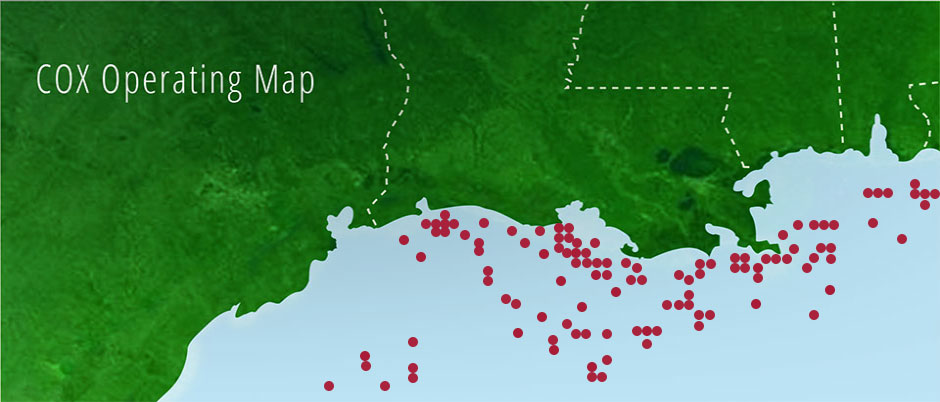
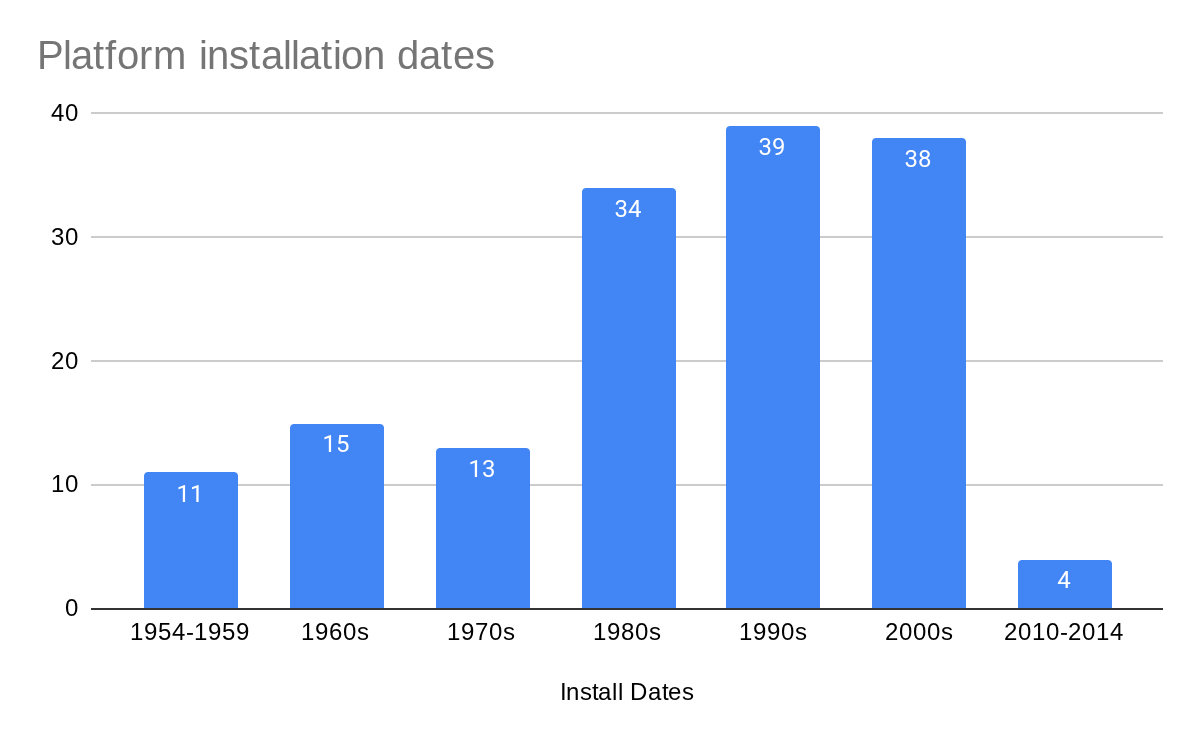
Old platforms: According to BOEM records, Array operates 154 platforms previously owned by Cox. These platforms are in the Ship Shoal, South Marsh Island, and West Delta areas of the Gulf of America. Most are >30 years old and four are more than 70 years old (see chart below). 41 are classified as major structures including 15 of the 26 platforms installed in the 1950s and 1960s. 44 are manned on a 24 hour basis. 79 have helidecks. Massive decommissioning liabilities loom.
Violations: NRW/Array ranks 37th out of 42 companies in GoA oil production (2025 YTD) and 36th out of 42 companies in gas production, but leads the pack in Incidents of Noncompliance (INCs):
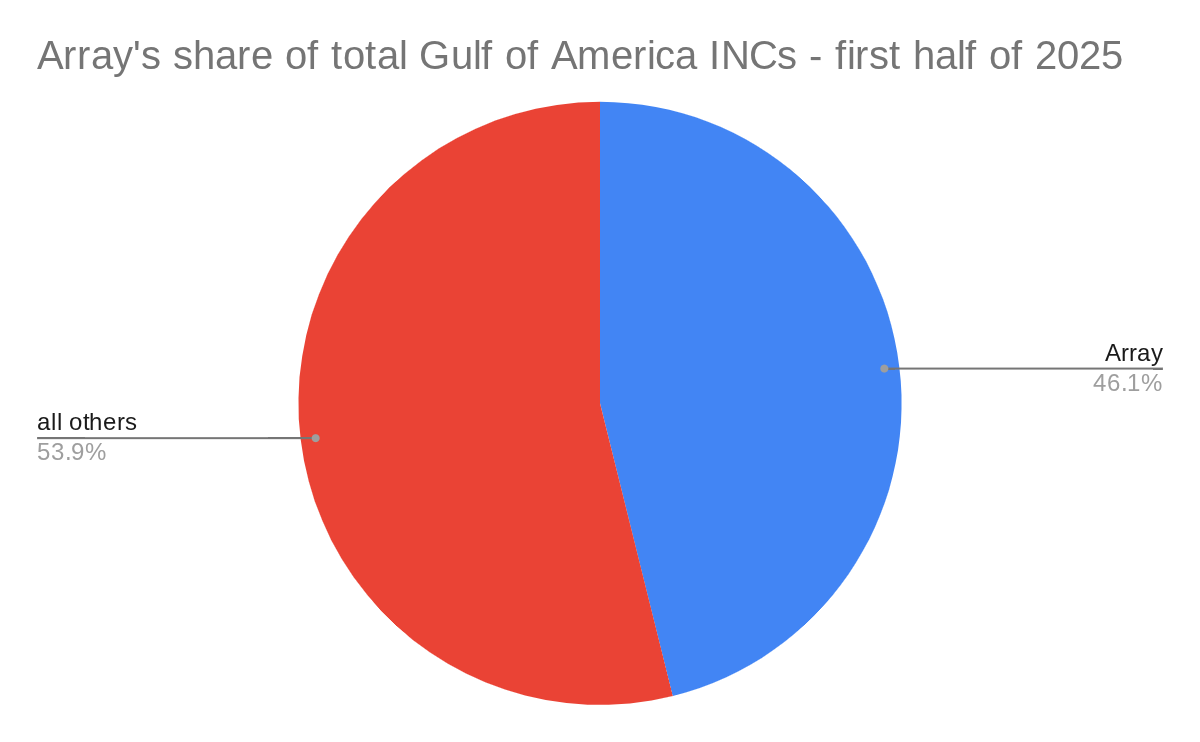
Array accounted for nearly half of all GoA INCs issued in the first half of 2025 (chart below).
Array was issued 9 times more warning INCs (311) than any other operator. Apache was second with 34.
There are many small and mid-sized companies that are responsible operators. Their participation in the OCS program should be encouraged. However, others have demonstrated, by their inattention to financial and safety requirements, that they are not fit to operate OCS facilities.
The growth of Fieldwood, Cox, Signal Hill, and Black Elk was in part facilitated by lax lease assignment and financial assurance policies.
Operating companies should have to demonstrate that they can operate safety and comply with the regulations before they are approved to acquire more properties.
Expect the ultimate public cost of the Cox bankruptcy, in terms of decommissioning liabilities and the need for increased oversight, to be large.
The Federal govt (Justice/Interior) should strongly oppose bankruptcy court asset sales that increase public financial, safety, and environmental risks.

 Bud's Offshore Energy (BOE)