As noted in previous posts, the Cox legacy of non-compliance has continued under new ownership. In 2026 YTD, Array Petroleum accounted for 52% of Gulf of America Incidents of Non-Compliance (INCs) while operating only 12% of the platforms, and producing only 0.06% of the oil and 0.17% of the gas (2025 production data). Their 2026 YTD INCs/inspection ratio is 7.55 times the Gulf average and 14.6 times the Gulf average if Array inspections are excluded.
The only platform operated directly by NRW was cited for 3 INCs on 2 inspections.
Per MMA data, W&T operates 117 platforms in the Gulf. The number of platforms that were included in the acquisition of the 6 Cox fields is unknown. W&T’s INC/inspection ratio in 2023, the year before the Cox acquisition, was 0.72 (80/111), which was better than their 2026 performance (0.94), but worse than the Gulf-wide 2023 average of 0.57. So W&T’s compliance relative to other Gulf operators was about the same before and after the acquisition.
According to the borehole file, neither Array, NRW, nor W&T conducted any drilling operations in 2026 YTD.
Kudos to the MMA inspectors for their diligence in identifying INCs and issuing citations. The 2026 YTD data table is below.
W
CSI
FSI
total INCs
facility insp
INCs/isp
Array
403
115
4
522
88
5.93
NRW
1
2
0
3
2
1.50
W&T
38
46
4
88
94
0.94
GoA total
653
296
56
1005
1280
0.785
Notes: Numbers are from published BSEE data (7/21/2026 inquiry); INC=incident of non-compliance; W=warning INC; CSI=component shut-in INC; FSI=facility shut-in INC; INCs/insp= INCs issued per facility inspection; each facility-inspection may include multiple types of inspections (e.g. production, pipeline, pollution, Coast Guard, site security, etc)
NRW contracted with Array Petroleum to operate the former Cox Assets. Array subsequently sued NRW, asserting that NRW received $78,000,000 in revenue, but disbursed only about $48,000,000 to pay Array’s invoices and those of the subcontractor.
The court filing claimed that NRW failed to pay Array $2.5 million, the subcontractors $10.7 million, and the United States $12 million. A large share of the subcontractor costs were probably for well operations given that 21 Array workover applications were approved in 2024 and 2025. The $12 million due to the Federal government is reportedly for royalty payments. Were any revenues set aside for decommissioning liabilities?
Array’s lawsuit was dismissed by the court on January 3, 2025, after a joint motion to dismiss was filed by the defendants. Information on the reasons for the dismissal is not publicly available.
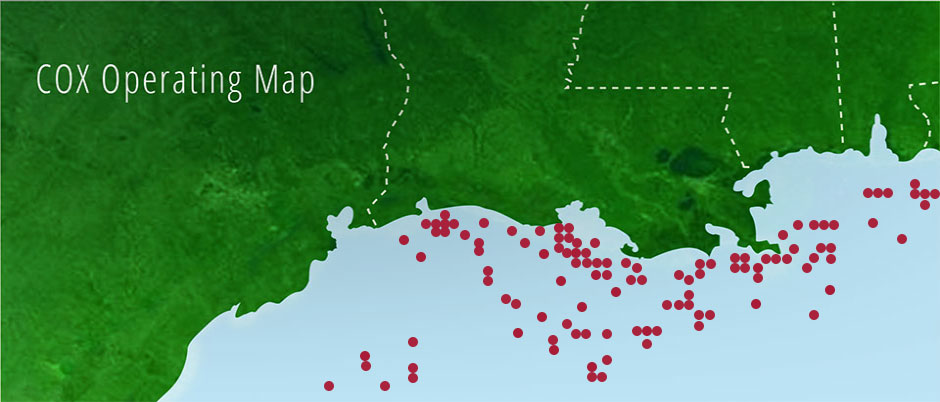
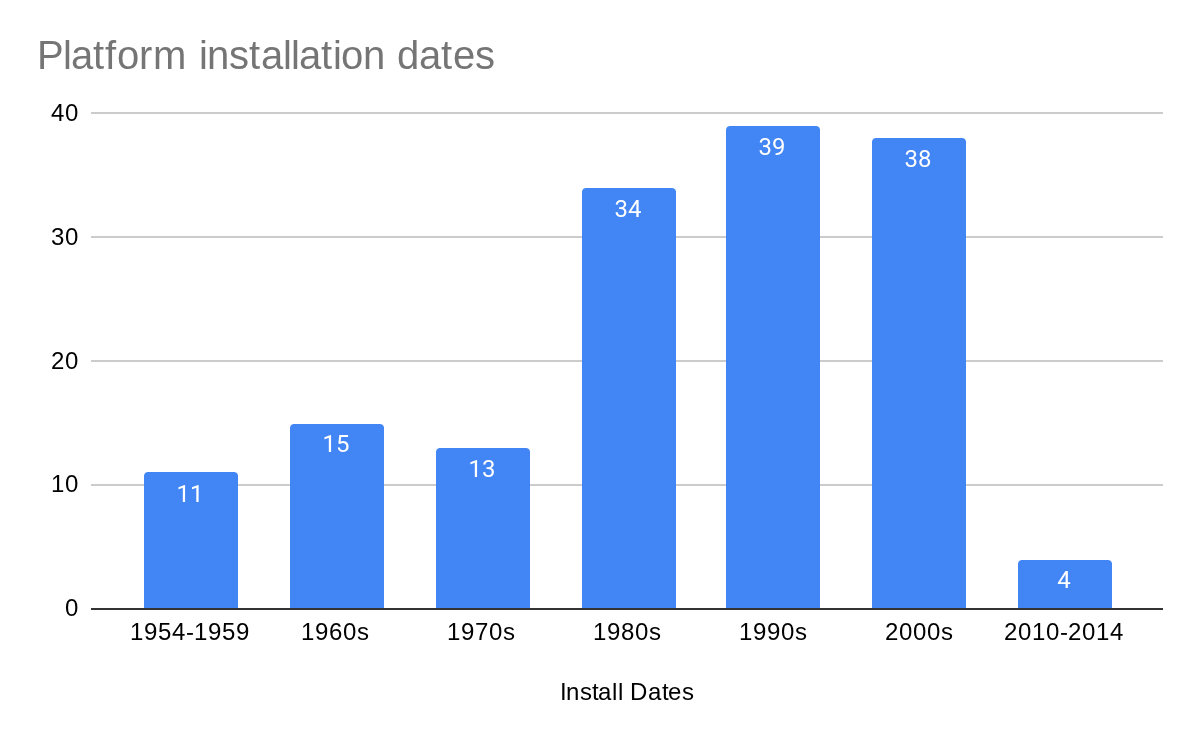
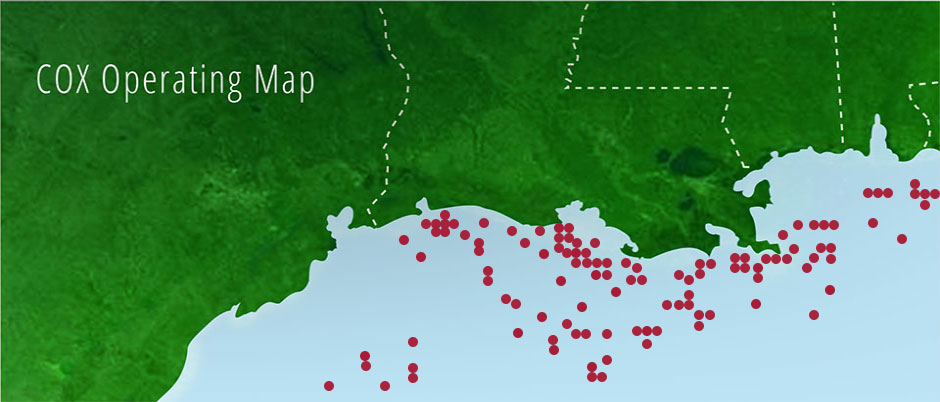
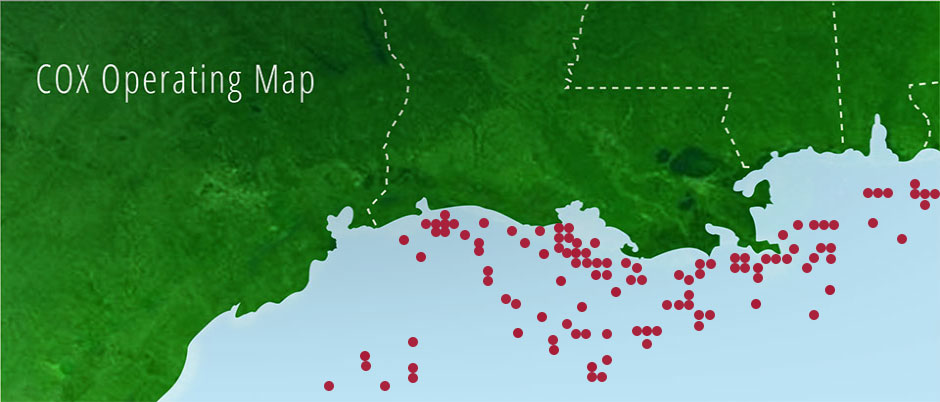
Old platforms: According to BOEM records, Array operates 154 platforms previously owned by Cox. These platforms are in the Ship Shoal, South Marsh Island, and West Delta areas of the Gulf of America. Most are >30 years old and four are more than 70 years old (see chart below). 41 are classified as major structures including 15 of the 26 platforms installed in the 1950s and 1960s. 44 are manned on a 24 hour basis. 79 have helidecks. Massive decommissioning liabilities loom.
Violations: NRW/Array ranks 37th out of 42 companies in GoA oil production (2025 YTD) and 36th out of 42 companies in gas production, but leads the pack in Incidents of Noncompliance (INCs):
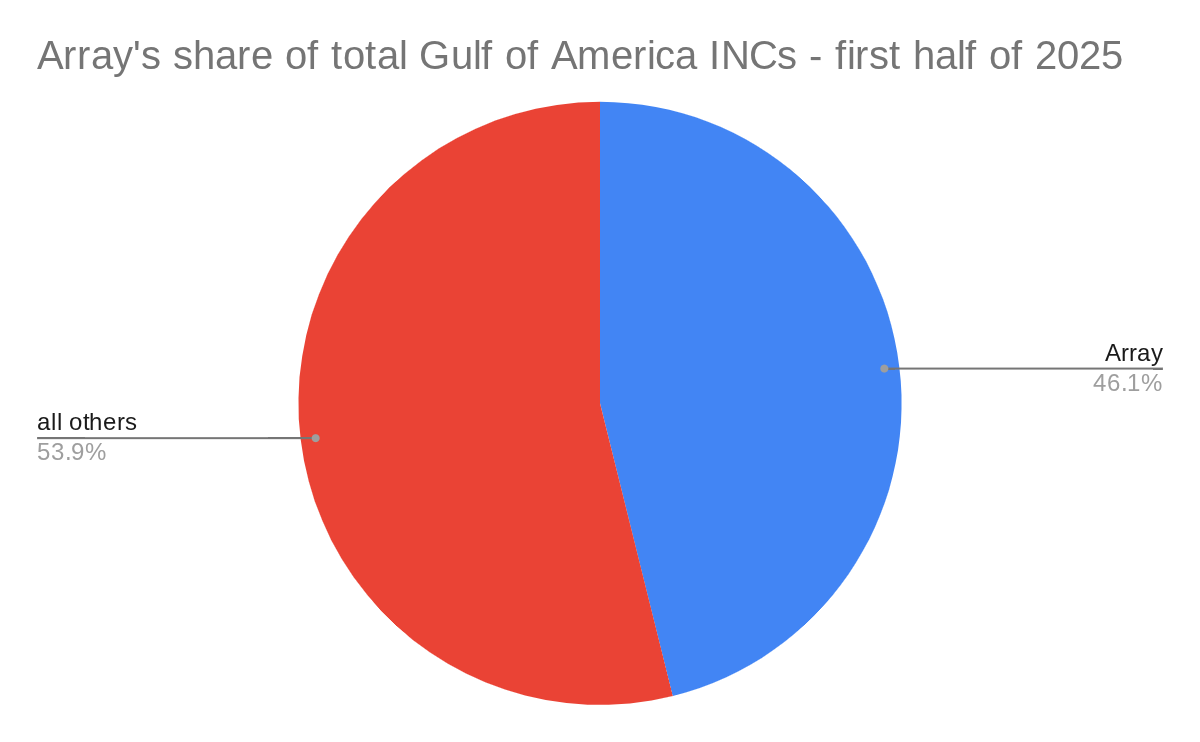
Array accounted for nearly half of all GoA INCs issued in the first half of 2025 (chart below).
Array was issued 9 times more warning INCs (311) than any other operator. Apache was second with 34.
There are many small and mid-sized companies that are responsible operators. Their participation in the OCS program should be encouraged. However, others have demonstrated, by their inattention to financial and safety requirements, that they are not fit to operate OCS facilities.
The growth of Fieldwood, Cox, Signal Hill, and Black Elk was in part facilitated by lax lease assignment and financial assurance policies.
Operating companies should have to demonstrate that they can operate safety and comply with the regulations before they are approved to acquire more properties.
Expect the ultimate public cost of the Cox bankruptcy, in terms of decommissioning liabilities and the need for increased oversight, to be large.
The Federal govt (Justice/Interior) should strongly oppose bankruptcy court asset sales that increase public financial, safety, and environmental risks.
In June 2023, Cox and affiliates operated 435 platforms in the Gulf.That number is now only 46, all of which are on relinquished or terminated leases.
Cox Operating LLC and affiliates were once again the violations leaders in 2024 accounting for 50% (479/957) of the warnings, 12% (47/398) of the component shut-ins, and 7.3% (8/109) of the facility shut-ins.
All but 3 of the Cox enforcement actions were during the first half of the year. This is presumably because of the termination of Cox operations and the ongoing divestiture of their assets.
According to BOEM’s platform data base, Cox (43) and affiliates Energy XXI (3) and EPL (0) now operate only 46 platforms. This is a big decline from Sept. 2024 and June 2023 when the Cox companies operated 243 and 435 platforms respectively. All of the remaining Cox platforms are non-producing and are on relinquished or terminated leases.
The curtailment of Cox operations is no doubt an important factor in the sharp decline in Gulf of America violations in the second half of 2024. Per the data below, total GoA wide violations declined by 58% (1031 vs. 433) in the second half of 2024 as Cox violations essentially disappeared:
Gulf of America inspection data
warnings
component shut-ins
facility shut-ins
facility inspections
first half 2024
725
243
63
1586
2nd half 2024
232
155
46
1546
reduction
493 (68%)
88 (36%)
17 (27%)
40 (2.5%)
Cox companies inspection data
warnings
component shut-ins
facility shut-ins
facility inspections
first half 2024
478
46
7
404
2nd half 2024
1
1
1
174
Some Cox assets have been acquired by W&T and Natural Resources Worldwide. BOEM records indicate that 8 record title assignments and 3 operating rights assignments from Cox to W&T were approved in the first half of 2024. W&T currently operates 116 platforms, but it’s unclear how many are former Cox facilities.
The acquisition of Cox properties does not appear to have significantly affected W&T 2024 inspection results, which were respectable:
W&T insp. data
warnings
component shut-ins
facility shut-ins
facility inspections
first half 2024
12
31
0
83
2nd half 2024
17
14
2
105
Additional record title and operating rights assignments to Natural Resources Worldwide (NRW) were approved in 2025, but NRW does not appear to be operating any platforms.
Ironically, NRW was cited for 1 warning and 1 facility shut-in without a single inspection. Presumably, these violations were the result of administrative issues.
Online data are insufficient to account for the 435 platforms that were on the Cox ledger in June 2023 or determine the remaining decommissioning liabilities. Per the platform database, no Cox, Energy XXI, or EPL platforms were removed in 2023, 2024, or 2025.
On a more positive note, most GoA operators had good safety and compliance records in 2024. One major producer had a historically significant record. More on that to follow.
The previously discussed sale of Cox assets in 6 GoM fields to W&T was completed in January for $72 million, $16.5 million less than the proposed price. W&T, an established GoM operator, believes they can increase the pre-bankruptcy production (8300 boepd) through workovers, recompletions, and facility repairs.
The extent to which W&T is assuming decommissioning liability for the Cox assets is unclear to this observer. Decommissioning information from W&T’s SEC filing is pasted at the end of this post.
In February, Cox won court approval to sell “about a dozen oil fields to Natural Resources Worldwide LLC for about $20 million following a bankruptcy court auction.” This sale is more concerning given that the purchaser has no operating history in the GoM, and scant information about the company can be found online. Perhaps they are affiliated with Natural Resources Partners L.P., an energy investment firm which “owns mineral interests and other rights that are leased to companies engaged in the extraction of minerals,” but “does not mine, drill, or produce minerals, has no operations, and conducts business solely in an office environment.”
Per BOEM data, Cox filed requests to assign a number of leases to Natural Resources Worldwide (NRW) in May, but those requests have yet to be approved. Hopefully, BOEM is taking a hard look at these requests and their obligations following the court auction. Decommissioning liabilities should be their number one concern. (Note: NRW was just listed as the operator of the former Cox platform at EI 361, so presumably at least some of those assignments have now been approved.)
According to BOEM’s platform data base, Cox and affiliates Energy XXI and EPL still operate 243 platforms, down from 435 in June 2023. Also per the data base, the Cox companies have not removed any platforms during 2023 or 2024 YTD, so the reduction in platforms is presumably the result of the W&T transaction. Most of the remaining Cox platforms are old – 16 of their 77 major platforms were installed in the 1950s!
Meanwhile, Cox and affiliates continue to be the GoM violations leader by far with 549 incidents of non-compliance (INCs) in 2024 YTD, 45% of the GoM total for all operators. No other company has more than 100 INCs (although Whitney Oil and Gas has a disappointing 93 INCs, including 33 facility shut-ins on only 65 inspections!)
operator
platforms/ major platforms
warning INCs
component shut-in INCs
facility shut-in INCs
Cox
209/69
407
44
4
Energy XXI
19/7
73
1
2
EPL
5/1
16
1
1
Total Cox
233/77
496
46
7
Total GoM
1519/736
831
317
68
INCs are for 2024 as of 9/17/2024. A major platform has at least 6 well completions or more than 2 pieces of production equipment.
The Company may be subject to retained liabilities with respect to certain divested property interests by operation of law. Certain counterparties in past divestiture transactions or third parties in existing leases that have filed for bankruptcy protection or undergone associated reorganizations may not be able to perform required abandonment obligations. Due to operation of law, the Company may be required to assume decommissioning obligations for those interests. The Company may be held jointly and severally liable for the decommissioning of various facilities and related wells. The Company no longer owns these assets, nor are they related to current operations.
During the three months ended March 31, 2024, the Company incurred $2.6 million in costs related to these decommissioning obligations and reassessed the existing decommissioning obligations, recording an additional $5.3 million. As of March 31, 2024, the remaining loss contingency recorded related to the anticipated decommissioning obligations was $20.8 million.
Although it is reasonably possible that the Company could receive state or federal decommissioning orders in the future or be notified of defaulting third parties in existing leases, the Company cannot predict with certainty, if, how or when such orders or notices will be resolved or estimate a possible loss or range of loss that may result from such orders. However, the Company could incur judgments, enter into settlements or revise the Company’s opinion regarding the outcome of certain notices or matters, and such developments could have a material adverse effect on the Company’s results of operations in the period in which the amounts are accrued and the Company’s cash flows in the period in which the amounts are paid. To the extent that the Company does incur costs associated with these properties in future periods, the Company intends to seek contribution from other parties that owned an interest in the facilities.
The bankruptcy court’s priorities should be 1) minimizing safety and environmental risks and 2) protecting the public from the massive decommissioning liabilities.
Per the latest BOEM information, Cox and affiliates Energy XXI and EPL operate 477 platforms, which is 31% of the Gulf of Mexico total! (See the related information posted last June.) BSEE estimates that the decommissioning costs for these platforms will exceed $4.5 billion!
Per BSEE data, Cox and its affiliates were cited for 780 incidents of noncompliance (violations) in 2023. They thus accounted for 43% of all 2023 GoM INCs.
Questions:
How will taxpayers be protected from Cox’s $4.5+ billion decommissioning obligations?
What is the plan for both safely decommissioning facilities and operating those that remain?
Why was Cox allowed to continue expanding GoM operations without demonstrating financial assurance and operational competence?
How was a failing operator (Cox) selected just 8 months ago for a Federally funded (DOE) project to repurpose GoM facilities for carbon sequestration purposes?
The Cox bankruptcy is yet another costly lesson for Federal regulators. Moving forward, decommissioning and lease assignment policies must prioritize safety, environmental protection, and protection of the public’s financial interests.
Offshore gas has important environmental advantages, particularly nonassociated gas-well gas (GWG). While the GoM production chart (below) is not pretty, there are signs that gas production may have bottomed and is slowly rising. This is largely due to growth in oil-well gas (OWG) associated with deepwater oil production.
A successful offshore program requires a mix of strategies, and it is encouraging that companies are still pursuing natural gas on the GoM shelf. The second chart (below), based on BOEM data, shows 2022 YTD (probably through Oct.) GWG production for the 11 companies that (1) produced more GWG than OWG and (2) produced more than 1 BCF of GWG.
Interestingly, 100% of the gas produced by Contango, Samchully, and Helis in 2022 was from gas wells. Contrast this with bp, the third largest GoM gas producer. None of bp’s gas production was from gas wells.



 Bud's Offshore Energy (BOE)