California Attorney General Bonta asks the Court to stay Energy Secretary Wright’s Order directing Sable, under the Defense Production Act to restart production and preliminarily enjoin Defendants, and all those acting in concert with Defendants (i.e. Sable), from enforcing or relying on it. See the attached Federal Court filing.
The AG’s irreparable harm and public interest arguments seem particularly weak, and this may not be the best time to attempt to halt a 20+% increase in California oil production.
Attached are my comments on BOEM’s proposed revisions to the decommissioning financial assurance regulations. These comments were submitted to Regulations.gov yesterday (3 days early 😀). Bud
Concluding Remarks
MMA’s highest priority must be assuring that facilities are safely decommissioned without public funding. Supplemental financial assurance determinations and lease assignment approvals must be consistent with that priority.
Predecessor liability is an important financial assurance principle, but legal boundaries and administrative procedures must be clearly established.
Safety and compliance are inextricably related to financial performance, and must be considered in determining supplemental assurance requirements.
Using reserve estimates to reduce supplemental assurance exposes taxpayers to geologic and accounting risks.
Unacceptable public risks have resulted from financial assurance decisions intended to advance offshore wind development.
An apology letter from the California Coastal Commission (CCC) to SpaceX was part of a lawsuit settlement. SpaceX alleged political bias in the commission’s 2024 decision to deny increased Falcon 9 launches at Vandenberg Space Force Base, based on comments about Elon Musk’s political views and SpaceX’s labor practices.
Excerpt:
“In 2024, the Commission reviewed consistency determinations by the U.S. Space Force for SpaceX’s Falcon 9 launch program at Vandenberg Space Force Base. During that review, some Commissioners made negative comments about SpaceX’s labor practices and its Chief Executive Officer’s political views. The Commission acknowledges that these political comments were irrelevant to the Commission’s consistency review and were improper, and the Commissioners apologize for those comments.”
AI confirms my suspicions that formal CCC apologies are highly unusual 😉
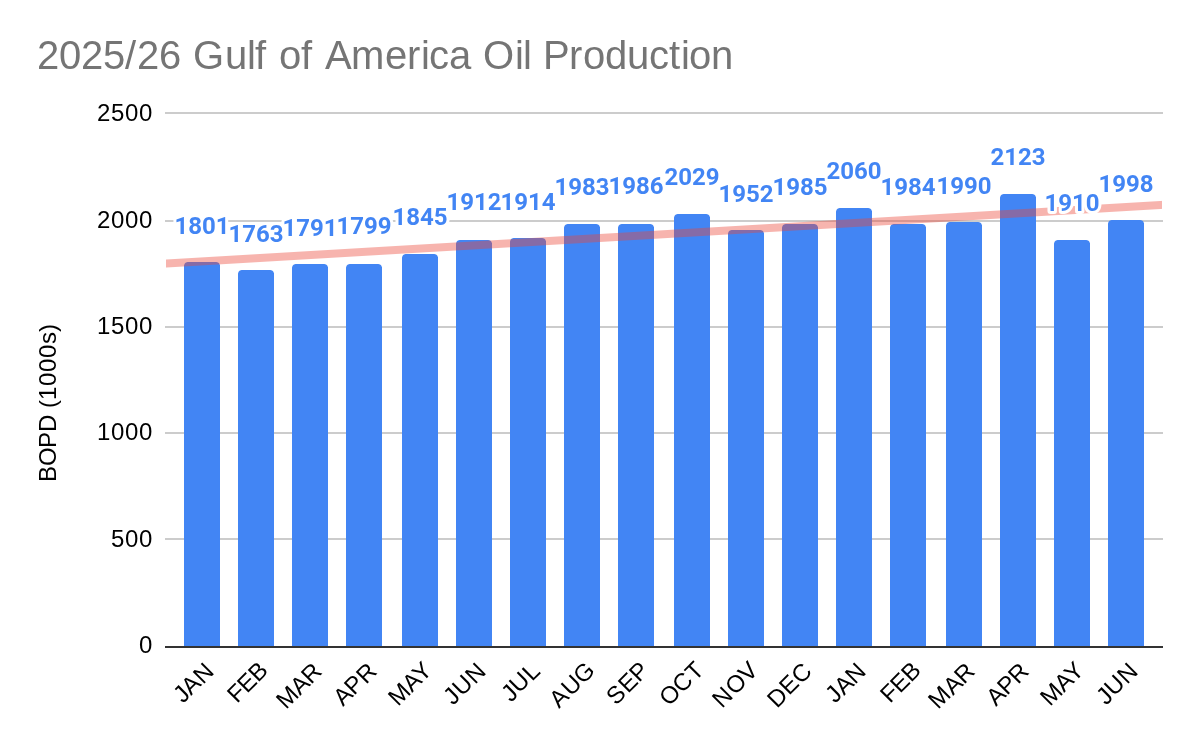
Update: Another EIA revision to Gulf of America oil production for Dec. 2025 (1.994 to 1.985 million bopd) means that 2019 retains the production record by the narrowest of margins – 1.898 to 1.897 million bopd. Stay tuned because this may not be the final word 😉.
Per EIA, Feb. 2026 production dipped a bit to 1.931 million bopd (chart below).
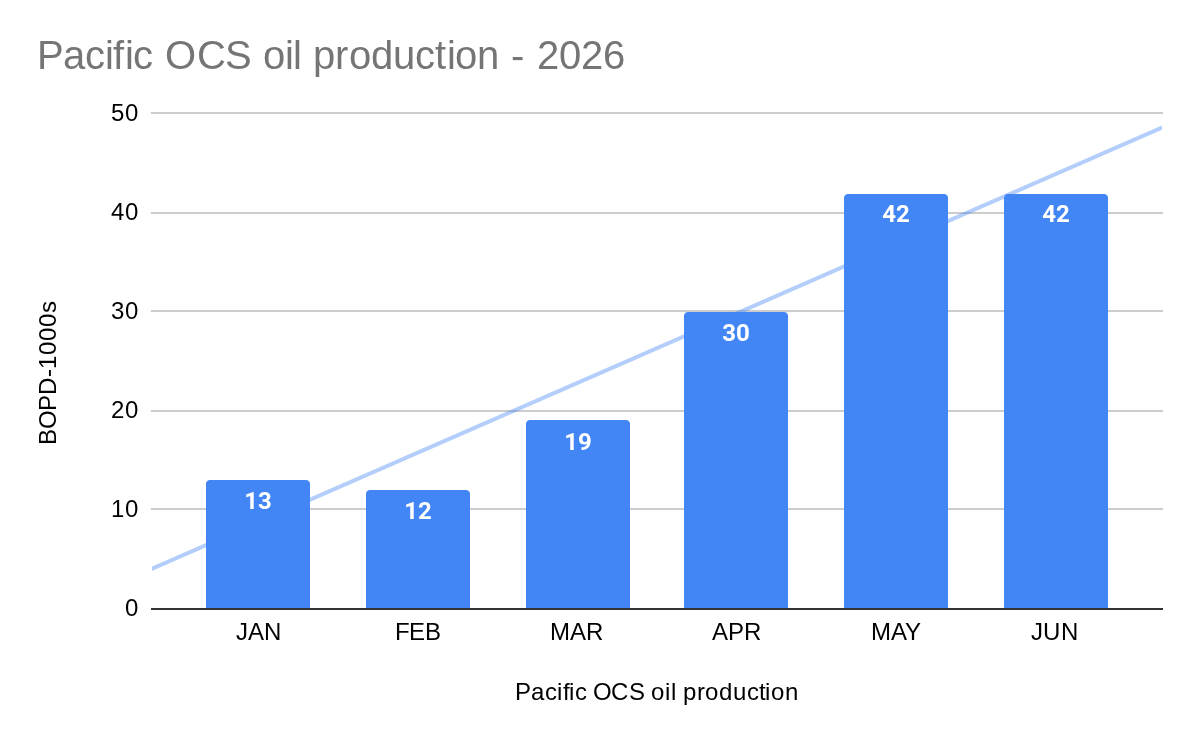
Meanwhile, California OCS oil production for FEB continued at about 10,000 bopd. This number may increase a bit for March, and more for April data when the first Sable sales are included. A big increase, by as much as 500%, should be apparent in the June report barring a court ordered shutdown.
Sable’s updated PowerPoint presentation is attached.
Also, the 2025 compensation package for Sable CEO Jim Flores is attracting attention. Flores received $76 million in total compensation. The bulk of his pay came from more than $69 million in stock awards, alongside a $1.3 million salary and a $3.9 million bonus.
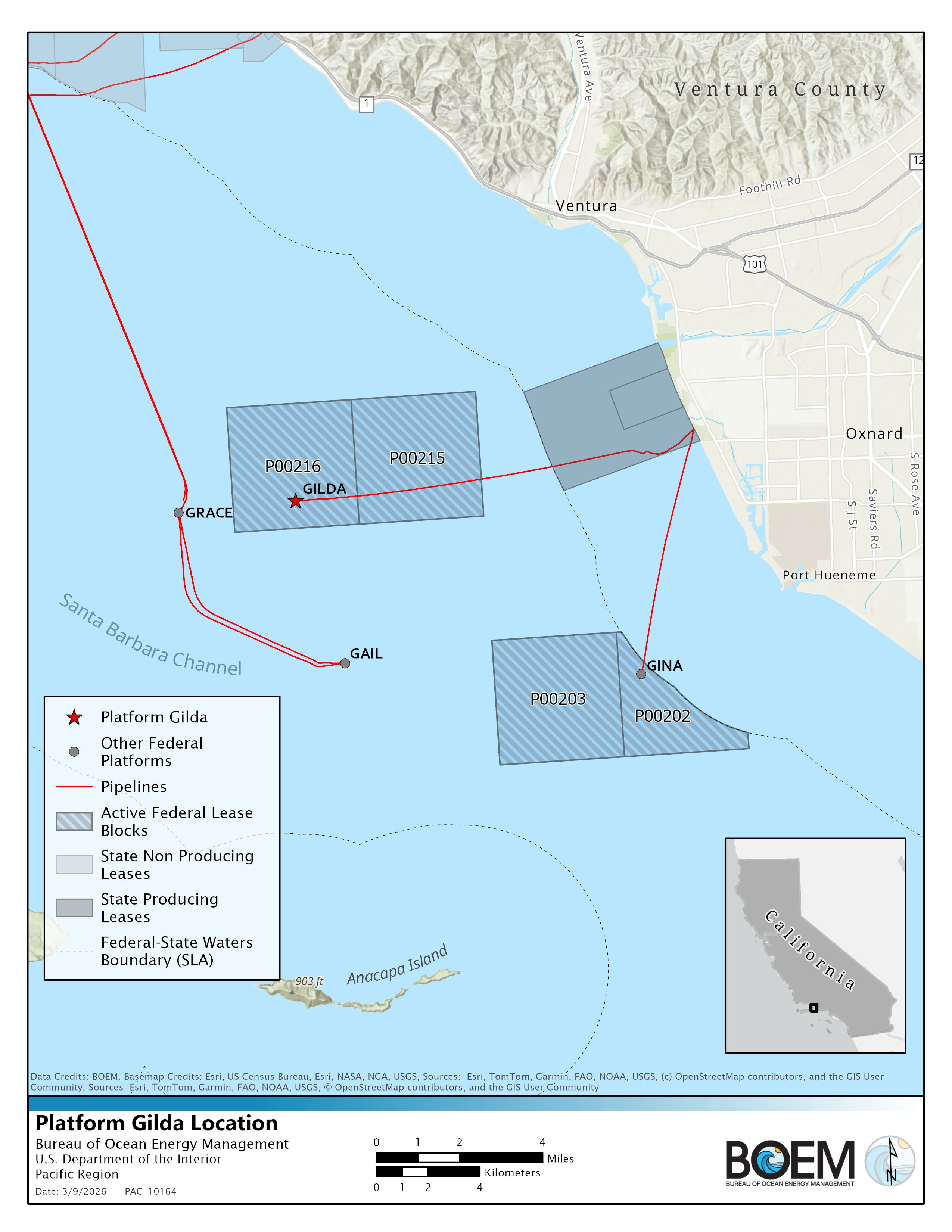
Looking up towards Platform Gilda from a depth of 100 feet, juvenile bocaccio rockfish swirl around the anemone-covered crossbeams (photo by Dr. Milton Love)
Dr. Jeremy Claisse, Cal Poly Pomona: “The oil and gas platforms off the coast of California are the most productive marine habitats per unit area in the world.”
Dr. Milt Love, UCSB: “Even the least productive platform was more productive than Chesapeake Bay or a coral reef in Moorea.”
John Smith has made the case for reefing California platforms. He is now proposing a change in the regulations that could facilitate such partial removals of offshore structures. His full proposal is attached.
As background John notes:
“In contrast to the Gulf of Mexico (GOM), where more than 600 decommissioned platforms have been converted to artificial reefs, the State of California does not have reefing legislation considered workable by industry, nor does it have an approved or State funded artificial reefing program which is a prerequisite under MMA (formerly BSEE and BOEM) OCS oil and gas regulations (30 CFR § 250.1730) for waiving platform removal requirements which allows conversion of the structure to an artificial reef.“
He further informs that “operators of the platforms have not expressed any serious interest in reefing OCS platform jackets because they consider the California Marine Resources Legacy Act unworkable in its present form due primarily to its liability provisions, inequitable 80% cost-savings sharing requirement, and the requirement for the first reefing applicant to fund the setup costs for the artificial reefing program.“
John’s proposal is intriguing because it allows qualified 3rd parties to accept title and liability for reefed structures. This would create interesting business opportunities. A company, consortium, nonprofit, or entrepreneur could, for a fee, acquire submerged structures and obtain insurance or other financial protection in accordance with their business plan. Reef preservation and enhancement studies, and other marine research could also be conducted at the sites. Marine ecosystems would be protected, and the cost and efficiency of decommissioning operations would be significantly improved.
“So, you disconnect the jacket… you kill all the fish. There’s an awful lot of animals that die,” said Dr. Love. As our world has become dependent on fossil fuels, so too have these millions of animals become dependent on the structures that pump them from beneath the sea floor. “As a biologist, I just give people the facts, but I have my own view as a citizen, which is I think it’s criminal to kill huge numbers of animals,” said Dr. Love.
(1) For the reasons set forth herein, the motion of real parties in interest Sable Offshore Corp. and Pacific Pipeline Company to dissolve or modify the preliminary injunction issued in this case is denied.
(2) The application of petitioners for issuance of an order to show cause why real parties should not be found in contempt and to enter additional orders is continued to May 22, 2026.
The Judge concluded:
The court is mindful that there are many moving judicial and administrative parts relating to the restart of the Las Flores Pipelines. (understatement of the year candidate? 😉)
Sable has not persuaded the court that the DPA (Defense Production Act) Order renders compliance with Federal Consent Decree unnecessary.
The Federal Consent Decree requires approvals from the OSFM (Office of the State Fire Marshal), which in turn must comply with state procedures in granting such approvals.
Sable has not met its burden to show that the preliminary injunction should be dissolved or modified. Sable’s motion will therefore be denied.
On May 22, Judge Geck will consider whether Sable should be held in contempt for not complying with the preliminary injunction.
If you haven’t been keeping up 😉:
Subsequent to Judge Geck’s preliminary injunction, the Pipeline and Hazardous Materials Safety Administration (PHMSA – a simpler agency name is long overdue!) asserted that the Las Flores Pipelines constitute an interstate pipeline subject to PHMSA’s exclusive jurisdiction.
PHMSA issued their own approvals and an emergency special permit.
The PHMSA approvals are the subject of proceedings in the Ninth Circuit Court of Appeals, which has not issued a final ruling.
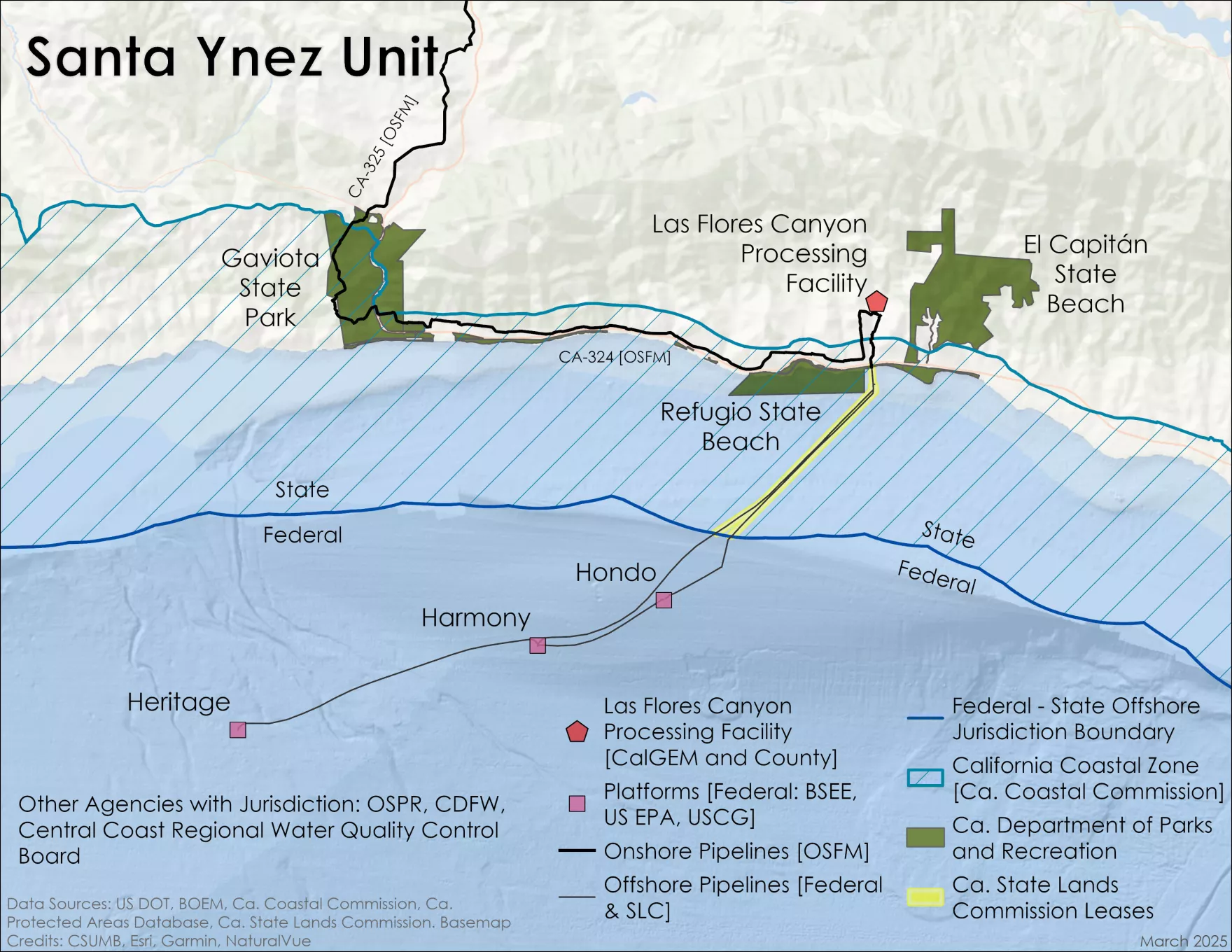
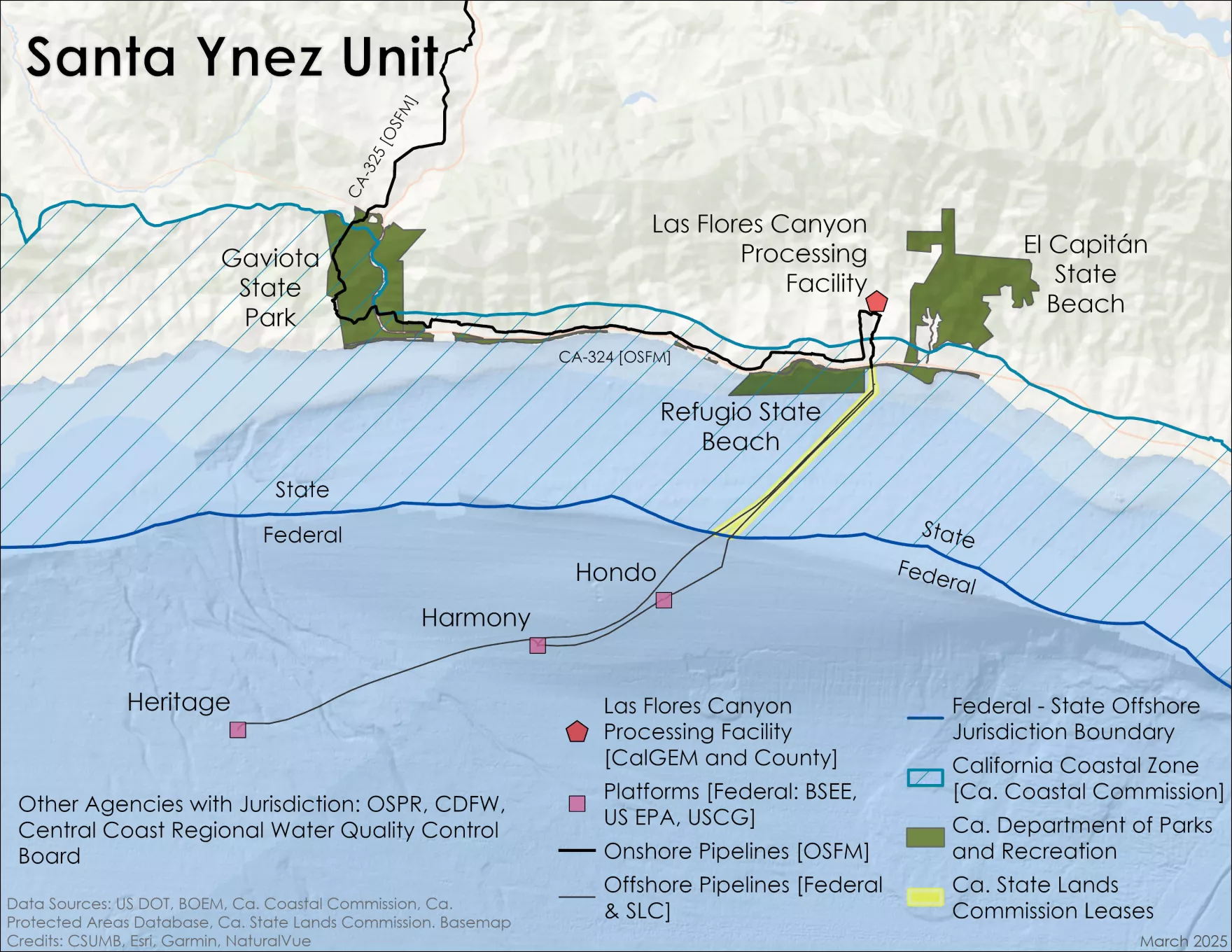
The 40 wells currently online at Platform Harmony and Platform Heritage are producing an average of 750 gross barrels of oil per day per well. Once all 74 production wells on these two platforms are online, Sable expects the average production per well to be approximately 700 gross barrels of oil per day.
Sable expects Platform Hondo to come online in June 2026 with an estimated fully ramped production rate of approximately 10,000 gross barrels of oil per day.
Hence, Sable production is estimated to reach ~60,000 bopd in June, which is about 6 times total California OCS production prior to the Sable restart!
The Case for Reefing California Platforms by John Smith
Environmental groups like the Environmental Defense Center and Get Oil Out continue to oppose converting the jackets of California oil and gas platforms to artificial reefs despite scientific studies (Claisse et al. 2014) showing “oil and gas platforms off the coast of California have the highest secondary fish production per unit area of seafloor of any marine habitat that has been studied.”
Another important factor environmental groups and the 2023 BOEM Programmatic EIS for Decommissioning failed to consider and acknowledge is the huge amount of air emissions that would be released by world-class heavy lift vessels like the Thialf or Balder Semi-submersible Crane Vessels (SSCVs) that would be required to safely and efficiently remove the large federal OCS platforms like Harvest, Hermosa, and Hidalgo (HHH). The HHH platforms are in waters depths ranging from 430-675 feet and have combined deck and jacket weights ranging from 20,000 – 25,000 tons. In comparison, the wrought iron structure of the Eiffel Tower weighs about 8,000 tons.
The SSCVs and accompanying Anchor Handling Tugs (AHTs) used to remove the HHH platforms will likely to be mobilized from distant locations like the North Sea or Gulf of America where they typically operate. Because SSCVs like the Thialf and Balder are too large to enter the Panama Canal, this would involve a 20,000 nautical mile roundtrip voyage around the tip of South America.
Three to four campaigns, and separate SSCV and AHT mobilizations and demobilizations, are projected to be required to fully remove the HHH platforms because the challenging oceanographic conditions offshore Point Arguello restrict heavy lift operations to a 150-day period between May and October.
Four campaigns by the SSCV and AHT would consume about 300,000 metric tons (mt) of marine diesel oil and release approximately 470,000 mt of CO2 and 11,000 mt of NOX emissions. To put these numbers into context, 470,000 mt of CO2 and 11,000 mt of NOX are:
the amount of CO2 emissions released by providing electrical power to 97,600 homes annually (the city of Santa Barbara has about 38,000 housing units).
the amount of CO2 emissions released by burning 1.1 million barrels of oil.
the amount of CO2 emissions released by 102,000 gasoline burning cars annually.
the amount of NOX emissions released by four large oil or coal-fired power plants annually.
the total annual NOX emissions in Santa Barbara County.
And this is only the emissions released during mobilization and demobilization of the SSCV and AHT. If full removal is required, an additional 50 days of operational time by the SSCV and AHT is estimated to be required to remove the topside and jacket of each HHH platform. This could be reduced to about 15 days per platform if the jackets are converted to artificial reefs. Only one SSCV and AHT campaign may be required if the HHH jackets are reefed, compared to the four campaigns required for the full removal scenario. This would result in a 75 percent reduction in CO2 and NOX emissions.
Background: By a 3-2 vote, the Santa Barbara County Planning Commission, acting under the direction of the Board of Supervisors (also by a 3-2 vote), passed ordinances to ban new onshore oil and gas wells and phase out old wells.
“We keep discovering new oil and new techniques to recover it,” said Commissioner John Parke. “The only thing to stop the oil industry and the production of oil is legislation.”
Comments:
The first sentence is perceptive, acknowledging that resources are not really finite given the ingenuity of engineers and geologists.
The second sentence is disturbing. The Commissioner believes he is legally and morally entitled to terminate an industry that has been present in Santa Barbara County for >130 years. He believes the Commission can do so by a slim majority and without compensation to those whose property rights are being abrogated.
The 2 Commissioners voting against euthanizing the County’s oil industry represent Districts 4 and 5 (maps below) where most of the wells are located. In essence, South County Santa Barbara is terminating an industry that is important to North County.
Pertinent to the County’s action is a suit filed by John and Melinda Morgan, who inherited the mineral rights to two parcels in the Cat Canyon Field (District 4). They argue that a similar provision in CA Senate Bill 1137 amounts to an unconstitutional taking of their property.
My comments on BOEM’s proposed revisions to decommissioning financial assurance requirements
Posted in California, decommissioning, energy policy, Gulf of Mexico, Offshore Energy - General, Regulation, tagged BOEM, comments, decommissioning, financial assurance, predecessor liability, proposed regulation, reserve estimates, safety and compliance on May 6, 2026| 1 Comment »
Attached are my comments on BOEM’s proposed revisions to the decommissioning financial assurance regulations. These comments were submitted to Regulations.gov yesterday (3 days early 😀). Bud
Concluding Remarks
Read Full Post »