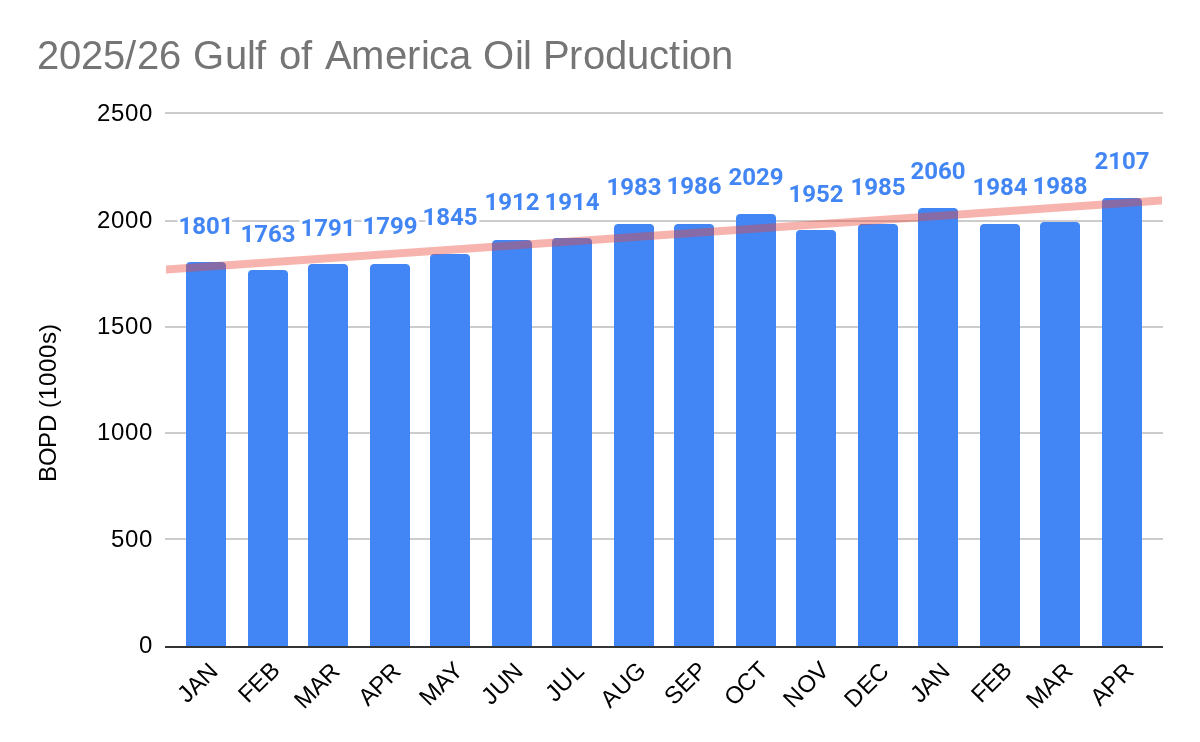
Per EIA, Gulf of America oil production declined in May by over 200,000 bopd from April’s record production, which was corrected upward by 2000 bopd. Was the April number anomalous? We’ll need additional monthly data and the audited ONRR numbers to get a better read.
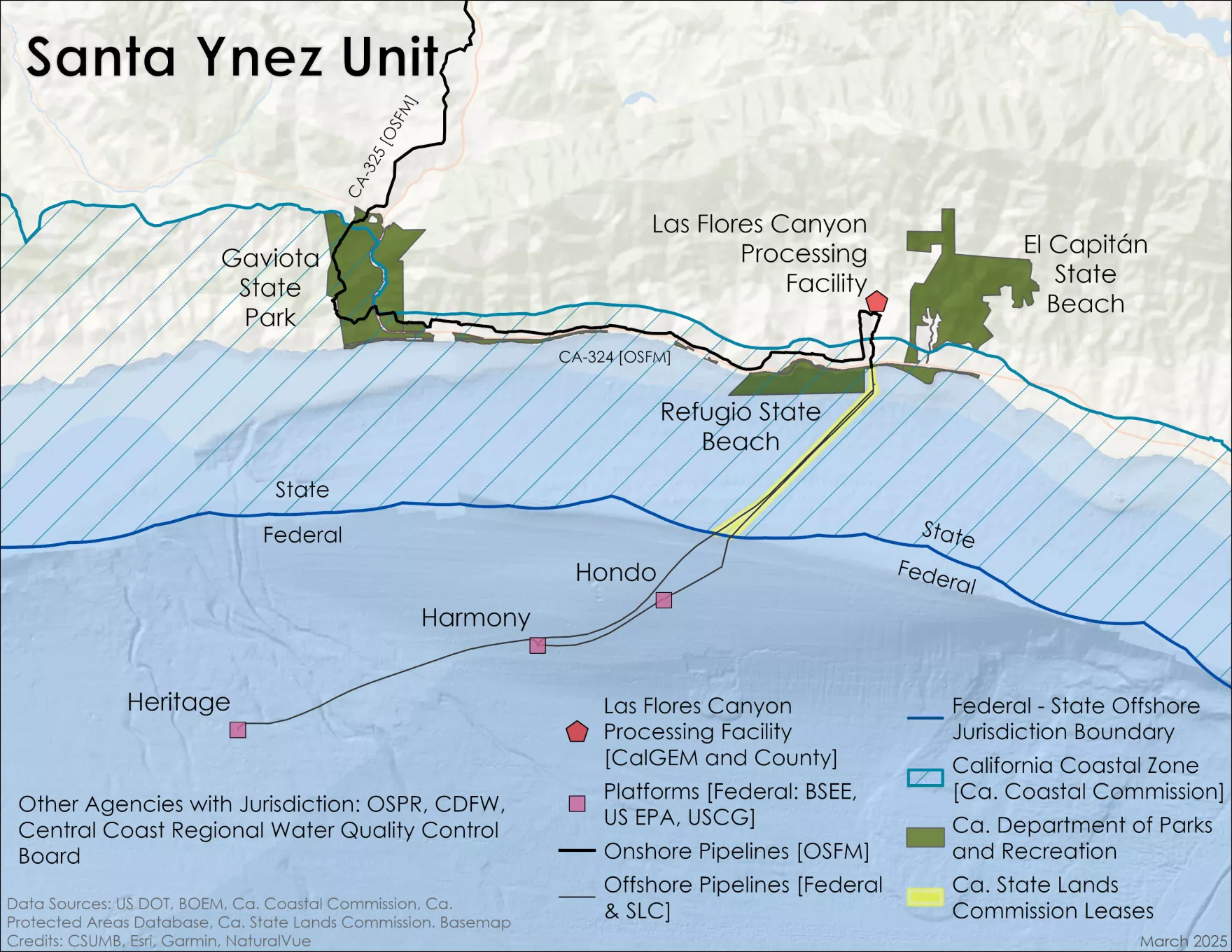
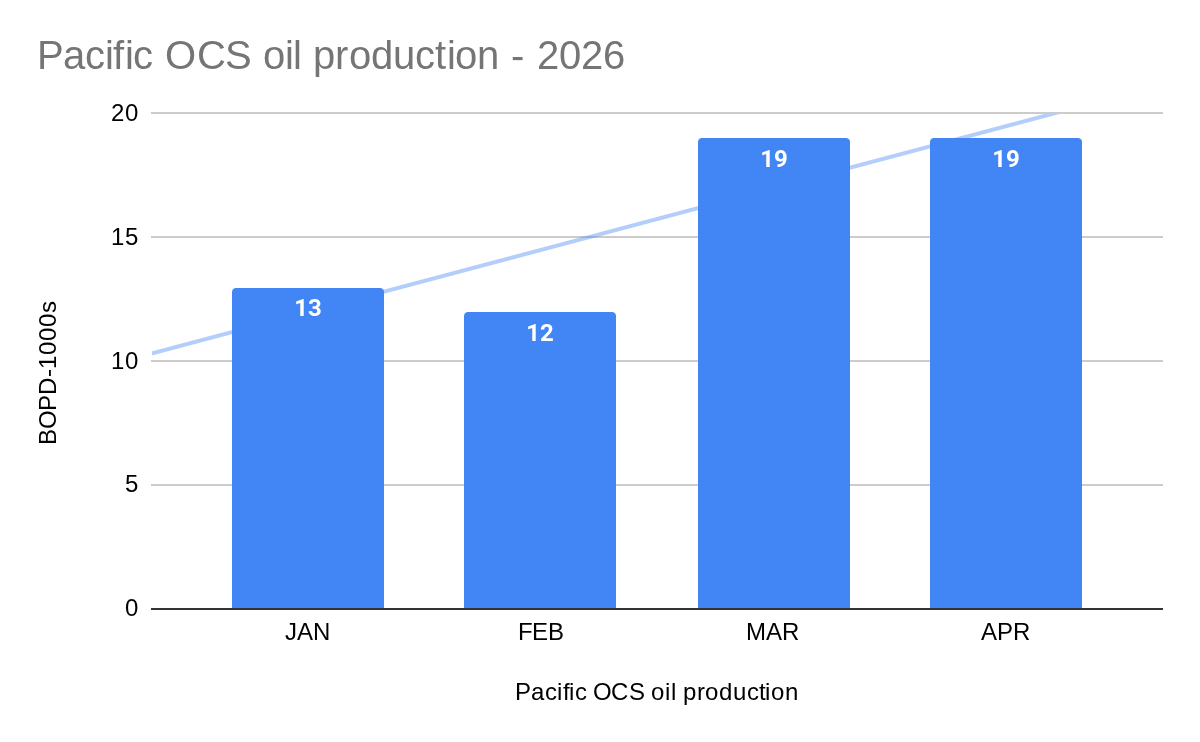
EIA posted corrected April and May totals of 30,000 bopd for the Pacific (California OCS), a 150% increase from February owing to the Sable Santa Ynez Unit restart. Although Pacific OCS production has been in the doldrums for years, the region has an impressive record of 202,000 bopd from Dec 1995.
A 7/28/2026 Dept. of Justice brief submitted to the Ninth Circuit Court of Appeals cites the 5/28/2026 Supreme Court decision in Flowers Foods Inc. v. Brock in asserting that Sable’s onshore pipeline segments are interstate and subject to Federal jurisdiction.
This filing is part of multi-faceted litigation involving Federal preemption, a 2020 Consent Decree, emergency special permits, and state environmental concerns. The Ninth Circuit is handling the expedited briefings and consolidation of petitions.
DoJ’s core argument is that Sable’s onshore segments do not interrupt the continuous “flow of commerce” from Outer Continental Shelf (OCS) offshore extraction → onshore processing → further transport to terminals (e.g., in Kern County). Thus, the system qualifies as interstate commerce subject to Federal (PHMSA) oversight rather than state regulation.
The Flowers Foods Inc. v. Brock case considered similar flow of commerce issues. The SCOTUS agreed with the Tenth Circuit that Brock delivery franchisees were engaged in interstate commerce even if they never cross State lines. The gist of the decision is as follows (emphasis added, full decision attached):
The Federal Arbitration Act (FAA) requires courts to enforce many private arbitration agreements, but it also provides that “nothing” in the law shall be used to compel arbitration in disputes involving the “contracts of employment” of any class of workers “engaged in . . . interstate commerce.” 9 U. S. C. §1. This case poses the question whether someone can qualify as a worker under the §1 exemption if he never crosses state lines and never interacts with vehicles that do. Flowers Foods, Inc., is a large producer of packaged baked goods with bakeries in 19 States. To get its products to market, the company depends in part on franchisees who buy the distribution rights to Flowers’s products in specific geographic territories. Angelo Brock is one such franchisee serving the Denver area; he picks up Flowers’s products from a warehouse in Colorado and delivers them to local stores, all without leaving the State. In 2022, Brock sued Flowers in federal district court alleging that the company had underpaid him and other distributors in violation of various federal and state laws. Flowers moved to compel arbitration, arguing that the FAA generally requires courts to stay or dismiss cases when the parties have agreed to resolve their disputes by arbitration and that Brock had signed a distribution agreement promising to arbitrate any disagreement. The district court denied Flowers’s motion, and the Tenth Circuit affirmed. Resting its decision on 9 U. S. C. §1, the Tenth Circuit reasoned that Brock belonged to a class of workers engaged in interstate commerce and thus the court lacked authority to compel arbitration.
We should soon find out what the Ninth Circuit thinks!
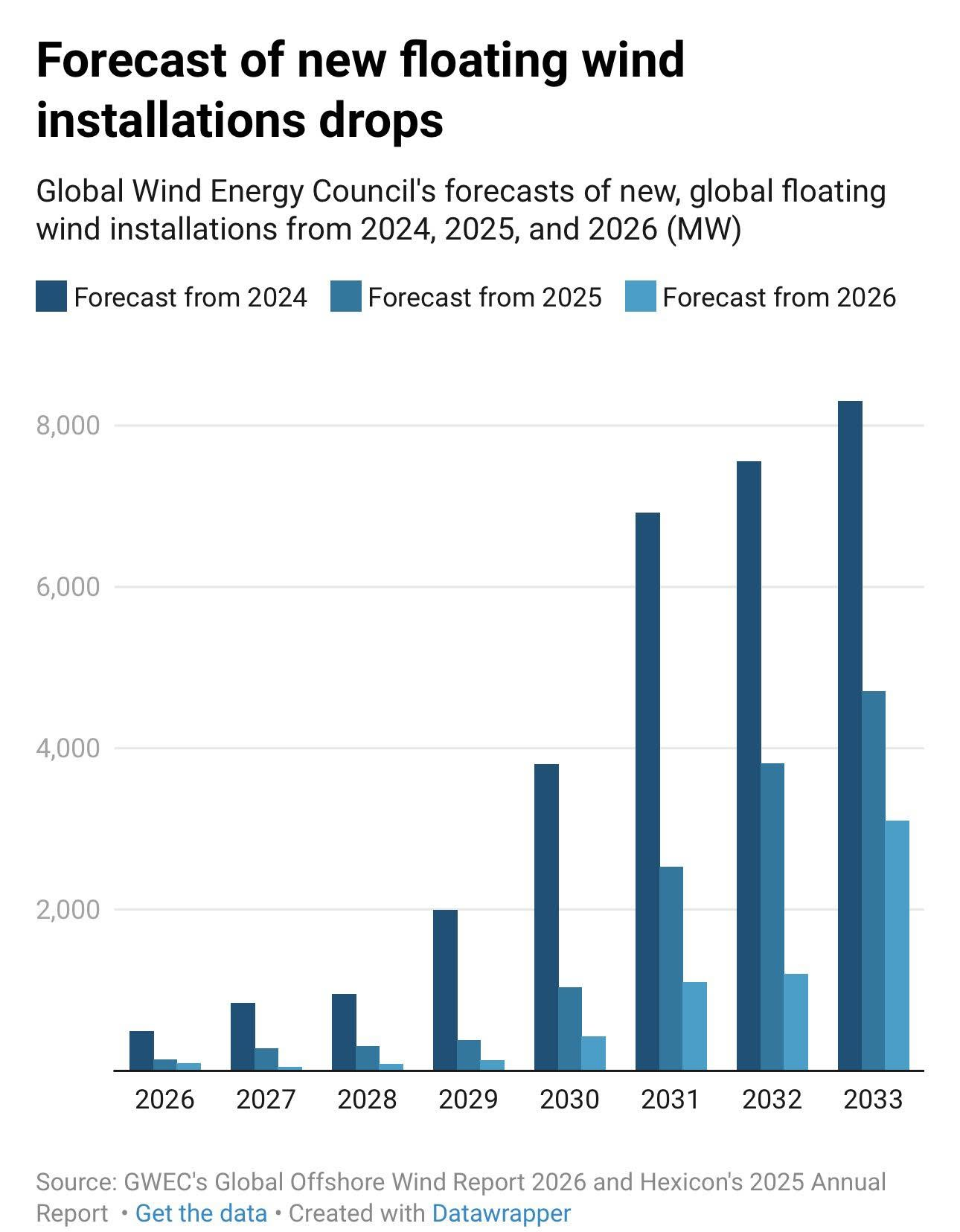
GWEC, the voice of the wind industry, continues to scale down estimates for floating turbines. In 2024, the GWEC expected 835MW of floating wind to be installed in 2027. Last year, this was lowered to 278MW, and expectations dropped further in the 2026 report to just 42MW. A similar trend applies to GWEC’s forecasts for the following years.
Despite strong support from the State, California’s offshore wind sector faces major challenges:
Deepwater technology: California offshore wind development is totally dependent on expensive and still unproven floating turbine technology. Norway, once a world leader in floating wind, has lost enthusiasm and is now requiring floating projects to be ‘quality-assured.’
Infrastructure: Major port upgrades, new transmission lines to bring power ashore, and specialized vessels are required. The supply chain is immature.
Costs: High capital costs plus storage costs (e.g. batteries) for reliability.
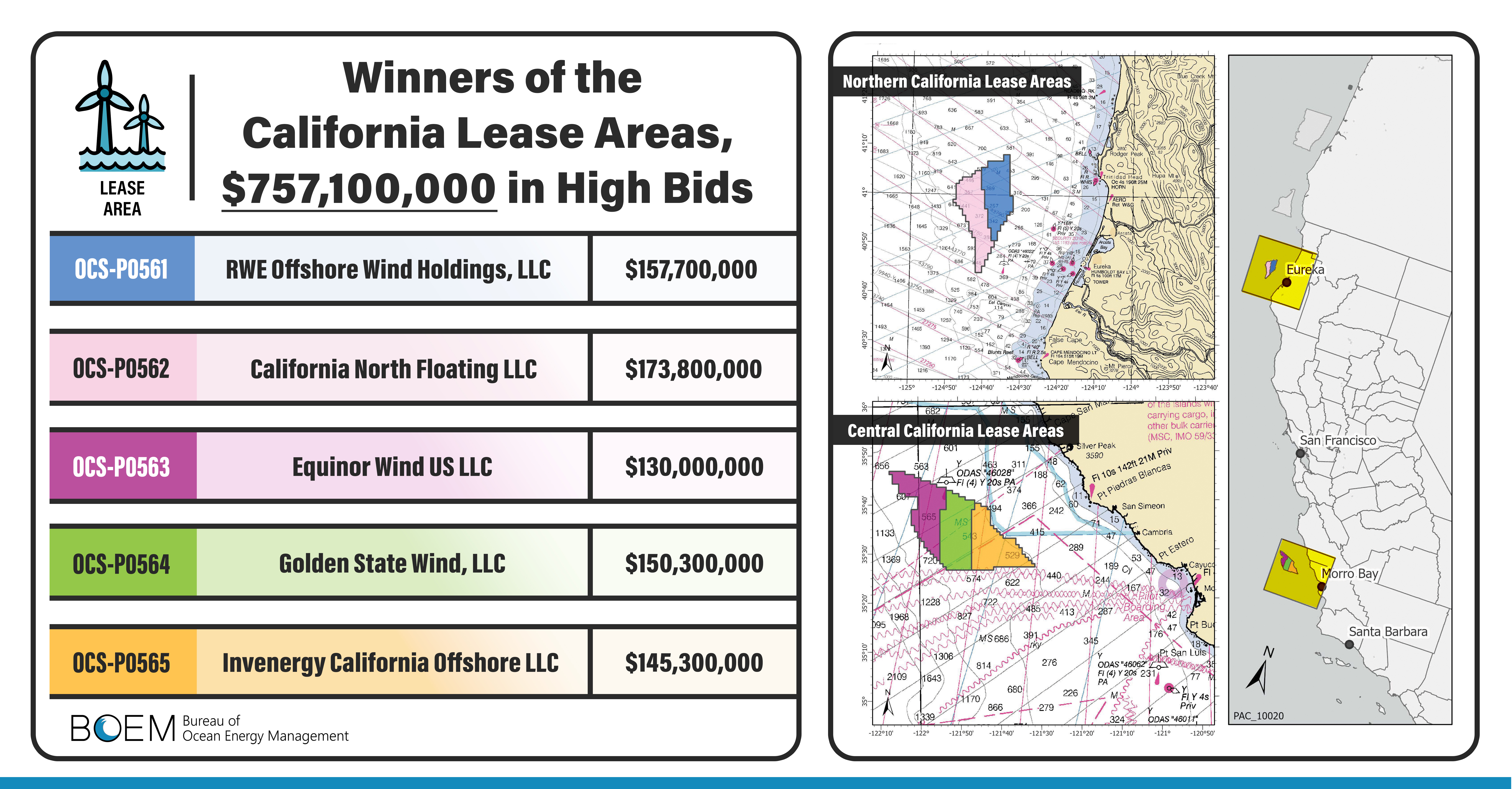
Two of the three Central Coast wind lessees (diagram below) have agreed to lease buyback deals. A lease cancellation letter is attached. The State is challenging the buyback agreements, and is thus in the difficult position of opposing deals that the wind developers voluntarily agreed to and believe are in their best interest. Does the State lose regardless of the outcome of their challenge?
The third Central Coast lessee, Equinor, is curtailing wind investments and has no plans to pursue new offshore wind projects in the US. A buyback deal with Equinor would be complicated by the company’s Empire Wind commitments, and is probably unnecessary given that Equinor has taken itself out of the game.
The two Northern California leases are still active, but the focus has been on regional planning. Funding for necessary infrastructure projects is uncertain and any wind lease development is far in the future.
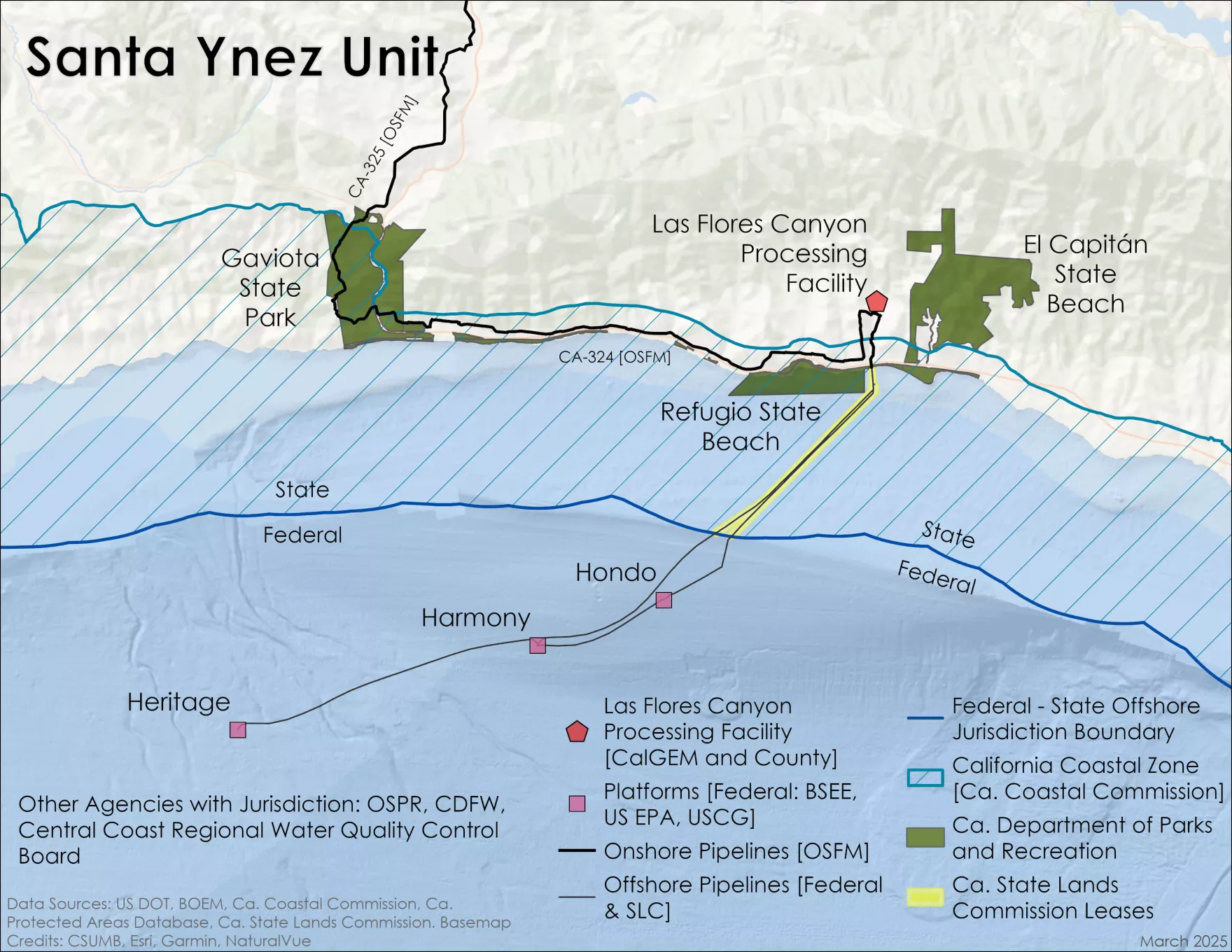
The National Defense Authorization Act (NDAA), as passed by the House this week, includes an amendment (attached) authorizing the Federal govt to acquire all lands along the Santa Ynez Pipeline System route. Wesley Hunt (TX), who introduced the amendment, comments in the short video below. The Senate has yet to approve the bill.
Assuming Sable’s attorneys are able to continue navigating through the legal minefield, the success of the project will depend on the performance of Sable’s well operations and production teams, and the extent to which they have the authority and confidence to curtail operations when deemed necessary to protect workers and the environment. In that regard, MMA engineers and inspectors have an important role in identifying risks and assuring that they are mitigated.
Excerpt from the amendment:
SEC. 28ll. ACQUISITION OF EASEMENTS FOR DEFENSE FUEL SUPPLY INFRASTRUCTURE. (a) AUTHORITY TO ACQUIRE.—The Secretary of Defense is authorized to acquire, by purchase, donation, exchange, or condemnation, on behalf of the United States, such permanent easements over all lands along the route of the Santa Ynez Pipeline System, including all lands owned or otherwise held by the State of California or any agency, department, or instrumentality thereof, as the Secretary of Defense determines necessary to ensure continuous pipeline transportation of crude oil from the Santa Ynez Unit to domestic refineries supplying Department of Defense installations in the State of California
The cessation of production at Platform Holly 10 years ago has contributed to the periodic surges in natural seepage that soil Santa Barbara area beaches (see the Instagram post above).
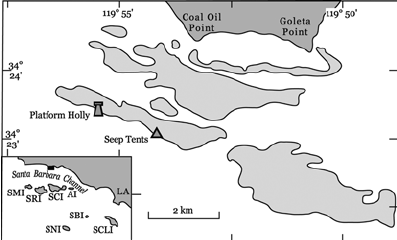
The correlation between production at Platform Holly, which lies just offshore from the Univ. of California at Santa Barbara (UCSB), and seepage in the Coal Oil Point area (map below) was apparent to those who worked at Holly. That association was confirmed by UCSB studies:
“Emeritus Professor James Boles collected and analyzed decades of data on methane seeping from the seafloor southeast of Platform Holly, just offshore from Isla Vista. He and colleagues Grant Garven at Tufts University and Chris Peltonen at Beacon West Energy Group determined that production of oil and natural gas from the platform reduced natural methane seepage into the waters of the Santa Barbara Channel, confirming earlier regional studies. The findings appear in the journal Marine and Petroleum Geology.“
This blog called Platform Holly a “net negative hydrocarbon polluter,“ because production from Holly reduced natural seepage and methane pollution from shallow formations beneath the Channel. Steel subsea pyramids (“tents”) installed by Arco in 1982 collected seafloor methane seepage, an added environmental benefit from the platform operations. As described in a 2014 presentation posted by the California State Lands Commission,“production at Platform Holly has resulted in significant improvement in local air quality.”
Further per UCSB:
After combing through 20 years of data, the authors found that production at Platform Holly significantly reduced the amount of methane seeping into the tents. For example, production from a well drilled 1 kilometer beneath the tents immediately reduced the natural seepage. In contrast, the seepage increased when production ceased from that well. “This indicates a direct link between the oil reservoir and the natural seepage in the area,” Boles noted.
Production at Holly ceased 10 years ago; the tents have been removed and the platform is being decommissioned. However, methane bubbles in the Channel and periodic beach tar will continue to remind us of Holly’s positive environmental legacy.
Map showing areas ( shaded ) of natural oil seeps offshore from Coal Oil Point near Santa Barbara, California. Inset map shows the Channel Islands ( I ) designated SM San Miguel, SR Santa Rosa, SC Santa Cruz, A Anacapa, SN San Nicholas, SB Santa Barbara, and SCL Santa Catalina. Seep fields were mapped between 1946 and 1973 (modified from Hornafius et al. 1999)
Federal Judge Dolly Gee, Central District of California
Sable Offshore and Exxon had alleged that Santa Barbara County’s refusal to transfer title and permits for Santa Ynez Unit facilities from Exxon to Sable amounted to an unconstitutional taking of their property rights. Judge Gee disagreed.
As colorfully put by Nick Welsh at the Santa Barbara Independent, Judge Gee told Sable and Exxon to “go pound sand” (not literally, but the judicial equivalent). The judge refused to even allow Sable to amend their filing. The judge will however allow Exxon to file an amended complaint, given that the company still has vested rights to the facilities and is still on the hook for the decommissioning costs.
As always with these Santa Ynez Unit matters, there is much more to come!
Per the preliminary EIA data for April, Gulf of America OCS facilities produced an average of 2.107 million bopd in April. This surpasses the previous record of 2.060 million bopd set in January.
Meanwhile, the Sable bump is now evident in the EIA’s Pacific OCS production data with a ~50% March-April increase from January-February. A bigger increase should be apparent when the May numbers are posted. How will Sable fare in the upcoming court battles?
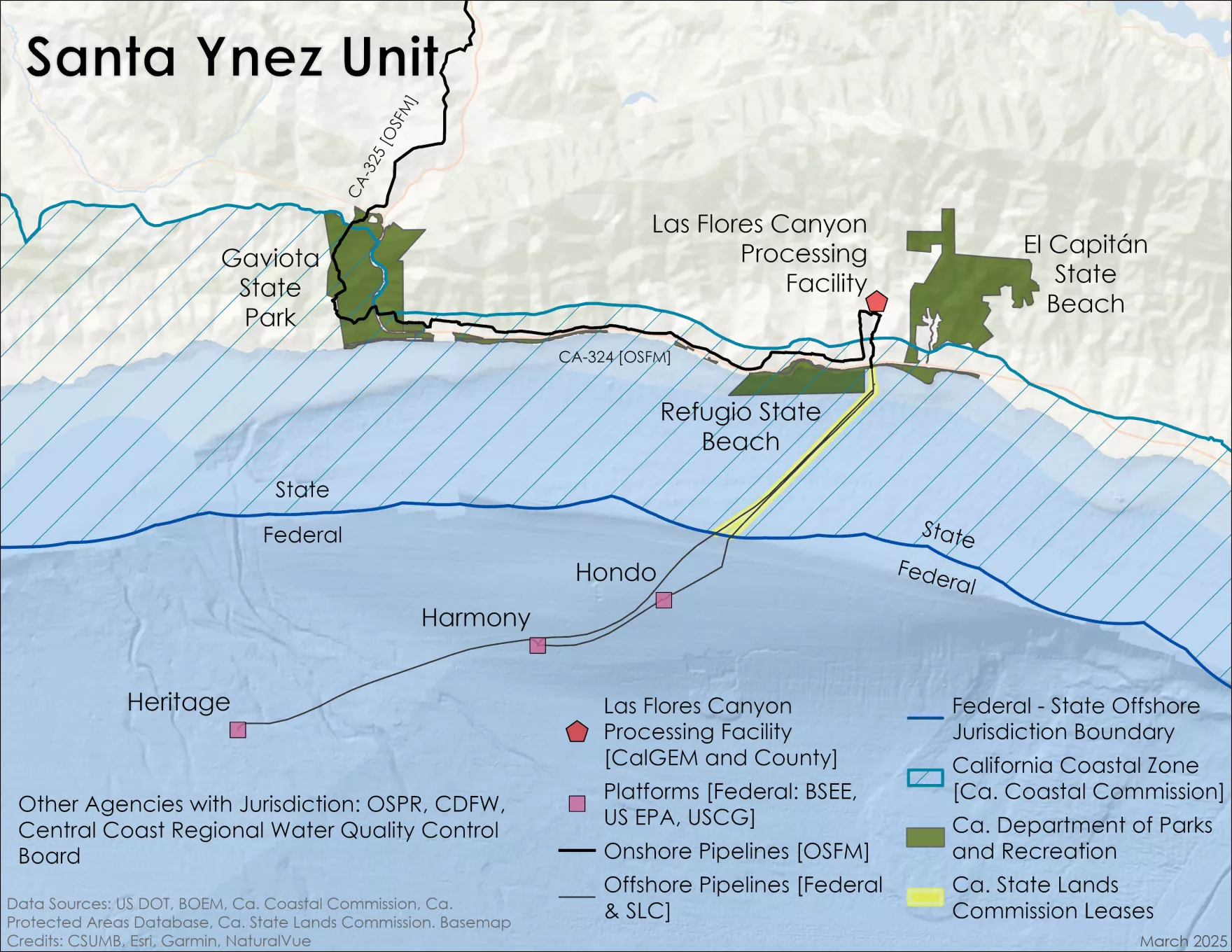
Sable Offshore began ramping up production at Platform Harmony last May delivering oil and gas to their Los Flores Canyon Processing Facility. In March, they resumed transportation to the Pentland pipeline segments and achieved first sales.
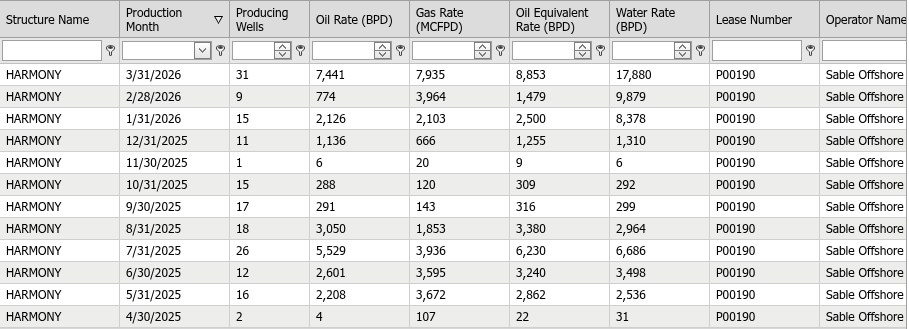
Below are BOEM production data for Harmony through March 2026. Harmony production was expected to increase to 22,000 bopd in May. Similarly, Sable forecasted Heritage production of 30,000 bopd for that month. The actual production numbers should be available in a month or two.
Nothing in the March production data for Harmony is particularly surprising. The gas-oil ratio (GOR) of ~1000 cu ft/bbl is rather typical for oil production in the region, as is the water cut, although less water production would be preferred. Produced water is not discharged from the platform, but is injected subsurface through disposal wells.
In the ongoing Santa Ynez Unit production restart saga, John Smith informs that a California Appellate Court ruled against Sable Offshore by a vote of 2-1, with a strong dissent from one of the three judges.
The decision (attached) affirms the California Coastal Commission’s regulatory authority over Sable’s Los Flores Canyon pipeline repairs, meaning that Sable could be ordered to cease operating the pipeline. However, this is just one element of a complex legal maze. An important case regarding PHMSA’s emergency special permit for the pipeline will be heard by the Federal 9th Circuit Court of Appeals in July.
The dissenting judge’s opinion beginning on p.15 of the attachment sets the stage for the upcoming arguments in the 9th Circuit. Excerpt:
“But first, a dose of reality. The repair work has been done. It is a “fait accompli.” And, pursuant to federal intervention, oil is now flowing in the pipeline without incident. The supremacy clause of the United States Constitution takes precedence. The federal Government trumped the state’s Commission “cease and desist” order and it trumps the preliminary injunction order. Based upon these events, the trial court should vacate the preliminary injunction, dismiss the matter as moot, and nullify the civil penalties.”
Meanwhile, the California Coastal Commission notified Sable Offshore that it intends to issue a cease and desist order aimed at shutting down crude oil extraction in the Santa Barbara Channel.
Sable responds:“Sable Offshore Corp. (“Sable”) through its subsidiary, Pacific Pipeline Company (“PPC”), continues to lawfully operate through its existing coastal development permits which were issued in 1986.”