Feeds:
Posts
Comments

Posts Tagged ‘PHMSA’

I asked two AI wizards if they could tell me the total number of lawsuits filed against Sable Offshore or the Federal govt regarding the restart and transport of production from the Santa Ynez Unit. One said the total fluctuates as new petitions are filed and consolidated. (Duh! 😉)

Grok gave it a good shot, qualifying the answer as appropriate:

“There is no single official or comprehensive public tally of every lawsuit ever filed on this topic. As of late September 2026, reporting describes roughly a dozen active/related lawsuits tied to the Santa Ynez Unit (SYU) pipelines and restart; many more have been filed overall (some resolved, consolidated, or mooted).” (Reasonable answer.)

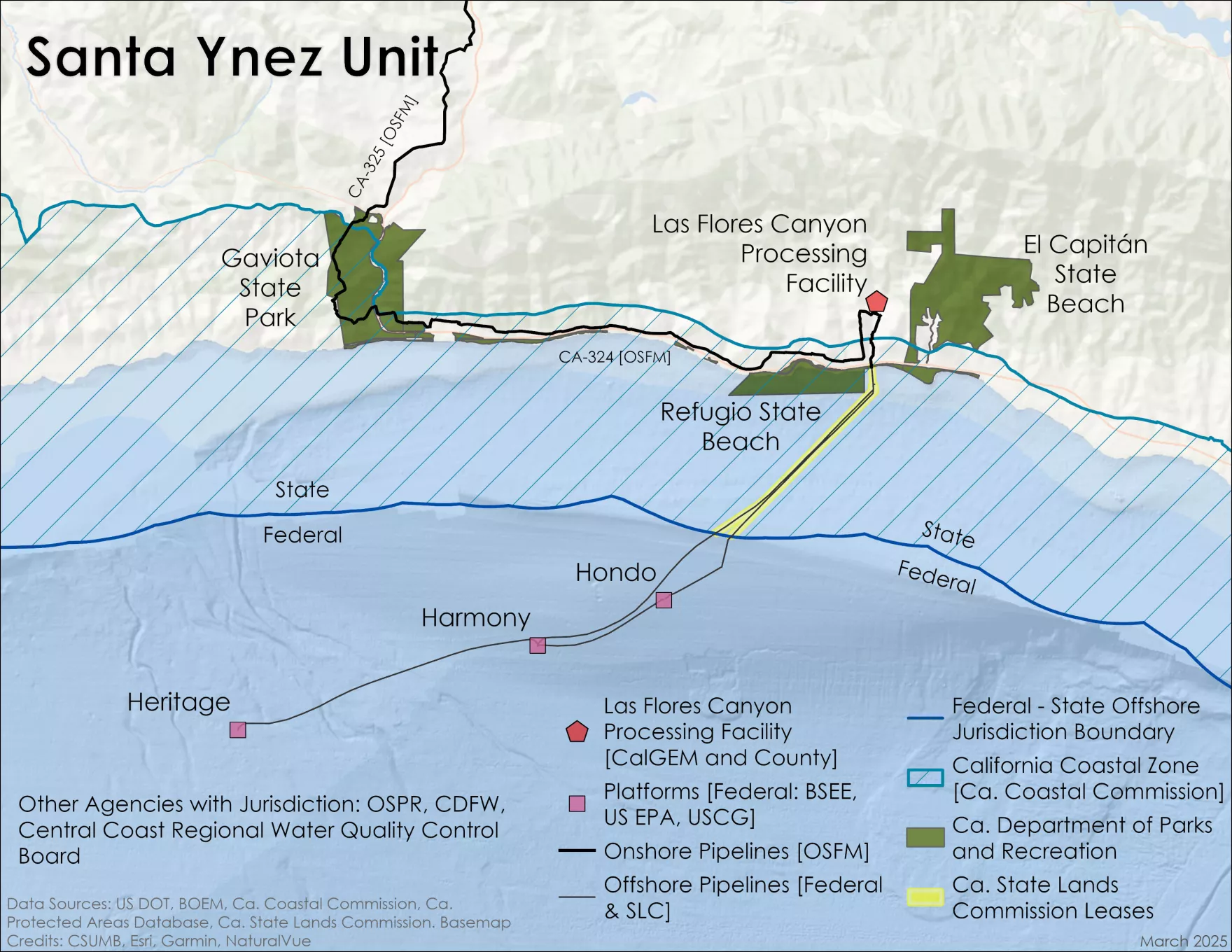
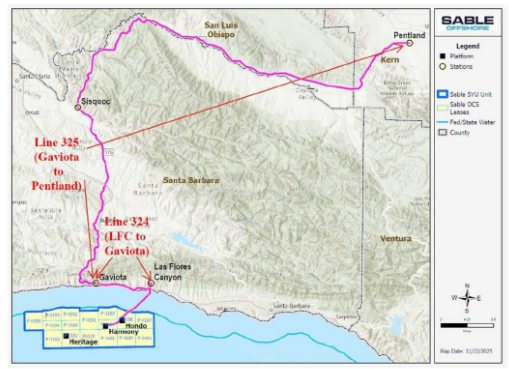
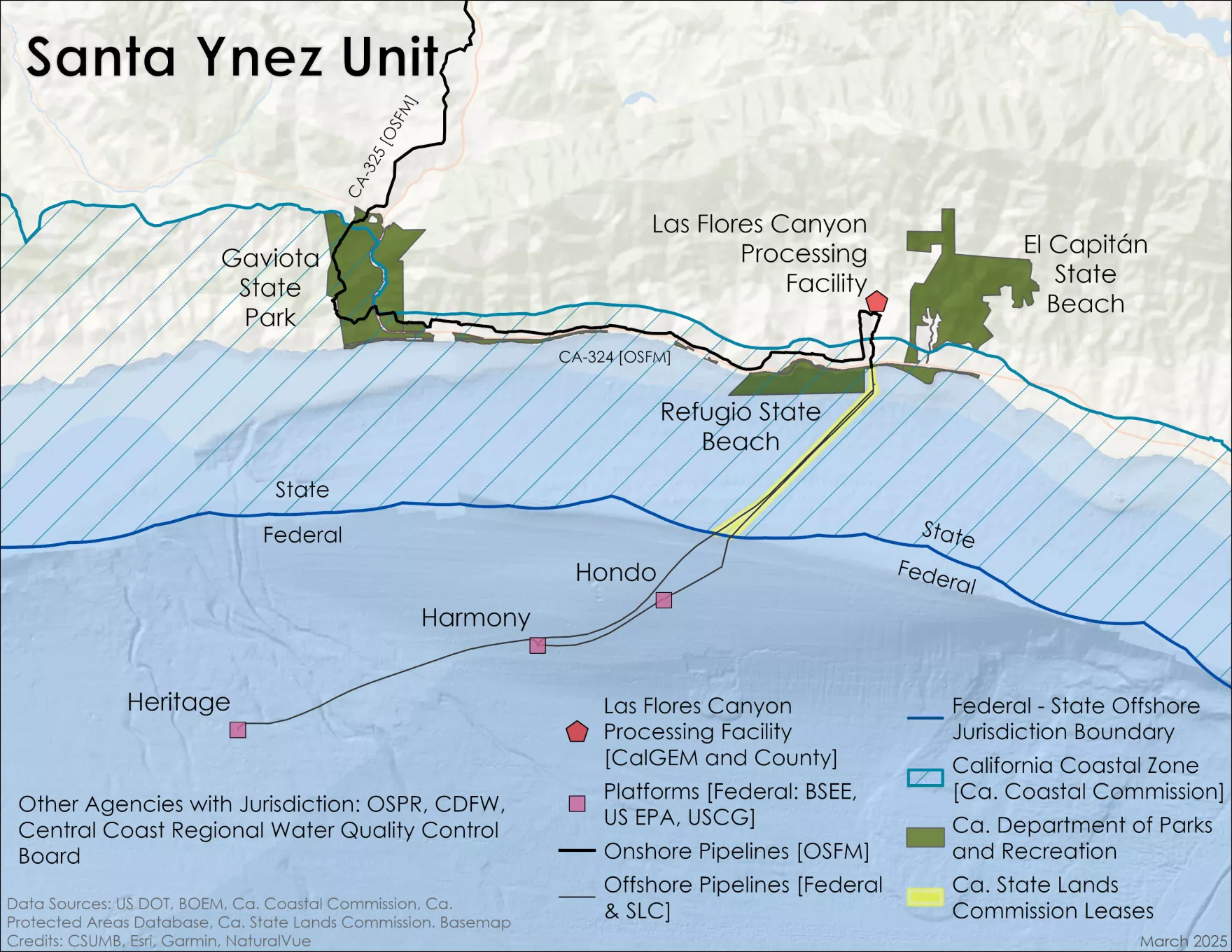
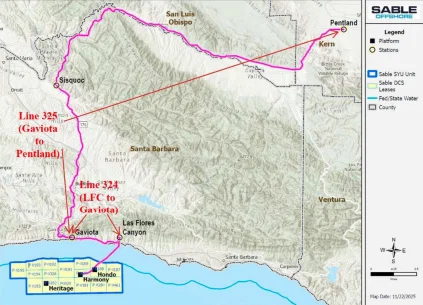
The most recent Court filing is by a group of NGOs challenging PHMSA’s June 25, 2026, order granting a “Special Permit” to Sable Offshore. The Special Permit, which is the subject of a number of lawsuits pertinent to the restart of Santa Ynez Unit production, applies to onshore pipeline segments CA-324 and CA-325. The pipeline originates at Las Flores Canyon in Santa Barbara County and terminates at Pentland Station in Kern County (map above).

In brief, the petitioners claim that the Special Permit and related documents were issued in excess of PHMSA’s statutory jurisdiction and authority and were issued unlawfully, and that PHMSA’s conclusions are arbitrary, capricious, and an abuse of discretion. Petitioners also challenge FWS’s concurrence with PHMSA’s determination that its order(s) will not likely adversely affect endangered species.

Here is a link to the complete Court filing, courtesy of Politico. For those who are following these matters, the PHMSA permit and related documents are included as exhibits. This compilation is helpful.
Read Full Post »

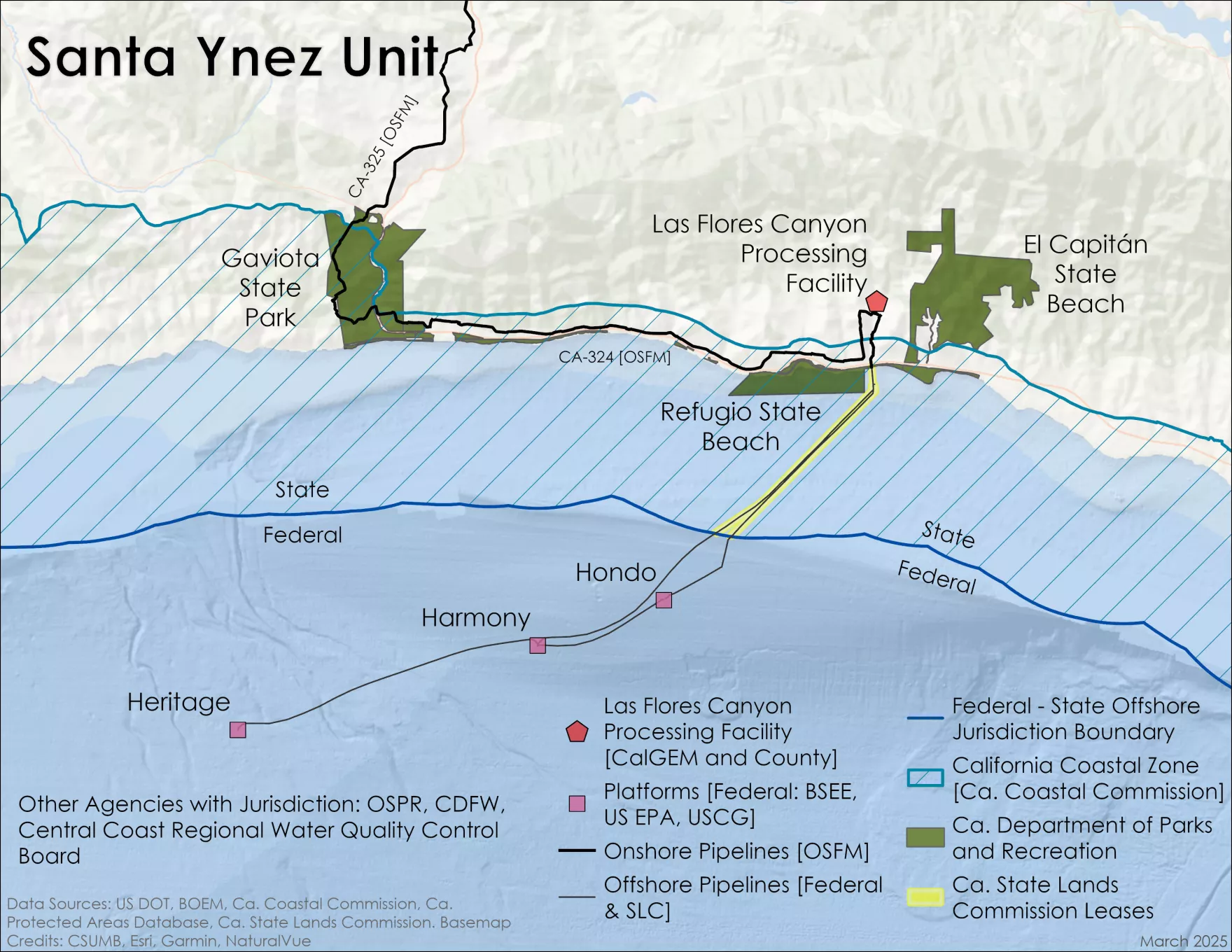
Inline inspections identified anomalies at multiple points in Segment 324 of Sable’s onshore pipeline. Sable is conducting validation digs.(Noozhawk image).

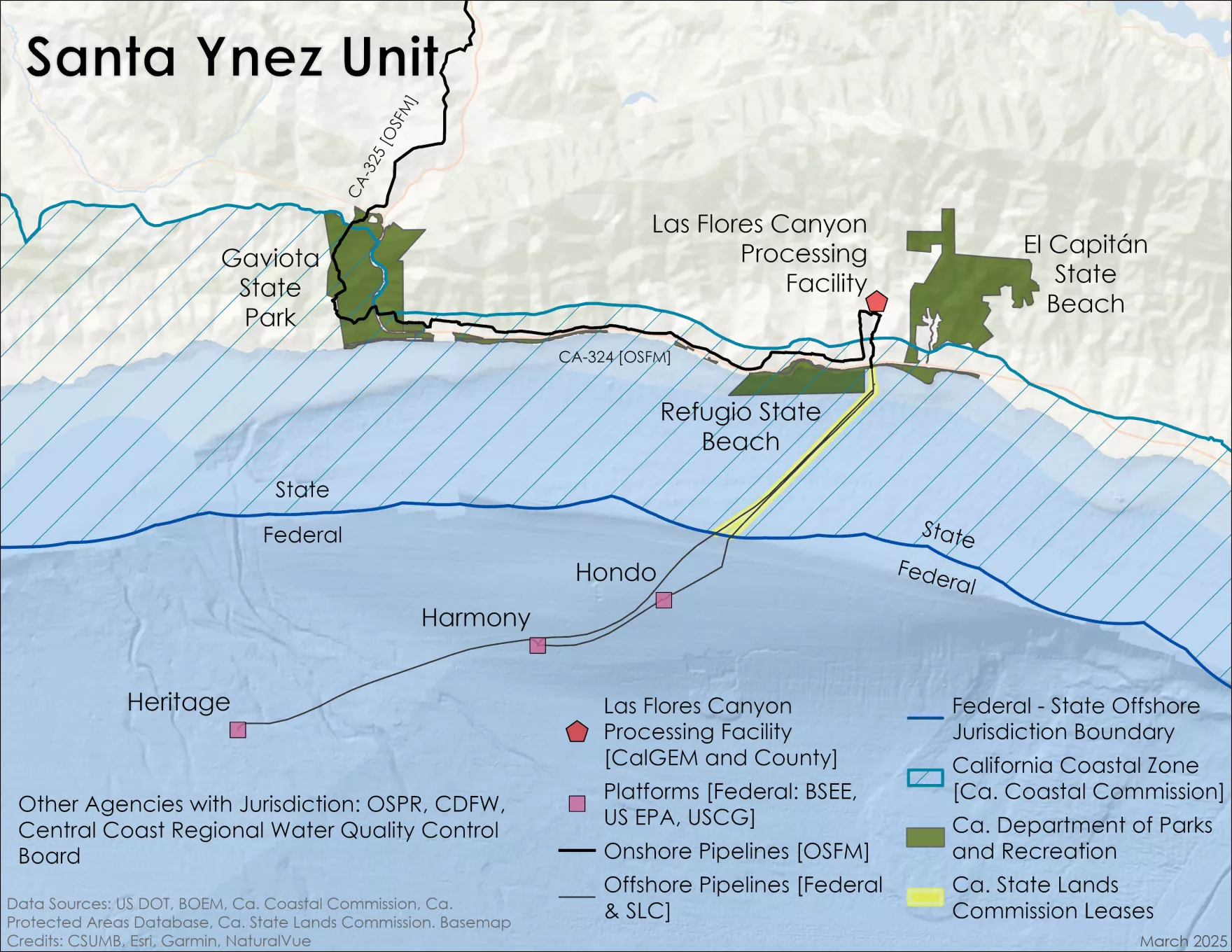
Sable Offshore has asked Santa Barbara County for approval to conduct exploratory digs to check anomalies at seven points along onshore Segment 324 of the Santa Ynez Unit pipeline system. This 10.86 mile segment runs from the Los Flores Canyon Processing Facility to the Gaviota Pump Station (map below).

According to the Emergency Special Permit issued by PHMSA, Sable is required to conduct in-line inspections (ILIs) with metal loss tools every 6 months for the first 2 years of operation.

Where metal loss is identified, immediate repair is required if the remaining strength of pipe shows a predicted failure pressure <1.39 times the maximum operating pressure (MOP).

Where direct field examinations indicate pipe wall loss of 40% or more, permanent repairs are required.

Comments:

Read Full Post »

Sable Offshore Corp. may use an emergency restart order from Energy Secretary Chris Wright as legal authority to continue transporting Santa Ynez Unit production through the onshore pipeline system.

Judge Stephen V. Wilson said the Defense Production Act (DPA) is a “significant statutory grant of authority to the executive, giving the President substantial discretionary power to compel private industry, allocate resources, and incentivize domestic production for national defense.”

The opinion also granted the Trump administration’s request to modify a federal consent decree entered in 2020 which governs the restart of the Las Flores pipeline system.

The order removes the California Office of the State Fire Marshal as the primary agency responsible for Sable’s compliance with the oil spill consent decree, and substitutes the Pipeline and Hazardous Materials Safety Administration.

Here is the 45 page decision.

Read Full Post »

In the ongoing Santa Ynez Unit production restart saga, John Smith informs that a California Appellate Court ruled against Sable Offshore by a vote of 2-1, with a strong dissent from one of the three judges.

The decision (attached) affirms the California Coastal Commission’s regulatory authority over Sable’s Los Flores Canyon pipeline repairs, meaning that Sable could be ordered to cease operating the pipeline. However, this is just one element of a complex legal maze. An important case regarding PHMSA’s emergency special permit for the pipeline will be heard by the Federal 9th Circuit Court of Appeals in July.

The dissenting judge’s opinion beginning on p.15 of the attachment sets the stage for the upcoming arguments in the 9th Circuit. Excerpt:

“But first, a dose of reality. The repair work has been done. It is a “fait accompli.” And, pursuant to federal intervention, oil is now flowing in the pipeline without incident. The supremacy clause of the United States Constitution takes precedence. The federal Government trumped the state’s Commission “cease and desist” order and it trumps the preliminary injunction order. Based upon these events, the trial court should vacate the preliminary injunction, dismiss the matter as moot, and nullify the civil penalties.”

Read Full Post »

California Superior Court Judge Donna Geck denies Sable’s motion to lift the preliminary injunction.

Judge Geck’s ruling

(1) For the reasons set forth herein, the motion of real parties in interest Sable Offshore Corp. and Pacific Pipeline Company to dissolve or modify the preliminary injunction issued in this case is denied.

(2) The application of petitioners for issuance of an order to show cause why real parties should not be found in contempt and to enter additional orders is continued to May 22, 2026.

 The Judge concluded:

  • The court is mindful that there are many moving judicial and administrative parts relating to the restart of the Las Flores Pipelines. (understatement of the year candidate? 😉)
  • Sable has not persuaded the court that the DPA (Defense Production Act) Order renders compliance with Federal Consent Decree unnecessary.
  • The Federal Consent Decree requires approvals from the OSFM (Office of the State Fire Marshal), which in turn must comply with state procedures in granting such approvals.
  • Sable has not met its burden to show that the preliminary injunction should be dissolved or modified. Sable’s motion will therefore be denied.

On May 22, Judge Geck will consider whether Sable should be held in contempt for not complying with the preliminary injunction.

If you haven’t been keeping up 😉:

  • Subsequent to Judge Geck’s preliminary injunction, the Pipeline and Hazardous Materials Safety Administration (PHMSA – a simpler agency name is long overdue!) asserted that the Las Flores Pipelines constitute an interstate pipeline subject to PHMSA’s exclusive jurisdiction.
  • PHMSA issued their own approvals and an emergency special permit.
  • The PHMSA approvals are the subject of proceedings in the Ninth Circuit Court of Appeals, which has not issued a final ruling.

Undaunted, Sable reports (4/20/2026):

  • The 40 wells currently online at Platform Harmony and Platform Heritage are producing an average of 750 gross barrels of oil per day per well. Once all 74 production wells on these two platforms are online, Sable expects the average production per well to be approximately 700 gross barrels of oil per day.
  • Sable expects Platform Hondo to come online in June 2026 with an estimated fully ramped production rate of approximately 10,000 gross barrels of oil per day.

Hence, Sable production is estimated to reach ~60,000 bopd in June, which is about 6 times total California OCS production prior to the Sable restart!

Read Full Post »

I’m attaching the complete comment letters from Sable Offshore and their main antagonist, California Attorney General Bonta, in response to PHMSA’s public notice and request for comments on Sable’s special permit application.

Summary of the California AG’s assertions:

“First, PHMSA is without authority to grant such a special permit because Lines CA-324/325 are intrastate pipelines and California regulators have sole regulatory oversight over any attempt to restart these Lines and issue state waivers. Second, California has vested interests in ensuring Lines CA-324/325 operate safely and PHMSA’s proposed special permit would dilute the higher state safety standards that were imposed on Sable and therefore it is inconsistent with pipeline safety. 49 C.F.R. § 190.341(d). Third, given the fact Line CA-324 already failed and caused a catastrophic oil spill in 2015 in Santa Barbara County, even if PHMSA had authority to issue a special permit (which it does not), a more robust environmental analysis needs to be performed. Fourth, PHMSA unlawfully invokes the Endangered Species Acts’s emergency consultation procedures and has given no indication that it will consult with the National Marine Fisheries Service, in violation of the Act. Finally, Secretary Wright’s March 13, 2026, order (“DPA
Order”) does not change anything about the propriety of the Application, because the DPA Order itself is unlawful.”

Summary of Sable’s position (screenshot):

You can sample the other public comments, some of which are quite good, by visiting the Regulations.gov docket.

Read Full Post »

Attached is an opinion prepared by the Assistant Attorney General, Office of Legal Counsel, for the General Counsel, Dept. of Energy. This opinion may boost prospects for Santa Ynez Unit (SYU) production, either by Sable Offshore or a successor.

BOE SYU watchers see this State-Federal battle ultimately ending up in the Supreme Court, perhaps following the 9th Circuit’s ruling on PHMSA’s preemption of State authority over the onshore pipeline segments.

A few key excerpts from the DOJ opinion (emphasis added):

p. 1: You have asked whether an order issued under the Defense Production Act of 1950 (“DPA” or “Act”), Pub. L. No. 81-774, 64 Stat. 798 (codified as amended at 50 U.S.C. § 4501 et seq.), to Sable by the President or his delegee would preempt the California laws currently impeding Sable from resuming production and operating the associated pipeline infrastructure. We conclude that it would.

p. 6: As the Supreme Court has explained, executive orders “may create rights protected against inconsistent state laws through the Supremacy Clause,” especially when such orders are issued pursuant to “congressional authorization.”

p. 20: State law, we have been advised, is not currently the only impediment to Sable’s ability to resume production and transportation of oil. A consent decree entered in United States v. Plains All American Pipeline L.P., No. 20-cv-02415 (C.D. Cal. Oct. 14, 2020), Dkt. 33 (“Consent Decree”), “currently vests authority over resumption of transportation through the onshore portions of the Santa Ynez Pipeline System with the California Office of the State Fire Marshal.” Sable Letter at 9. We have been advised that, in addition to the United States and various State of California entities, Sable is a party to the Consent decree as a result of an acquisition. You have asked whether an executive order under the DPA would displace these provisions of the Consent Decree, even though there are both federal- and state-law claims at issue in that case. For three reasons, we think it would.

Read Full Post »

John Smith has shared the Environmental Assessment (attached) associated with PHMSA’s Special Permit for segments 324 and 325 of Sable’s Santa Ynez Unit (SYU) pipeline system. The document is an interesting read for those following Sable’s attempt to restart production from the SYU.

Read Full Post »

PHMSA’s public notice (attached) is required because Sable’s Emergency Special Permit expired on 21 FEB. Comments are due by 26 MAR. More background.

“PHMSA is publishing this notice to solicit public comments on a request for a special permit submitted by Sable Offshore Corp. (Sable). Sable is seeking relief from compliance with certain requirements in the Federal pipeline safety regulations. PHMSA has proposed conditions to ensure that the special permit is not inconsistent with pipeline safety. At the conclusion of the 30-day comment period, PHMSA will review the comments received from this notice as part of its evaluation to grant or deny the special permit request.“

Read Full Post »

As posted on 9/10/2025 (prior to PHMSA’s assertion of jurisdiction): Given that the Sable pipeline will carry OCS production, it would seem to fundamentally be an interstate line (Federal jurisdiction), as it was when owned by Plains. Could DOT reverse the 2016 letter agreement? That is conjecture for the attorneys and courts to consider.

A new Bloomberg Law article explains PHMSA’s position after a challenge by the California AG:

PHMSA said state-based hurdles are preempted by federal authorizations in the emergency permit notice letter the agency sent to Sable last year. Because the pipeline originates on the Outer Continental Shelf, the system automatically comes under federal oversight, the agency said.

A law professor adds the following:

The administration is invoking interstate commerce to classify the pipeline as a federal issue, “arguing that this is between a place in a state and outside that state,” said Hannah Wiseman, a professor at the Penn State Dickinson Law.

They are claiming this under their interpretational authority, as opposed to the actual language of the Pipeline Safety Act,” she said.

The language of the law only assigns PHMSA jurisdiction over oil operations that run outside or between state lines, but here the agency is arguing the pipeline’s start point is on the OCS, not at the onshore processing facility, she said.

Not mentioned in the article but pertinent:

  • In PHMSA’s favor, the onshore pipeline was initially under their jurisdiction.
  • In California’s favor, a court approved Consent Decree clearly identifies the California Fire Marshal as the sole oversight authority.

Meanwhile, Kruti Shah cleverly summarizes the Santa Ynez Unit story in a series of posts on X. Click on the post below to get the full thread. Great read for Sable/SYU followers:

Read Full Post »

Older Posts »