Judge Stephen V. Wilson said the Defense Production Act (DPA) is a “significant statutory grant of authority to the executive, giving the President substantial discretionary power to compel private industry, allocate resources, and incentivize domestic production for national defense.”
The opinion also granted the Trump administration’s request to modify a federal consent decree entered in 2020 which governs the restart of the Las Flores pipeline system.
The order removes the California Office of the State Fire Marshal as the primary agency responsible for Sable’s compliance with the oil spill consent decree, and substitutes the Pipeline and Hazardous Materials Safety Administration.
(1) For the reasons set forth herein, the motion of real parties in interest Sable Offshore Corp. and Pacific Pipeline Company to dissolve or modify the preliminary injunction issued in this case is denied.
(2) The application of petitioners for issuance of an order to show cause why real parties should not be found in contempt and to enter additional orders is continued to May 22, 2026.
The Judge concluded:
The court is mindful that there are many moving judicial and administrative parts relating to the restart of the Las Flores Pipelines. (understatement of the year candidate? 😉)
Sable has not persuaded the court that the DPA (Defense Production Act) Order renders compliance with Federal Consent Decree unnecessary.
The Federal Consent Decree requires approvals from the OSFM (Office of the State Fire Marshal), which in turn must comply with state procedures in granting such approvals.
Sable has not met its burden to show that the preliminary injunction should be dissolved or modified. Sable’s motion will therefore be denied.
On May 22, Judge Geck will consider whether Sable should be held in contempt for not complying with the preliminary injunction.
If you haven’t been keeping up 😉:
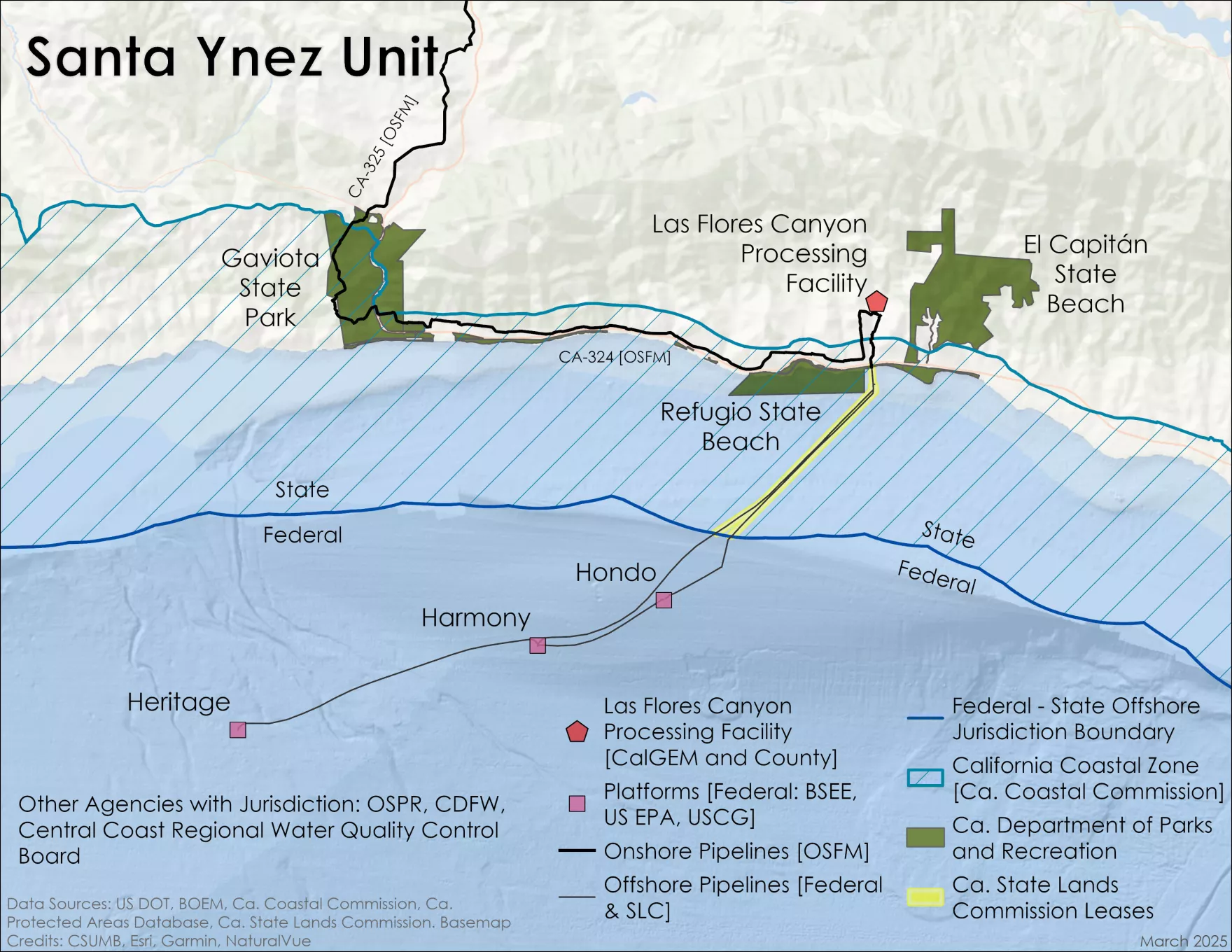
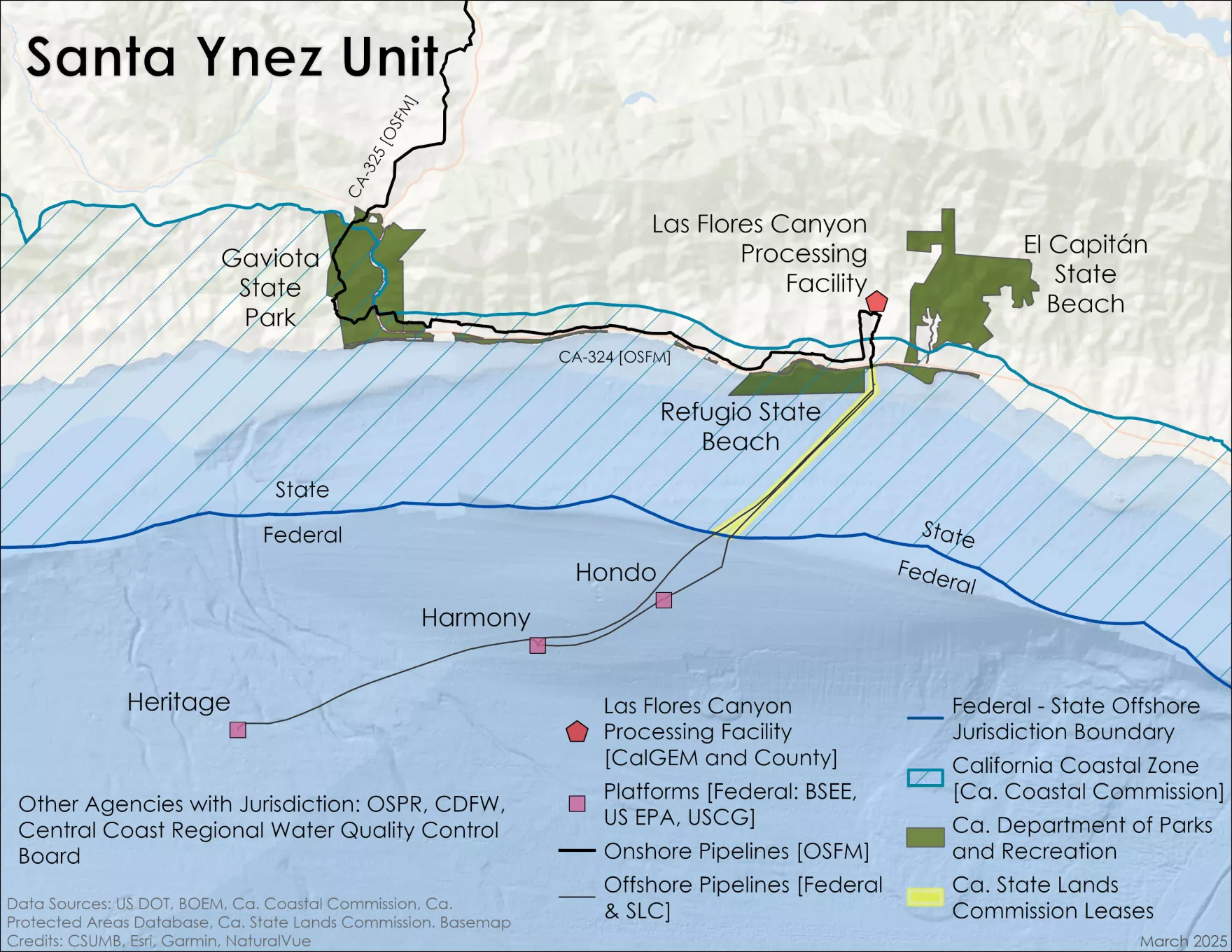
Subsequent to Judge Geck’s preliminary injunction, the Pipeline and Hazardous Materials Safety Administration (PHMSA – a simpler agency name is long overdue!) asserted that the Las Flores Pipelines constitute an interstate pipeline subject to PHMSA’s exclusive jurisdiction.
PHMSA issued their own approvals and an emergency special permit.
The PHMSA approvals are the subject of proceedings in the Ninth Circuit Court of Appeals, which has not issued a final ruling.
The 40 wells currently online at Platform Harmony and Platform Heritage are producing an average of 750 gross barrels of oil per day per well. Once all 74 production wells on these two platforms are online, Sable expects the average production per well to be approximately 700 gross barrels of oil per day.
Sable expects Platform Hondo to come online in June 2026 with an estimated fully ramped production rate of approximately 10,000 gross barrels of oil per day.
Hence, Sable production is estimated to reach ~60,000 bopd in June, which is about 6 times total California OCS production prior to the Sable restart!
As posted on 9/10/2025 (prior to PHMSA’s assertion of jurisdiction): Given that the Sable pipeline will carry OCS production, it would seem to fundamentally be an interstate line (Federal jurisdiction), as it was when owned by Plains. Could DOT reverse the 2016 letter agreement? That is conjecture for the attorneys and courts to consider.
A new Bloomberg Law article explains PHMSA’s position after a challenge by the California AG:
PHMSA said state-based hurdles are preempted by federal authorizations in the emergency permit notice letter the agency sent to Sable last year. Because the pipeline originates on the Outer Continental Shelf, the system automatically comes under federal oversight, the agency said.
The administration is invoking interstate commerce to classify the pipeline as a federal issue, “arguing that this is between a place in a state and outside that state,” said Hannah Wiseman, a professor at the Penn State Dickinson Law.
They are claiming this under their interpretational authority, as opposed to the actual language of the Pipeline Safety Act,” she said.
The language of the law only assigns PHMSA jurisdiction over oil operations that run outside or between state lines, but here the agency is arguing the pipeline’s start point is on the OCS, not at the onshore processing facility, she said.
Not mentioned in the article but pertinent:
In PHMSA’s favor, the onshore pipeline was initially under their jurisdiction.
In California’s favor, a court approved Consent Decree clearly identifies the California Fire Marshal as the sole oversight authority.
Meanwhile, Kruti Shah cleverly summarizes the Santa Ynez Unit story in a series of posts on X. Click on the post below to get the full thread. Great read for Sable/SYU followers:
A company bought a cursed oil field that ExxonMobil abandoned after 7 years of failure.
They financed the purchase mostly with a loan from… Exxon itself.
Now they're fighting California, the courts, the Coastal Commission, and their own investors — simultaneously.$SOC is… pic.twitter.com/rdGSNMQE1A
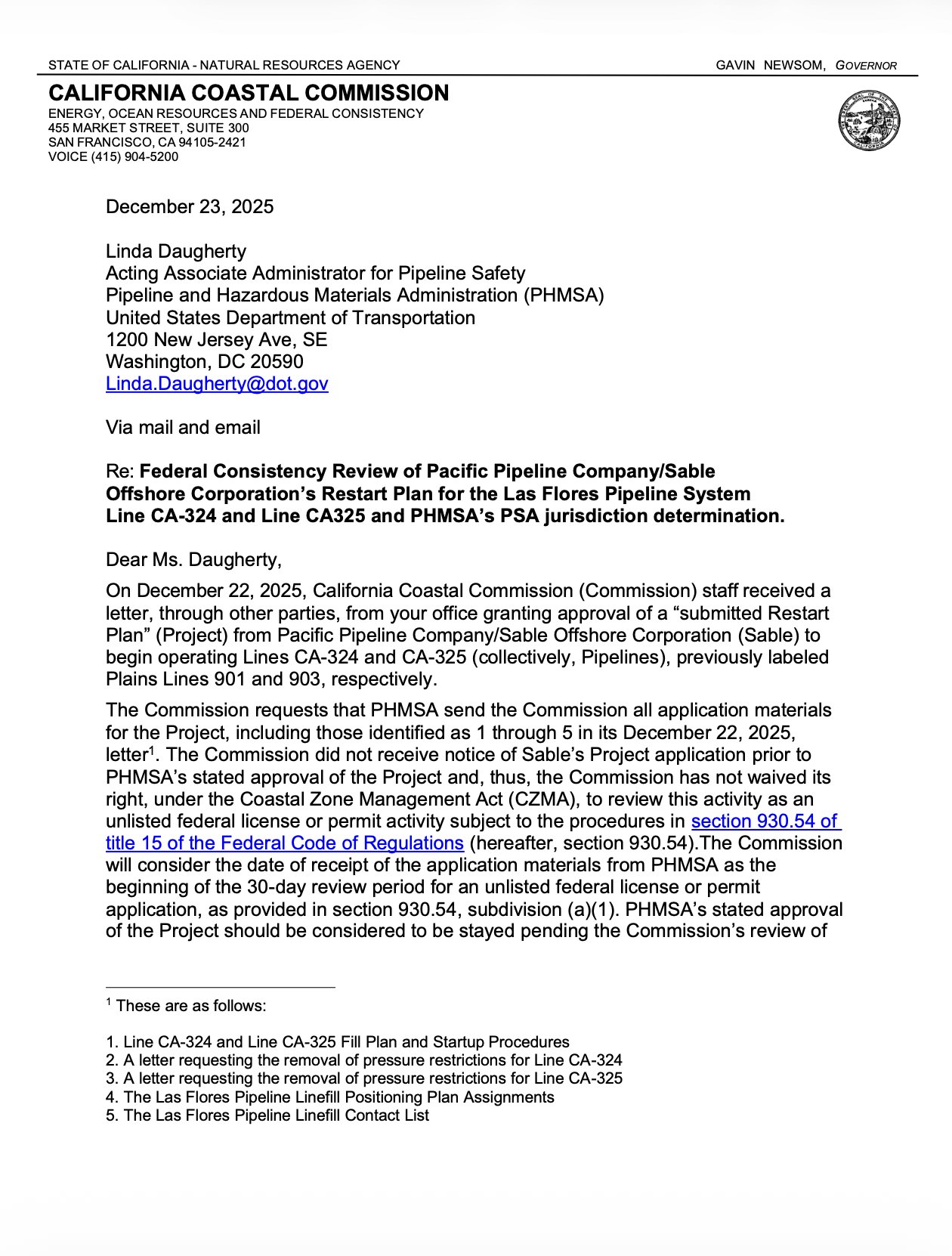
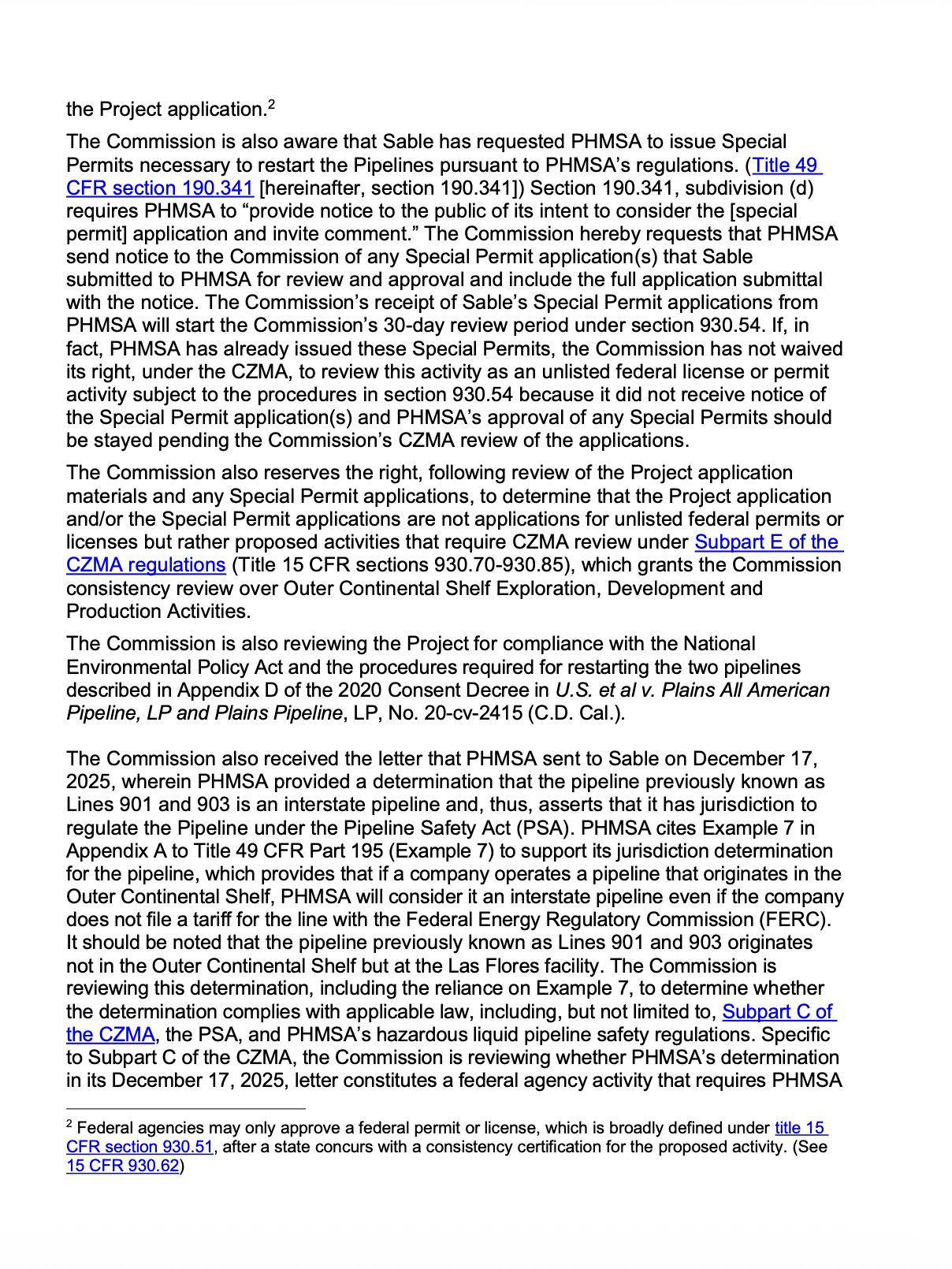
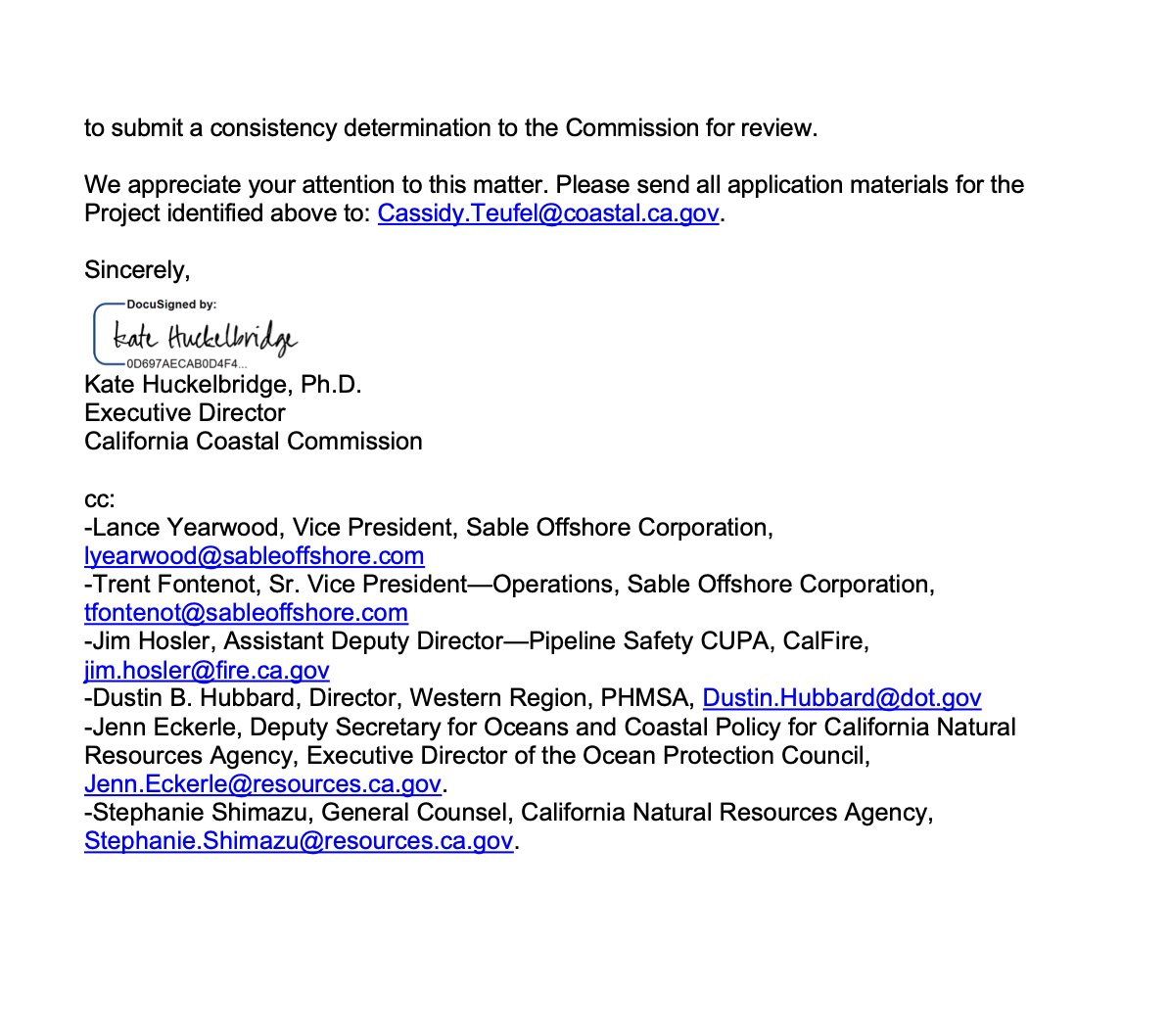
The Commission’s letter to PHMSA is attached (click on pages to enlarge). The CCC asserts the right, pursuant to the Coastal Zone Management Act, to review Sable’s restart/special permit application and further asserts that PHMSA’s special permit should be stayed pending their review.
The Commission also raises NEPA and Consent Decree compliance issues, and implies that PHMSA’s designation of the pipeline as “interstate” is subject to consistency review.
Attached are PHMSA’s Christmas week Emergency Special Permit and Permit Analysis document. Is the path clear to restart SYU production before New Year’s day?
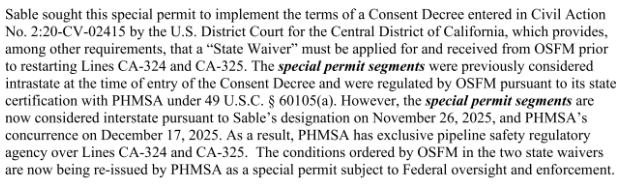
Three excerpts from the first attachment are pasted below. The last paragraph on p. 2 succinctly explains PHMSA’a emergency permit:
PHMSA was able to assume jurisdiction from the State because the pipeline transports Federal OCS oil and is thus inherently interstate. The perceived problem with a PHMSA takeover had been the court approved Consent Decree that was executed following the 2015 Refugio pipeline spill. That Decree specifies that the State Fire Marshal must approve a restart of the pipeline. The first paragraph on p. 2 of the permit explains PHMSA’s position that the Consent Decree has been superseded.
The provision pasted below (p. 4 of the permit) seems contradictory in that it stipulates compliance with the Consent Decree. However, PHMSA apparently sees no contradiction in that references to the Fire Marshal (OSFM) should now be read as references to PHMSA. PHMSA presumably included this provision to reaffirm the need to comply with the technical requirements in the Decree.
The second attachment is PHMSA’s analysis of the special permit. Note that the permit expires in 60 days. Public notice and opportunity for comment would be required for a renewal.
Environmental organizations reacted quickly to the PHMSA permit, filing an emergency motion in the 9th circuit (third attachment). Observations:
Impressive effort given the time crunch. The PHMSA permit was issued on 12/23, just 3 days prior to the court filing. No Christmas break for those folks!
If you wonder why the petition was filed with the 9th Circuit (seemed convenient given the 9th Circuit’s reputation), a filing at the Circuit level is required for appeals of PHMSA orders.
Petitioners strongest argument: Sable is not entitled to emergency relief, as there is no real emergency. PHMSA asserts that EO 14156, which declared a National Energy Emergency, supports the emergency permit.
The petitioners environmental doom prediction is not compelling. PHMSA’s position is that the mitigations they are imposing (reduced operating pressure, inline inspections, testing and sampling, etc) provide protection equal to or greater than than the corrosion remediation requirement that is being waived.
The petitioners asked the Court for relief no later than 12/26. That date has passed. Will there be a ruling today?
Barring an injunction, odds are that Sable restarts production prior to New Year’s Day, when a requirement (SB 237) for a new Coastal Development Plan, takes effect.
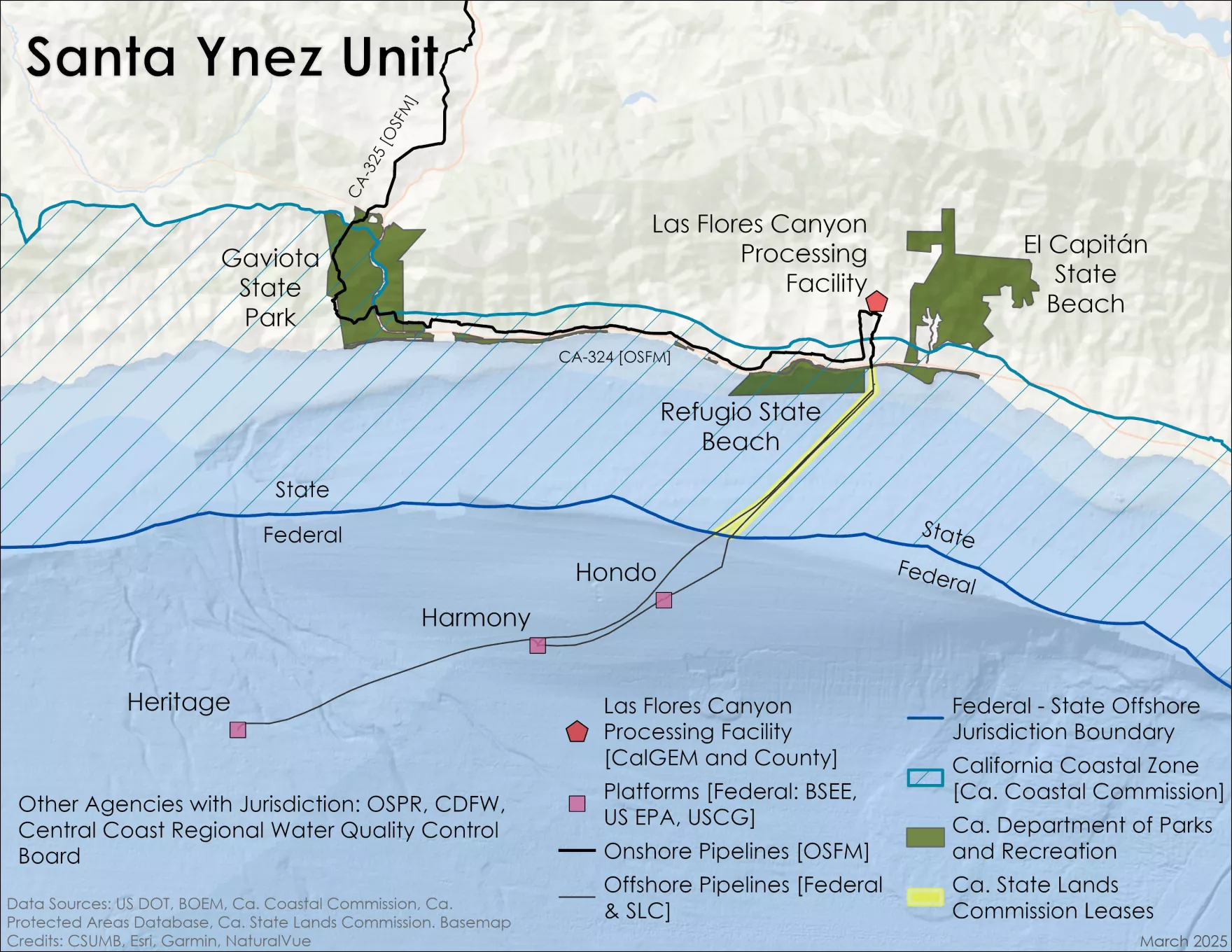
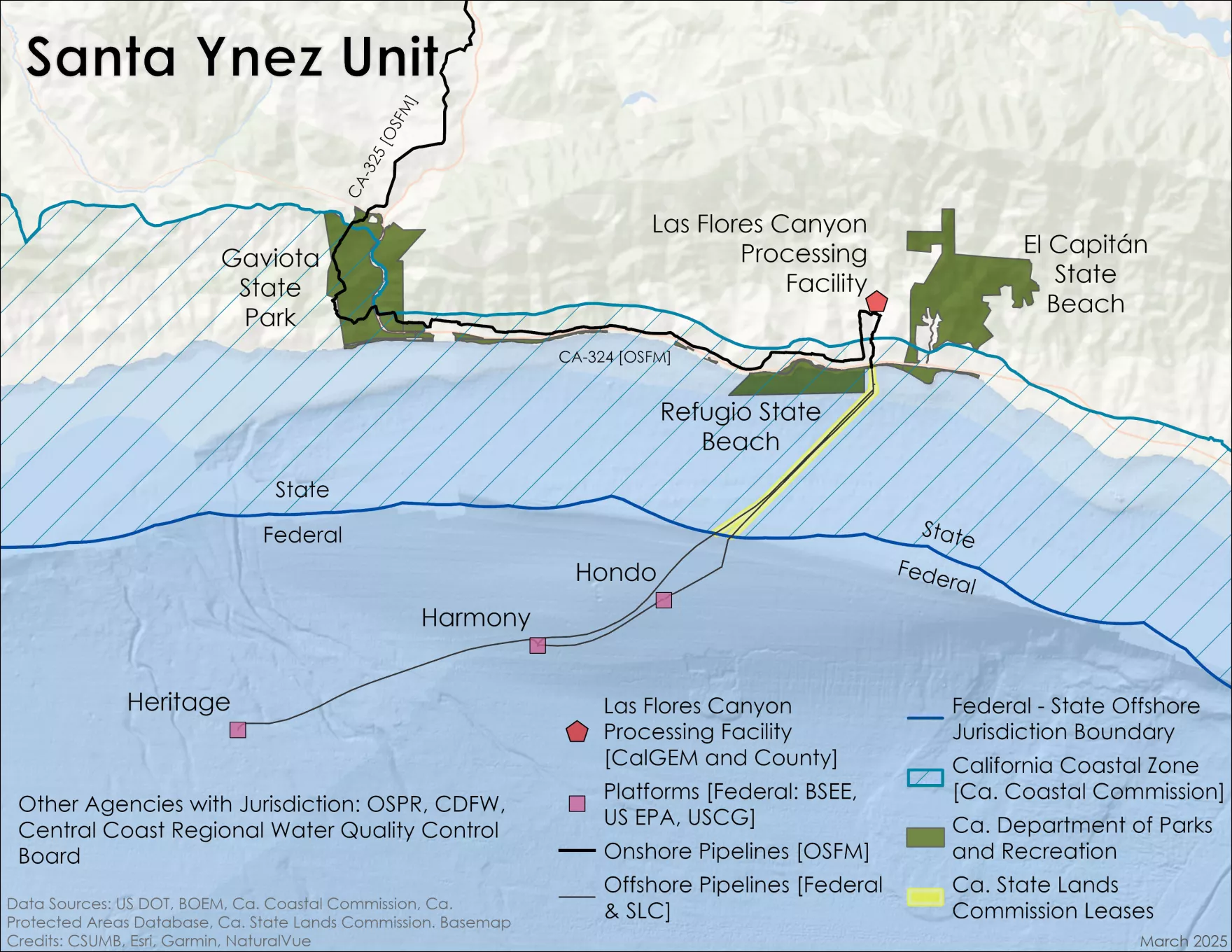
The anticipated State-Federal jurisdictional battle over Sable’s Las Flores Canyon Pipeline is on! See the attached letter from the Pipeline and Hazardous Materials Safety Administration (PHMSA) declaring that the pipeline is under Federal jurisdiction.
The major hurdle for PHMSA/Sable is thecourt approved Consent Decree that was executed following the 2015 Refugio pipeline spill. The Decree, which designates the California Fire Marshal as the sole regulator for the pipeline, is not mentioned in the PHMSA letter. Needless to say, another major legal battle looms.
Excerpt from the PHMSA letter:
PHMSA’s evaluation of the Las Flores Pipeline confirms that it transports crude oil from the OCS to an onshore processing facility at Las Flores Canyon and continues the transportation of crude oil from Las Flores Canyon to Pentland, California. Consistent with Appendix A, the Las Flores Pipeline is an interstate pipeline. As portions of the Las Flores Pipeline were previously considered to be intrastate and regulated by OSFM, PHMSA is notifying OSFM that the Las Flores Pipeline is subject to the regulatory oversight of PHMSA.
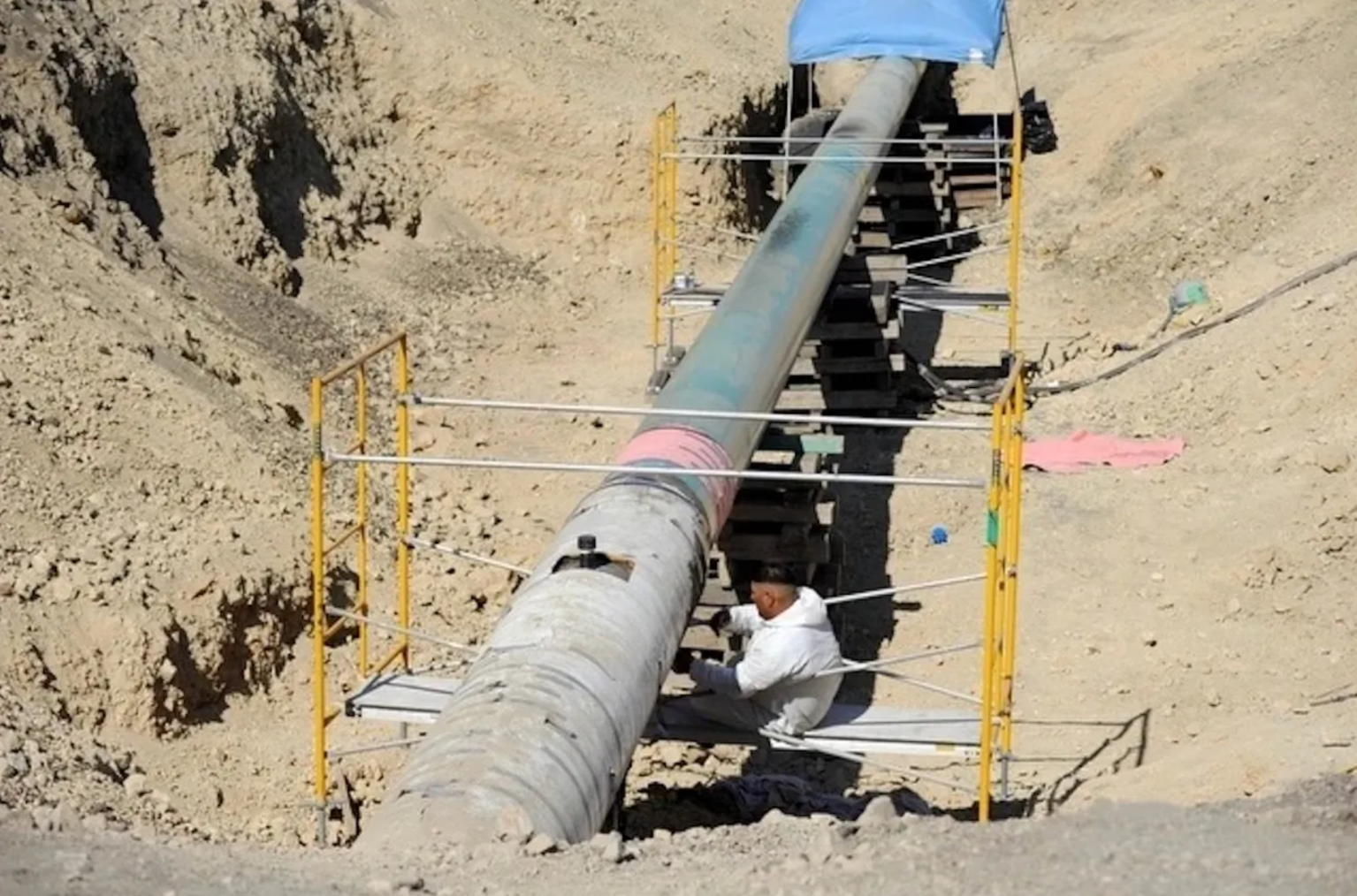
Sable Offshore is attempting to restart the same pipeline that caused the Refugio Oil Spill in 2015. | Credit: Paul Wellman File Photo
Sable Offshore oil believes the federal Pipeline and Hazardous Materials Safety Administration (PHMSA) , not the California Fire Marshal, should have jurisdiction over the company’s onshore pipeline.
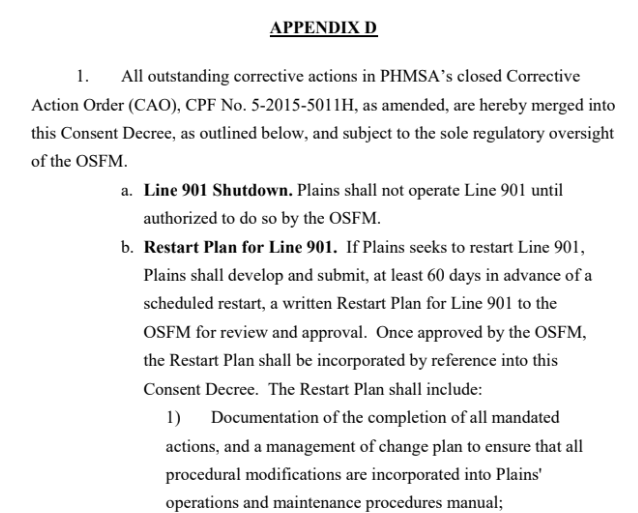
I once had the same opinion as Sable. Their pipeline is, by definition, an interstate line because it carries OCS production. Then I read Appendix D of the court approved Consent Decree that was executed following the 2015 Refugio pipeline spill. That Decree is quite clear regarding regulatory jurisdiction, and would have to be overturned to transfer authority to PHMSA.
The full Consent Decree is attached. Pasted below is an excerpt from Appendix D:
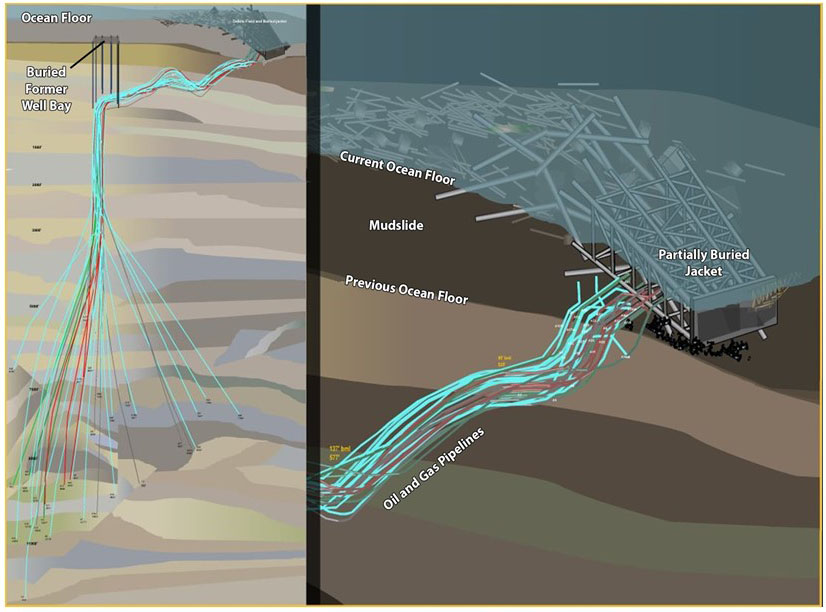
Taylor Energy’s Mississippi Canyon Block 20 “A” platform was destroyed by a massive mudslide during Hurricane Ivan in 2004 (see illustrations below). Per Naval Research Laboratory sensors, “Ivan the Terrible” generated freak waves as high as 91 feet, and NRL computer models suggest that wave heights may have exceeded 130 feet. The changes in pressure resulting from the motion of the huge waves triggered the flow of the unstable Mississippi delta sediments. The platform was swept 500 feet downslope and the wells were severed and buried under a deep layer of sediment. That was essentially the end for Taylor Energy, as the company would spend the next 17 years locating and plugging wells, decommissioning piping, collecting seepage, and mitigating pollution. Since 2008, when Taylor sold its remaining oil and gas assets, the company has been solely engaged in the MC-20 response.
NOAA illustration
Last week, Taylor and the Justice Department signed a consent degree that transfers the company’s remaining assets and control of the decommissioning trust fund to the Federal government. Questions remain as to whether the platform and wells could have been better designed to withstand the mudslide (note that the platform was installed and operated by BP prior to being sold to Taylor), and whether more should have been done to mitigate the seepage. Taylor does a good job of making its case at their response website.
Few offshore operators would argue that what happened to Taylor couldn’t happen to them. That would be brash and foolish. Hopefully, the companies that remain have absorbed the lessons of MC-20 and are applying them to their operations and management programs.