The attached order by Kern County Superior Court Judge Bernard C. Barmann Jr.:
Declares the California Geologic Energy Management Division (“CalGEM”) 2021-2024 policy of denying all well stimulation treatment (WST) permit applications invalid.
Declares the 2024 Rule (Cal. Code Regs., tit. 14, § 1780, subd. (d)) invalid because CalGEM’s determination that the categorical ban is reasonably necessary is not supported by substantial evidence and lacks a rational connection to the statute’s GHG-reduction purpose.
Directs CalGEM to set aside the 2024 Rule and the challenged permit denials; reconsider the denied applications; and consider the pending applications under section 3160 and applicable regulations, without reliance on the invalid underground policy or the invalidated Rule.
The Court does not direct issuance of any permit or impose additional denial-letter or deadline requirements.
The ruling could unlock oil resources in in Kern County’s diatomite formations estimated at up to a billion barrels.
Will this decision have any effect on the dispute related to the California Coastal Commission’s prohibition against the resumption of hydraulic well stimulation at Platform Gilda?
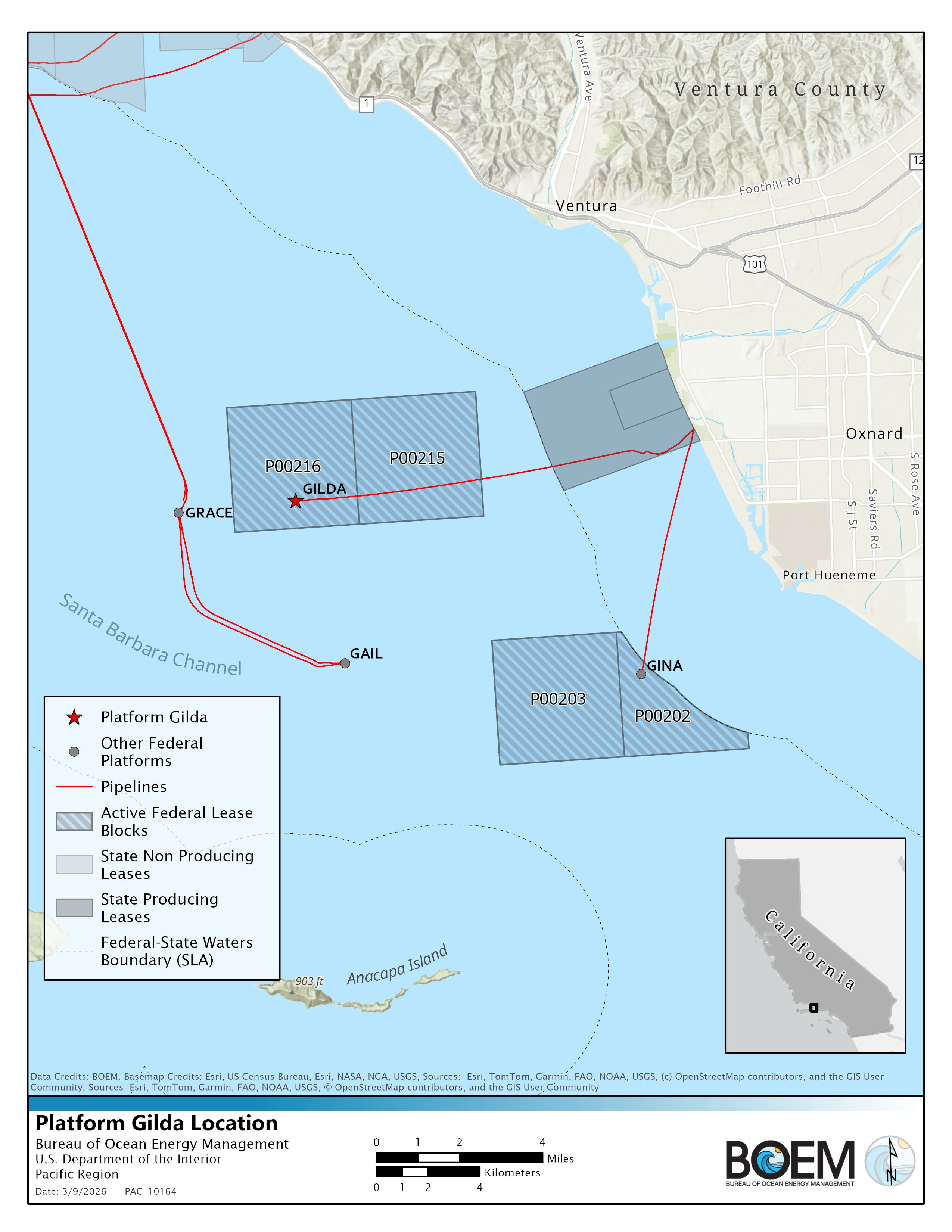
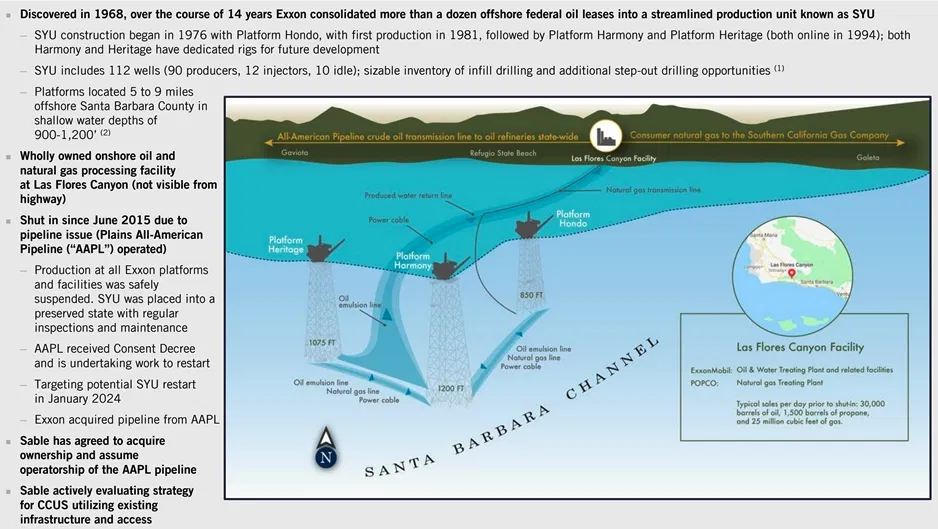
Despite favorable environmental reviews from both the Obama and Trump Administrations, the California Coastal Commission, empowered by the Courts, voted last week to prohibit the resumption of hydraulic well stimulation at DCOR’s Platform Gilda (map above).
Of course, as is always the case offshore California, the regulatory and legal battles will continue. The Secretary of Commerce may choose to overrule the CCC, in which case further litigation is certain.
This dispute comes at a time when the CCC, which operates with extraordinary autonomy, is undergoing a performance review by Commerce. Needless to say, the Commission and its supporters are not thrilled with the oversight.
In light of the spotlight on “offshore fracking,” I wanted to draw attention to a 2019 National Academies workshop that considered this very issue. I had the opportunity to participate in this workshop and was impressed by the input from industry and govt representatives.
Key points from the workshop:
If wells are not completed effectively, the value of drilling is negated, and it is impossible to deliver the oil or gas production needed to make the wells economically sustainable.
The frac pack (as is proposed for Platform Gilda) is one of the most commonly used completion techniques worldwide.
A gravel pack uses sieved sand as a filter to prevent formation sand from entering the wellbore, while the frac pack combines the gravel pack with hydraulic fracturing to create wide fractures filled with sieved sand that aid in connecting the reservoir to the wellbore.
Frac packs can create 50- to 250-foot fractures to stimulate production in a well.
Well stimulation offshore, which has been in practice for decades, has far less negative impact potential than well stimulation onshore.
Hydraulic fracturing minimizes the number of wells needed to develop a reservoir with the result being less environmental impact potential. This completion technique allows for the development of natural resources not previously considered commercially viable.
Offshore California, oil and gas formations typically have low permeability, and production is dependent on natural fractures. The objective is to enhance the flow of oil and gas from the tight matrix pores into the fractures.
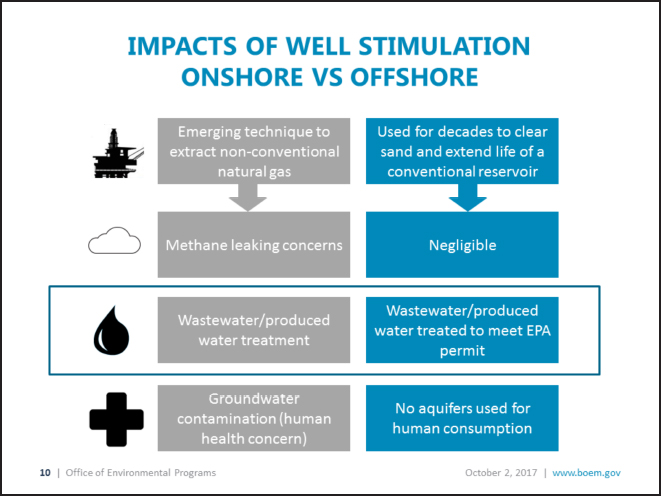
The workshop graphic below highlights the differences in well stimulation risks onshore vs. offshore. The graphic is a bit unfair in that the onshore risks are being effectively mitigated. The main point is that much of the onshore risk potential doesn’t exist for offshore well stimulation.
In the ongoing Santa Ynez Unit production restart saga, John Smith informs that a California Appellate Court ruled against Sable Offshore by a vote of 2-1, with a strong dissent from one of the three judges.
The decision (attached) affirms the California Coastal Commission’s regulatory authority over Sable’s Los Flores Canyon pipeline repairs, meaning that Sable could be ordered to cease operating the pipeline. However, this is just one element of a complex legal maze. An important case regarding PHMSA’s emergency special permit for the pipeline will be heard by the Federal 9th Circuit Court of Appeals in July.
The dissenting judge’s opinion beginning on p.15 of the attachment sets the stage for the upcoming arguments in the 9th Circuit. Excerpt:
“But first, a dose of reality. The repair work has been done. It is a “fait accompli.” And, pursuant to federal intervention, oil is now flowing in the pipeline without incident. The supremacy clause of the United States Constitution takes precedence. The federal Government trumped the state’s Commission “cease and desist” order and it trumps the preliminary injunction order. Based upon these events, the trial court should vacate the preliminary injunction, dismiss the matter as moot, and nullify the civil penalties.”
Meanwhile, the California Coastal Commission notified Sable Offshore that it intends to issue a cease and desist order aimed at shutting down crude oil extraction in the Santa Barbara Channel.
Sable responds:“Sable Offshore Corp. (“Sable”) through its subsidiary, Pacific Pipeline Company (“PPC”), continues to lawfully operate through its existing coastal development permits which were issued in 1986.”
An apology letter from the California Coastal Commission (CCC) to SpaceX was part of a lawsuit settlement. SpaceX alleged political bias in the commission’s 2024 decision to deny increased Falcon 9 launches at Vandenberg Space Force Base, based on comments about Elon Musk’s political views and SpaceX’s labor practices.
Excerpt:
“In 2024, the Commission reviewed consistency determinations by the U.S. Space Force for SpaceX’s Falcon 9 launch program at Vandenberg Space Force Base. During that review, some Commissioners made negative comments about SpaceX’s labor practices and its Chief Executive Officer’s political views. The Commission acknowledges that these political comments were irrelevant to the Commission’s consistency review and were improper, and the Commissioners apologize for those comments.”
AI confirms my suspicions that formal CCC apologies are highly unusual 😉
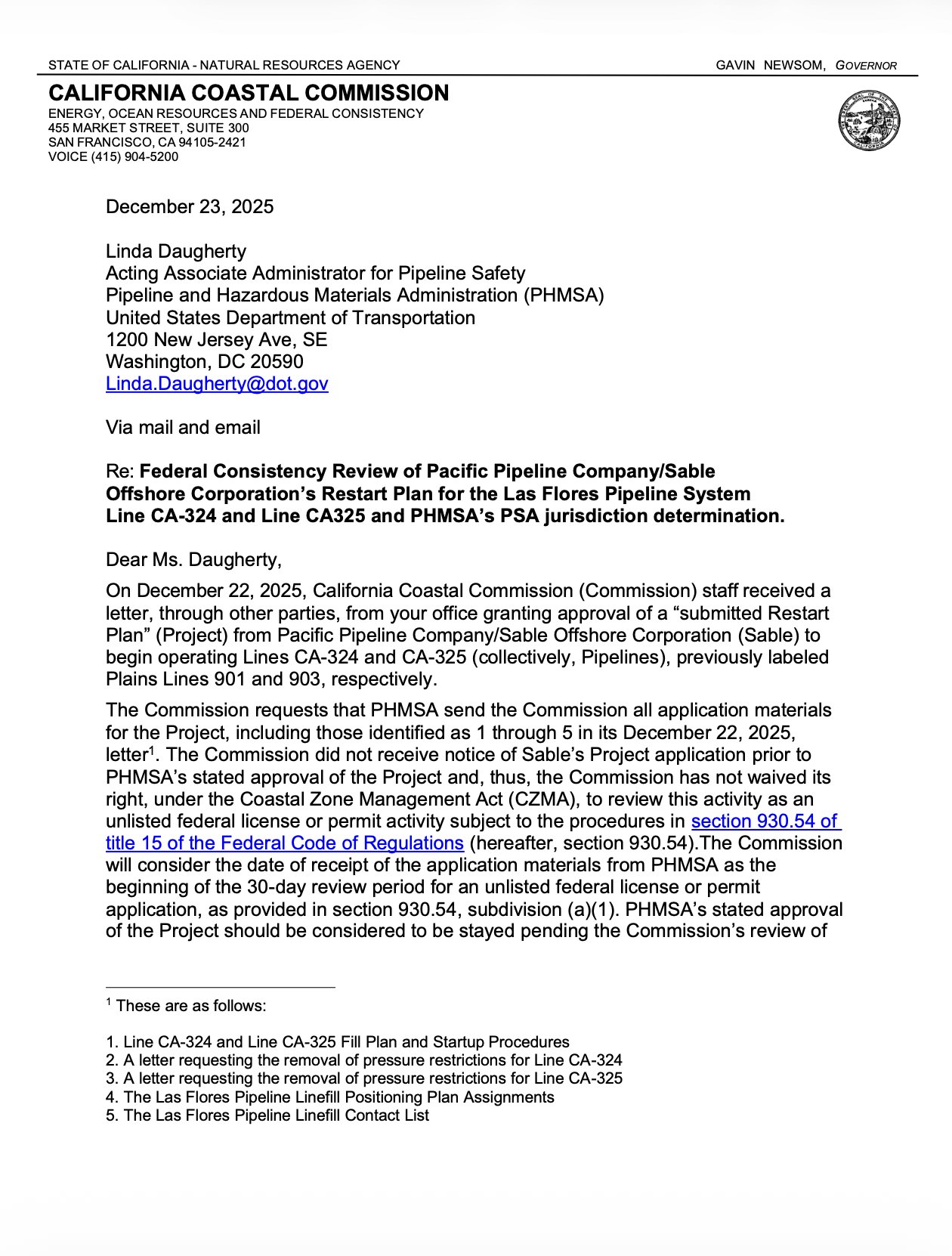
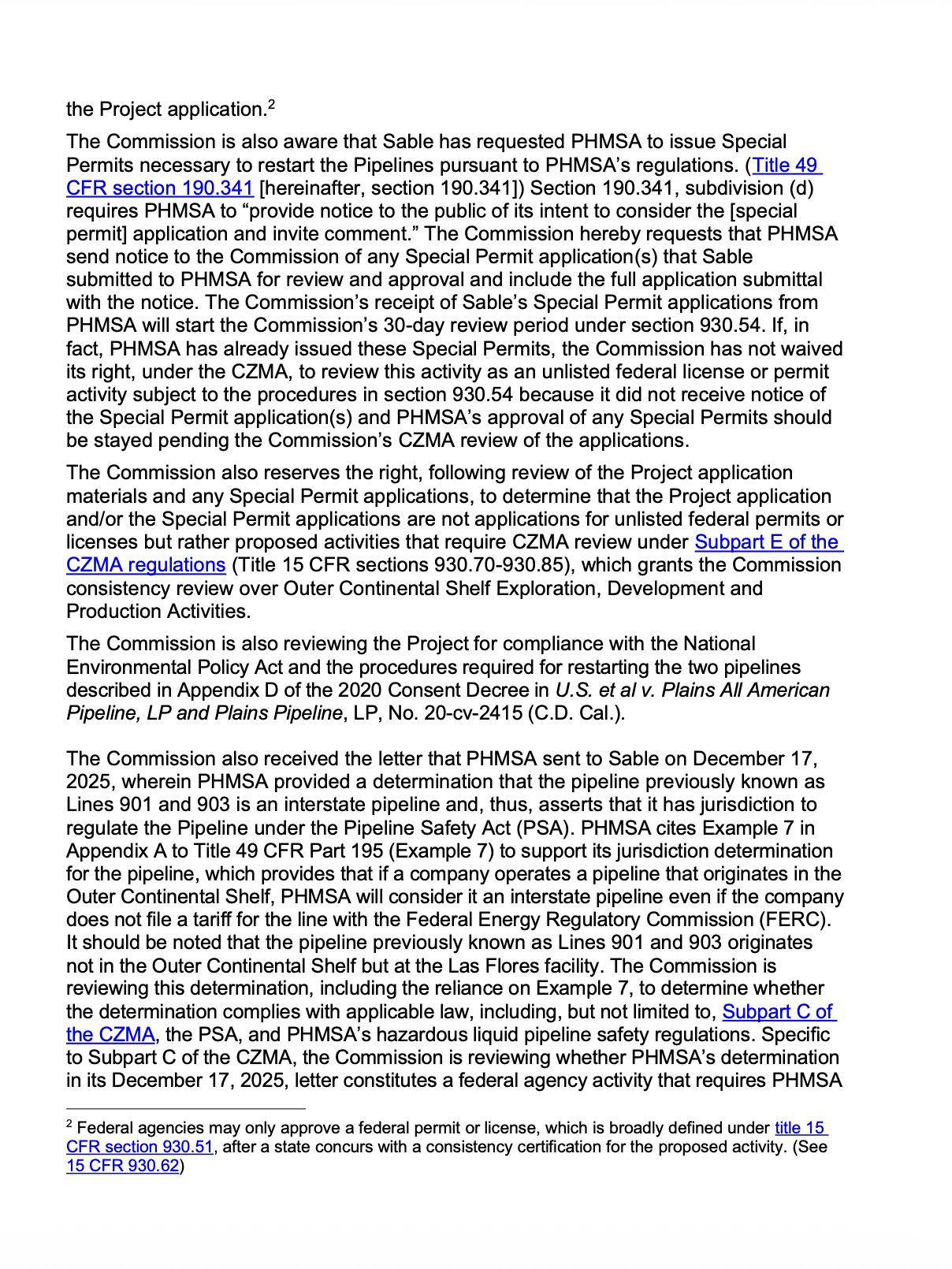
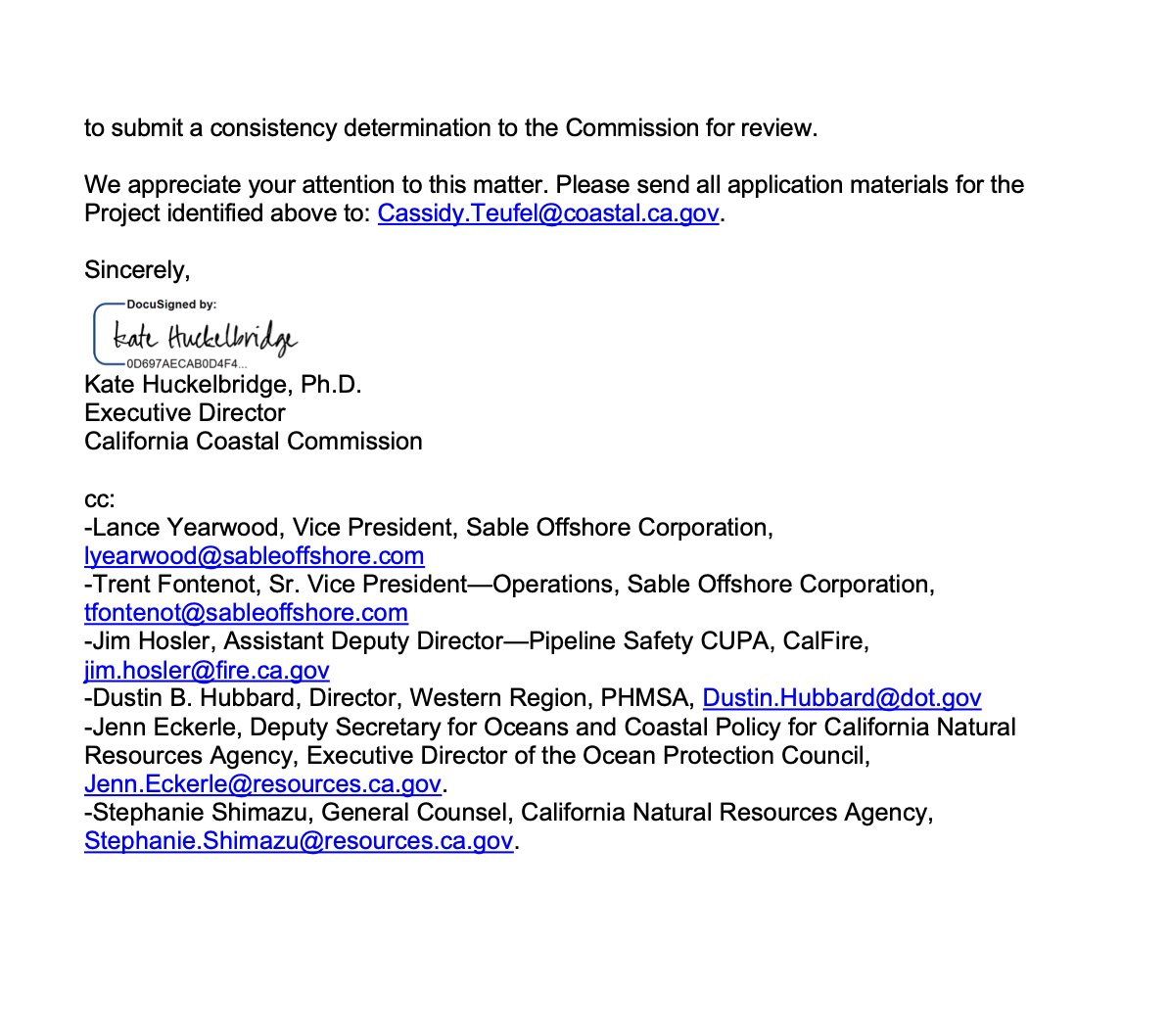
The Commission’s letter to PHMSA is attached (click on pages to enlarge). The CCC asserts the right, pursuant to the Coastal Zone Management Act, to review Sable’s restart/special permit application and further asserts that PHMSA’s special permit should be stayed pending their review.
The Commission also raises NEPA and Consent Decree compliance issues, and implies that PHMSA’s designation of the pipeline as “interstate” is subject to consistency review.
As the above discussion demonstrates, the issue before the Court is not whether the specific work conducted by Sable was or is ultimately necessary or appropriate for pipeline safety. The issue before the Court is whether the Commission abused its discretion in issuing the April 10 Orders under the standards for review by petition for administrative writ of mandate.
Based on the foregoing analysis and a review of all of the arguments of the parties and the AR, the Court finds the Commission’s factual findings are supported by substantial evidence and that Sable has not met its burden to show an abuse of discretion by the Commission in issuing the April 10 Orders.
Accordingly, the petition for administrative mandate as set forth in the first cause of action of Sable’s FAP will be denied.
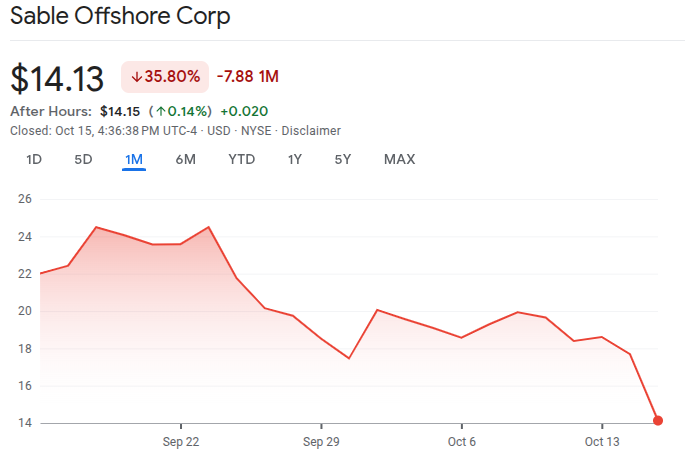
The road ahead for Sable continues to get rockier, and their share price took a major hit today.
As a result, on Sept. 29 Sable Offshore filed a declaratory judgement action against the State of California in Kern County. Sable is asking the court to confirm that the objectionable permitting provisions of SB 237 do not apply to their Las Flores Pipeline System.
Also, on Oct. 6 Sable filed a motion increasing the monetary damages in its ongoing case against the California Coastal Commission to $347 million. Sable asserts that their pipeline repair program was authorized by existing permits issued by the County of Santa Barbara under its Local Coastal Program and delegated Coastal Act authority.
These seem like good tactical moves on the part of Sable.
Phil also believes SYU production would reduce natural seepage: “UCSB and State Lands Commission studies (Quigley, Luyendyk, Hornafius, Peltonen, and others) have shown that when oil production is active, reservoir pressure is reduced and natural seepage declines by up to 50%. That means: •Cleaner beaches (less tar and oil) •Cleaner ocean surface (fewer sheens) •Healthier marine life with reduced chronic stress“
Note that those studies are specific to Platform Holly and the Coal Oil Point area. To the best of my knowledge, no studies have associated SYU production with a reduction in natural seepage.
While Platform Holly may be a negative spillage facility (i.e. Holly’s seep reduction may significantly exceed the platform’s production spillage), this type of seepage reduction has not been demonstrated at other platforms. Decisions on offshore exploration and development should be driven by the economic, energy security, and environmental benefits. To the extent that production reduces natural seepage, all the better. However, seepage reduction is not a primary reason for producing offshore oil and gas.
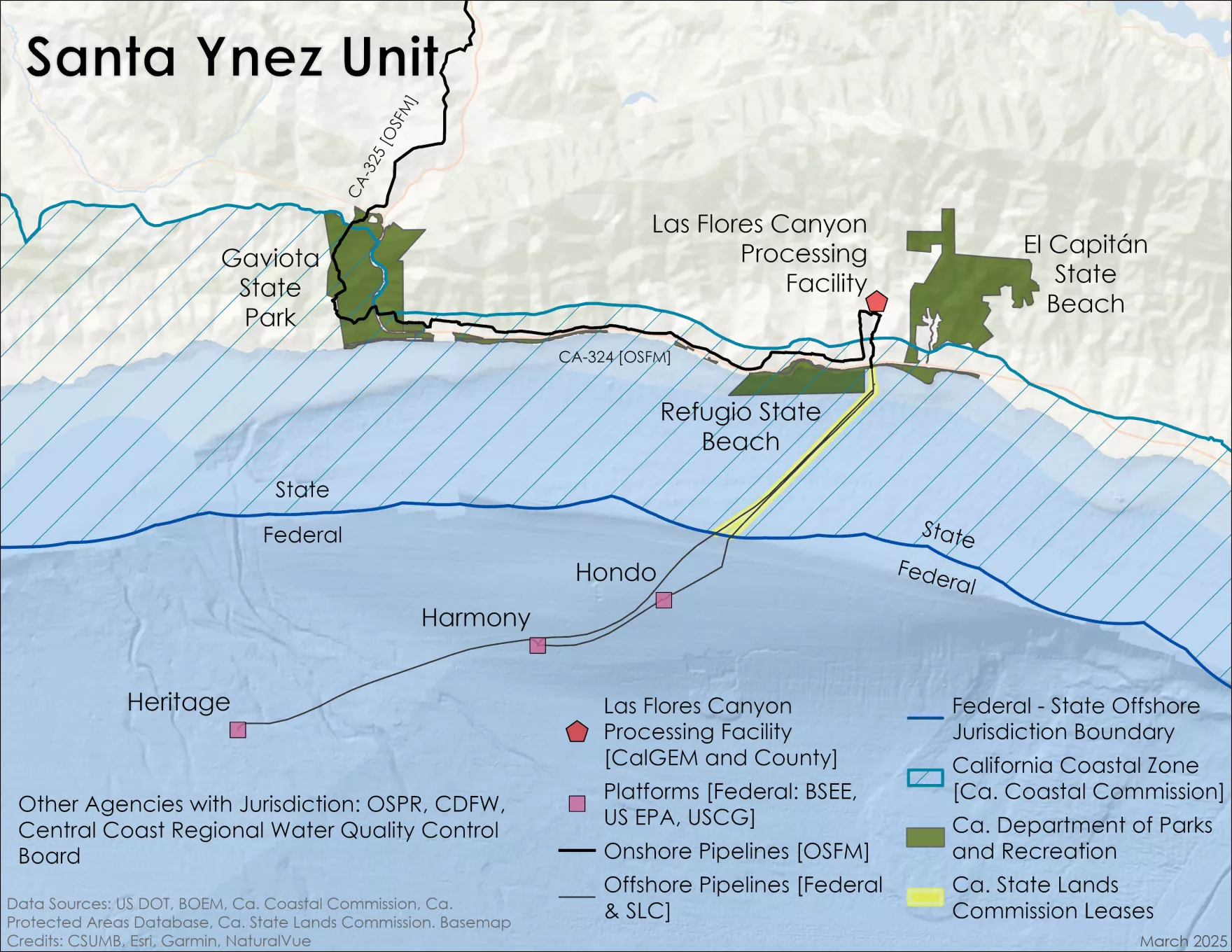
Option 1 (use of existing onshore infrastructure) is preferable from cost, air emissions, spill risk, State and local revenue, and regional energy supply standpoints. This is the only option that makes sense despite the enormous permitting challenges.
Option 2 (floating processing facility and tankers) would literally be an “in your face” act of defiance given the coastal visibility of the offshore facilities. Supporters of this option should be aware that there was no Coastal Zone Management Act when Exxon produced from Platform Hondo (the only SYU platform at the time) to the Offshore Storage and Treatment (OS&T) vessel in the 1980s. An EIS would not favor this option, and the California Coastal Commission would surely rule that this option was inconsistent with their CZM plan. The Secretary of Commerce could overrule the Commission’s decision, but legal objections to the override would seem to have a good chance of success.
The only reasonable path forward is to do the right thing and continue to pursue the State pipeline/onshore approvals. Although these approvals are substantively warranted, more litigation is probably inevitable. It will be far better to defend a good project (option 1) than a contrived workaround (option 2).
John Smith has highlighted the attached bill that could, if passed, further derail Sable’s plans to restart Santa Ynez Unit (SYU) production.
This provision appears to target Sable:
Section 3(b)(2): Repair, reactivation, and maintenance of an oil and gas facility facility, including an oil pipeline, that has been idled, inactive, or out of service for five years or more shall be considered a new or expanded development requiring a new coastal development permit consistent with this section.
The legislation would be effective on 1/1/2026 so perhaps Sable will already be producing. Sable may also explore the jurisdictional and interstate commerce issues touched on in this post.
This LA Times update adds to the confusion as to the implications for Sable.