Feeds:
Posts
Comments

Posts Tagged ‘Coal Oil Point’

The cessation of production at Platform Holly 10 years ago has contributed to the periodic surges in natural seepage that soil Santa Barbara area beaches (see the Instagram post above).

The correlation between production at Platform Holly, which lies just offshore from the Univ. of California at Santa Barbara (UCSB), and seepage in the Coal Oil Point area (map below) was apparent to those who worked at Holly. That association was confirmed by UCSB studies:

Emeritus Professor James Boles collected and analyzed decades of data on methane seeping from the seafloor southeast of Platform Holly, just offshore from Isla Vista. He and colleagues Grant Garven at Tufts University and Chris Peltonen at Beacon West Energy Group determined that production of oil and natural gas from the platform reduced natural methane seepage into the waters of the Santa Barbara Channel, confirming earlier regional studies. The findings appear in the journal Marine and Petroleum Geology.

This blog called Platform Holly a “net negative hydrocarbon polluter, because production from Holly reduced natural seepage and methane pollution from shallow formations beneath the Channel. Steel subsea pyramids (“tents”) installed by Arco in 1982 collected seafloor methane seepage, an added environmental benefit from the platform operations. As described in a 2014 presentation posted by the California State Lands Commission,“production at Platform Holly has resulted in significant improvement in local air quality.”

Further per UCSB:

After combing through 20 years of data, the authors found that production at Platform Holly significantly reduced the amount of methane seeping into the tents. For example, production from a well drilled 1 kilometer beneath the tents immediately reduced the natural seepage. In contrast, the seepage increased when production ceased from that well. “This indicates a direct link between the oil reservoir and the natural seepage in the area,” Boles noted.

Production at Holly ceased 10 years ago; the tents have been removed and the platform is being decommissioned. However, methane bubbles in the Channel and periodic beach tar will continue to remind us of Holly’s positive environmental legacy.
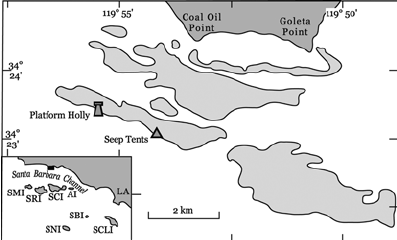

Map showing areas ( shaded ) of natural oil seeps offshore from Coal Oil Point near Santa Barbara, California. Inset map shows the Channel Islands ( I ) designated SM San Miguel, SR Santa Rosa, SC Santa Cruz, A Anacapa, SN San Nicholas, SB Santa Barbara, and SCL Santa Catalina. Seep fields were mapped between 1946 and 1973 (modified from Hornafius et al. 1999) 

Read Full Post »

Thumbs up to Santa Ynez Unit production from Phil Mickelson!

Phil also believes SYU production would reduce natural seepage:UCSB and State Lands Commission studies (Quigley, Luyendyk, Hornafius, Peltonen, and others) have shown that when oil production is active, reservoir pressure is reduced and natural seepage declines by up to 50%. That means: •Cleaner beaches (less tar and oil) •Cleaner ocean surface (fewer sheens) •Healthier marine life with reduced chronic stress

Note that those studies are specific to Platform Holly and the Coal Oil Point area. To the best of my knowledge, no studies have associated SYU production with a reduction in natural seepage.

From a related 2010 BOE post entitled “Slick Talk About Seeps” (note that production at Platform Holly has since been terminated):

While Platform Holly may be a negative spillage facility (i.e. Holly’s seep reduction may significantly exceed the platform’s production spillage), this type of seepage reduction has not been demonstrated at other platforms.  Decisions on offshore exploration and development should be driven by the economic, energy security, and environmental benefits.  To the extent that production reduces natural seepage, all the better.  However, seepage reduction is not a primary reason for producing offshore oil and gas.

Thoughts on Sable’s production options:

Option 1 (use of existing onshore infrastructure) is preferable from cost, air emissions, spill risk, State and local revenue, and regional energy supply standpoints. This is the only option that makes sense despite the enormous permitting challenges.

Option 2 (floating processing facility and tankers) would literally be an “in your face” act of defiance given the coastal visibility of the offshore facilities. Supporters of this option should be aware that there was no Coastal Zone Management Act when Exxon produced from Platform Hondo (the only SYU platform at the time) to the Offshore Storage and Treatment (OS&T) vessel in the 1980s. An EIS would not favor this option, and the California Coastal Commission would surely rule that this option was inconsistent with their CZM plan. The Secretary of Commerce could overrule the Commission’s decision, but legal objections to the override would seem to have a good chance of success.

The only reasonable path forward is to do the right thing and continue to pursue the State pipeline/onshore approvals. Although these approvals are substantively warranted, more litigation is probably inevitable. It will be far better to defend a good project (option 1) than a contrived workaround (option 2).

Read Full Post »