The cessation of production at Platform Holly 10 years ago has contributed to the periodic surges in natural seepage that soil Santa Barbara area beaches (see the Instagram post above).
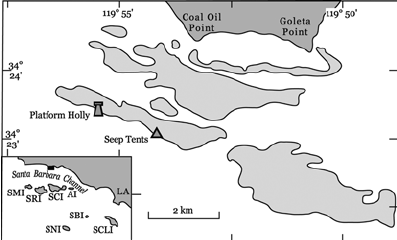
The correlation between production at Platform Holly, which lies just offshore from the Univ. of California at Santa Barbara (UCSB), and seepage in the Coal Oil Point area (map below) was apparent to those who worked at Holly. That association was confirmed by UCSB studies:
“Emeritus Professor James Boles collected and analyzed decades of data on methane seeping from the seafloor southeast of Platform Holly, just offshore from Isla Vista. He and colleagues Grant Garven at Tufts University and Chris Peltonen at Beacon West Energy Group determined that production of oil and natural gas from the platform reduced natural methane seepage into the waters of the Santa Barbara Channel, confirming earlier regional studies. The findings appear in the journal Marine and Petroleum Geology.“
This blog called Platform Holly a “net negative hydrocarbon polluter,“ because production from Holly reduced natural seepage and methane pollution from shallow formations beneath the Channel. Steel subsea pyramids (“tents”) installed by Arco in 1982 collected seafloor methane seepage, an added environmental benefit from the platform operations. As described in a 2014 presentation posted by the California State Lands Commission,“production at Platform Holly has resulted in significant improvement in local air quality.”
Further per UCSB:
After combing through 20 years of data, the authors found that production at Platform Holly significantly reduced the amount of methane seeping into the tents. For example, production from a well drilled 1 kilometer beneath the tents immediately reduced the natural seepage. In contrast, the seepage increased when production ceased from that well. “This indicates a direct link between the oil reservoir and the natural seepage in the area,” Boles noted.
Production at Holly ceased 10 years ago; the tents have been removed and the platform is being decommissioned. However, methane bubbles in the Channel and periodic beach tar will continue to remind us of Holly’s positive environmental legacy.