I’m not aware of any backstory behind Matt Giacona’s departure. He was well regarded and was providing strong leadership as Acting Director of the consolidated offshore energy bureau.
Managing the offshore program is very difficult and administratively complex, with acrimony and litigation around every corner. Less stress and (presumably) more money may have made the Halliburton opportunity attractive. Best wishes to Matt in his new position!
Mike Olsen has served in a number of positions in Interior and reports have been favorable. BOE wishes him well in leading this nationally important bureau.
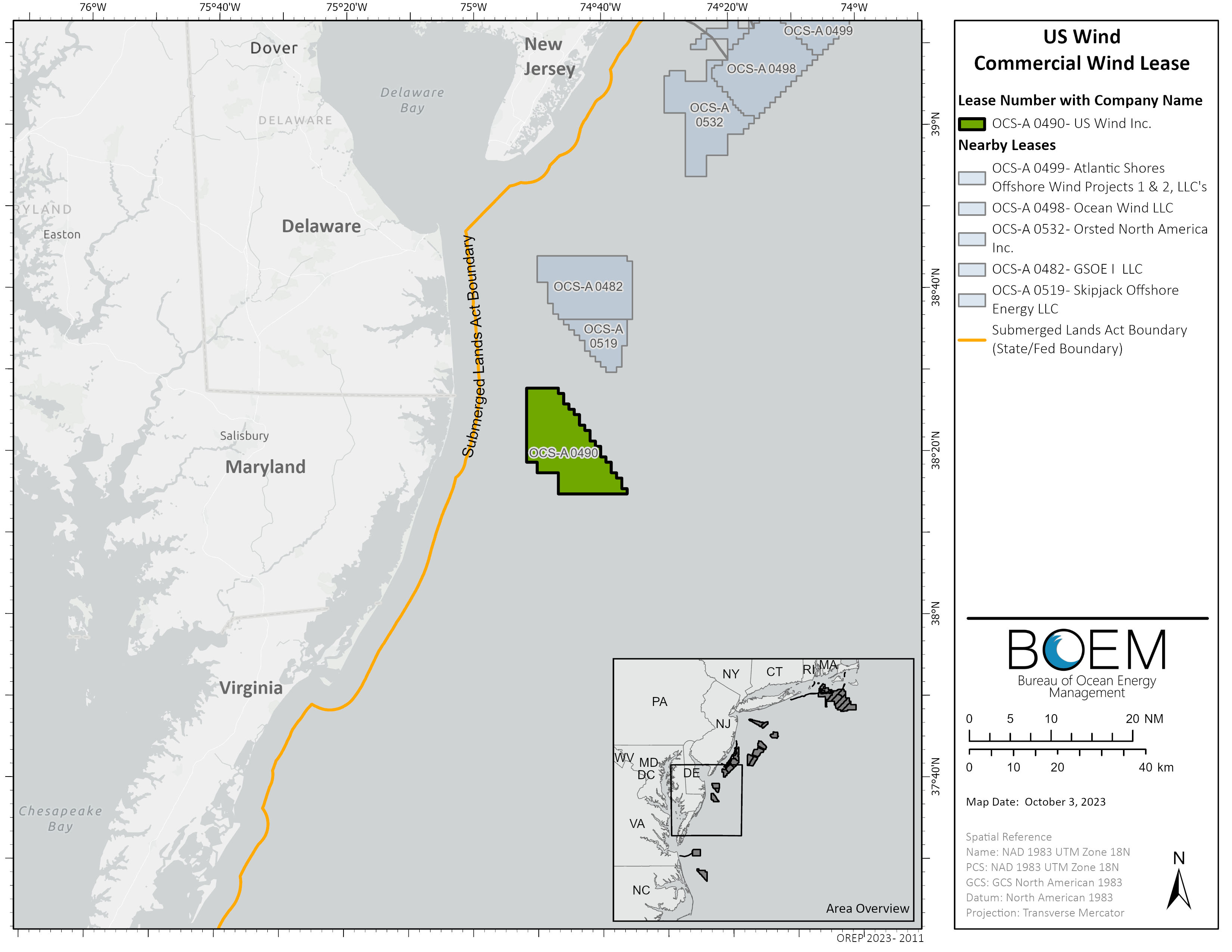
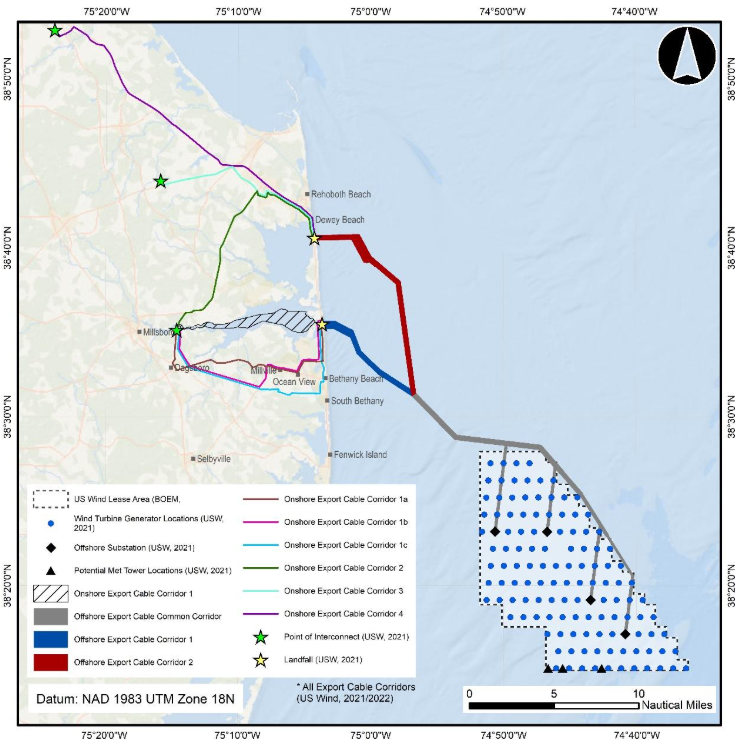
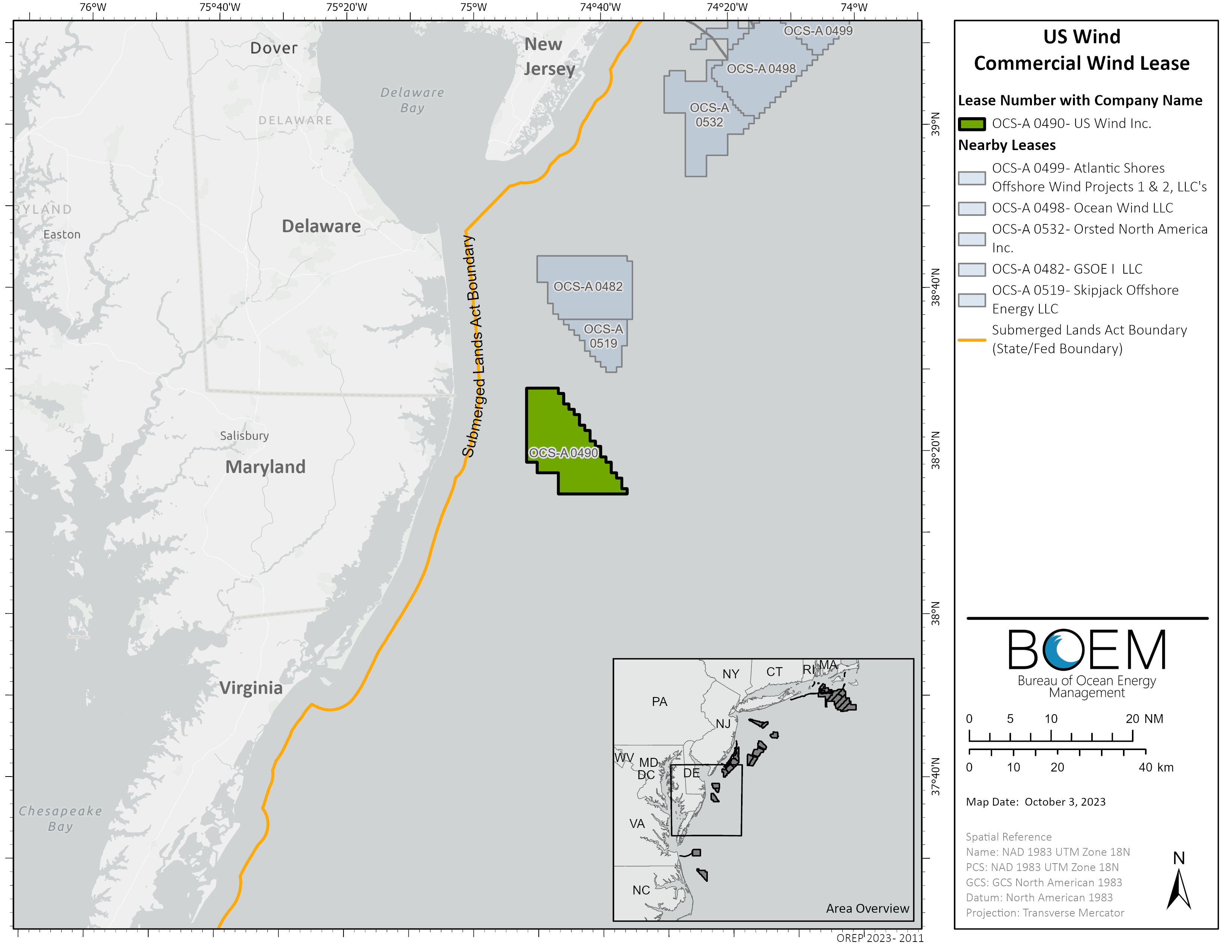
US Wind “MarWin” lease – greenUS Wind “MarWin” project
Unlike offshore oil and gas projects, where State and local govt are usually of one mind (pro or con), States and localities have disagreed sharply about offshore wind. This is particularly true in New Jersey, Delaware, and Maryland, where the State governments are wind advocates despite strong local opposition.
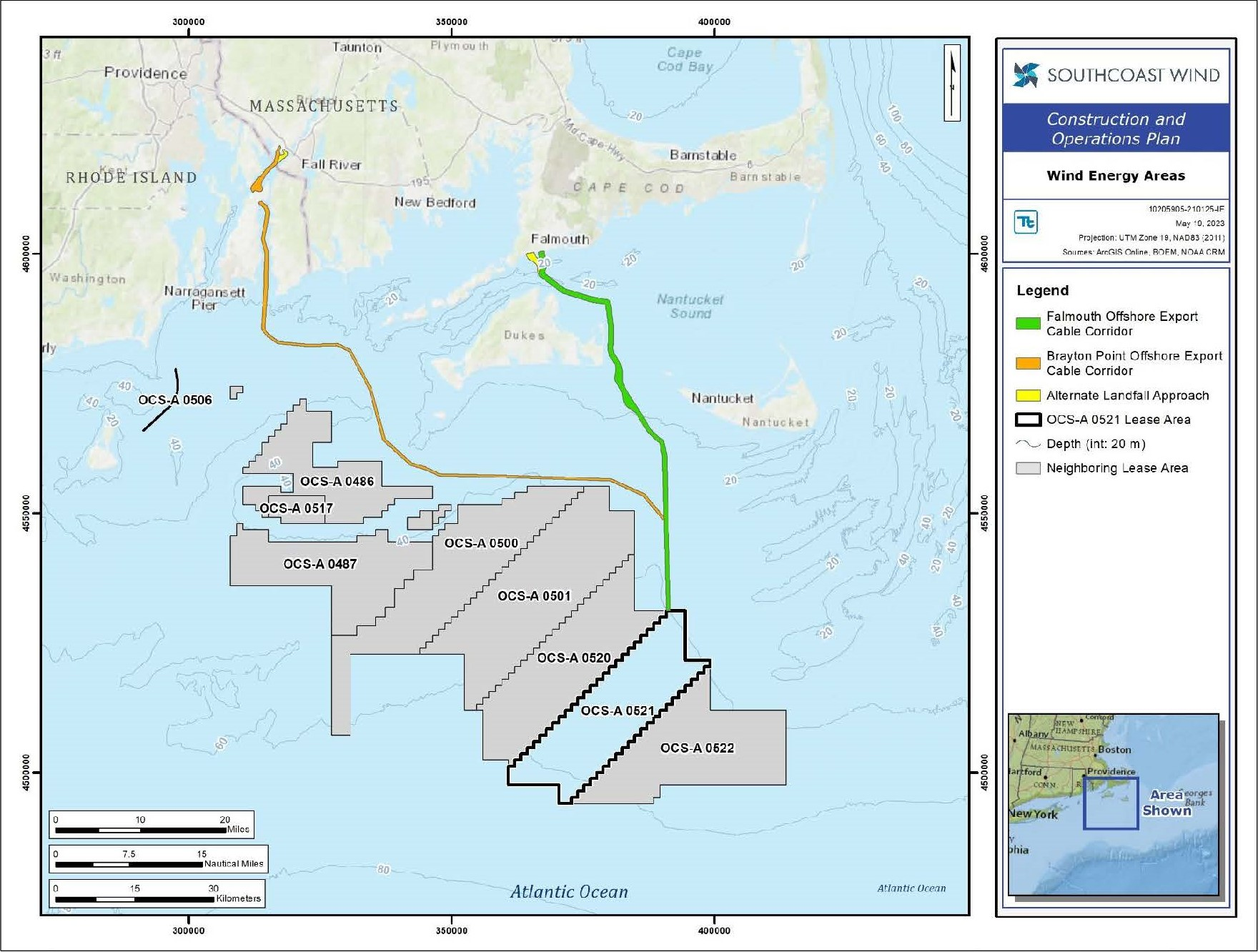
As a result of litigation filed by local entities, and with the acceptance of the Courts, the US Dept. of the Interior is reconsidering Construction & Operations Plan (COP) approvals for the SouthCoast Wind project offshore Massachusetts and Rhode Island, the Atlantic Shores project offshore New Jersey, and US Wind’s Maryland Offshore Wind (“MarWin”) project. These COPs were approved at the end of the previous Administration. Most notably, the SouthCoast Wind COP was approved on 1/17/2025, just three days before the inauguration.
With regard to the US Wind MarWin project, there is a new twist in that the Delaware Environmental Appeals Board unanimously agreed to hear challenges to the State’s CZMA consistency decisions. The complete appeal file is attached.
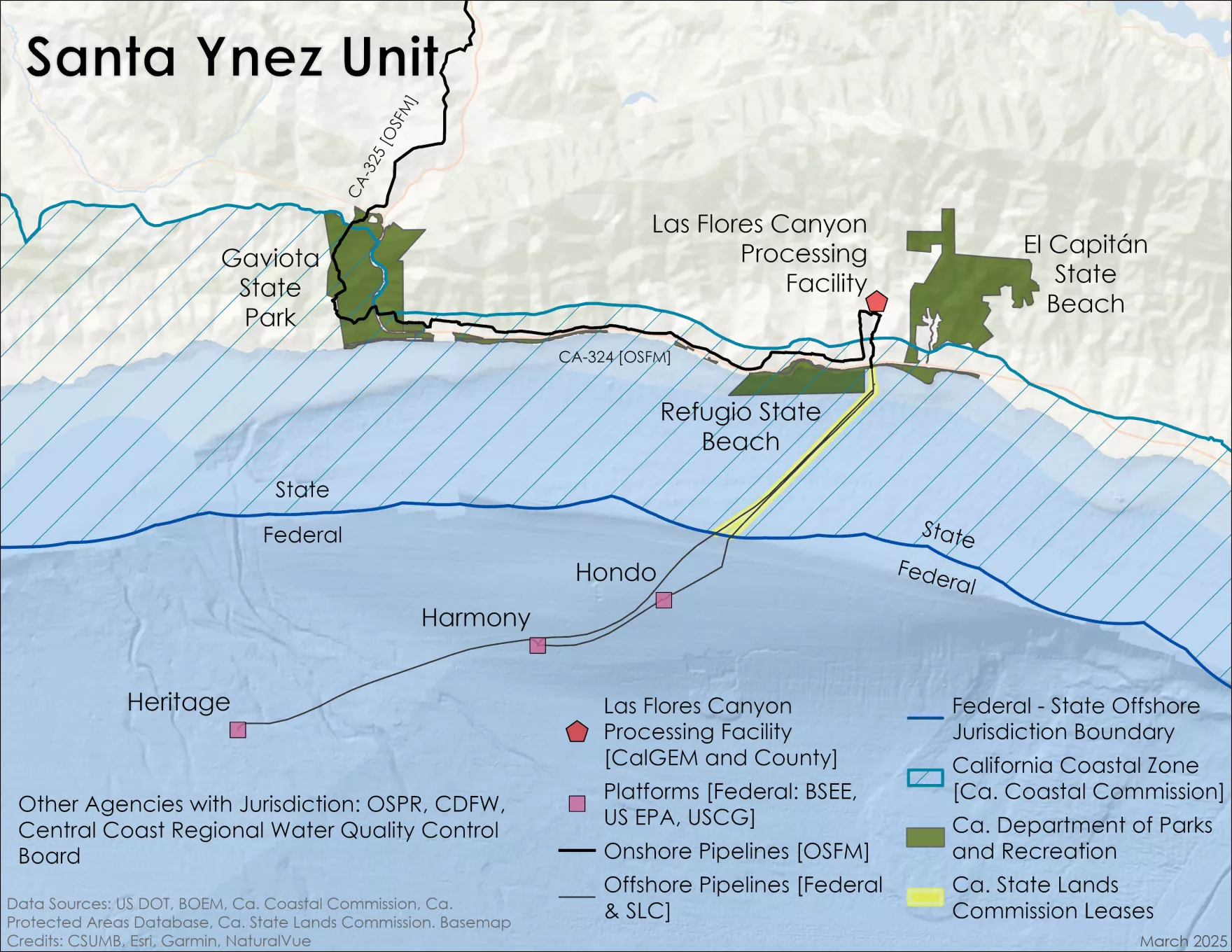
The CBD had challenged an April 2025 BOEM decision concludingthat Sable was not required to revise its development and production plan for the SYU. They sought a court order requiring a revised plan. This suit seemed to be a stretch, so its dismissal is not a surprise.
Per the Dept. of Justice, the court dismissed the lawsuit because the plaintiffs’ asserted procedural injury had no basis in the statute, was not traceable to any action by BOEM, and could not be redressed by an order of the court.(Other than that, it was just fine. 😉)
Among other problems the court identified with the plaintiffs’ case, they invoked a provision of the statute that governs “approval of a development and production plan,” not revision of an already-existing plan. It will be interesting to see the full decision so that we can better understand the context for that statement. Distinguishing revised plans in that manner could have significant policy implications.
For a full update on Sable litigation, see the section of their Quarterly Report beginning on p. 12.
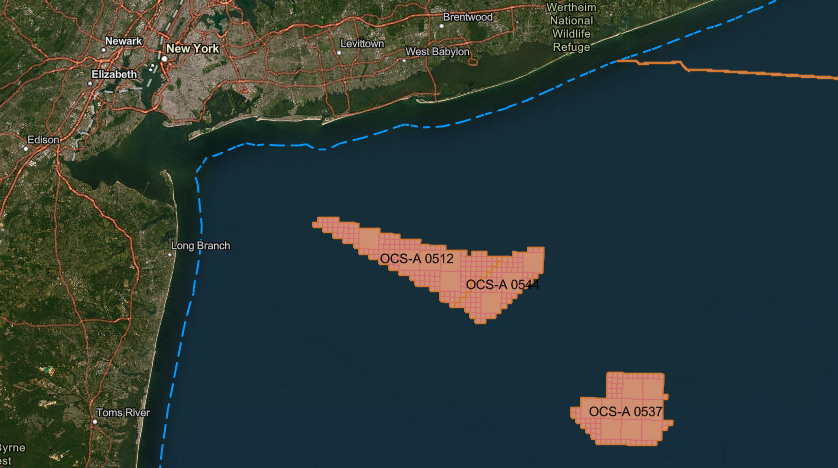
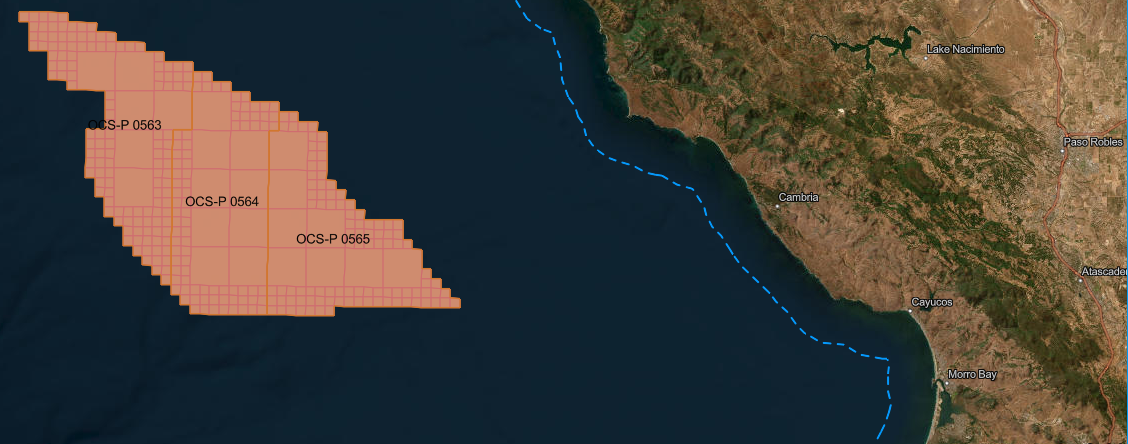
Bluepoint Wind Lease 0537 owned by Global Infrastructure Partners, a part of BlackRock, and Ocean Wind (Engie, France and EDP Renewables, Portugal)Golden State Wind Lease 0564 owned by Ocean Wind (Engie, France and EDP Renewables, Portugal) and the Canada Pension Plan Investment Board
These are mutually beneficial “Win-Win” agreements. Bluepoint and Golden State benefit by escaping bad business decisions:
Bluepoint massively overpaid ($765 million) for Atlantic lease 0537 during the brief irrational exuberance era of the offshore wind program. The intense bidding was driven by the lure of subsidies, guaranteed power sales, unprecedented Federal and State promotion, peak climate activism, inattention to mounting public opposition, and irrational expectations regarding the role of offshore wind in powering the economy.
The value of Atlantic wind leases declined by 99.4% between 2022 and 2024, and this was before the Presidential election!
Golden State bid $150 million for a wind lease that will require floating turbines. The 50 MW Kincardine Offshore Windfarm, which is billed as the “world’s largest floating wind farm,” experienced a £30 million loss in 2023 following a £18 million loss in 2022. Another floating wind project, Hywind Scotland, had to be taken offline for 4 months for maintenance after less than 6 years of operation. BOEM was forced to “postpone” the Oregon wind sale given the absence of bidders.
Significant work had not yet begun on either the Bluepoint or Golden State projects.
Many in Morro Bay and elsewhere along the Central Coast of California are not pleased with the attempt to “industrialize the coast.” Opposition to offshore wind projects is now well established along the Atlantic Coast.
The companies get to invest their inflated wind dollars in profitable energy projects without penalty. What prudent executive wouldn’t jump at the deal?
Waiting for the next Administration is not likely to improve the fundamental economics of offshore wind development, and increased subsidies are not popular.
A pro-wind govt would facilitate permitting, but is unlikely to buyback existing leases.
The Administration also benefits:
Two more wind leases are off the books.
Removing one of three leases could significantly affect the economics of Central Coast (CA) wind development.
Agreements were necessary because it’s difficult to cancel leases, and compensation would be required. If settled in court, the compensation could easily exceed the lease purchase price.
The companies agreed not to pursue any new offshore wind projects in the United States.
The rebates will be invested in projects favored by the Administration.
Question: Are the partners and parent companies also precluded from investing in offshore wind projects or just the Bluepoint Wind and Golden State Wind entities? If BlackRock, EDP, and Engie can no longer make such investments, that is a big deal. This is especially true given the agreement with Total, Vineyard Wind’s problems, Orsted’s financial challenges, BP and Shell’s apparent exit from the US offshore wind market, and Equinor’s reduced renewable energy ambitions.
Finally, a December 7, 2022 release by the Canada Pension Plan Investment Board heralding the 50% partnership in Golden State Wind might be of interest to our Canadian readers. That bad investment can now be removed from the books.
A New York Times article suggests that the consolidation of BOEM and BSEE into the Marine Minerals Administration will weaken environmental oversight. It will not. On the contrary, regulation is likely to be strengthened as resources shift from inter-bureau coordination and redundancy management to the primary safety and environmental protection missions.
Given the challenges associated with Federal reorganizations, agency heads often opt for the status quo. I’m pleased that the current DOI leadership team, with whom I disagree on some issues, chose to merge the bureaus.
Quotes from the NYT article followed by my comments:
NYT:The Trump administration is creating a new office that critics say could weaken the environmental oversight of oil drilling and seabed mining in territorial waters.
Comment: The functional overlap and associated uncertainty that permeates the offshore regulatory regime is a weakness, not a strength. Virtually every element of the regulatory program requires coordination between the two bureaus. This includes plan and permit approvals, decommissioning and financial assurance, spill response plans, lease stipulations, assignments, pipeline regulation, environmental reviews, enforcement actions, and geologic data collection and review. Note the list of MOUs that are intended to coordinate BOEM and BSEE redundancy. The documents often do more to confuse than clarify. For example, see the MOU entitled “Environmental and NEPA.”
Multi-bureau organizational complexity is not in the best interest of safety and environmental protection. Overlapping responsibilities, coordination challenges, and “turf” issues distract the technical staff from their important risk management duties, the work they are good at and enjoy doing. BSEE and BOEM should be overseeing the offshore industry, not each other.
NYT:The new agency, the Marine Minerals Administration, will be formed by reunifying two offices that had been split up after the 2010 Deepwater Horizon oil spill in an effort to increase environmental oversight of the energy industry and prevent future oil disasters. After the split, the Interior Department’s oil-leasing activities were separated from environmental regulation and financial management. (emphasis added)
Comment: The assertion that the leasing and environmental regulation were separated is false. The leasing bureau (BOEM) was assigned lead responsibility for the review and approval of the fundamental operational planning documents – Exploration Plans, Development and Production Plans, and Development Operations Coordination Documents. This includes the environmental reviews pursuant to NEPA.
NYT:The move is “worrisome because it has the potential of bringing things back where they were, where there was this inherent conflict of interest between promotion of offshore oil and gas, and oversight safety,” according to Donald Boesch, emeritus professor at the University of Maryland Center for Environmental Science.
“In recent years various bodies have concluded that certain MMS offices and programs have violated ethical rules or guidelines. In the wake of the Deepwater Horizon disaster, some questioned whether ethical lapses played any role in causing the blowout. The Chief Counsel‘s team found no evidence of any such lapses.“
NYT:The new bureau will also take on oversight of the Trump administration’s plans to lease waters in U.S. territories to deep-sea mining companies. The first of these sales, according to the spokeswoman for the Interior Department, are likely to happen next year.
Comment: DOI’s marine minerals program is decades old and is a priority for the current administration. Reorganization should not affect the MMA’s capability to oversee these activities.
Attached is the supplemental complaint in the lawsuit Revolution Wind, LLC v. United States Department of the Interior, Case No. 1:25-cv-02999-RCL, filed in the U.S. District Court for the District of Columbia.
The December 28 court ruling is consistent with the Department of the Interior’s position that the TRO request be converted to a request for a preliminary injunction. Interior had argued that a preliminary injunction motion could likely be resolved by mid-to-late-January.
The Government also asserted that more time is needed to submit the classified information that is central to the dispute.
Thoughts on this case: A respected colleague recalled this advice from Don Hodel, a widely admired Secretary of the Interior during the Reagan administration: “For all its faults, a contract is a contract, great men and great nations keep their word.”
Another colleague reminded me of the offshore North Carolina oil and gas leases that were suspended in the 1990s. The companies sued the Federal government for breach of contract, and the U.S. Supreme Court ruled 8-1 on June 26, 2000, in Mobil Oil Exploration & Producing Southeast Inc. v. United States, that the government must repay the lessees.
If the suspended Atlantic wind leases are cancelled, the govt would presumably have to compensate lessees for lease purchase and development expenditures. The costs to the Federal govt would be enormous – in the tens of $billions.
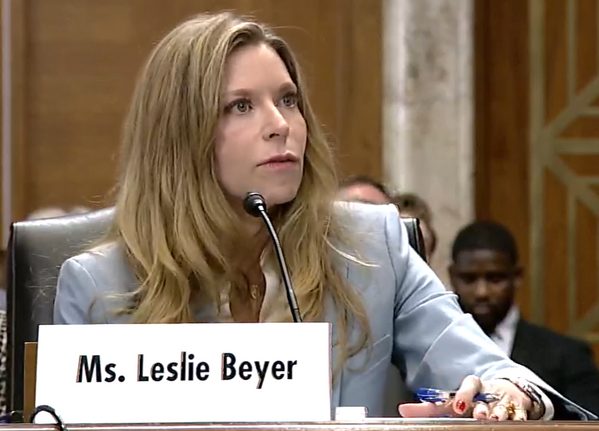
Leslie Beyer, Assistant Secretary for Land and Minerals Management (ASLM), has stepped down from her post as the leader of the Dept of the Interior’s offshore energy programs. She was the senior official at this month’s BGG1 lease sale, and made strong remarks about the importance of the offshore oil and gas program. Ms. Beyer was confirmed by the Senate in September.
Lanny Erdos, Director, Office of Surface Mining Reclamation and Enforcement, has been named Acting ASLM.
This leaves the offshore energy program without a confirmed Asst. Secretary and with Acting Directors at both BOEM (Matthew Giacona) and BSEE (Kenny Stevens).
The Construction and Operations Plan (COP) for the SouthCoast Wind project was approved during the last week of the Biden Administration. That approval has been challenged by the Town and County of Nantucket. Ocean Wind, a joint venture of EDP Renewables (Portugal) and ENGIE (France), is the leaseholder.
As is the case for Maryland Wind, a court filing (attached) indicates that DOI is reconsidering the approval of the SouthCoast Wind COP. Construction has not begun on this project.
A further deferral of Federal Defendants’ responsive pleading deadline in this case is needed because Interior intends to reconsider its COP approval and will therefore be moving for a voluntary remand of that agency action by September 18, 2025.
Historically, State and local governments have tended to be aligned, either for or against offshore energy (primarily oil and gas) leasing. However, a new (offshore) world orderis emerging with local governments joining the new Administration in opposition to wind projects.
Most recently, and consistent with previous speculation, the Federal govt announced its intent to revoke approval of the Construction and Operations Plan for the US Wind project offshore Maryland and Delaware. (See the attached court filing.) This project is not yet in the construction phase.
Particularly noteworthy, as has been the case for other wind projects offshore Mid-Atlantic and New England states, is the alignment of Federal and local (coastal) govts in opposition to State policies.
Specifically, with regard to the US Wind project, the positions of State and local leaders couldn’t differ more:
Ocean City MD Town Manager Terry McGean:
“This is an extremely positive development in our fight against the irresponsible and costly US Wind project,”McGean said to WBOC on Monday. “We have stated all along that the approval of this project was fast and tracked without adequate public input and that approvals ignored significant risks to our economy, fishing industry, marine mammals, and the horseshoe crab. We are glad that our concerns are finally being taken seriously.”
“For the past eight years, Ocean City has voiced strong opposition to the proposed US Wind project. Unfortunately, we believe this project was fast-tracked and that our serious concerns have been largely ignored throughout the review process.“
“Canceling a project set to bring in $1 billion in investment, create thousands of good paying jobs in manufacturing, and generate more Maryland-made electrical supply is utterly shortsighted,” the Governor’s statement reads in part. “The President’s actions will directly lead to utility-rate hikes by taking off most promising ways for Maryland to meet its looming energy generation challenges.”
Such sharply divergent views are also evident in other coastal states. Offshore wind could be a factor in the upcoming gubernatorial race in NJ. The pro-wind energy candidate has the support of large environmental NGOs, while her opponent is supported by grass roots environmental groups that strongly oppose wind projects.