Feeds:
Posts
Comments

Posts Tagged ‘ConocoPhillips’

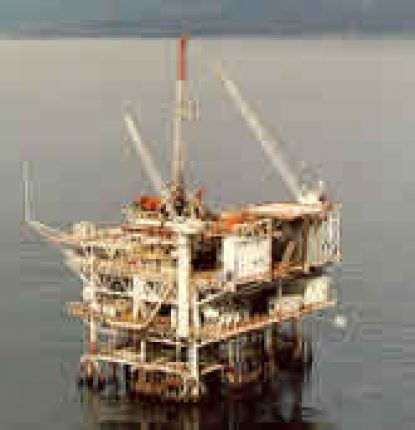
Platform Houchin, Lease OCS-P 0166, Santa Barbara Channel

In light of the decommissioning fire at Platform Habitat, I checked on the status of well plugging operations at Platforms Hogan and Houchin.

BSEE (2020) estimates the cost of decommissioning these facilities to be $85 million (too low), and there is no collateral or third party guarantee.

The responsibility for decommissioning these platforms has yet to be settled. ConocoPhillips, Oxy, and Devon have appealed decommissioning orders from BSEE. The Interior Board of Land Appeals (IBLA) has yet to rule on those appeals. The appellants are funding some plugging operations and facility upgrades pending the IBLA decision.

Per BSEE’s borehole file, this is the current status of the Hogan and Houchin wells:

  • 33 completed and not yet plugged; these wells were drilled between 1968 and 2010
  • 43 temporarily abandoned (TA) wells plugged in accordance with 30 CFR § 250.1721
  • 10 wells have been updated to TA status in the past 6 months (latest 3/22/2026), so some progress is being made
  • 0 permanently abandoned wells (30 CFR § 250.1715)

Therefore, by my count, 33 wells have yet to be TA’d, and all 76 wells remain to be PA’d. Note that the lease was relinquished nearly 6 years ago (10/14/2020).

If you are interested in the Hogan/Houchin mess or decommissioning liability in general, I highly recommend that you look at Devon’s informative and rather compelling appeal to IBLA. Similar appeals were submitted by Oxy and ConocoPhillips.

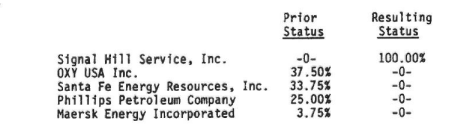
Lease history (excerpted from the Devon appeal):

  • Lease OCS-P 0166 was issued effective January 1, 1967.
  • Phillips Petroleum Company (“Phillips”) (predecessor to ConocoPhillips), Cities Service Oil Company (predecessor to Oxy), and Continental Oil Company (predecessor to ConocoPhillips) were the initial lessees
  • Phillips was designated operator on January 25, 1967
  • February 28, 1983: Petro-Lewis Funds, Inc., obtained the 37.5% interest of the Continental Oil Company (which in 1979 had changed its name to Conoco Inc., now Conoco Phillips Company (“ConocoPhilips”)).
  • November 1983: Cities Service Oil Company assigned its 37.5% interest to Cities Service Oil and Gas Corporation (now OXY U.S.A. Inc).
  • July 2, 1987: the Minerals Management Service (“MMS”) approved two more assignments of the Lease. One, from PetroLewis Funds, Inc. to American Royalty Producing Company (“American Royalty”), was approved retroactively to December 31, 1984. The other, from American Royalty to Santa Fe Energy Company(“Santa Fe”), was approved retroactively to April 30, 1987.
  • April 1, 1988: Santa Fe transferred a 3.75% interest to Maersk Energy Incorporated, reducing Santa Fe’s share to 33.75%.

1991 Assignment to Signal Hill: MMS approved assignment of the lease to Signal Hill effective February 5, 1991. The assignment was approved without any provision under which the assignors agreed to be liable for decommissioning operations on the lease. MMS’s approval actually had the opposite effect, leaving such obligations to the assignee. The assignment was approved despite concerns within the MMS about the financial strength of Signal Hill and the technical competence of Pacific Operators Offshore Inc (POOI), the affiliate that would operate the facilities.
Comments:

  • The assignment to Signal Hill should have never been approved. The outcome was predictable.
  • The Devon, Oxy, and ConocoPhillips appeals are very strong and would seem to have a good chance of success. Perhaps that is why the IBLA decision is taking so long (nearly 5 years to date).
  • Given the uncertainty regarding this appeal, the absence of transparency about other potential decommissioning liabilities, and the uncertainties regarding the administration of predecessor liability, this is not the time to be relaxing financial assurance requirements and further exposing taxpayers to decommissioning risks.

This is the final day to comment on BOEM’s proposal:
Read Full Post »

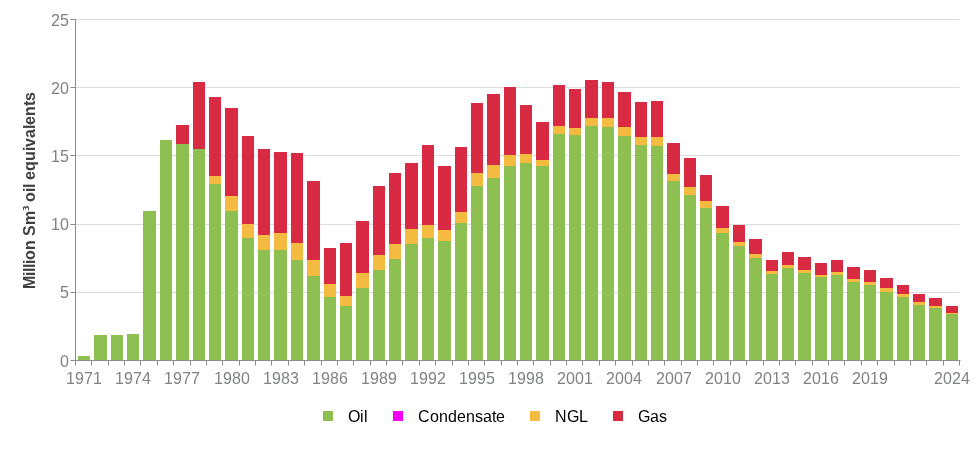
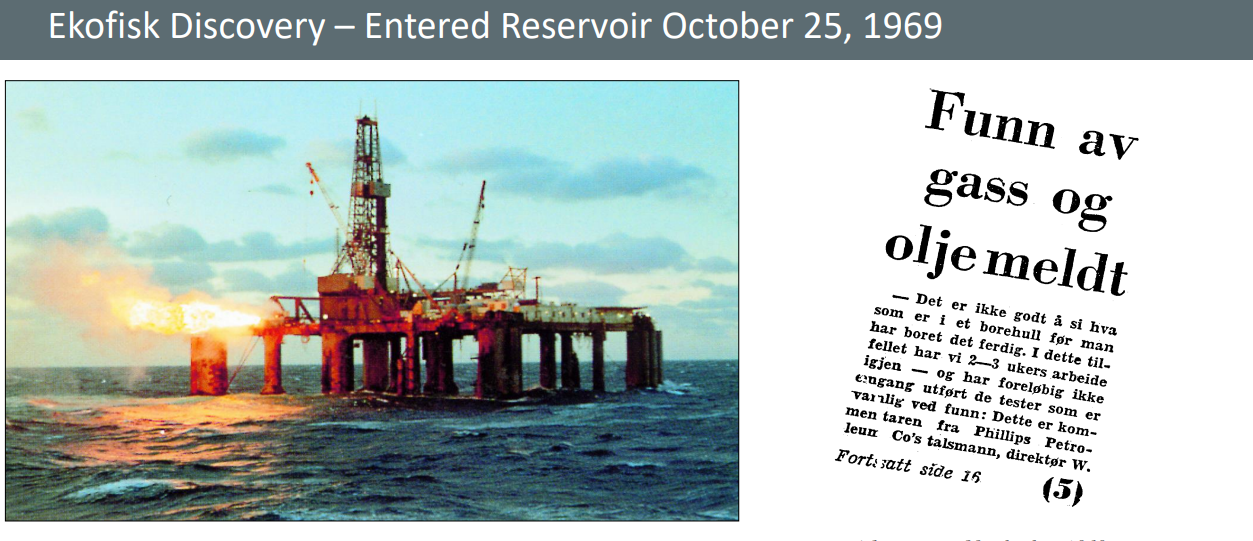
Ekofisk was Norway’s first commercial oil discovery in 1969, with first production in 1971. Another redevelopment phase could extend production to 2050 and beyond. This is a good example of how technology and reservoir management can extend field life indefinitely. Finite resources are not really finite.

Ekofisk production history; water injection began boosting production in 1987. The expected final recovery factor for Ekofisk is now estimated to be >50%.

ConocoPhillips and partners have approved the redevelopment of three gas and condensate fields depicted below — Albuskjell, Vest Ekofisk, and Tommeliten Gamma. Better well placement and the use of horizontal well technology will increase resource recovery.

The $1.8 billion project consists of four new subsea templates and 11 production wells tied back to the Ekofisk complex. First production is planned towards the end of 2028. Recoverable gas and condensate reserve additions are estimated at between 90 million and 120 million barrels of oil equivalent.

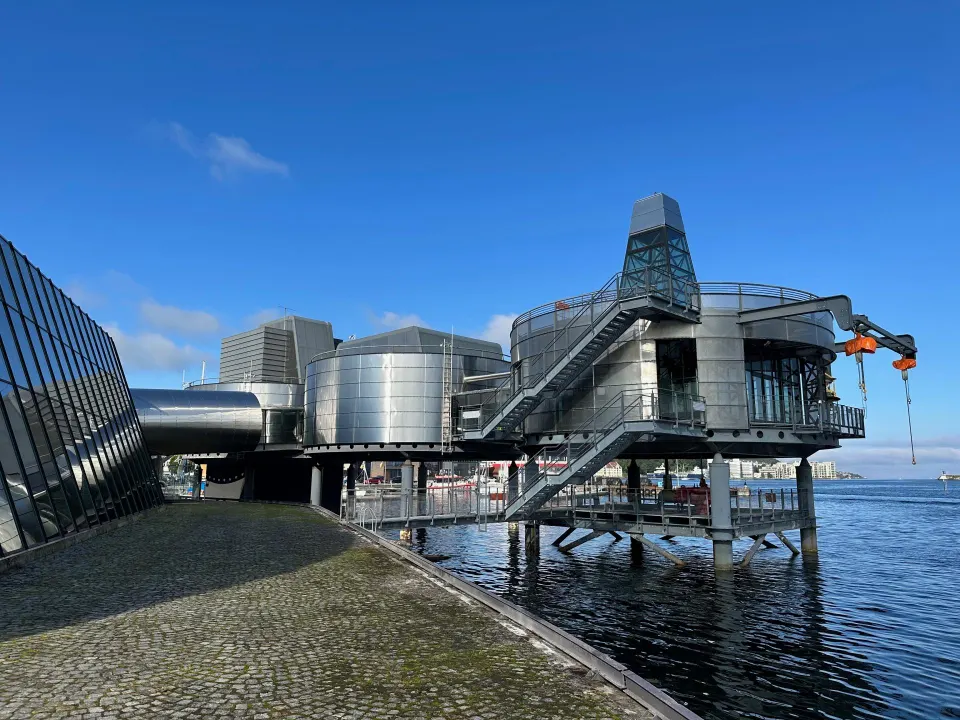
If you ever get to Stavanger, be sure to visit the Petroleum Museum! HIghly recommended!

Norwegian Petroleum Museum, Stavanger

Read Full Post »

  • Zero oil production
  • Zero gas production
  • Zero well starts in the past 8 years
  • Zero participation in recent lease sales

CP’s acquisition of Marathon is an endorsement of shale production, most of which is from private lands. Sadly, these historically important OCS operators no longer have an interest in the Federal offshore sector.

Given the potential for long-term, high-rate, and cost-effective production from deepwater wells, it may not be prudent for a US super-major to put all of the corporate eggs in the shale basket and ignore the OCS. However, contrary to the direction provided by the OCS Lands Act, Federal policies seem to encourage industry rejection.

The 5 year plan boasts about offering only 3 mandated lease sales, and punitive executive branch decisions are a continuous threat. Presidential withdrawals and other actions have eliminated 96.3% of the OCS from even being considered for leasing. Production from private onshore lands in supportive States like Texas and North Dakota is very attractive by comparison.

Read Full Post »

Was 2021 the low point? Hopefully that is the case, but consistent leasing is essential.

Looks like Woodside is now officially the GoM operator of record (was BHP prior to merger). Kudos to them.

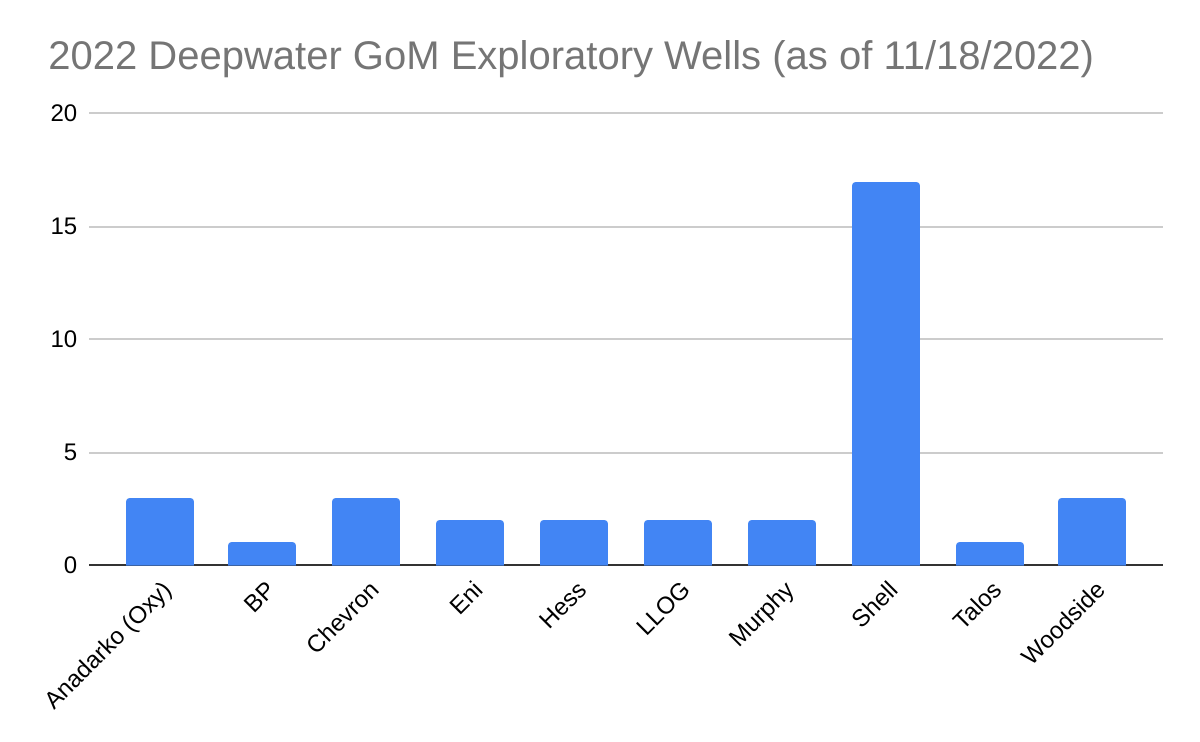
Shell continues to be the GoM bellwether. There is no OCS program without them.

What’s up with BP and Chevron? Big declines from both.

US super-majors Exxon and ConocoPhillips remain out of the picture, both in terms of lease acquisition and exploration. Disappointing.

Tip of the hat to Hess, LLOG, Murphy, and Talos – independents committed to deepwater production.

Read Full Post »

Foremost energy experts like Daniel Yergin understand that oil and gas will be critical to our economy and security for decades, and that offshore production is an important component of our energy supply chain. Unfortunately, our massive outer continental shelf has, from an oil and gas standpoint, been effectively reduced to the central and western GoM.

Opportunities in the GoM are being seriously constrained by the extended pause in leasing. A lease sale has not been held for 615 days, the longest US offshore leasing gap since the 1950’s.

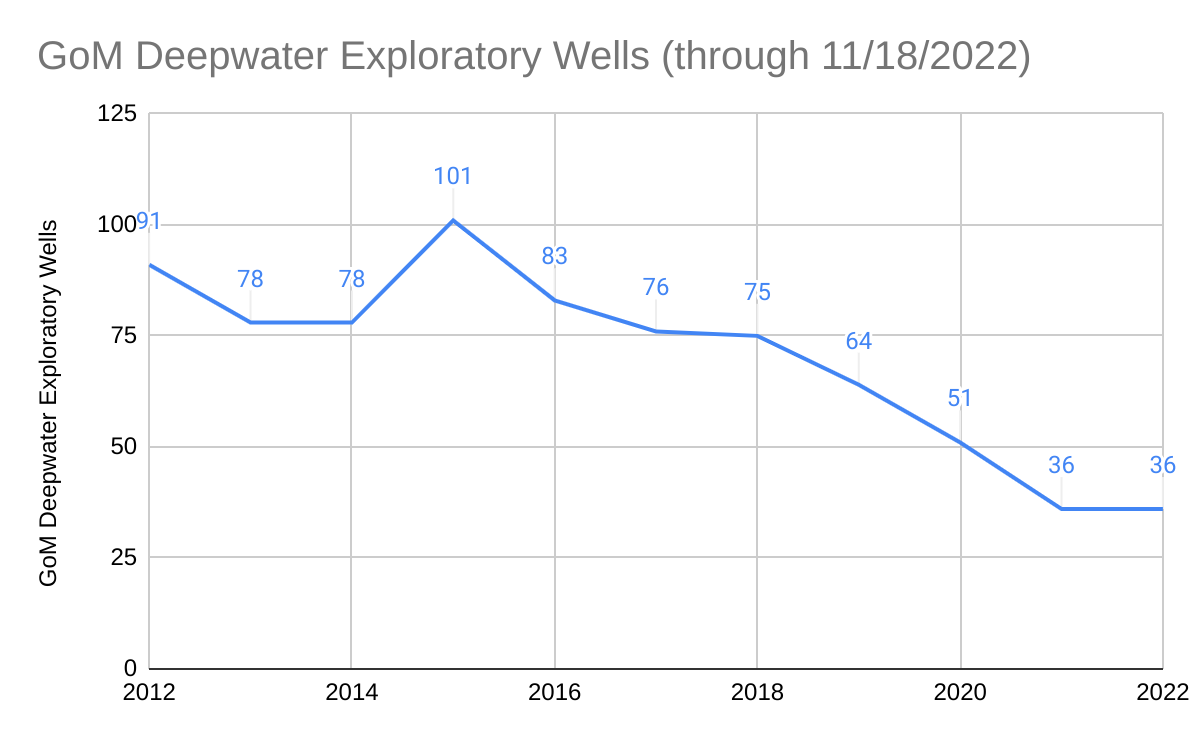
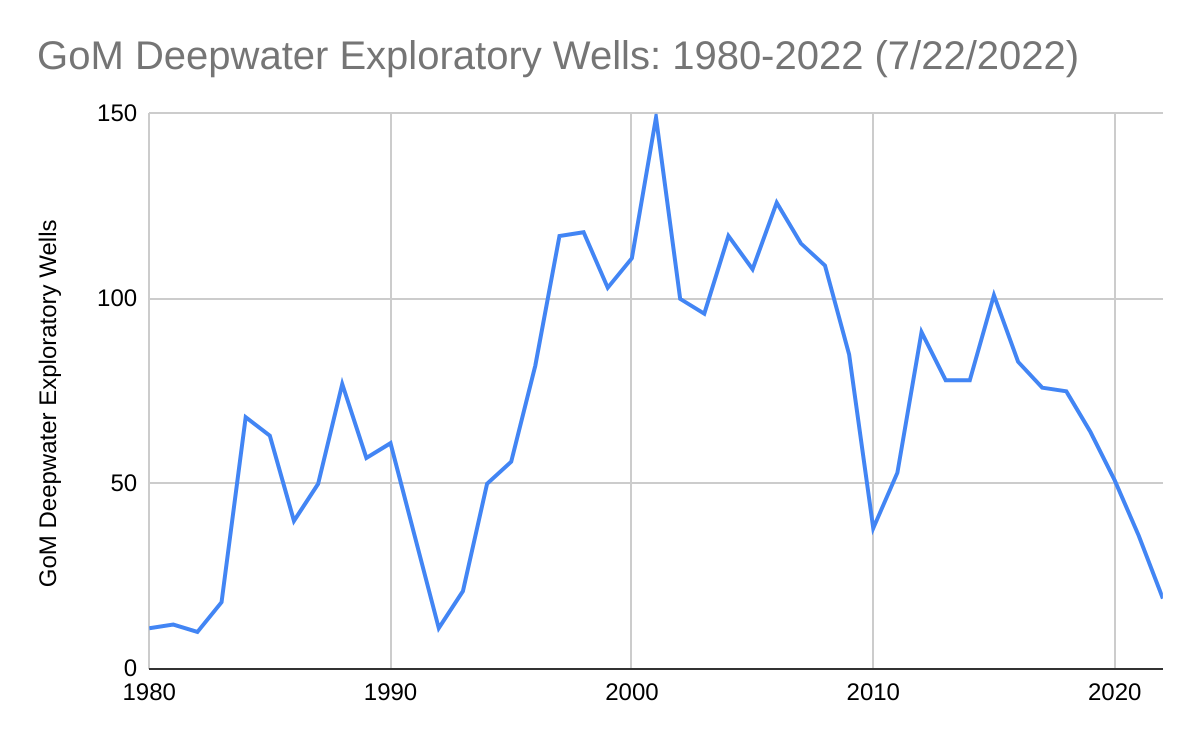
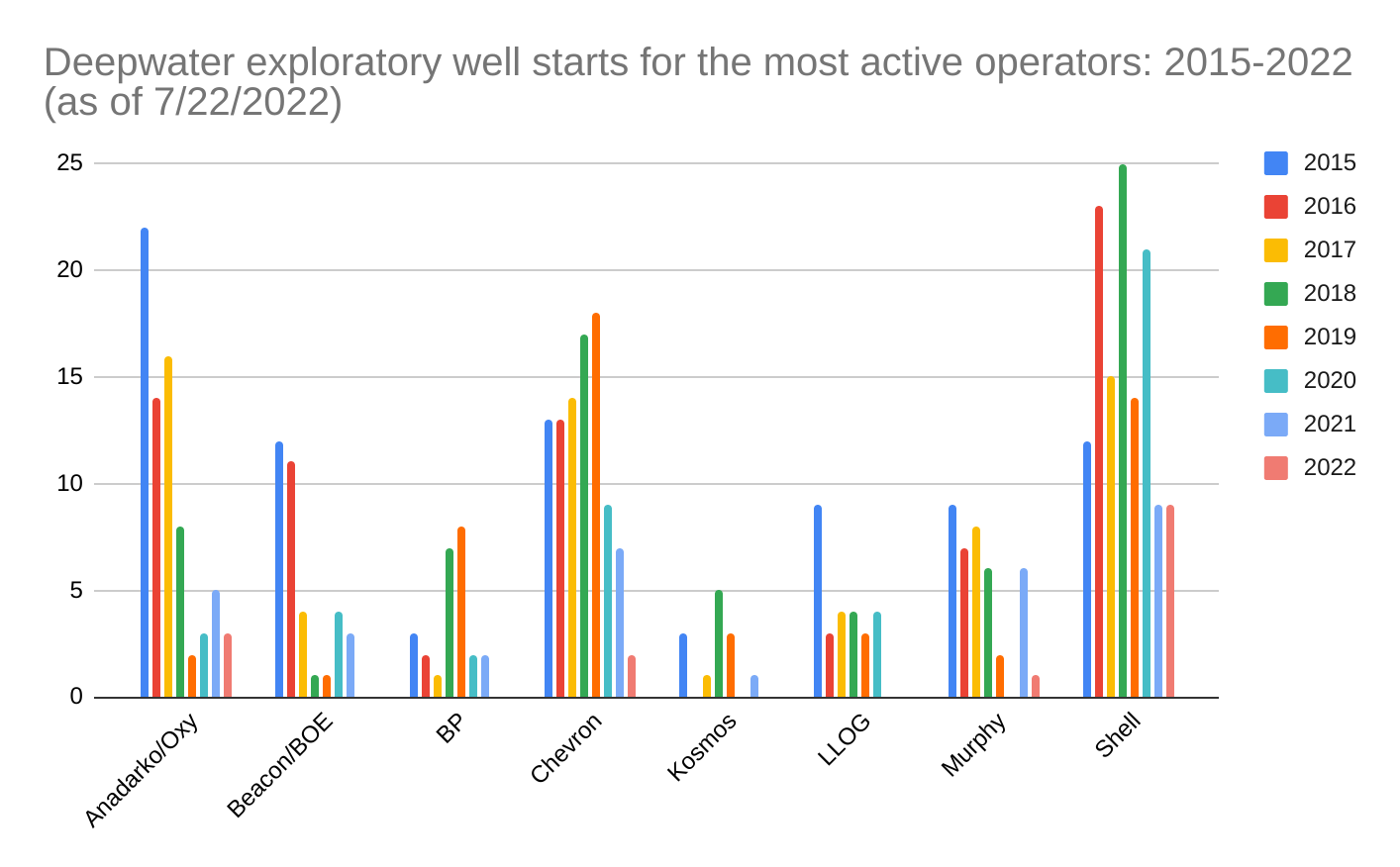
Reserve replacement and sustained production are dependent on exploration. The charts below illustrate the decline in GoM exploratory drilling and the reduced activity by some of the more important operating companies.

Per BSEE data, the number of exploratory well starts averaged only 3/month for the last 18 months (chart 2). This level of activity is the lowest since the early days of deepwater operations (chart 1). There was even more drilling during the post-Macondo moratorium (2010-2011).

ConocoPhillips and Exxon have not drilled a GoM exploratory well since 2016 and 2018 respectively. Activity by other operators has also declined significantly (chart 3). BP has not spudded an exploratory well since Sept. 2021.

No one should be surprised by the sharp decline in reserves and the dearth of recent field discoveries. Hopefully, government and industry will engage in a more thorough discussion of these trends and measures that might improve the intermediate and longer term production outlook.

chart 1
chart 2
chart 3

Read Full Post »

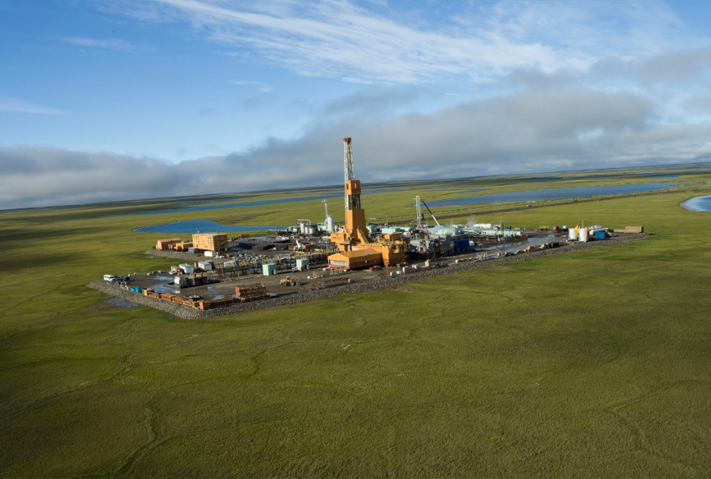
Alpine drill site, CP photo

In March, a gas release incident occurred while drilling a disposal well in the Alpine field on the North Slope of Alaska. While there were no injuries or environmental impacts, the investigation and findings will help minimize well construction risks during future operations. The report is attached.

Some comments:

  1. I like the way the report, related information, and all situation reports were posted in a timely manner on the Alaska Oil and Gas Conservation Commission (AOGCC) homepage. It’s refreshing that the AOGCC homepage is 100% substantive and completely devoid of the spin and propaganda you find on most government and corporate websites. (For comparison purposes, check out the Department of Energy and Department of the Interior homepages.)
  2. The ConocoPhillips (CP) incident report is concise, logically organized, and clearly written.
  3. The findings are consistent with the data, and the supporting figures are legible and understandable.
  4. Instead of blaming the crew or using the “human error” cop out for the leak-off test execution and subsequent monitoring issues, the report rightfully attributes those failures to company procedures and communications. This reflects well on CP’s understanding of the human and organizational factors that contribute to safety performance, and CP/AOGCC efforts to foster a strong safety culture. (Remember the shameful prosecution of well site leaders Bob Kaluza and Don Vidrine following the Macondo blowout.)

Read Full Post »

From Reuters article:

  • bp: Only 15% of shareholder votes backed a call for the company to accelerate its energy transition, compared with the 21% in favor in a similar vote last year.
  • Oxy: Only 17% of investors backed a call for emissions-reduction targets. (I wonder how Buffett voted 😀)
  • Marathon: 16% supported a measure calling for the company to report on how its transition plans affected workers and communities
  • ConocoPhillips: 42% supported an emissions-reductions targeting measure vs. 58% last year.

Exxon, Shell, and Chevron are on deck!

Read Full Post »

Mr Mueller likens the role of cementers in well construction to that of cornerbacks in football: “When we fall down and someone passes for a touchdown, everyone sees it. … When there’s a failure (in cementing), it’s typically quite noticeable and costly, even catastrophic. … You have to always ask yourself, ‘What haven’t I thought about? What can go wrong? If it does go wrong, how can we fix it?’ ”

In the wake of Montara, I recommend that you read an excellent article in the latest edition of Drilling Contractor magazine about Dan Mueller, a cementing specialist for ConocoPhillips.  Having read hundreds of pages about the cementing issues that appear to be the root-cause of the Montara blowout, it was refreshing to see Mr. Mueller’s comments and learn more about his company’s commitment to safe and effective cementing operations.  While incidents like Montara rightfully attract much of our attention, most companies understand the importance of cementing and provide the resources necessary to ensure success.  As the article reminds us:

The high stakes at play – plus the increasingly hostile conditions under which wells are drilled today – means that preplanning on a well-by-well basis is crucial. Thermal modeling, wellbore stress modeling, hydraulics modeling, computational dynamics modeling – everything that can be done has to be done to make sure nothing gets overlooked. In today’s complex wells, Mr Mueller explained, anything that’s an “unknown” has the potential to damage the cement’s effectiveness.

Read Full Post »