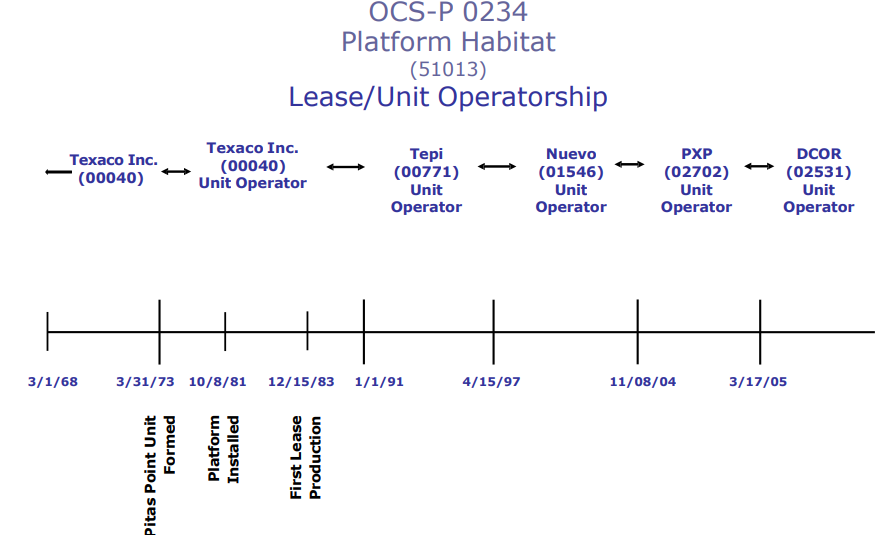
The Appeal Process is Broken – The GAO should have emphasized this point. Companies routinely appeal orders to decommission platforms to forestall having to spend money on plugging wells and removing platforms, pipelines and other facilities. The appeal process commonly takes 5 or more years to reolove (e.g., DCOR appeal of BSEE order to decommission Platform Habitat).
Well P&A – BSEE has been negligent in requiring operators to plug and abandon wells no longer useful for operations. I’m shocked BSEE has curtailed or stopped issuing Inc’s for the failure of operators to P&A wells. That’s a major failure on the part of BSEE management. That may explain why operator performance criteria was proposed to be eliminated for financial assurance.
Failure to Issue Civil Penalties for Well P&A – From GAO Report “BSEE officials explained that their reluctance to pursue civil penalties stems in part from concerns about whether inducing financial harm against an operator is an effective approach to compel decommissioning. They expressed reservations about taking actions—such as issuing civil penalties—that might strain the financial resources of operators to the point of pushing them into bankruptcy.” This attitude underscores a real problem – an abrogation of regulatory and enforcement responsibility by BSEE.
POCS Well P&A – More than 700 wells have been drilled from the 23 California OCS platforms. The GAO report notes that approximately 200 are in the process of being plugged and abandoned – about 50% of those are probably associated with Gail, Grace, Harvest, Hermosa, Hidalgo, where P&A work has largely been completed by Chevron and Freeport McMoRan. The vast majority of the remaining 500 wells are no longer useful for operations and have been idle for several decades. Note POCS was never part of the Idle Well and Idle Iron Program, which was exclusive to the GOM. GAO gave POCS BSEE a pass by not highlighting that problem in POCS. It would have been interesting to know how many of the remaining 500 POCS wells are considered no longer useful for operations, and how many of those have been temporarily plugged and abandoned pursuant to regulations. The GAO report broke that down for the GOM.
Footnote 46 of GAO Report – “Two of the eight platforms due for decommissioning in the Pacific—platforms Hogan and Houchin—have posed serious safety, environmental, and financial risks, including poor safety compliance records, severe corrosion, and ongoing disputes about who will assume decommissioning liabilities for the platforms and their associated wells, according to BSEE officials and documentation. According to BSEE, these platforms are currently being attended, monitored, and maintained as part of an agreement between BSEE, BOEM, Interior’s Office of the Solicitor, and the three predecessor operators pending a decision from the Interior Board of Land Appeals on the predecessors’ appeal. BSEE estimates that approximately $5 million of the estimated costs to decommission 21 orphaned sidetrack wells associated with these platforms are uncovered by financial assurances.” $5 million divide 21 = $238,000 per well – extremely conservative cost estimate given age of wells, likely collapsed casing, and downwhole equipment that needs to be removed. The cost could easily be 3-4 times higher and there is no bonding so the federal government and taxpayers are on the hook for those costs.
Platform Hogan and Houchin Wells – approximately 75 wells were drilled from the platforms. It would be interesting to know the status of those wells. How many have been properly temporarily plugged and abandoned with long-term barriers installed to prevent leaks before decommissioning pursuant to OCS regulations? Are the 21 orphaned wells mentioned above the Signal wells? What about the other 54 wells? Have the predecessor lessees agreed they are responsible for plugging and abandoning those wells?
Platform Habitat – GAO could have noted this is another example of the broken appeal process. It would be interesting to know whether the 21 wells (primarily if not all gas wells) on Habitat have been temporarily abandoned. There are likely to be significant fugitive emission levels at the platform. Hopefully the APCD is on top of that. Note – the platform is unmanned and as I previously mentioned a potential catastrophe was avoided several years ago when a fire broke out on the platform.
Read Full Post »