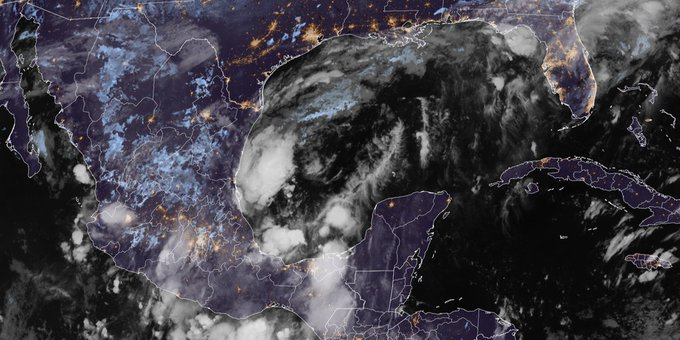
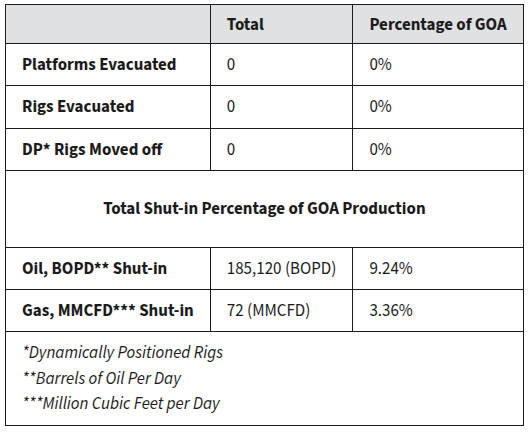
MMA estimates that approximately 9.24% of current Gulf of America oil production and 3.36% of natural gas production were shut-in as of 1130 CT today. No personnel had been evacuated.
Posted in Gulf of Mexico, hurricanes, Offshore Energy - General, tagged Gulf of America, Invest 92L, production shut-in, tropical storm on October 6, 2026| Leave a Comment »
MMA estimates that approximately 9.24% of current Gulf of America oil production and 3.36% of natural gas production were shut-in as of 1130 CT today. No personnel had been evacuated.
Posted in California, energy policy, Offshore Energy - General, pipelines, Regulation, tagged 9th circuit, delayed decision, Las Flores Canyon, pipeline, Sable Offshore, Santa Ynez Unit on October 6, 2026| Leave a Comment »
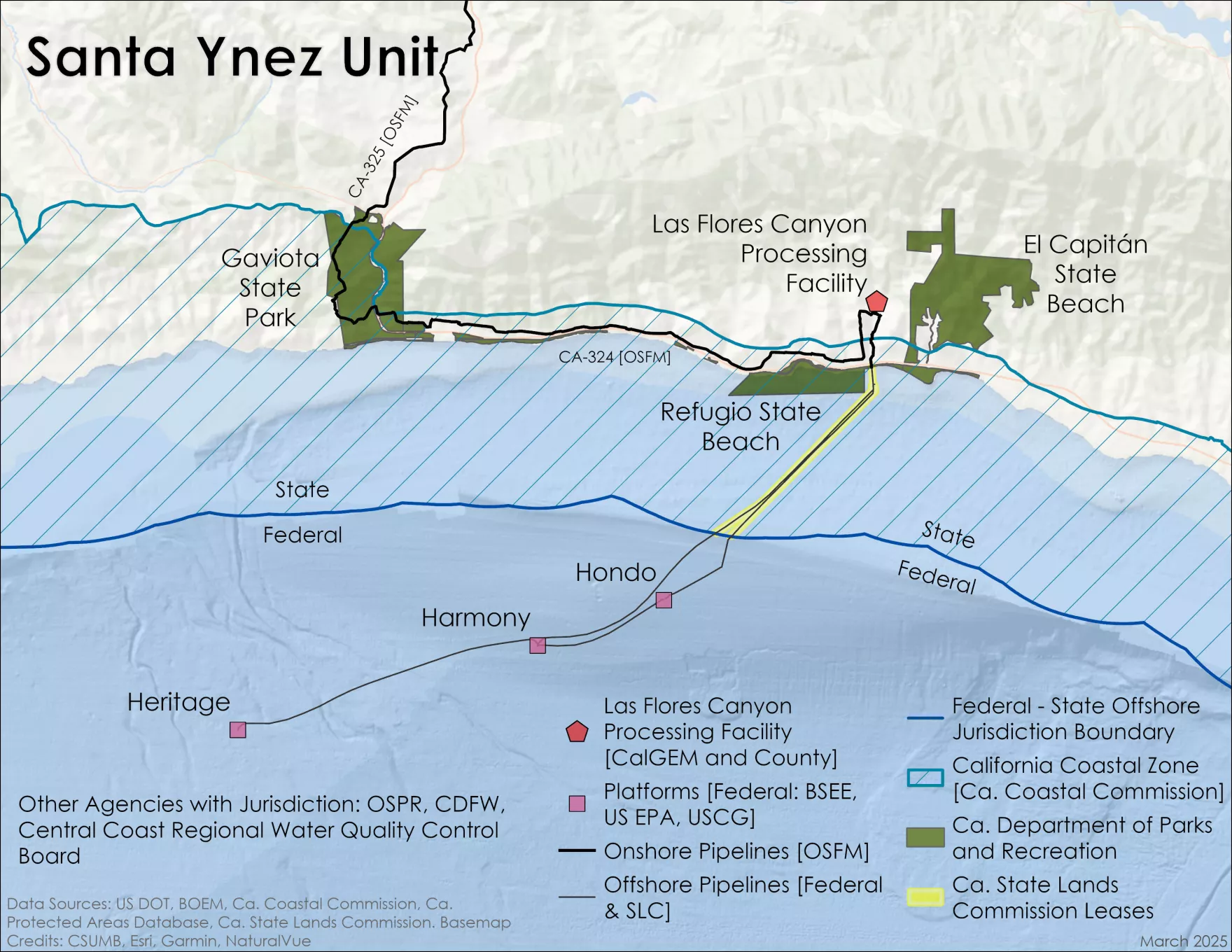
The U.S. Court of Appeals for the Ninth Circuit has not yet ruled on the merits of the challenge to PHMSA’s assertion of exclusive Federal jurisdiction over Sable Offshore Corp.’s Las Flores (Santa Ynez) pipeline segments (CA-324 and CA-325) or related restart approvals. A three-judge panel ordered additional briefing after a status conference, and a decision is expected to take months.
The 9th Circuit panel held a video status conference on 10/5/2026, and consolidated petitions from the Environmental Defense Center (and other groups) and the State of California. The panel ordered further briefing rather than issuing an immediate decision on the core jurisdictional question—whether the onshore pipeline segments engage in “interstate commerce” under the Pipeline Safety Act (making them subject to exclusive PHMSA authority rather than California’s Office of the State Fire Marshal).
Concise background summary from Grok: PHMSA reclassified the pipelines as interstate in late 2025 (asserting jurisdiction because they transport crude from Outer Continental Shelf platforms through California to a Kern County terminal, with arguments that onshore processing does not break the flow of interstate commerce). This enabled restart approvals and special permits (initially emergency, later a longer-term one) that environmental groups and California challenge as unlawful, preemptive of state authority, and deficient under the Pipeline Safety Act, NEPA, and ESA. Sable restarted operations earlier in 2026 amid related litigation (including Defense Production Act issues and consent-decree matters in district court). The Ninth Circuit cases are Environmental Defense Center et al. v. PHMSA (No. 25-8059) and the consolidated California petition (originally No. 26-508 / related Nos.).
Posted in Alaska, drilling, energy policy, Offshore Energy - General, Regulation, well control incidents, tagged Arctic drilling, MMA, regulations, regulatory fragmentation, same season relief well, subsea isolation device, well control on October 5, 2026| Leave a Comment »
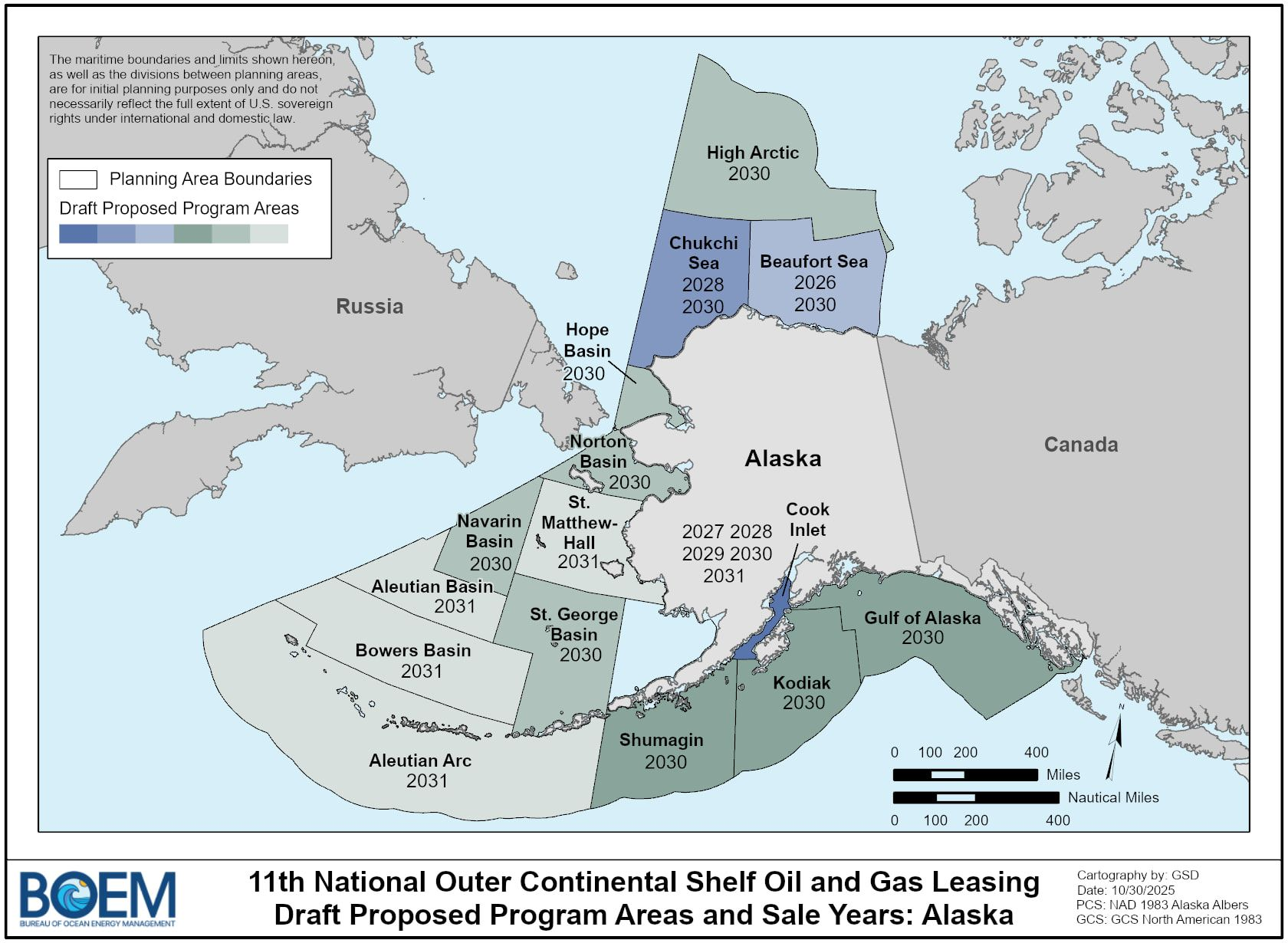
Comments on the proposed “Revisions to the Requirements for Exploratory Drilling on the Arctic Outer Continental Shelf” are due today.
My submission (one page) is attached. Main points:
Posted in California, energy policy, Offshore Energy - General, Regulation, tagged 2025 Gulf of America oil production, AB 1448, MMA, Platform Hondo, Sable Offshore, Santa Ynez Unit on October 2, 2026| Leave a Comment »
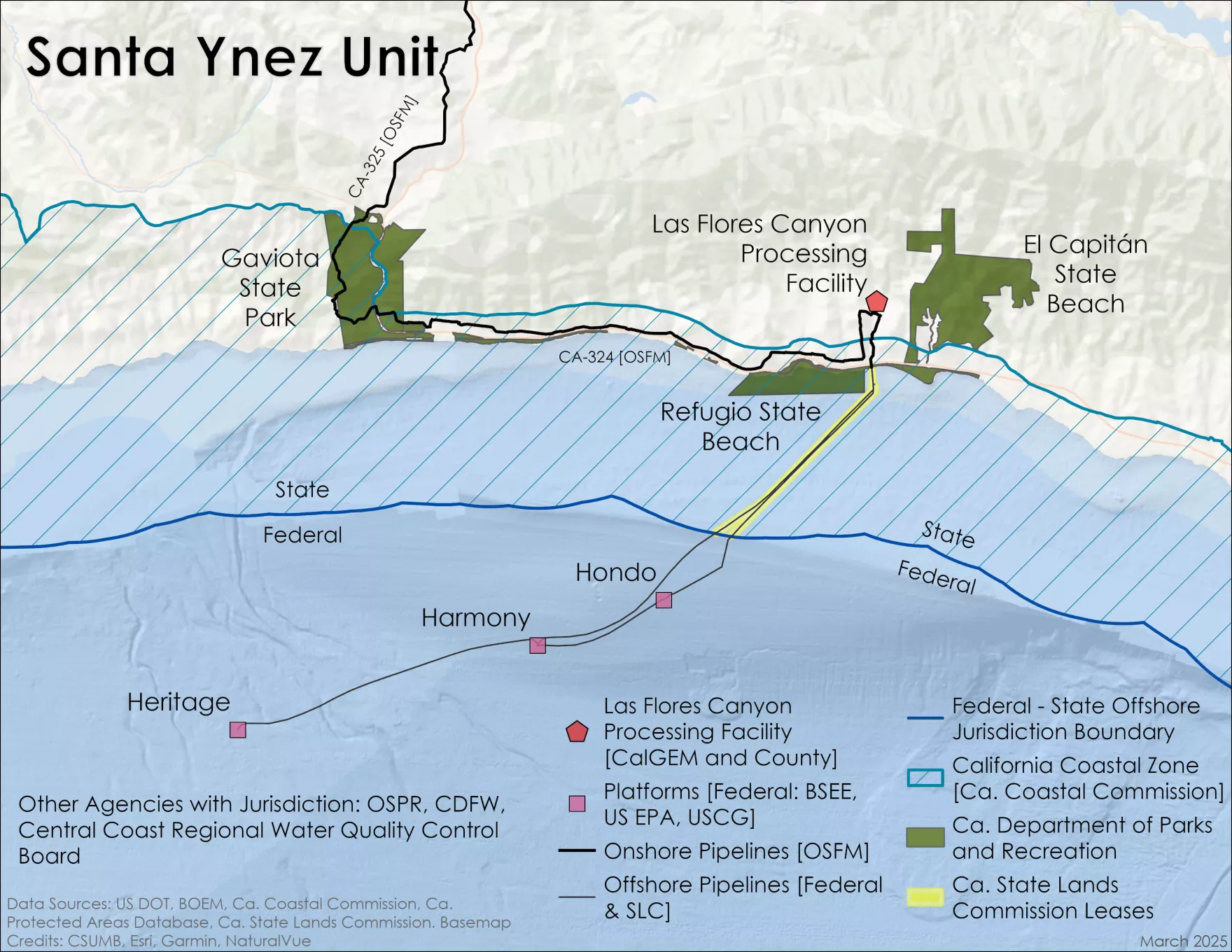
Sable’s update includes production and sales information, but nothing about the pipeline anomalies. Summary:
Also Sable related:
Posted in California, Gulf of Mexico, Offshore Energy - General, tagged EIA, Gulf of America, offshore oil, Pacific, production on October 1, 2026| 3 Comments »
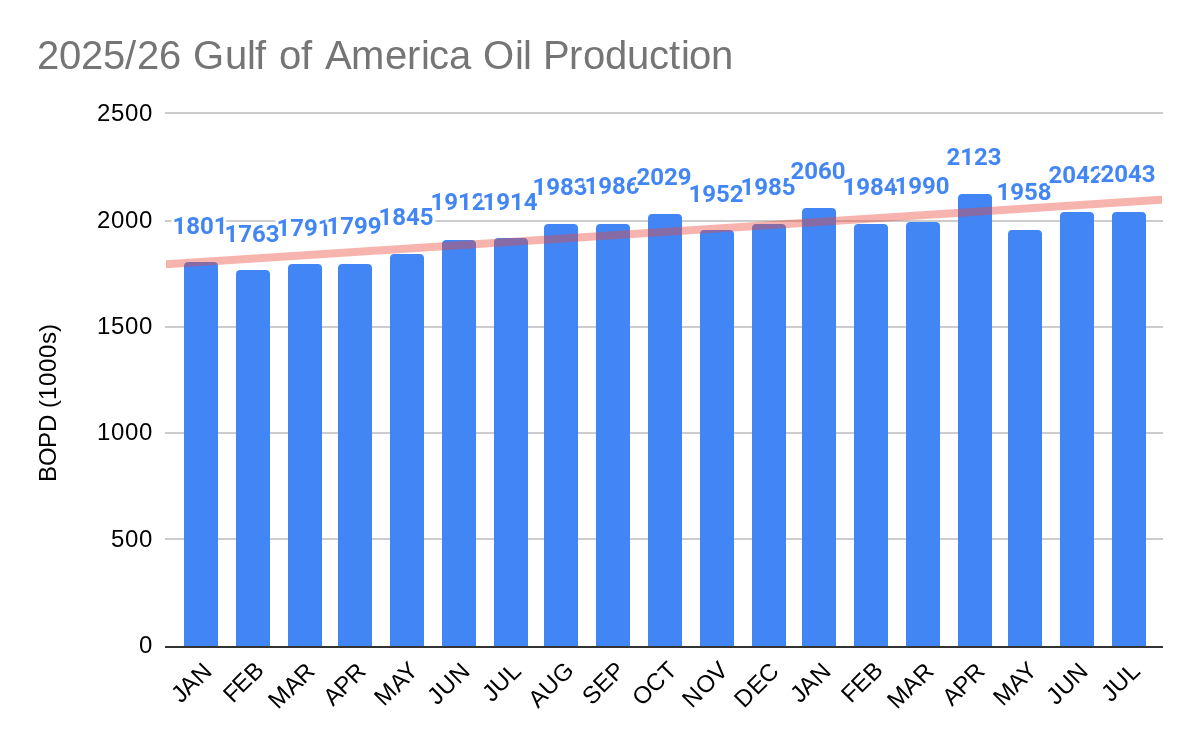
2025 was a record production year for the Gulf. Assuming the continued absence of tropical storms, 2026 will likely surpass 2025.
The EIA’s Gulf production revisions have been more significant in recent months. For example, May production was increased by 48,000 bopd over the past 2 months. Yesterday’s report increased June production by 44,000 bopd.
More importantly, the EIA and official ONRR production totals for 2025 are now aligned! Is the EIA reading this blog? 😉
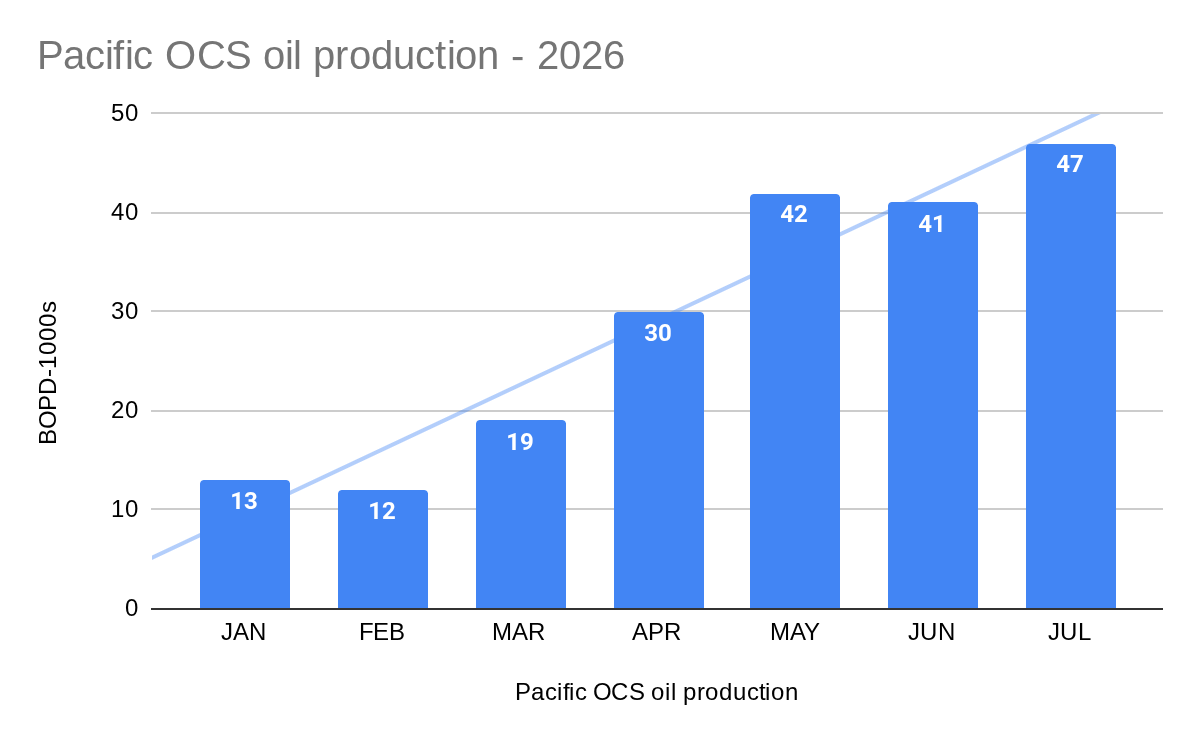
The July production bump in the Pacific was slightly less than expected. Given that Sable reported July production of 38,000 bopd and the production estimate for the other platforms is ~12,000 bopd, a total of 50,000+ bopd was expected.
Posted in California, Offshore Energy - General, Regulation, tagged AI, litigation, number of cases, PHMSA, Santa Ynez Unit, special permit on September 30, 2026| Leave a Comment »
I asked two AI wizards if they could tell me the total number of lawsuits filed against Sable Offshore or the Federal govt regarding the restart and transport of production from the Santa Ynez Unit. One said the total fluctuates as new petitions are filed and consolidated. (Duh! 😉)
Grok gave it a good shot, qualifying the answer as appropriate:
“There is no single official or comprehensive public tally of every lawsuit ever filed on this topic. As of late September 2026, reporting describes roughly a dozen active/related lawsuits tied to the Santa Ynez Unit (SYU) pipelines and restart; many more have been filed overall (some resolved, consolidated, or mooted).” (Reasonable answer.)
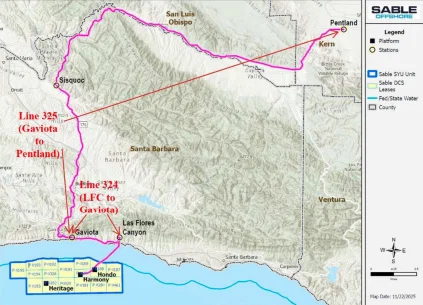
The most recent Court filing is by a group of NGOs challenging PHMSA’s June 25, 2026, order granting a “Special Permit” to Sable Offshore. The Special Permit, which is the subject of a number of lawsuits pertinent to the restart of Santa Ynez Unit production, applies to onshore pipeline segments CA-324 and CA-325. The pipeline originates at Las Flores Canyon in Santa Barbara County and terminates at Pentland Station in Kern County (map above).
In brief, the petitioners claim that the Special Permit and related documents were issued in excess of PHMSA’s statutory jurisdiction and authority and were issued unlawfully, and that PHMSA’s conclusions are arbitrary, capricious, and an abuse of discretion. Petitioners also challenge FWS’s concurrence with PHMSA’s determination that its order(s) will not likely adversely affect endangered species.
Here is a link to the complete Court filing, courtesy of Politico. For those who are following these matters, the PHMSA permit and related documents are included as exhibits. This compilation is helpful.
Posted in Offshore Energy - General, California, Gulf of Mexico, energy policy, rigs-to-reefs, tagged decommissioning, EO 14430, John B Smith, Marine Minerals Administration, NOAA, repurposing platforms, rigs to reefs on September 25, 2026| 2 Comments »
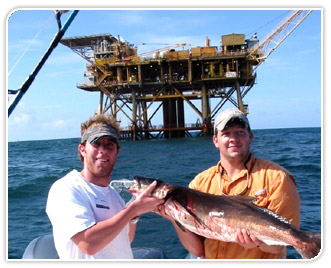
Section 6 of EO 14430, RESTORING AMERICAN SALTWATER ANGLING AND RECREATION, establishes a program to facilitate the reefing of decommissioned platforms (i.e. “Rigs-to-Reefs”).
Presumably, existing Gulf State reefing programs and private initiatives for repurposing offshore platforms will be integrated into the new Federal program. Where State reefing legislation is unworkable (California), liability issues will have to be resolved. John Smith has made a proposal in that regard.
Full text of Section 6:
Sec. 6. Fast-Tracking Artificial Reefs and Habitat Creation. (a) Within 60 days of the date of this order, the Secretary of the Interior, acting through the Marine Minerals Administration, shall establish a Federal Outer Continental Shelf Reef-in-Place Program (Program) to facilitate the conversion of decommissioned offshore oil and gas and other-use structures, with the exception of infrastructure associated with offshore wind energy facilities, into permanent artificial reefs through reef-in-place, topple-in-place, or other approved reefing methods, where consistent with applicable law.
(b) The Program shall be available to qualifying offshore structures and leaseholders that satisfy all applicable statutory, regulatory, environmental, navigational, and safety requirements. The Secretary of the Interior shall establish criteria and standards for the program that ensure protection of navigation and national security interests.
(c) In establishing the Program, the Secretary of the Interior shall coordinate with the Secretary of Commerce, the Secretary of War, the Commandant of the United States Coast Guard, and the heads of other appropriate agencies to streamline interagency review and permitting to the maximum extent permitted by law, reduce unnecessary administrative delays, and promote timely decisions for qualifying reef projects.
(d) Within 120 days of the date of this order, the Secretary, acting through the NOAA Administrator, in coordination with the Secretary of the Interior, shall review and, as appropriate and consistent with applicable law, revise policies and procedures governing SUPs and other applicable authorizations for the placement and management of artificial reefs within National Marine Sanctuaries and Marine National Monuments. Such revisions shall seek to establish transparent and efficient permitting pathways, identify areas suitable for artificial reef development and other national interest uses, and enhance fisheries, recreational fishing, diving, and other compatible public uses.
Posted in energy policy, natural gas, Offshore Energy - General, tagged Gulf of America, Marcellus, minnow, natural gas, production, production by state on September 22, 2026| Leave a Comment »
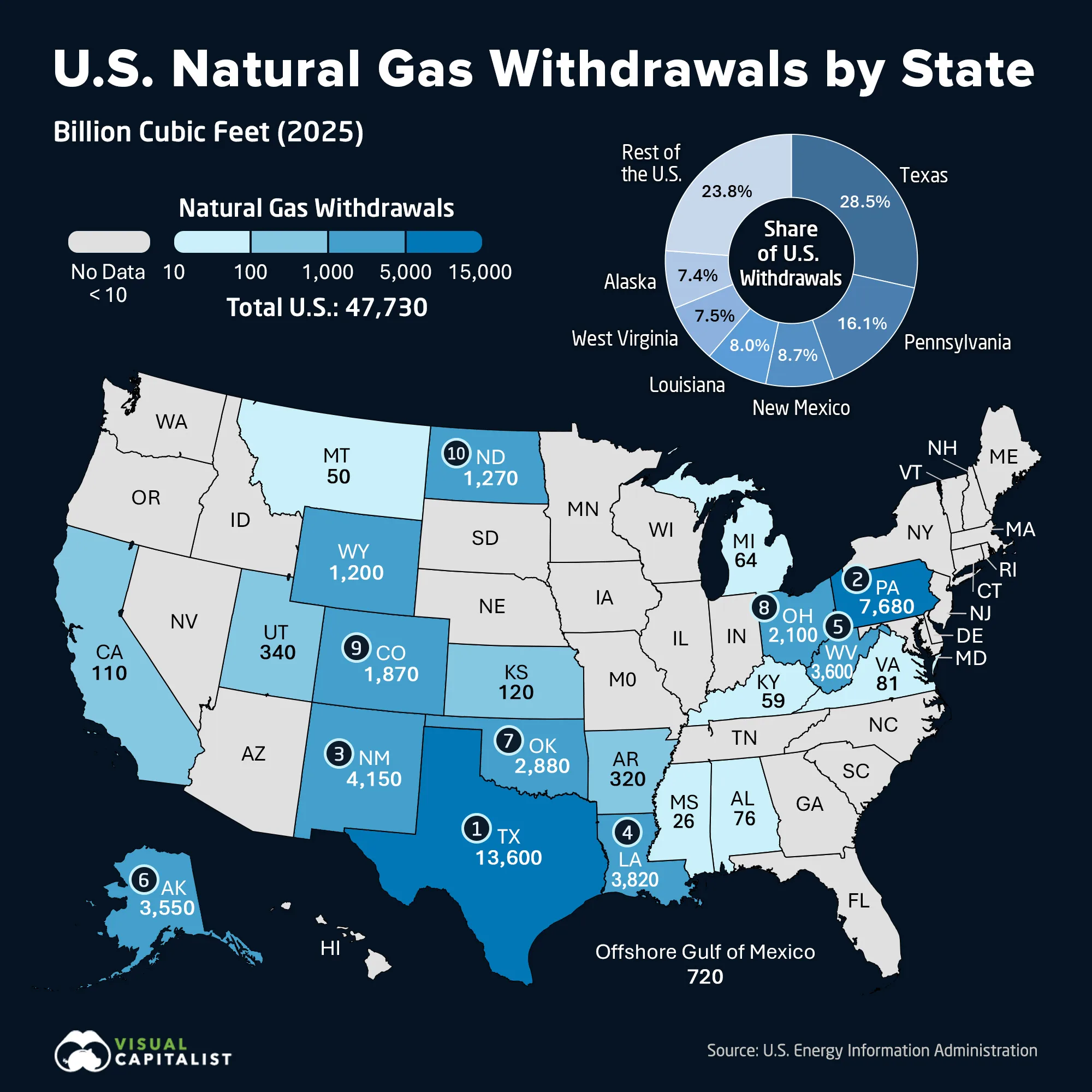
2025 Gulf of America gas production as compared to:
Gas production in OK, OH, CO, ND, and WY also exceeded Gulf production.
NY gas production would also be far > than Gulf production, if companies were allowed to access natural gas in the Marcellus and Utica shale formations.
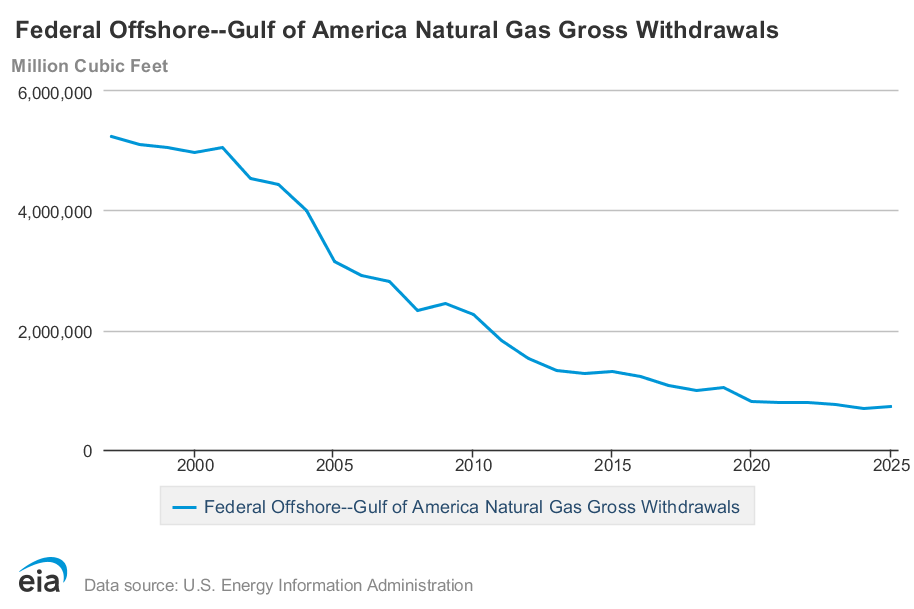
Total US gas withdrawals have doubled from 30 years ago when the Gulf accounted for >20% of the US total. Gulf production declined by 87% in that timeframe.
Posted in energy policy, Guyana, Offshore Energy - General, tagged Atlantic oil and gas, BOEM, Mauritania, pangea, Paul Post, Senegal on September 21, 2026| Leave a Comment »
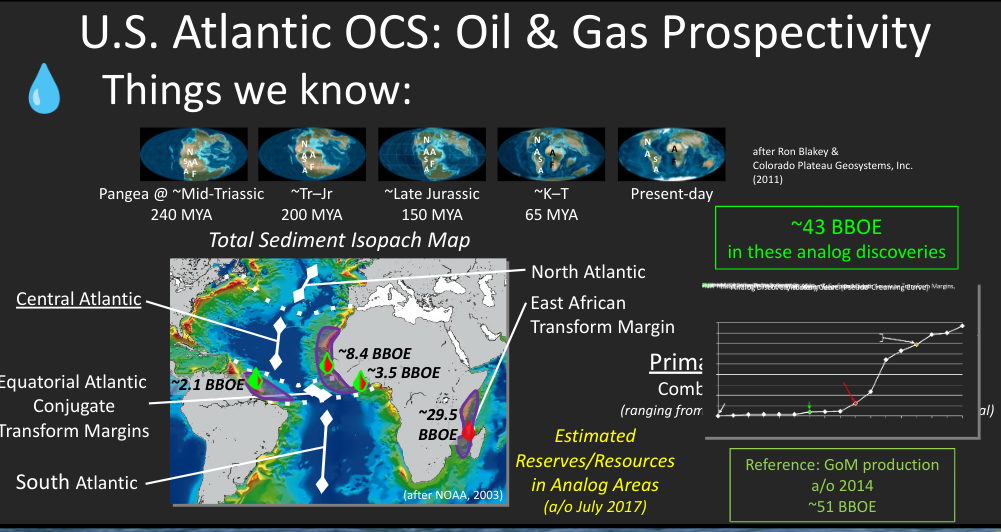
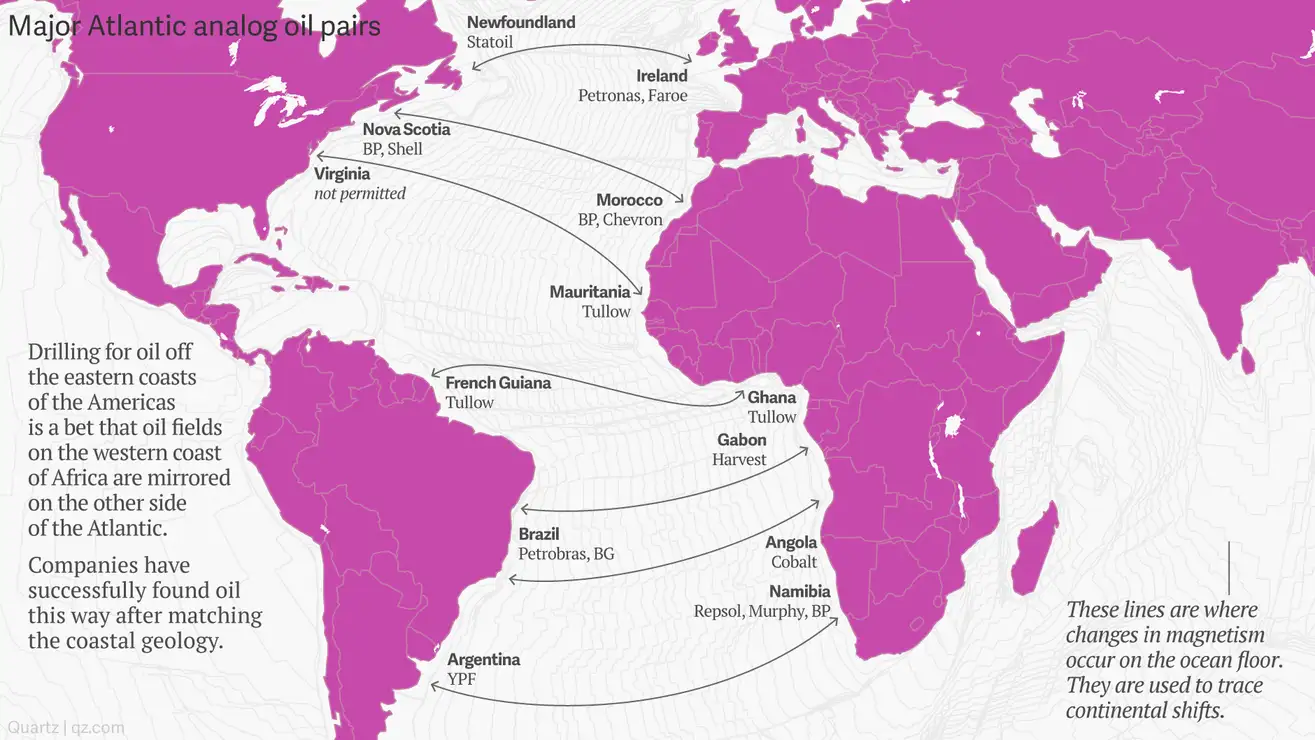
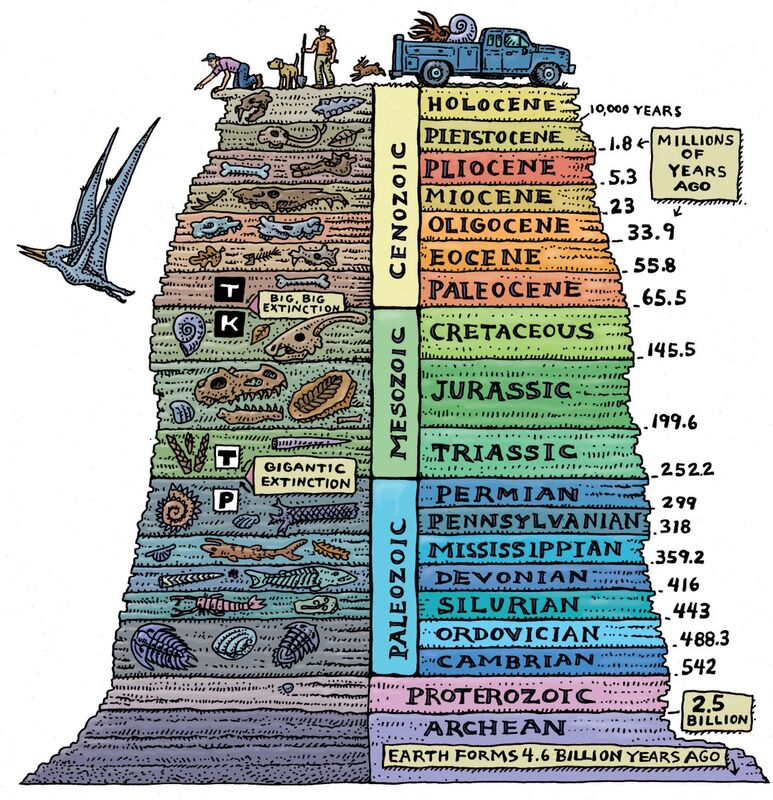
Until the late Triassic period, Virginia, the Carolinas, and Georgia were co-joined with Mauritania and Senegal as part of the Pangea super-continent. These Pangea neighbors share a common ancient geology.
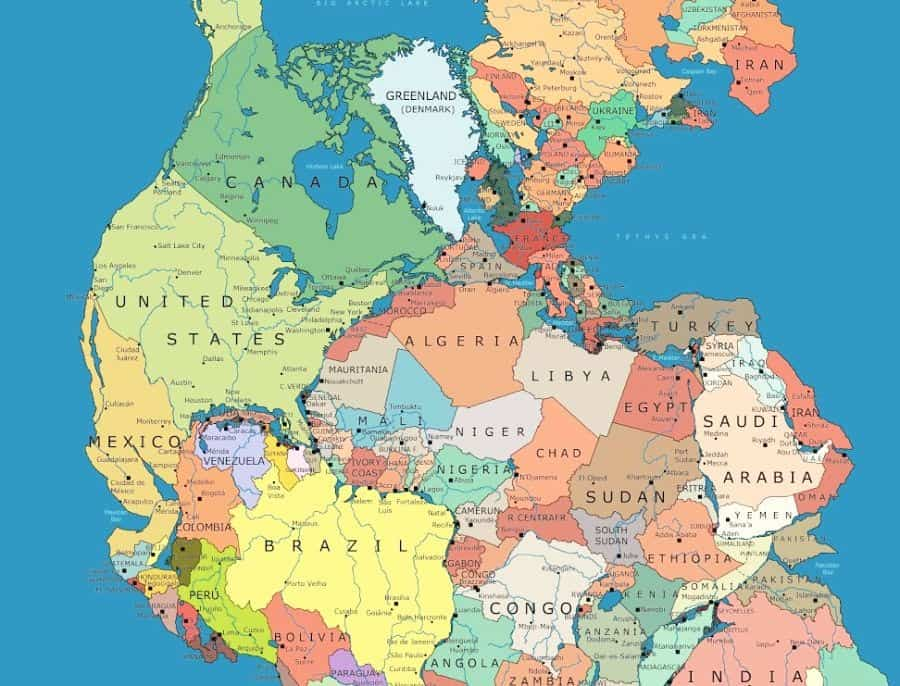
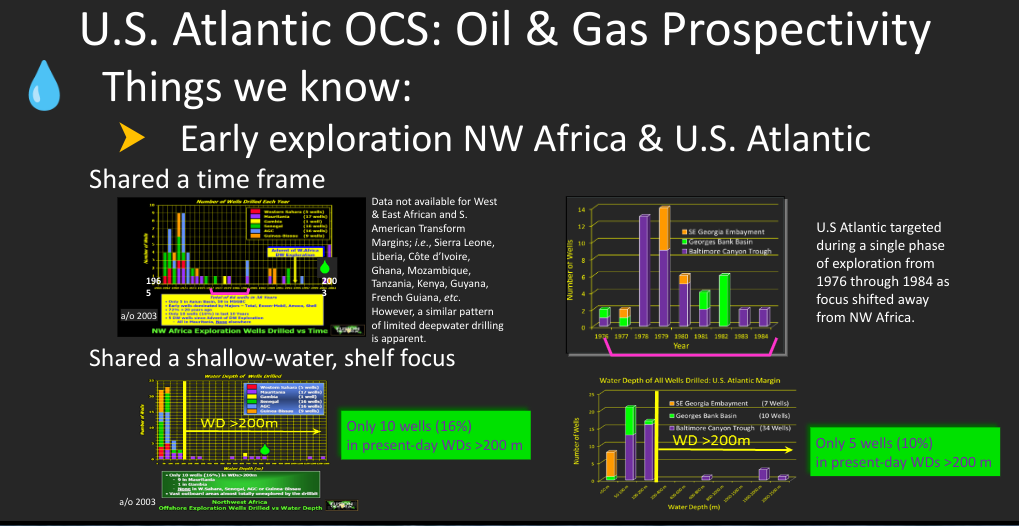
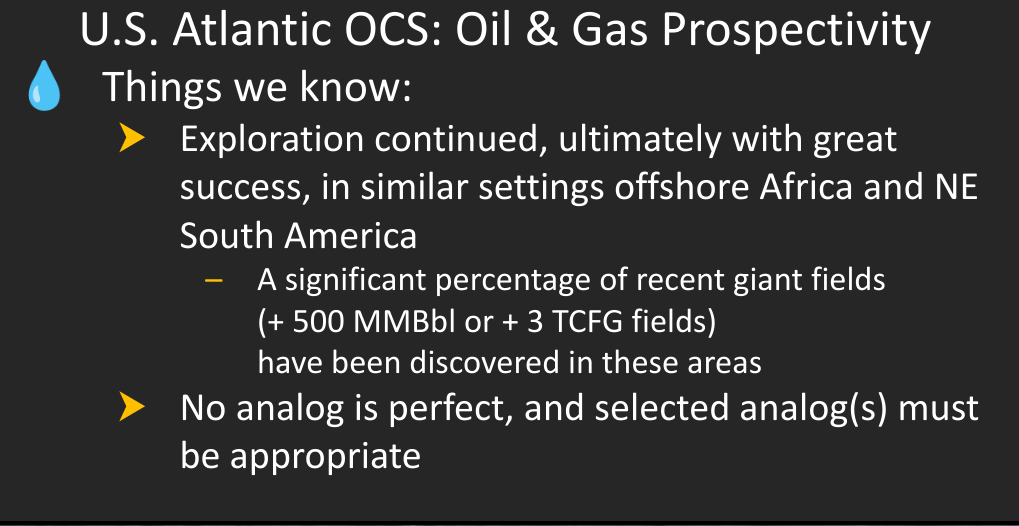
Paul Post believed the untested West African analogs in the US Atlantic were highly prospective, and could contain >20 billion barrels of oil equivalent (BOE). Paul was not alone in his thinking about Atlantic resource potential.
Sadly, Paul is no longer with us 😥. I’m sharing a few of his slides as a reminder of his important work. I have also attached his 2016 report and am linking the 2021 update.
Given the current Atlantic moratoriums and the steep legal, social, and political barriers that would have to be cleared, evaluating the US Atlantic is not imminent. However, nearly all Atlantic nations and their Caribbean and North Sea cousins have exploration programs and some have been wildly successful. Oil and gas consumption will be stable or growing for the foreseeable future, and it’s important to better understand the petroleum potential of our Atlantic continental margin.
Posted in energy policy, Jamaica, Offshore Energy - General, tagged drilling study, farmout, Jamaica, license extenstions, United Oil and Gas, Walton Morant License on September 17, 2026| Leave a Comment »
United Oil and Gas reported a loss after tax of US$1.25 million for 2025, and closed the year with just US$1.67 million in cash. Their stock trades well below £1 per share (currently 0.22 GBX/share) on the London Exchange.
UOG’s primary asset is the massive Walton-Morant lease offshore Jamaica. The company’s future is dependent on finding a partner to fund an exploratory well. In that regard, UOG’s optimism has yet to result in a farmout deal after years of trying.
Absent a partner, UOG is promoting a drilling planning study, a very modest step forward in the drilling process:
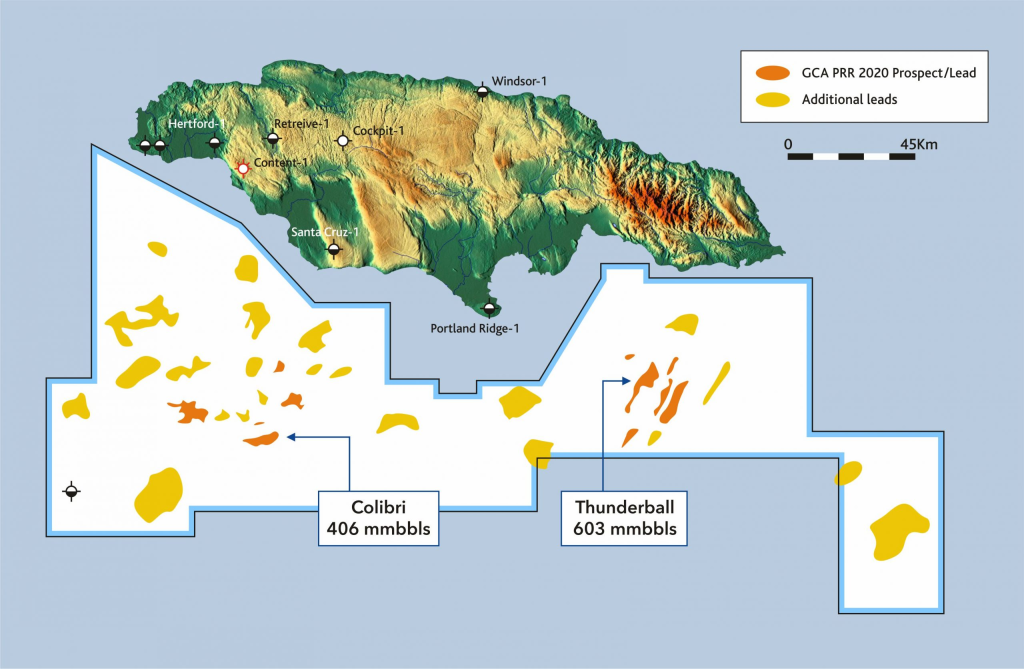
“This drilling study marks an important step in our operational planning to advance the Walton-Morant Licence towards a potential future drilling programme. It will provide a current, market-based assessment of rig suitability, availability, commercial conditions, and the long-lead items required to drill Colibri and Thunderball or similar targets.
Colibri and Thunderball represent substantial exploration opportunities within the Licence, with a combined potential of over 1 billion barrels of mean prospective resources out of the 7 billion barrels of prospective resources identified on the licence to date.
By undertaking this study now, we are positioning the Company for operational readiness ahead of future drilling, whilst providing valuable information to support our on-going work as we push to conclude the Jamaican farm-out process. We look forward to updating the market with the study results in the coming weeks.”
Questions:
I have been following this story for 5 years, and am still hopeful for a positive outcome for Jamaica.
Below are UOG’s resource assessments for the prospects in their license area.
| Name | Assignation | Location | Mean/Mid Prospective Resources (MMBo / MMboe) |
| Lead 11F | Lead | Walton Basin | 1126 |
| Zumbador | Lead | Morant Basin | 925 |
| Thunderball | Lead | Morant Basin | 603² |
| Colibri | Prospect | Walton Basin | 406² |
| Lead D | Lead | Walton Basin | 382 |
| Moonraker | Lead | Morant Basin | 323² |
| Cascade Central | Lead | Pedro Bank | 275 |
| Streamertail | Prospect | Walton Basin | 221² |
| Oriole | Prospect | Walton Basin | 220² |
| Boag | Lead | Walton Bank | 219 |
| Lead 6I | Lead | Walton Bank | 205 |
| Goldeneye | Lead | Morant Basin | 174² |
| Moneypenny | Lead | Morant Basin | 173² |
| Blofeld | Lead | Morant Basin | 171² |
| Earspot | Lead | Walton Bank | 145 |
| Squire | Lead | Walton Basin | 139 |
| Lead 12M | Lead | Walton Basin | 133 |
| Lead 6H | Lead | Walton Bank | 120 |
| Lead 12V | Lead | Walton Basin | 111 |
| Cascade South | Lead | Pedro Bank | 101 |
| Lead6Q | Lead | Walton Bank | 101 |
| Cascade East | Lead | Pedro Bank | 86 |
| Rumpspot | Lead | Walton Bank | 85 |
| Lead 7P | Lead | Walton Bank | 76 |
| Lead 7N | Lead | Walton Bank | 70 |
| Lead 10K | Lead | Walton Basin | 70 |
| Lead 12L | Lead | Walton Basin | 70 |
| Lead 7T | Lead | Walton Bank | 60 |
| Bluefields | Lead | Walton Bank | 57 |
| Tody | Prospect | Walton Bank | 53² |
| Mango | Lead | Walton Basin | 53 |
| Guani | Lead | Walton Bank | 53 |
| Lead 12U | Lead | Walton Basin | 41 |
| Jaws | Lead | Morant Basin | 39² |
| Euphonia | Prospect | Walton Bank | 38² |
| Lead 6G | Lead | Walton Bank | 38 |
| Booby | Lead | Walton Basin | 34 |
| Lead 10B | Lead | Walton Basin | 32 |
| Lead 7R | Lead | Walton Bank | 28 |
| Lead 7S | Lead | Walton Bank | 28 |
| TOTAL | 7,284¹ |

