
Feeds:
Posts
Comments

Posts Tagged ‘high bids’

Per yesterday’s discussion comparing recent onshore and offshore lease sales, the investments are really quite different. When you acquire Permian and Delaware Basin shale tracts you are essentially buying oil in place that should be producible with current technology.

At offshore sales, you are typically acquiring the opportunity to learn more, either through site surveys or drilling. Your lease exploration and development strategy will also be influenced by drilling outcomes for similar targets on other leases. A return on your investment is far from certain.

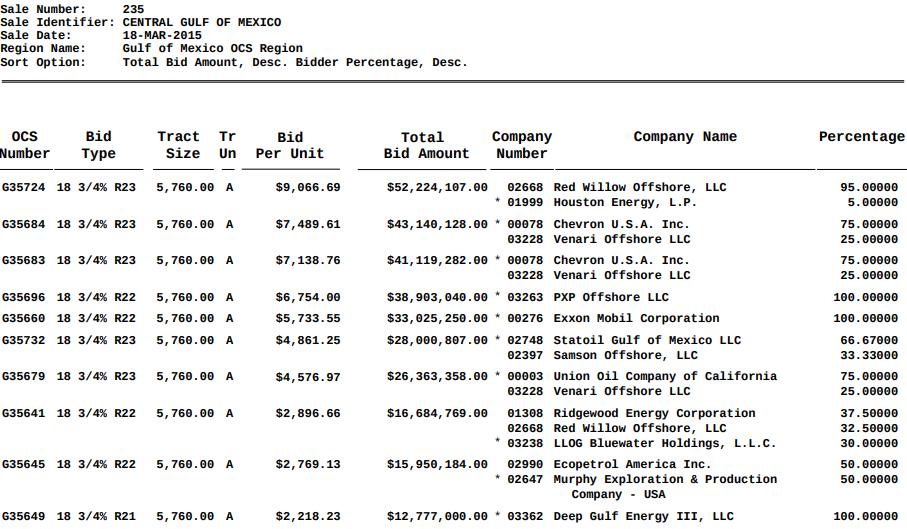
I looked back at the top ten leases (by high bid) issued at Central Gulf Sale 235. That sale was chosen because it was 11 years ago, giving time to explore and initiate development, and the bidding was strong. The top ten leases received bids ranging from $12.8 million to $52.2 million. See the screenshot below.

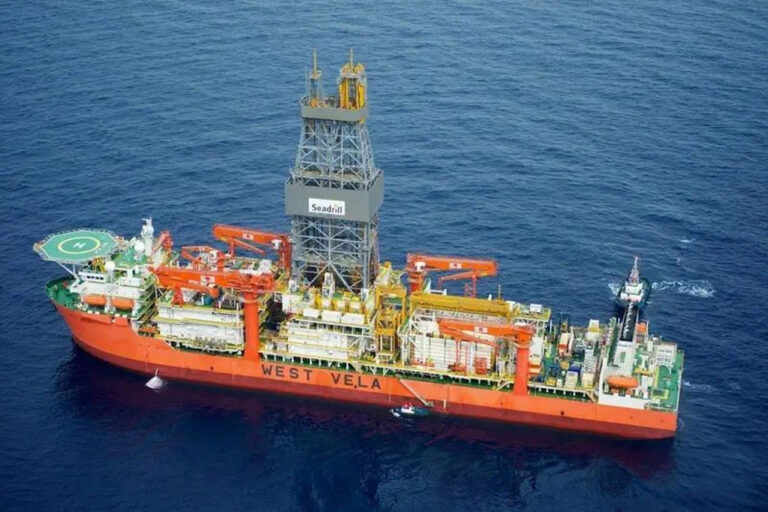
Surprisingly, only four of the leases were ever drilled and nine of the ten leases have expired. The only lease remaining is the highest bid block (OCS-G 35724, Walker Ridge Block 107, $52.2 million) now owned by Talos (27% and operator), Red Willow (22.5%), Shell (22.5%), CSL (9%), and two investment partnerships. This lease is being held by operations given that a well was drilled within the past year. However, Talos has announced a discovery, and the well has been temporarily abandoned to preserve future utility:

The discovery well was drilled to a total vertical depth of 33,228 feet utilizing the West Vela deepwater drillship and encountered oil pay in multiple high-quality, sub-salt Miocene sands. A comprehensive wireline program was conducted, acquiring core, fluid, and log data to evaluate the reservoir.

So the bottom line is $308.3 million in bonuses for 10 leases, 9 of which have now expired, and one discovery which could prove to be commercial down the road.
Read Full Post »

It’s always interesting to compare the high bids with the “runner-up” bids on the same tracts. Usually the gap is large and, as indicated in the table below, that is the case with the Sale 261 “top 10.” This tells us that bidding is independent, that tract evaluation is far from an exact science, that information and expert opinions differ, and that companies have different business and bidding strategies.

Particularly interesting in this sale were the tracts that both Hess and Chevron, its future parent, sought to acquire. Chevron and Hess bid against each other on two of the “top 10” tracts, and Hess outbid Chevron by wide margins. Will this affect post-merger relationships? πŸ˜‰

In a future post, we’ll look at the 14 rejected Sale 259 high bids and the bidding on these tracts in Sale 261.

blockhigh bid
(million $)
company2nd highest bid
(million $)
company
MC 38925.5Anadarko1.9LLOG
GC 18821.0Hess4.8Chevron
GC 15118.0Hess3.0Anadarko
GC 72317.2Anadarko (55%)
Chevron (45%)
2.0Equinor
GC 11614.0Hess7.5Anadarko
GC 72212.0Equinor1.4Chevron (55%)
Anadarko (45%)
GC 727.5Hesssingle bidder
GC 2327.0Hess1.1Chevron
GB 7016.7Shellsingle bidder
KC 2105.3Shellsingle bidder

Read Full Post »

A BOE post from last December commented on the seemingly irrational bidding for Atlantic and Pacific wind leases. More recent posts have reported on the woes of Atlantic leaseholders.

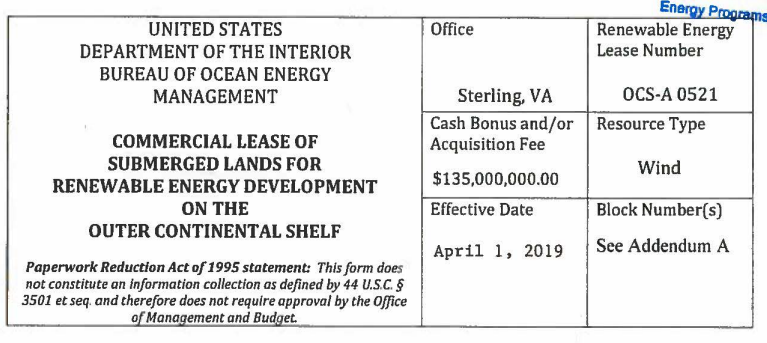
Two Atlantic lessees, Commonwealth Wind and SouthCoast Wind, which paid $135 million for each of their North Atlantic leases, have now agreed to pay $48 million and $60 million respectively to cancel their power purchase agreements with electric utilities. Perhaps the effective date of these leases (see below) reflects on the wisdom of their purchase.πŸ‹

Both Commonwealth Wind and SouthCoast Wind are hoping to rebid their projects in a Massachusetts offshore wind procurement scheduled for next year.Β 

Commonwealth Magazine

Some northeast states and their public utilities may be in a bit of a bind. Either they accept higher electric rates and the likely public backlash, or they deviate from their staunch anti-gas, anti-nuclear orthodoxy. Similarly, oil companies that have invested heavily in offshore wind may find that they are not just less profitable, but (even) less popular.

Read Full Post »