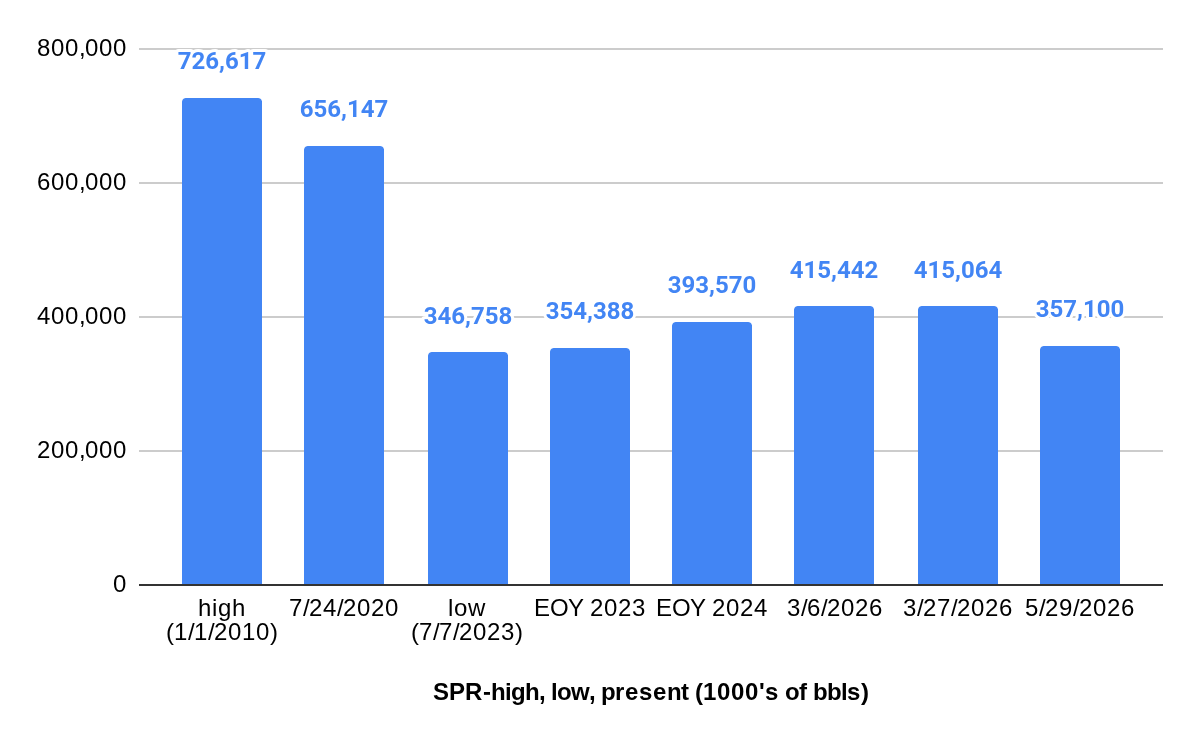
Nothing tilts public opinion more than high gasoline prices, or worse yet shortages! Hence the 1975 legislation establishing the SPR, the massive SPR drawdown in 2022, and this year’s withdrawals.
Looking back to the halcyon days of the US offshore program, it was the gas lines in the 1970s that drove the remarkable and rather unlikely growth in the program during the Carter Administration (1977-1981). A few highlights from those four years:
15 lease sales including 3 offshore Alaska, 3 in the Atlantic, and 1 offshore California
Drilling activity in all 4 regions: GoM, Pacific, Alaska, and Atlantic
North, Mid, and South Atlantic District offices for permitting and inspections
5300 well starts including 97 in water depths > 1000′
314 new platforms including Cognac, the world’s first platform in > 1000′ of water
Perhaps unthinkable today, the Governor of Massachusetts from 1979-1983, Ed King, was a strong supporter of offshore drilling. Absent that support, the exploratory drilling on Georges Bank would probably have never occurred. /s/ Nostalgic Old Man 😉
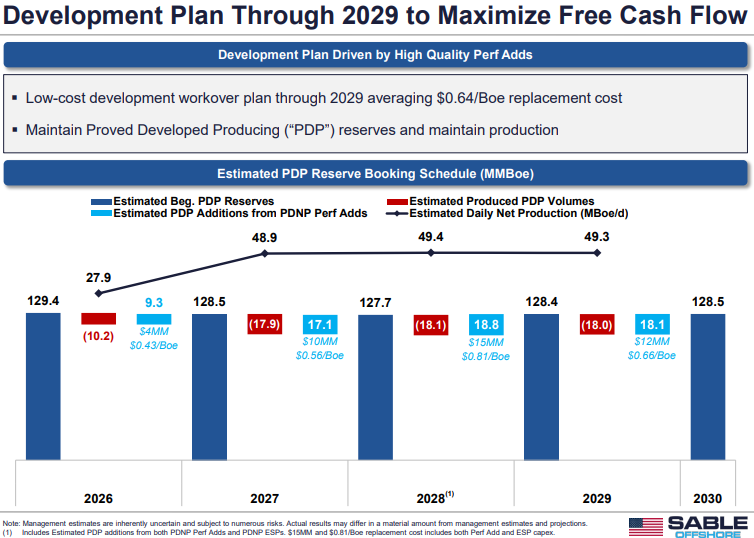
Those who have been following the Santa Ynez Unit saga should take a look at Sable’s informative PowerPoint update (attached). The presentation includes reserve data, well operation plans, production forecasts, financial and legal updates, and regional energy supply information.
Also, Sable CEO Jim Flores has announced that Energy Secretary Wright and Interior Secretary Burgum will be visiting the project this week. Transportation Secretary Duffy was also expected, but he will not be attending.
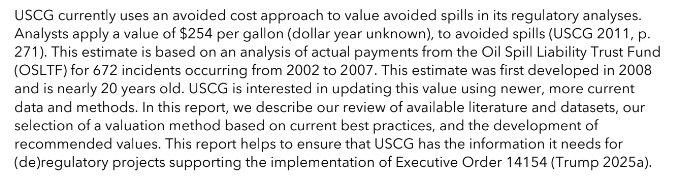
The report is intended to update the Coast Guard’s methodology for estimating the cost savings resulting from spill prevention regulations. The paragraph pasted below is a good summary of the objective.
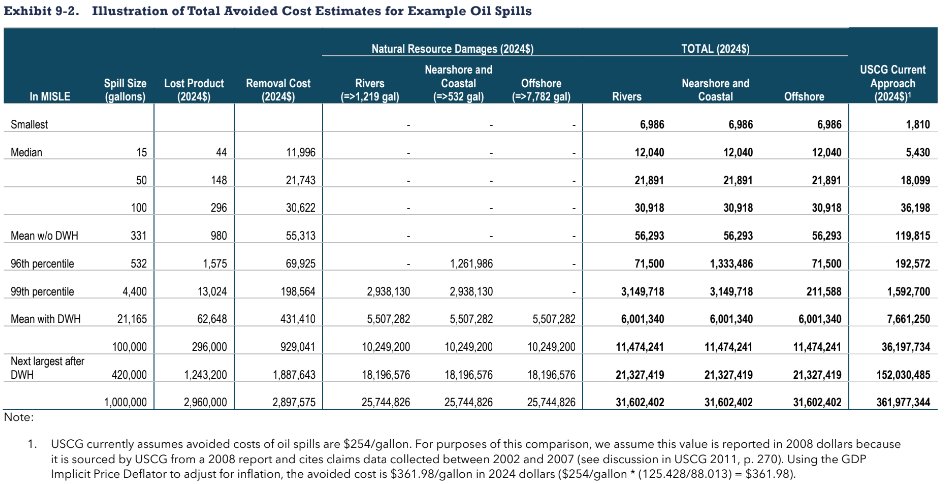
The offshore industry could benefit from this report, because the estimated cost of spills >100 gallons is reduced, dramatically so when the DWH/Macondo blowout is excluded (see the second table below). That reduction would support regulatory reform initiatives,and could thus generate some controversy.
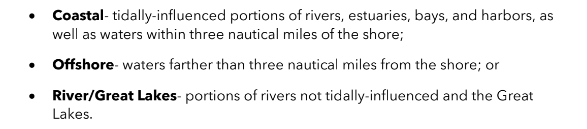
My main concern is that there is only a single distance-from-shore category for offshore spills (see text below). The natural resources damage from a spill 3 miles from shore will almost always be much greater than from an equivalent volume spill 100 miles from shore.
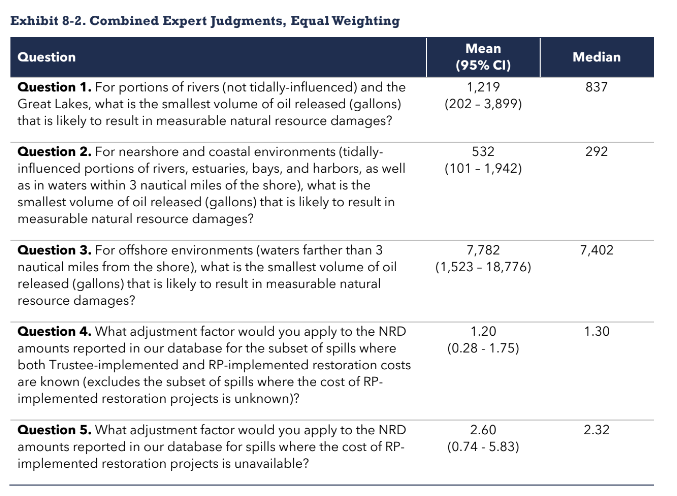
The single-offshore-category issue is illustrated in the 2 tables pasted below. The first table presents a summary of expert opinions on the smallest spill size that is likely to result in measurable natural resource damages. The mean response to Question 3 (offshore) is 7782 gallons. A spill of that size occurring 3 miles from shore is much more likely to result in resource damage than a spill originating 50 or 100 miles from shore.
In the second table, note the new methodology results in the same cost estimates for large nearshore/coastal spills as for offshore spills. Again, this is presumably because there is only a single offshore category.
The public comments on this report should be interesting.
John Smith’s update on California OCS Decommissioning Obligations is attached. His comments:
Chevron and FMC hold joint and several liability responsibilities for many platforms and all of those operated by DCOR. This reflects Chevron’s long history in developing CA onshore and offshore oil and gas resources. A 2020 report issued by BSEE estimated the nine platforms operated by DCOR had a combined decommissioning cost of $397 million.The actual cost could be 2-3-fold higher based on estimates for decommissioning California state water platforms prepared by experienced decommissioning consultants.
Chevron may be checking out of California by moving its corporate offices to Houston, but as someone once said about decommissioning – referring to the popular Eagles Hotel California song “You can check out but you can never leave.”
Official decommissioning anthem 😉: Hotel California
Excerpt from the lyrics – Hotel California, Eagles, 1976
Last thing I remember I was running for the door I had to find the passage back To the place I was before “Relax, ” said the night man “We are programmed to receive You can check out any time you like But you can never leave”
Permian drilling rigWest Vela drillship made Walker Ridge discovery for Talos
Per yesterday’s discussion comparing recent onshore and offshore lease sales, the investments are really quite different. When you acquire Permian and Delaware Basin shale tracts you are essentially buying oil in place that should be producible with current technology.
At offshore sales, you are typically acquiring the opportunity to learn more, either through site surveys or drilling. Your lease exploration and development strategy will also be influenced by drilling outcomes for similar targets on other leases. A return on your investment is far from certain.
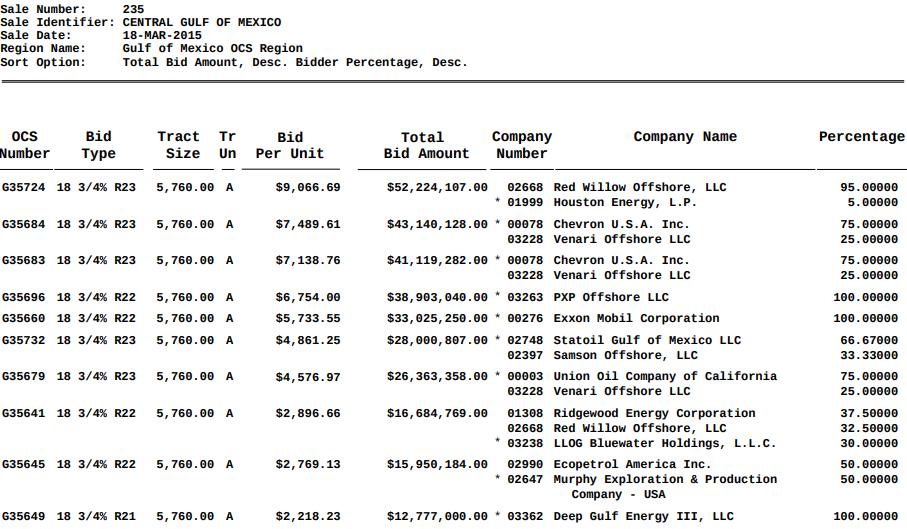
I looked back at the top ten leases (by high bid) issued at Central Gulf Sale 235. That sale was chosen because it was 11 years ago, giving time to explore and initiate development, and the bidding was strong. The top ten leases received bids ranging from $12.8 million to $52.2 million. See the screenshot below.
Surprisingly, only four of the leases were ever drilled and nine of the ten leases have expired. The only lease remaining is the highest bid block (OCS-G 35724, Walker Ridge Block 107, $52.2 million) now owned by Talos (27% and operator), Red Willow (22.5%), Shell (22.5%), CSL (9%), and two investment partnerships. This lease is being held by operations given that a well was drilled within the past year. However, Talos has announced a discovery, and the well has been temporarily abandoned to preserve future utility:
The discovery well was drilled to a total vertical depth of 33,228 feet utilizing the West Vela deepwater drillship and encountered oil pay in multiple high-quality, sub-salt Miocene sands. A comprehensive wireline program was conducted, acquiring core, fluid, and log data to evaluate the reservoir.
So the bottom line is $308.3 million in bonuses for 10 leases, 9 of which have now expired, and one discovery which could prove to be commercial down the road.
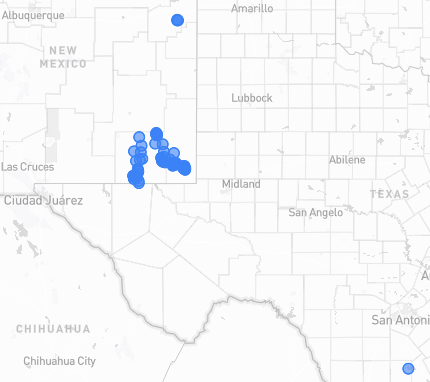
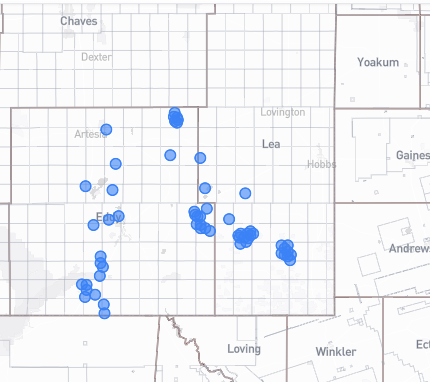
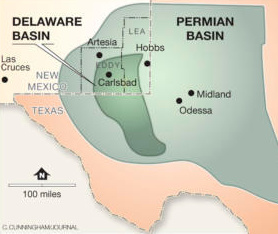
Delaware Basin sale parcels mostly in NMLea and Eddy counties, NM
The Federal onshore oil and gas program was always secondary to the offshore program, at least in the opinion of those of us who worked in the offshore program 😉. That was before the shale era revolutionized US energy production.
The table below compares the last two Big Beautiful Gulf sales and the record 2008 Gulf of Mexico sale with the BLM NM sale. Most astonishing is the record $357,129 per acre bid for a single NM tract. Devon Energy, which exited the Gulf in 2010, was the mega-bidder acquiring 24 tracts for $2.6 billion! (Devon is still bogged down in the Hogan/Houchin decommissioning dispute in the Pacific, a case which should temper enthusiasm for relaxed lease assignment and financial assurance policies.)
The attractiveness of the Permian, Delaware, and similar onshore basins has been greatly enhanced by vastly improved drilling and well completion technology. The short lead times to first production are a big advantage relative to offshore development.
The total high bids for Gulf Sale 206, which dwarfed the BBG1 and 2 sales, are still a Federal oil and gas leasing record when converted to 2026 dollars, but the sale area was much larger than for the NM sale.
Sale
date
tracts bid on
acres bid on
total high bids
highest bid/acre
BLM NM
5/20/2026
74
33,529
$4,007,609,288
$357,129
BBG2
3/11/2026
25
140,753
$46,976,423
$3,647.57
BBG1
12/10/2025
181
1,023,526
$300,425,222
$3,227.79
206
7/21/2008
615
3,323,047
$3,677,688,245 ($5.7 million in 2026 dollars)
$18,333.47 ($28,300 in 2026 dollars)
The royalty rate on Sale 206 leases is 18.75%, versus 12.5% for the other 3 sales.
Perhaps the wind industry’s problems are more fundamental than those presented by US policies. Why else would TotalEnergies, the company that jumped at the chance to annul its costly romance with US offshore wind, be looking for a way out of its German commitments?
NDR / Süddeutsche Zeitung: TotalEnergies is seeking to quit a major offshore wind energy project in Germany for which it offered to pay six billion euros in a 2023 state auction, arguing that slow grid connections and a deteriorating economic environment have triggered the decision.
According to the reports, energy company BP, which also won a successful multi-billion euro bid in 2023, could seek a similar opt-out. After transferring its offshore wind activities into a subsidiary in 2025, the new company is said to be scaling back and ultimately planning to shut down its offices in Berlin and Hamburg.
Does this sound familiar?The mood in Germany’s offshore wind industry and elsewhere in Europe has shifted markedly in recent years. While bidders in offshore auctions in 2023 were ready to pay billions of euros for the right to implement new projects, a subsequent auction round in 2025 failed to attract a single bid. According to offshore wind industry association BWO, the meager expansion of less than 1 GW annually since 2020 was mainly triggered by a spike in investment and capital costs.
Environmental NGO Deutsche Umwelthilfe (DUH, not the best acronym in English 😉) called the result a “quantum leap” for offshore wind energy. “Wind power at sea is now so economically attractive that project developers are outbidding each other for access to marine areas,” said DUH executive director Sascha Müller-Kraenner. “The fairy tale of expensive green electricity is thus finally off the table.” (This quote didn’t age well!)
“The sums are obscene,” an industry source, who was part of a non-successful bid, told business daily Handelsblatt. (Irrational bidding similar to what we saw during the 2022 U.S. Atlantic Wind Sale.)
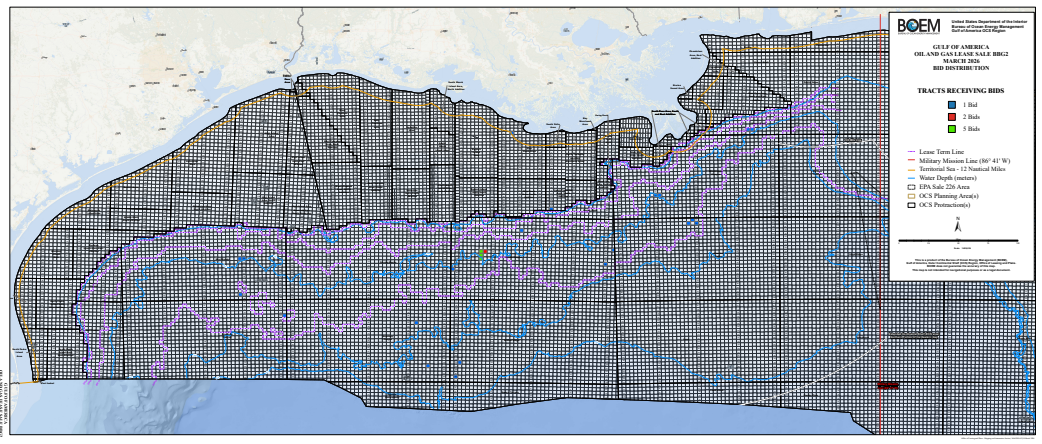
Although BOEM’s decision matrix has not yet been posted, a comparison of the acceptances with the bids submitted tells us that the Keathley Canyon Block 828 ($1,101,202) and Atwater Valley Block 63 ($650,018) bids were rejected.
Both of the rejected bids were submitted by LLOG, partnering with 4 other companies on the Atwater Valley block. LLOG’s high bids on 3 other blocks were accepted, so their rejection rate was 40%. Interestingly, 2 of the 3 BBG1 rejected bids were also submitted by LLOG.
There is no shame in bid rejections, which are part of the legislated leasing process. Why pay more than you have to (or think a block is worth)? A bid rejection may attract future competition, but otherwise the only downside is that you don’t get a lease that you can possibly acquire at another sale if desired (an advantage of regular, predictable lease sales).
BOEM is charged with making fair market value determinations and their process and decisions are publicly available. Of course, opinions differ on the value of an unexplored lease. We will see what the bidding on the BBG1 and BBG2 rejections looks like in future sales.
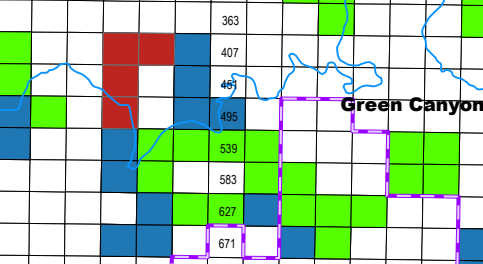
BOEM did accept the the high bids for the BBG2 “sweet spot” blocks (red in map below; also see the table) in the Green Canyon Area of the Gulf. These 4 blocks accounted for 17 of the sale’s 38 bids (45%) and $32.8 milion of the sale’s $47 million in high bids (70%). BP’s $21 million bid for GC 404 was by far the sale’s highest bid.
red=blocks receiving bids at BBG2; blue=BBG1 and Sale 261 leases; green=active leases issued prior to Sale 261
Thankfully, from the standpoint of those of us whose primary concerns are the integrity of the OCS program and protecting taxpayers from decommissioning liabilities, the API comments (attached), along with those submitted by Shell and Chevron, have exposed the folly of eliminating financial assurance whenever there is a financially strong company somewhere in the lease chain of custody.
Mindful of ongoing and anticipated decommissioning liability battles, API effectivelychallenges the BOEM proposal on legal grounds. API also demonstrates why revisions intended to improve regulatory efficiency and increase production would do exactly the opposite. Excerpts from the API comments (emphasis added):
Further, foisting financial assurance obligations on predecessors will not achieve BOEM’s stated aims of financial “savings” and increased OCS oil and gas production; it more likely will do the opposite. The Proposed Rule would just shift financial assurance burdens to financially stronger predecessors, many of which remain engaged in the majority of leasing and production across the OCS and are far more likely to be future investors in increased OCS development and production. By contrast, nothing ensures that entities standing to benefit from the Proposed Rule will reinvest saved financial assurance premium dollars into OCS production; in fact, such entities largely do not explore or increase reserves, but merely buy pre-discovered reserves and produce them to a lower economic limit.
Nor would the Proposed Rule promote or save costs for future OCS transactions since, in the absence of any option for BOEM-demanded financial assurance from current interest holders, assignors will demand financial assurance at sufficiently conservative levels to address the risk of residual liability if assignees default on their obligations.
Even more problematically, the Proposed Rule would retroactively impose this new regulatory burden on entities that divested their OCS property interests years (or decades) earlier—in reliance on BOEM’s regulations that required their assignees to provide any supplemental financial assurance. Such entities are no longer in privity with BOEM, and have no control over current operations on those OCS properties. The Proposed Rule would reach back even to impose these obligations on predecessors that divested their interests before the 1997 regulatory imposition of joint and several liability for assignors (a time period on which the Proposed Rule is silent).
This novel and misguided approach allows, and even encourages, current interest holders to eschew their lease and grant obligations, and instead freely operate on the backs of predecessors and taxpayers. Meanwhile, current interest holders could choose to allocate little or no funding for end-of-life obligations like decommissioning whenever they desire to conclude production, file for bankruptcy, and leave BOEM to eventually issue decommissioning orders to predecessors that have not operated the grants and leases for years or even decades. This would create higher administrative and financial burdens for the government and system as a whole, including where no viable predecessor had accrued liability for decommissioning all facilities present on the lease or grant, and potential operational impacts that a predecessor has no obligation to cure.
This new proposed obligation on predecessors is arbitrary and capricious and unlawful on multiple grounds. It violates the rule against retroactivity by creating new federal liability stemming from already-completed transactions. It violates the agency change in position doctrine, particularly given that BOEM on multiple occasions has rejected precisely the same approach as in the Proposed Rule. It is unsupported, as it overstates the burdens under the discretionary Existing Rule, disregards repeated U.S. Government Accountability Office (“GAO”) and BOEM findings calling for more robust financial assurance by current interest holders, cites only anecdotal prior comments while ignoring the bulk of countervailing comments detailing reality on the OCS, and identifies no means by which BOEM can compel collect, and assess adequate financial information for all predecessor entities. And it is self contradictory, including by tying up more capital among entities producing the vast majority of oil and natural gas on the OCS.
Chevron points to their potential liability balance of ~ $2 billion for satisfying the decommissioning obligations of default owners:
John Smith and I do not agree with the industry support for the use of reserves as financial assurance. The margin of error in reserve, oil price, and decommissioning cost estimates, not to mention the potential for facility damage, the ever-changing political environment, and the administration challenges, present an unacceptably high risk for taxpayers. If companies want to guarantee decommissioning based on reserves, let them do so. Shell makes a good point about why it is especially important to prohibit the use of reserve estimates on a company-wide basis:






Restart seems likely for decommissioning financial assurance rule
Posted in Regulation, decommissioning, energy policy, tagged Chevron, Shell, decommissioning, BOEM, API, financial assurance, comments, NEFSA, proposed regulation on May 18, 2026| Leave a Comment »
Thankfully, from the standpoint of those of us whose primary concerns are the integrity of the OCS program and protecting taxpayers from decommissioning liabilities, the API comments (attached), along with those submitted by Shell and Chevron, have exposed the folly of eliminating financial assurance whenever there is a financially strong company somewhere in the lease chain of custody.
Mindful of ongoing and anticipated decommissioning liability battles, API effectively challenges the BOEM proposal on legal grounds. API also demonstrates why revisions intended to improve regulatory efficiency and increase production would do exactly the opposite. Excerpts from the API comments (emphasis added):
Further, foisting financial assurance obligations on predecessors will not achieve BOEM’s stated aims of financial “savings” and increased OCS oil and gas production; it more likely will do the opposite. The Proposed Rule would just shift financial assurance burdens to financially stronger predecessors, many of which remain engaged in the majority of leasing and production across the OCS and are far more likely to be future investors in increased OCS development and production. By contrast, nothing ensures that entities standing to benefit from the Proposed Rule will reinvest saved financial assurance premium dollars into OCS production; in fact, such entities largely do not explore or increase reserves, but merely buy pre-discovered reserves and produce them to a lower economic limit.
Nor would the Proposed Rule promote or save costs for future OCS transactions since, in the absence of any option for BOEM-demanded financial assurance from current interest holders, assignors will demand financial assurance at sufficiently conservative levels to address the risk of residual liability if assignees default on their obligations.
Even more problematically, the Proposed Rule would retroactively impose this new regulatory burden on entities that divested their OCS property interests years (or decades) earlier—in reliance on BOEM’s regulations that required their assignees to provide any supplemental financial assurance. Such entities are no longer in privity with BOEM, and have no control over current operations on those OCS properties. The Proposed Rule would reach back even to impose these obligations on predecessors that divested their interests before the 1997 regulatory imposition of joint and several liability for assignors (a time period on which the Proposed Rule is silent).
This novel and misguided approach allows, and even encourages, current interest holders to eschew their lease and grant obligations, and instead freely operate on the backs of predecessors and taxpayers. Meanwhile, current interest holders could choose to allocate little or no funding for end-of-life obligations like decommissioning whenever they desire to conclude production, file for bankruptcy, and leave BOEM to eventually issue decommissioning orders to predecessors that have not operated the grants and leases for years or even decades. This would create higher administrative and financial burdens for the government and system as a whole, including where no viable predecessor had accrued liability for decommissioning all facilities present on the lease or grant, and potential operational impacts that a predecessor has no obligation to cure.
This new proposed obligation on predecessors is arbitrary and capricious and unlawful on multiple grounds. It violates the rule against retroactivity by creating new federal liability stemming from already-completed transactions. It violates the agency change in position doctrine, particularly given that BOEM on multiple occasions has rejected precisely the same approach as in the Proposed Rule. It is unsupported, as it overstates the burdens under the discretionary Existing Rule, disregards repeated U.S. Government Accountability Office (“GAO”) and BOEM findings calling for more robust financial assurance by current interest holders, cites only anecdotal prior comments while ignoring the bulk of countervailing comments detailing reality on the OCS, and identifies no means by which BOEM can compel collect, and assess adequate financial information for all predecessor entities. And it is self contradictory, including by tying up more capital among entities producing the vast majority of oil and natural gas on the OCS.
Chevron points to their potential liability balance of ~ $2 billion for satisfying the decommissioning obligations of default owners:
John Smith and I do not agree with the industry support for the use of reserves as financial assurance. The margin of error in reserve, oil price, and decommissioning cost estimates, not to mention the potential for facility damage, the ever-changing political environment, and the administration challenges, present an unacceptably high risk for taxpayers. If companies want to guarantee decommissioning based on reserves, let them do so. Shell makes a good point about why it is especially important to prohibit the use of reserve estimates on a company-wide basis:
Lastly, kudos to the New England Fisherman’s Stewardship Association for raising the concern about financial assurance for decommissioning offshore wind facilities
Read Full Post »