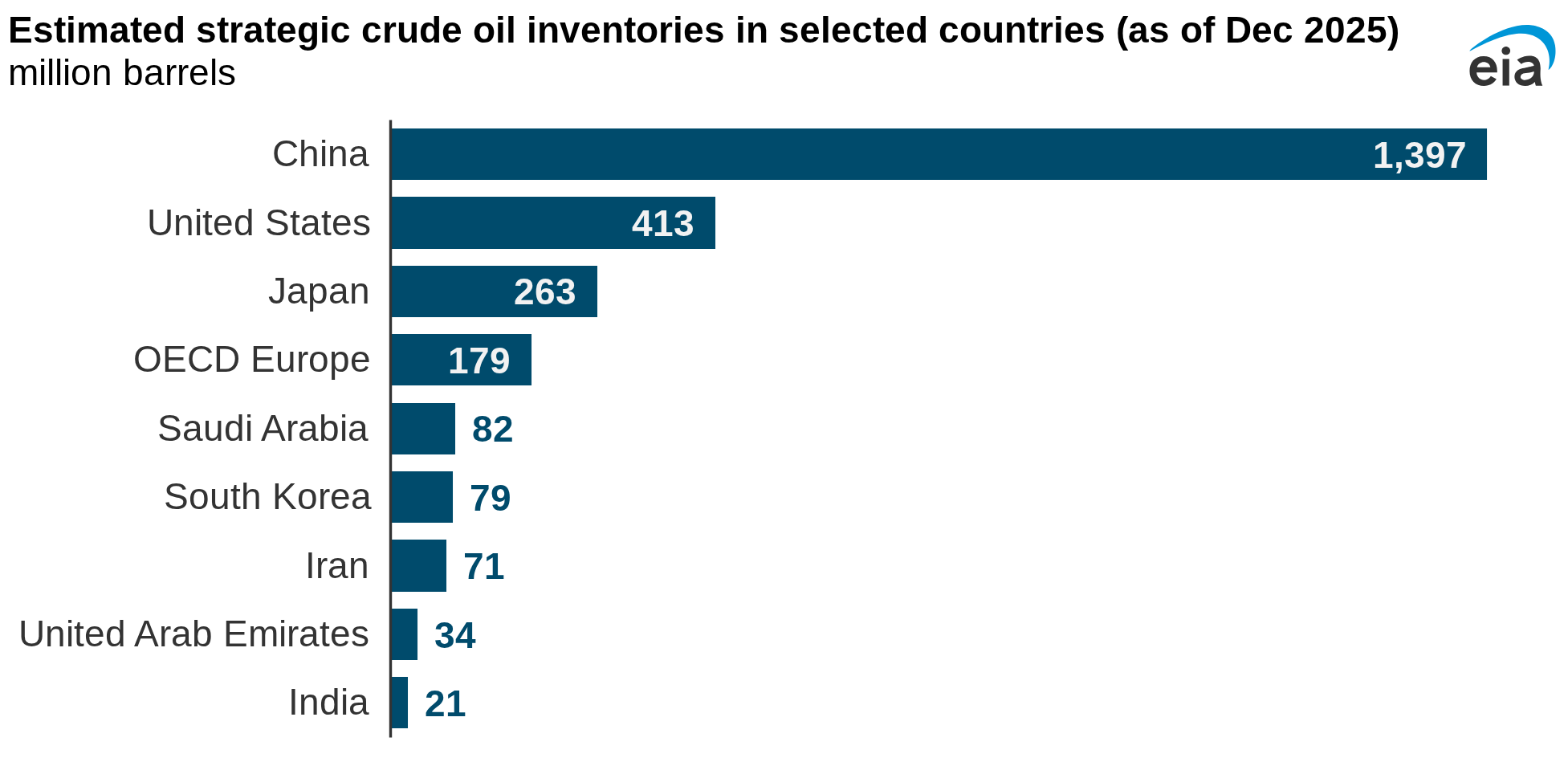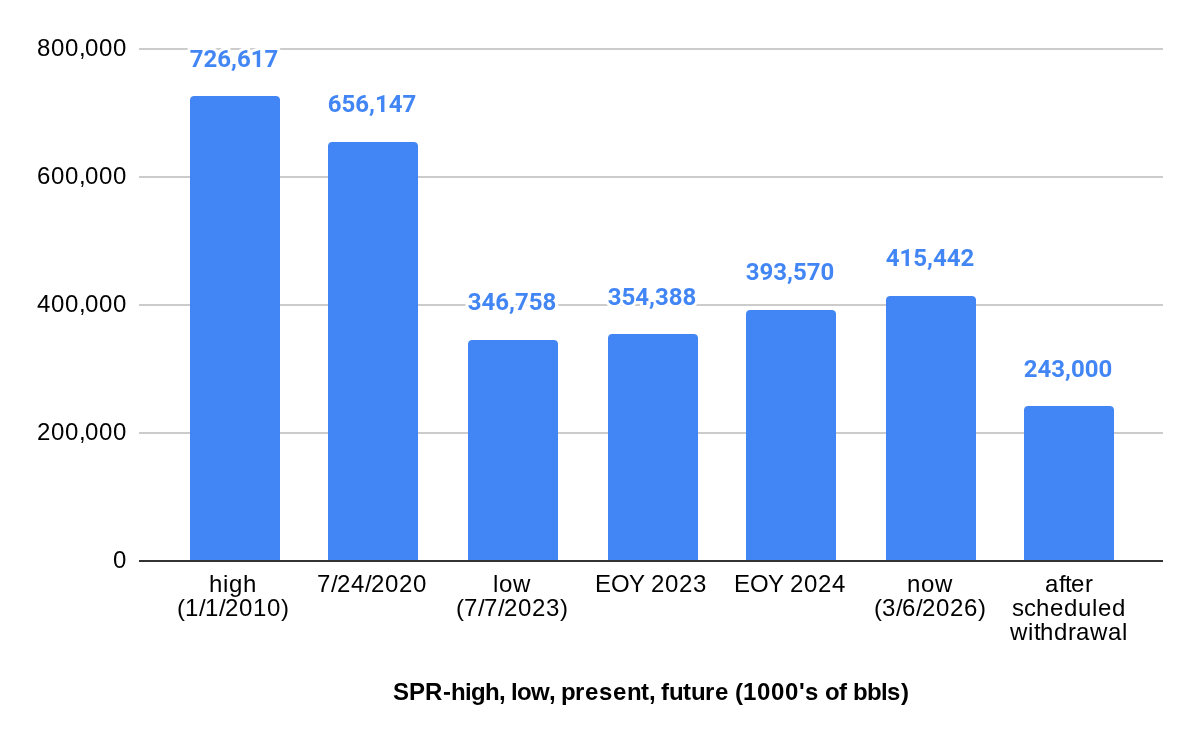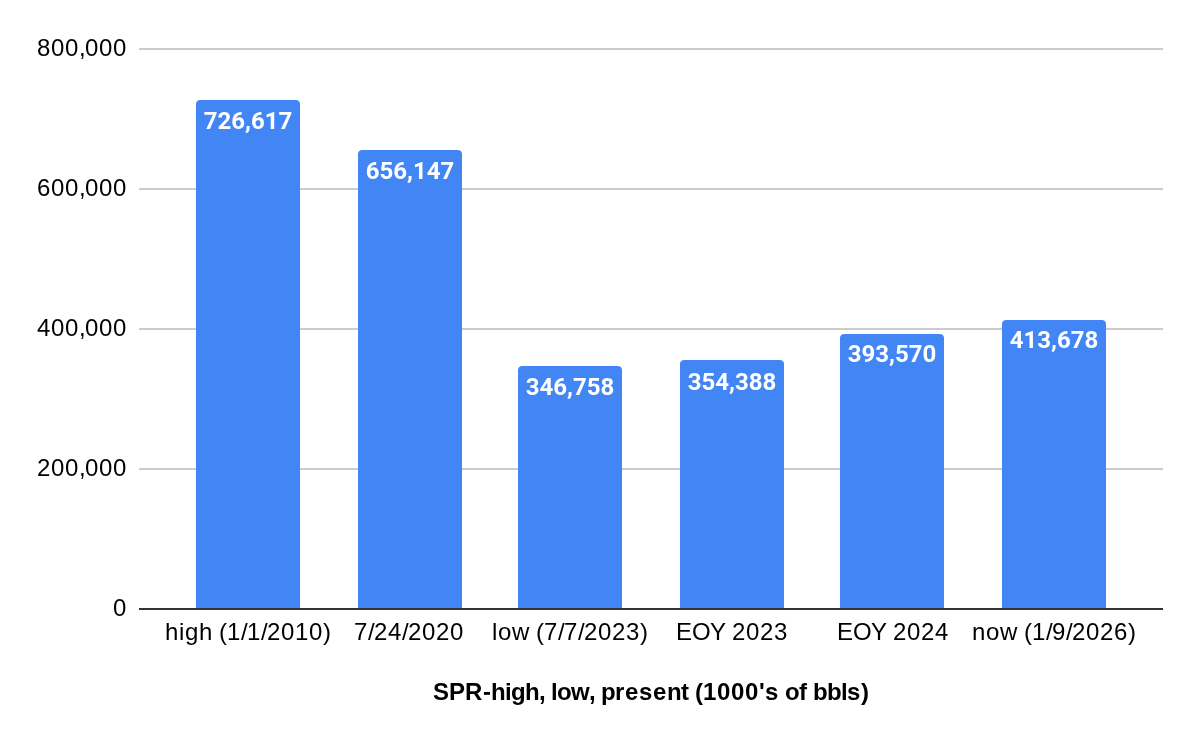
EIA estimates that China added an average of 1.1 million barrels per day of crude to their strategic inventories in 2025. Wow! If accurate, that’s a massive SPR operation – equivalent to storing ~60% of the total daily oil production in the Gulf of America or offshore Norway! See the video at the bottom of this post.
How much of that oil was imported from Iran?
Meanwhile, US weekly SPR withdrawals have exceeded 4 million barrels over the past two weeks. Presumably that pace will continue consistent with the DOE announcement.
DOE (3/11/2026): “Earlier today, 32 member nations of the International Energy Agency unanimously agreed to President Trump’s request to lower energy prices with a coordinated release of 400 million barrels of oil and refined products from their respective reserves.
“As part of this effort, President Trump authorized the Department of Energy to release 172 million barrels from the Strategic Petroleum Reserve, beginning next week. This will take approximately 120 days to deliver based on planned discharge rates.
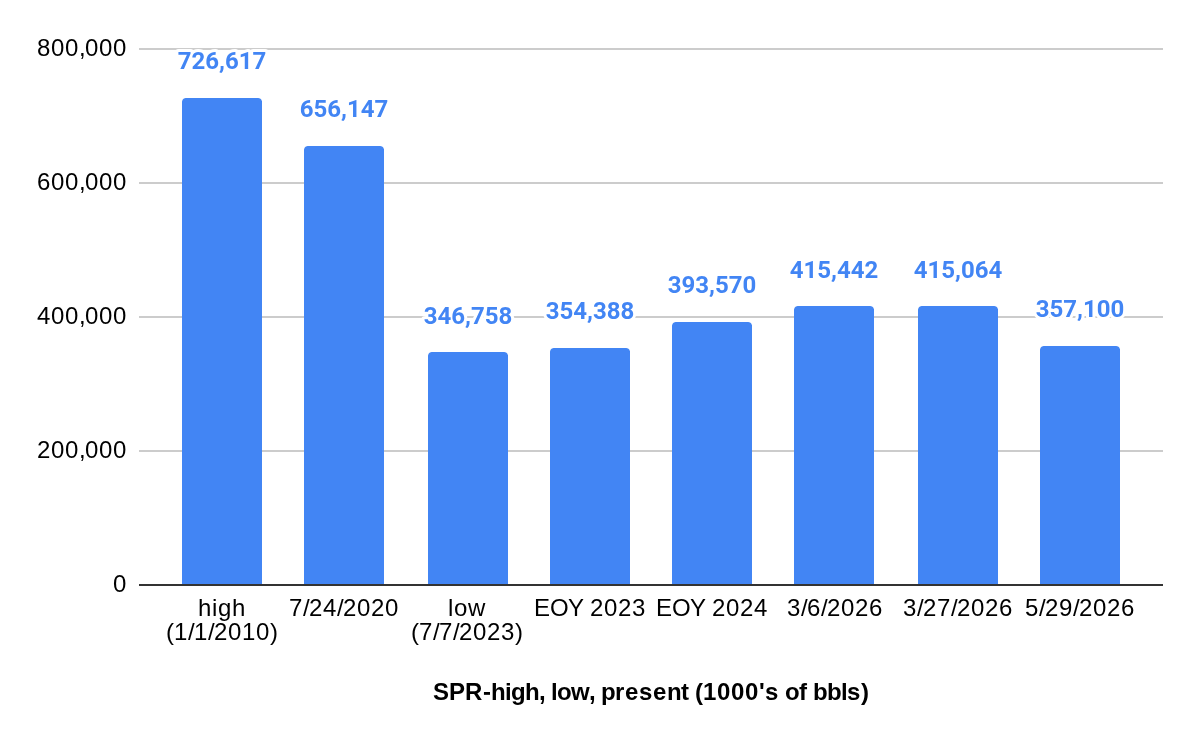
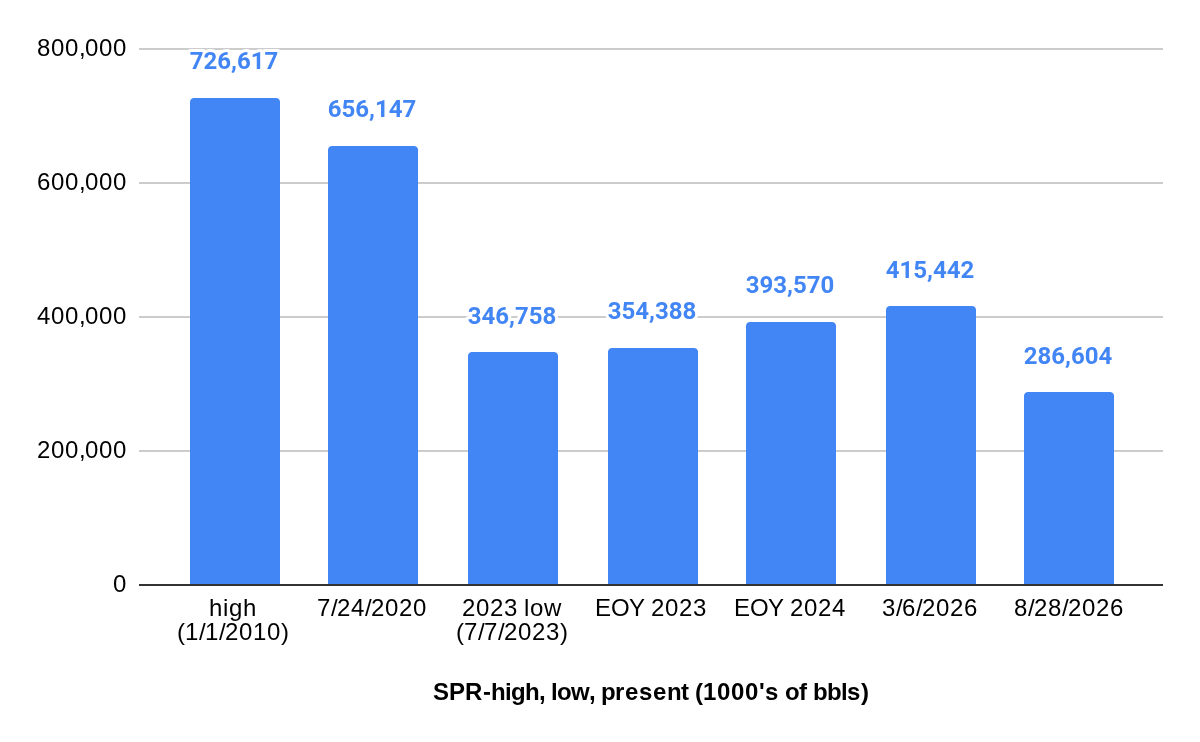
This will reduce the SPR to ~ 243 million bbls, 1/3 of capacity and the lowest level since it was initially filled in 2010. Market disturbances and national elections are too frequent to have confidence that the SPR will be refilled, even to the 500 million bbl level.
Meanwhile, the oil markets didn’t seem to be impressed by the announcement.
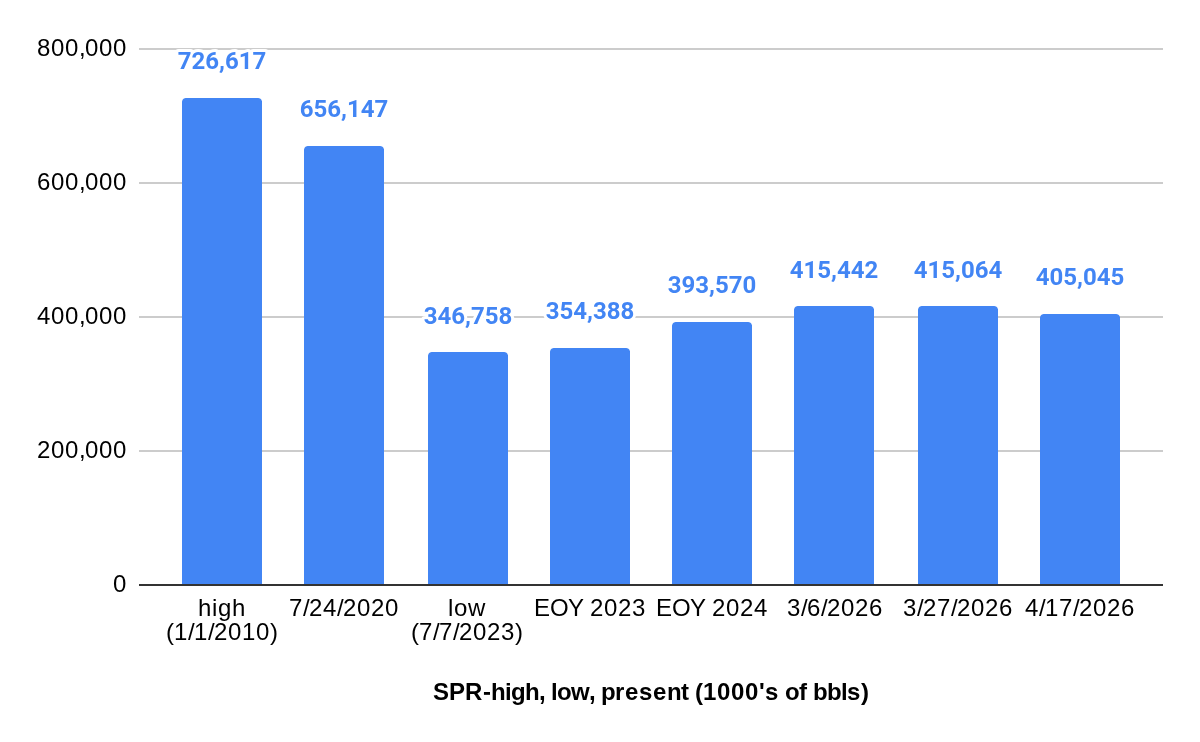
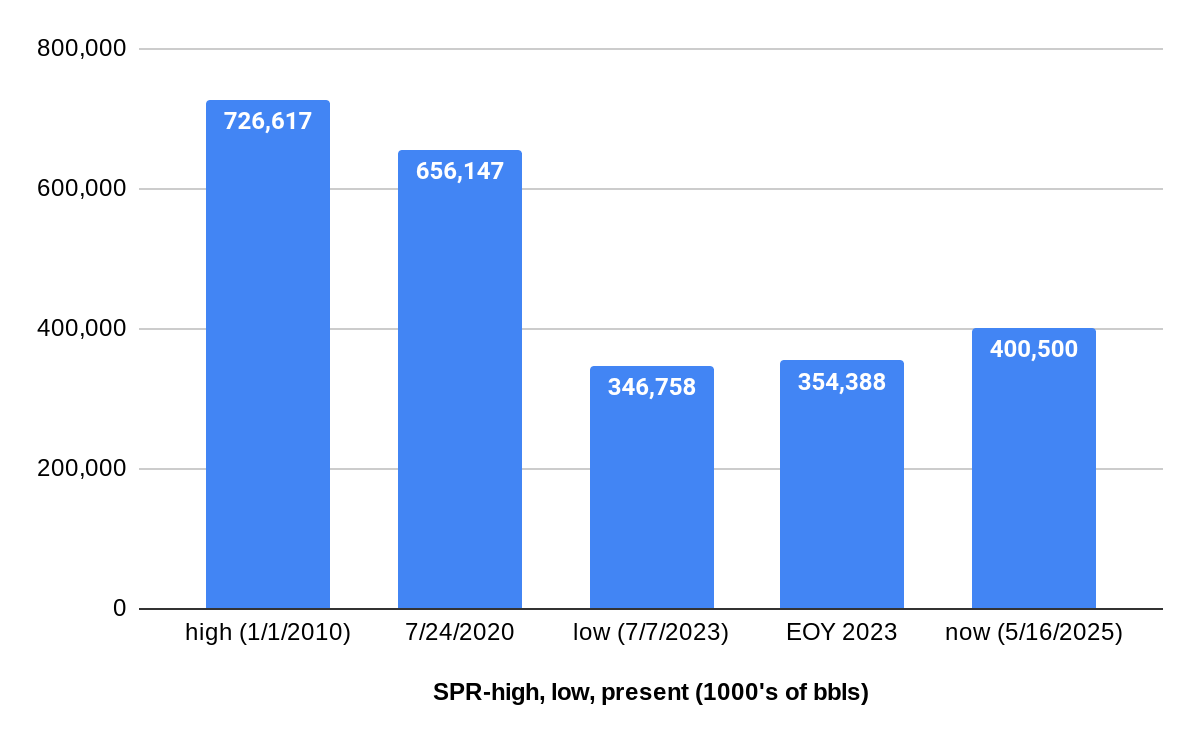
10 million bbls were added in 2025. Only 67 million bbls (<10% of capacity) have been added since the 7/7/2023 nadir. Unsurprisingly, It’s easier to deplete strategic national assets than replace them.
Reuters and others report that zinc from a new Chevron well has contaminated oil production destined for an Exxon refinery via Shell’s Mars Pipeline System. Because contaminated crude may cause maintenance issues and reduces the quality of refined products, Exxon will not accept crude from the Mars system until the zinc issue has been resolved.
The Mars system delivers about 575,000 bopd raising concerns about supplies to Gulf Coast refineries. But fear not, DOE authorized the delivery of up to 1 million barrels of oil from the Strategic Petroleum Reserve to the Exxon’s Baton Rouge refinery.
(Ironically, yesterday’s post pointed to the importance of the SPR and questioned the decision to drastically reduce crude oil purchases. This zinc incident is likely to be minor, and Exxon will repay the SPR in kind. However, more serious regional, domestic, and international events could call for much greater SPR withdrawals.)
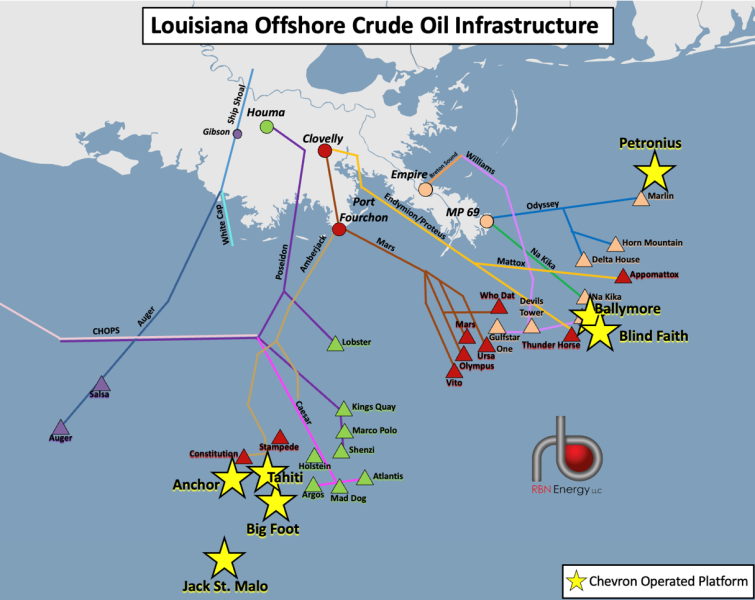
The above map shows Chevron platforms that connect with the Mars system at Port Fourchon.
Speculation/commentary:
The well/platform responsible for the zinc contamination has not been identified. Given that production is ramping up at Chevron’s Anchor facility, a new well on that platform may be the source of the zinc. Other Chevron platforms that connect to the Mars system are indicated in the diagram above.
Given that zinc in crude oil is rare, a well completion fluid containing zinc bromide may be the culprit.
Note the integration of offshore production streams, and the involvement of 3 industry super-majors. These companies are highly competitive, as evidenced by the Chevron-Exxon Stabroek dispute, but are also cooperative in producing, transporting, and refining oil and gas. However, they and other majors are restricted (rather illogically) from bidding jointly for leases.
During the 2024 presidential campaign and early in his second term, President Trump repeatedly pledged to “immediately refill” the Strategic Petroleum Reserve(SPR) to its maximum capacity, emphasizing its role in ensuring energy security and stabilizing oil markets during global supply disruptions.
The Big Beautiful Bill (BBB) sends a much different message, providing only $171 million for petroleum acquisition and $218 million for maintenance of SPR facilities through 2029. This is an 87% reduction in the acquisition funding from the House version that proposed $1.3 billion for crude oil purchases.
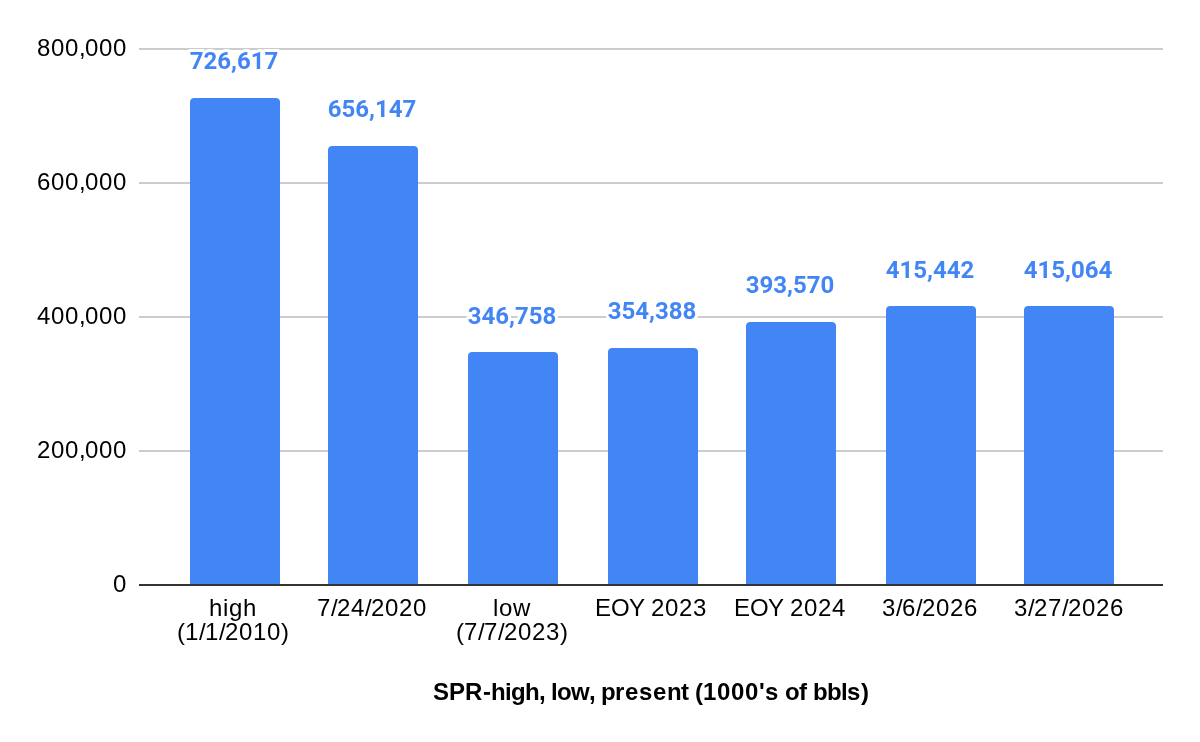
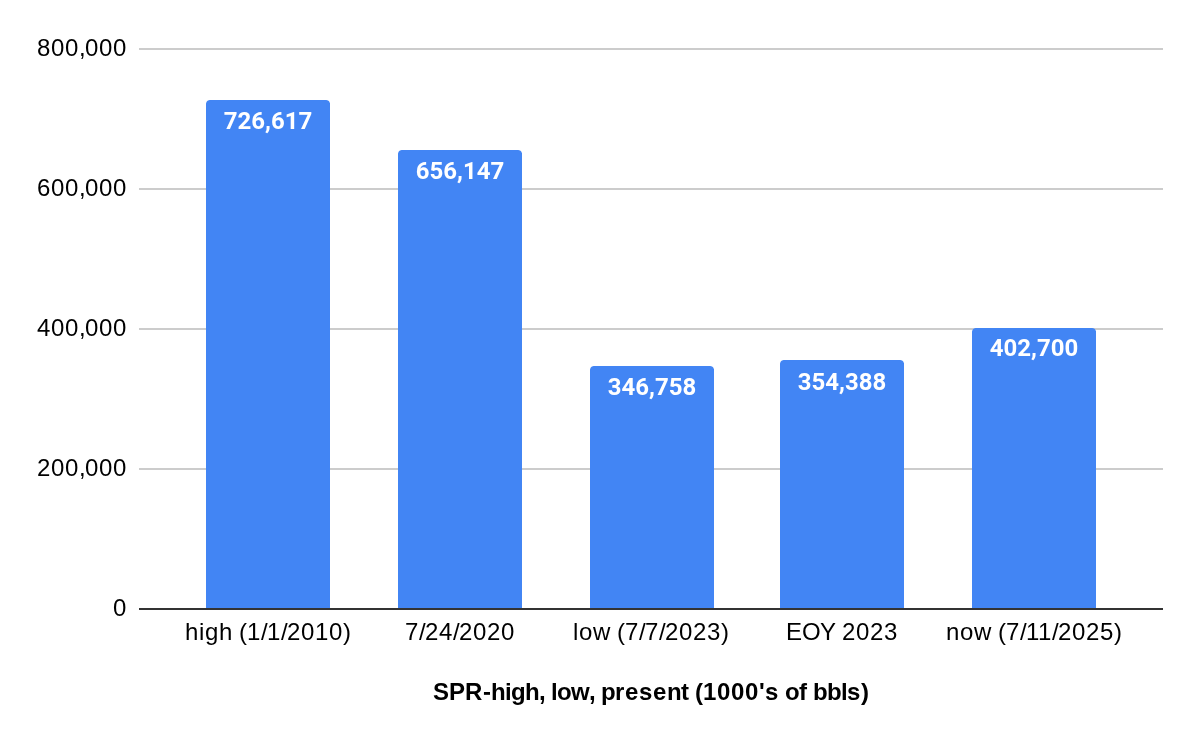
The Administration has offered no comment on the BBB’s surprise SPR language. Meanwhile, the SPR will likely remain at or near the current level, which is 324 million bbls below the 2010 high and only 56 million bbls above the 2023 low. (See the above chart.)
Energy Sec. Wright has called for the SPR to be refilled, for the infrastructure to be reviewed, and for plans to be developed to safeguard this strategically important asset.
Although not ostensibly a reason for refilling the reserve, doing so will reduce the risk of a freefall in oil prices and the associated economic turmoil.
Closing the books on the Biden administration’s management of the Strategic Petroleum Reserve:
Incoming reserve as of 1/22/2021: 638.086 million bbls (This was also the max. volume during the Biden administration.)
Outgoing reserve as of 1/17/2025: 394.566 million bbls
Net loss: 234.520 million bbls
% loss: 38.2%
Cost to replace (assuming $70/bbl ave. oil price): $16.416 billion
Time required to refill at max. rate of 685,000 bopd: 342.5 days (Taking into consideration acquisition, operational, and maintenance delays, and concerns about oil price impacts, a more realistic estimate would be 5 years, and this would require a concerted effort.)
The Strategic Petroleum Reserve would have no doubt been tapped again, as the Administration implied in June, if prices had exceeded $80/bbl for a sustained period prior to the upcoming elections. Fortunately, for the consumer and the SPR, that has not been the case.
Prior to the 2022 midterm elections, oil prices reached as high as $122/bbl in June and remained above $90/bbl through July. The SPR was tapped hard with a massive reduction of 123 million bbls in the 5 months prior to the elections.
June-Oct WTI range $/bbl
beginning of June SPR vol. (bbls)
end of Oct. SPR vol. (bbls)
net gain or (loss)
midterm elections 11/8/2022
80-120
519,323
396,219
(123,104)
general elections 11/5/2024
65-83
370,526
384,642
14,116
Despite the modest additions to the SPR in 2024, the reserve is only about one-half of capacity and 11% above the all-time low (7/7/2023).
Given the relatively moderate oil prices during much of 2024, DOE has made some progress in adding to the Strategic Petroleum Reserve. However, the 31 million bbls added since July 2023 only amount to about 10% of the reserves withdrawn during the 3 years prior (July 2020 to July 2023) and about 4% of the SPR’s capacity.