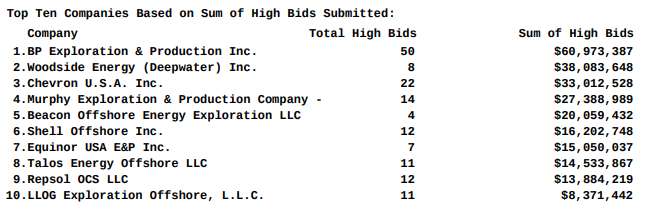
Which majors will be the most active bidders? BP (50 high bids), Chevron (22), and Shell (12)
Will former Gulf of Mexico stalwarts Exxon and Conoco Phillips participate for the first time in years? They did not.
How many companies will submit bids? Would like that to be a number >35. Only 30 companies participated.
How many tracts will receive bids? A number >300 would be very encouraging. Only 181 tracts received bids.
Will the total high bids exceed $400 million? No, the total was $279.4 million.
Will we see an increase in shelf interest? Shelf bidding continued to be limited (map). Renaissance, Byron, Arena, GOM Shelf LLC, Walter, W&T, Cantium, and WYOTEX Offshore submitted bids for shelf leases.
Which independents will be the most active? Woodside and Murphy are large independents, and their participation was most impressive. Murphy submitted 14 high bids totaling $27.4 million. Woodside had 8 high bids including the sale’s two highest for a total of $38.1 million, second only to BP in terms of the sum of their high bids.
The sale was beautifully conducted by BOEM, and Leslie Beyer – Assistant Secretary for Land and Minerals Management, Dept of the Interior – and Matt Giacona, Acting BOEM Director, delivered strong messages in support of the OCS oil and gas program.
However, as a colleague commented just after the sale, it was beautiful but not big. He and I expected more given the time since the last sale and the attractive terms.
Below is a comparison with the previous 3 Gulf sales. More to follow.
Sale No.
257
259
261
BBG1
date
11/17/2021
3/29/2023
12/20/2023
12/10/2025
companies participating
33
32
26
30
total bids
2233
2842
3161
219
tracts receiving bids
2143
2442
2751
181
sum of all bids $millions
198.5
309.8
441.9
371.9
sum of high bids ($millions)
101.7
263.8
382.2
279.4
highest bid company block
$10,001,252.00 Anadarko AC 259
$15,911,947 Chevron KC 96
$25,500,085 Anadarko MC 389
$18,592,086 Chevron KC 25
most high bids company sum ($millions)
46 bp 29.0
75 Chevron 108.0
65 Shell 69.0
50 bp 61.0
sum of high bids ($millions) company
47.1 Chevron
108 Chevron
88.3 Hess
61.0 bp
most high bids by independent
14-DG Expl.
13-Beacon 13-Red Willow
22-Red Willow
14-Murphy
1excludes 36 leases improperly acquired for carbon disposal purposes; 2excludes 69 leases improperly acquired for carbon disposal purposes; 3excludes 94 leases improperly acquired for carbon disposal purposes
Judge Patti Saris vacated part 2 of Trump’s 1/20/2025 “Wind Memo.”Part 1, which withdrew all OCS lands from wind leasing, was not in dispute. Part 2 suspended issuing wind energy permits and other authorizations.
The judge ruled (full order attached) that the suspension of wind permitting violates Administrative Procedures Act provisions requiring agencies “to proceed within a reasonable time and to set and complete proceedings expeditiously.”
She concluded further that “the moratorium halts all wind energy authorizations indefinitely, pending a comprehensive assessment with no timeline, which is inconsistent with statutory deadlines and general commands for prompt processing in laws like OCSLA, the Clean Water Act, and others governing wind projects.”
Although the judge’s assessment of the permitting moratorium seems sound, the merits of offshore wind as a primary energy source remain very much in doubt.
Seconds matter – training, equipment maintenance, and effective leadership are critical!
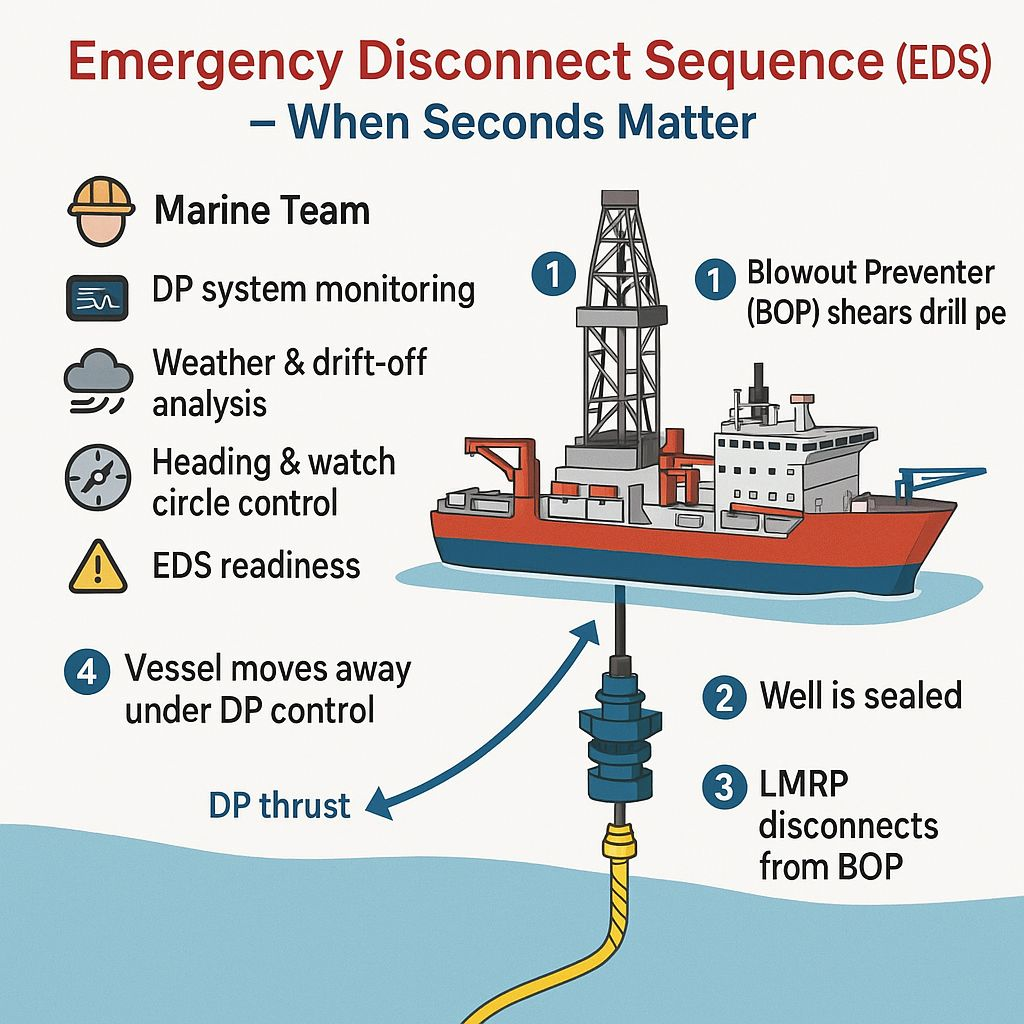
Several BSEE Safety Alerts have just been released. Of particular importance to those interested in deepwater drilling is the attached alert describing two separate Emergency Disconnect Sequence (EDS) incidents.
The EDS (see the diagram above) is a critically important safety protocol that ensures that a well is sealed and the riser and rig are disconnected from the blowout preventer in the event of a well control emergency, unforeseen weather/ocean conditions, loss of power, or positioning system malfunction. Note that the Macondo blowout could have been prevented if the Deepwater Horizon crew had activated the EDS in a timely manner.
The two EDS events cited in the Safety Alert were presumably the March 28, 2025 and March 5, 2024 incidents investigated by BSEE district offices. The drillships were the Stanley Lafosse and the Deepwater Poseidon The investigation reports provide detailed information on these incidents.
Unintended riser disconnects not associated with EDS activations are a related safety and pollution concern that necessitated the issuance of a 2000 Notices to Lessees that was subsequently updated:
BOEM informs (post below) that Wednesday’s BBG1 oil and gas lease sale will be streamed live here at 10 AM ET. Given that this is the first sale in two years and the first BBG sale, some dignitaries may be in attendance.
On December 10, we will host the Big Beautiful Gulf 1 oil and gas lease sale, our first under the One Big Beautiful Bill Act.
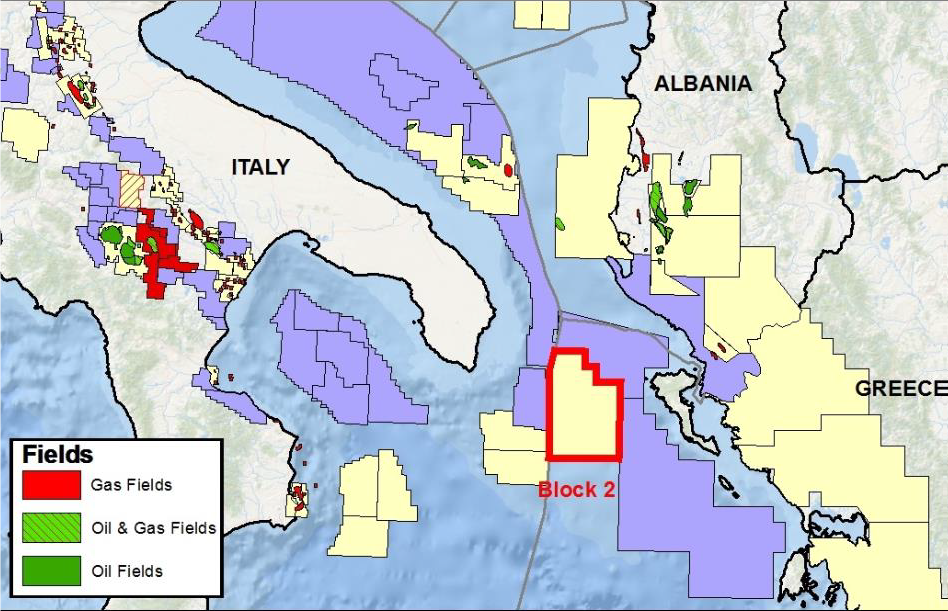
Location: In the Ionian Sea 30 km west of Corfu Island (note: that’s 18.6 miles, not the 125 mile buffer that Florida views as sacred)
Water depth: 500 to 1,500 m
Block size: 2,422.1 sq Km, the largest unexplored offshore structure in the Mediterranean (note: Gulf of America leases are only 23.3 sq km or < 1% as large)
First drilling: late 2026 or early 2027. This will be the first exploratory offshore drilling in Greece since 1981!
Energean’s participation is set at 30%, down from 75%.
Helleniq participation is now 10%, down from 25%.
Energean will remain the operator during the exploration stage.
In the event of a commercial discovery, Exxon will assume the operatorship during the development phase.
Andreas Shiamishis, CEO of HELLENiQ ENERGY: “Greece is emerging as one of Europe’s newest and promising regions for hydrocarbon exploration and development. This transaction represents a positive step not only for the joint venture partners, but also for the Greek economy.”
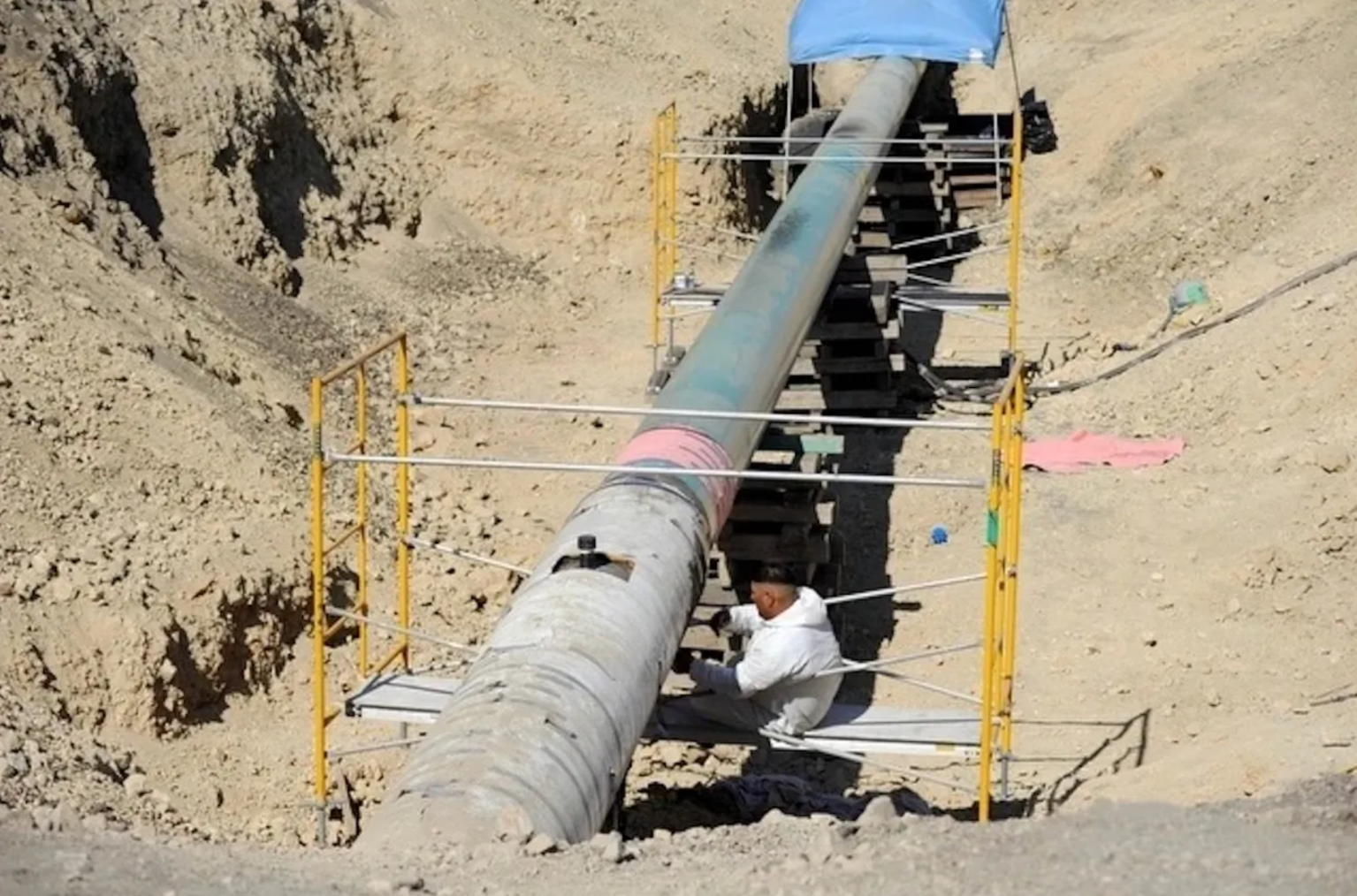
Sable Offshore is attempting to restart the same pipeline that caused the Refugio Oil Spill in 2015. | Credit: Paul Wellman File Photo
Sable Offshore oil believes the federal Pipeline and Hazardous Materials Safety Administration (PHMSA) , not the California Fire Marshal, should have jurisdiction over the company’s onshore pipeline.
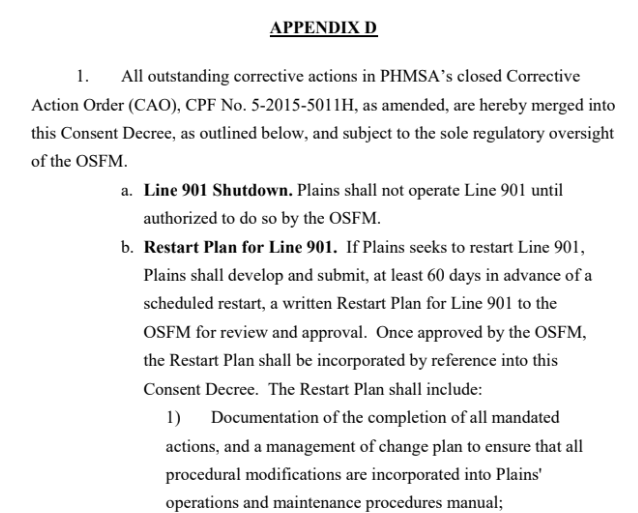
I once had the same opinion as Sable. Their pipeline is, by definition, an interstate line because it carries OCS production. Then I read Appendix D of the court approved Consent Decree that was executed following the 2015 Refugio pipeline spill. That Decree is quite clear regarding regulatory jurisdiction, and would have to be overturned to transfer authority to PHMSA.
The full Consent Decree is attached. Pasted below is an excerpt from Appendix D:
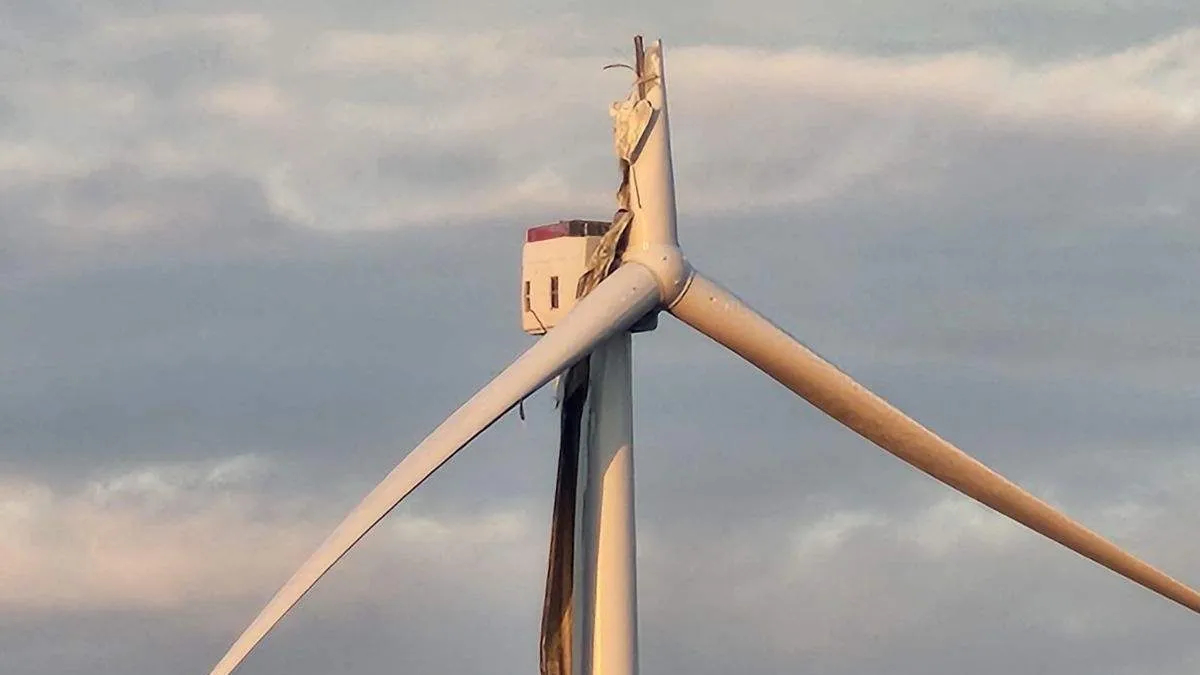
The Town of Nantucket’s attorney, Greg Werkheiser of Cultural Heritage Partners, told The Light last month that “it’s taken far too long” to get a final report on the blade failure.
Will the oil and gas lease sale boldly named Big Beautiful Gulf 1 (BBG1) live up to its grand name? Given the more favorable lease terms and the 2 year gap since the last sale, BBG1 should surpass the previous 3 sales (table below). Questions:
Which majors will be the most active bidders? Chevron? Shell? BP? Oxy/Anadarko?
Will former Gulf of Mexico stalwarts Exxon and Conoco Phillips participate for the first time in years? Probably not, but US super-majors should participate in the US offshore program.
How many companies will submit bids? Would like that to be a number >35.
How many tracts will receive bids? A number >300 would be very encouraging.
Will the total high bids exceed $400 million?
Will we see an increase in shelf interest?
Which independents will be the most active?
After the not-so-clever carbon disposal acquisitions in the last 3 sales, will the number of carbon disposal bids be zero? For the first time ever, the Federal government felt compelled to stipulate the obvious (see the proposed notice for OCS Sale 262) – that an Oil and Gas Lease Sale is only for oil and gas exploration and development.
See the summary data below for the last 3 Gulf lease sales. We’ll fill in the blanks next week.
Sale No.
257
259
261
BBG1
date
11/17/2021
3/29/2023
12/20/2023
12/10/2025
companies participating
33
32
26
total bids
2233
2842
3161
tracts receiving bids
2143
2442
2751
sum of all bids $millions
198.5
309.8
441.9
sum of high bids ($millions)
101.7
263.8
382.2
highest bid company block
$10,001,252.00 Anadarko AC 259
$15,911,947 Chevron KC 96
$25,500,085 Anadarko MC 389
most high bids company sum ($millions)
46 bp 29.0
75 Chevron 108.0
65 Shell 69.0
sum of high bids ($millions) company
47.1 Chevron
108 Chevron
88.3 Hess
most high bids by independent
14-DG Expl.
13-Beacon 13-Red Willow
22-Red Willow
1excludes 36 leases improperly acquired for carbon disposal purposes; 2excludes 69 leases improperly acquired for carbon disposal purposes; 3excludes 94 leases improperly acquired for carbon disposal purposes
“Natural gas and LNG are fast becoming the gravitational center of the global energy system, but some energy experts said the world is only beginning to grasp the scale of what’s to come.” ~Natural Gas Intelligence
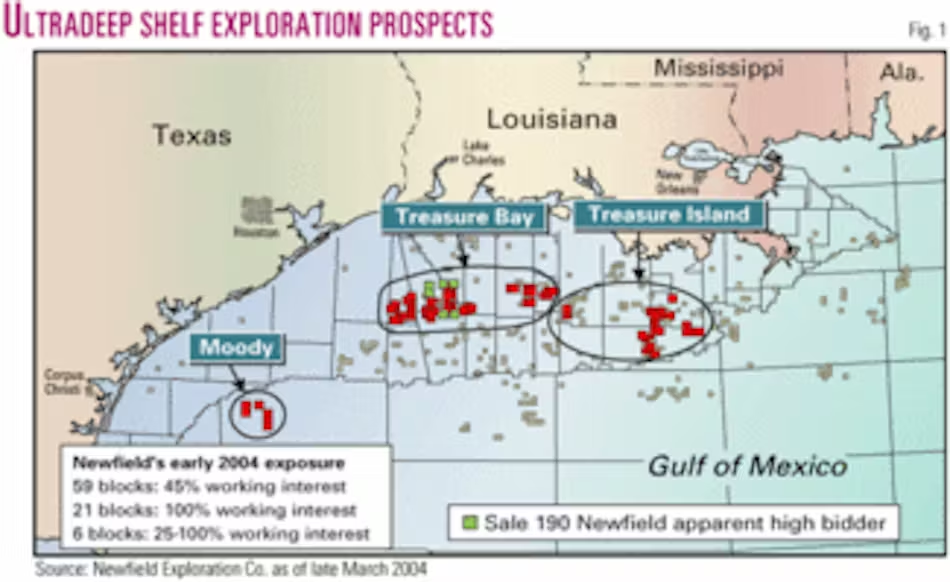
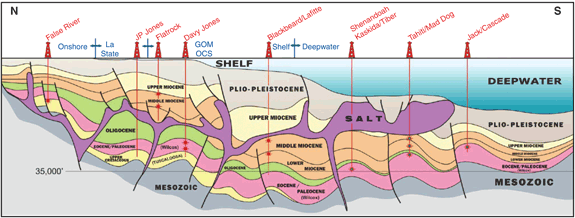
Demand and high well producibility are stimulating exploration in the high pressure, high temperature Western Haynesville (Texas) and other ultradeep onshore gas prospects. Is it time to revisit ultradeep gas on the Gulf of America shelf? See the above targets map from 2004.
20 years ago Newfield, Exxon, and McMoRan drilled pioneering ultradeep wells targeting gas-prone reservoirs below salt welds in Miocene and older formations (diagrams below). The water depths were <100 feet but well depths exceeding 30,000 feet, and high temperatures and pressures, pushed the limits of drilling technology at the time. Noteworthy wells:
Blackbeard West (Exxon): Spudded in early 2005 in 70 feet of water in South Timbalier Block 168. The target was gas in Miocene sands at 27,000-32,000 feet total depth. Drilling reached 30,067 feet by 2006, but was prudently suspended due to extreme pressures, temperatures (up to 600°F), and technical challenges with equipment.
Blackbeard West, part 2: In 2008, McMoRan re-entered the well with upgraded equipment and drilled to a record 32,997 feet below the mudline. They encountered hydrocarbon shows in multiple zones, including potential gas pay in Middle and Deep Miocene sands below 30,000 feet, validating the ultradeep concept.
Followup McMorRan wells:
Blackbeard East (2010-2011): Drilled to 33,400 feet in South Timbalier Block 144, logged potential hydrocarbons in Sparta and Vicksburg sands.
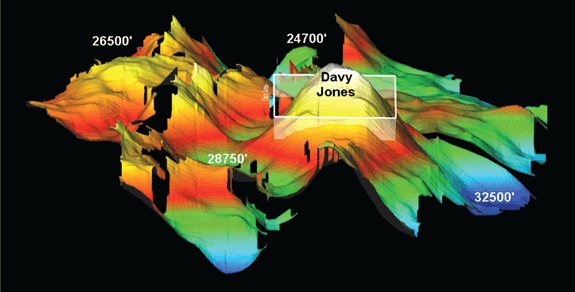
Davy Jones (2009-2010): South Marsh Island Block 230 in 20 feet of water; reached 29,122 feet; discovered gas in Wilcox sands, but faced flow-testing challenges.
Lafitte (2011): Eugene Island Block 223, found additional pay in ultradeep Miocene zones. These wells targeted gas reservoirs but encountered operational hurdles.
Also, note that a company targeting hydrocarbons below 25,000 feet (true vertical depth subsurface) may earn an additional 3 years on their lease. (See the Notice for next week’s lease sale.) Will improved technology and demand expectations finally open the ultradeep gas frontier?


 Bud's Offshore Energy (BOE)