Feeds:
Posts
Comments

Archive for the ‘Gulf of Mexico’ Category

Quite a bit per the GAO, and their report only deals with DOE management of demonstration projects. The Infrastructure Bill authorizes $2.5 billion for commercial projects (and much more for other CCS purposes).

DOE provided nearly $684 million to eight coal projects, resulting in one operational facility. Three projects were withdrawn—two prior to receiving funding—and one was built and entered operations, but halted operations in 2020 due to changing economic conditions. DOE terminated funding agreements with the other four projects prior to construction.

DOE provided approximately $438 million to three projects designed to capture and store carbon from industrial facilities, two of which were constructed and entered operations. The third project was withdrawn when the facility onto which the project was to be incorporated was canceled.

GAO

So DOE’s actual success ratio was 0.182 (2 for 11) – not very compelling.

With regard to proposals for offshore carbon sequestration, who will be liable for future cost overruns, operating losses, infrastructure failures including pipeline and well leaks, and decommissioning costs? Who ensures that there will never be any leakage from CO2 disposal reservoirs? Does all of this fall on the Federal government?

Corporations that want to engage in carbon sequestration for commercial or other purposes should fund the projects with their own revenues or fees charged to the companies whose emissions they are collecting. The Outer Continental Shelf is publicly owned and those wishing to dispose of substances should pay a usage fee, be responsible for all costs, and be liable for pollution and damages.
Read Full Post »

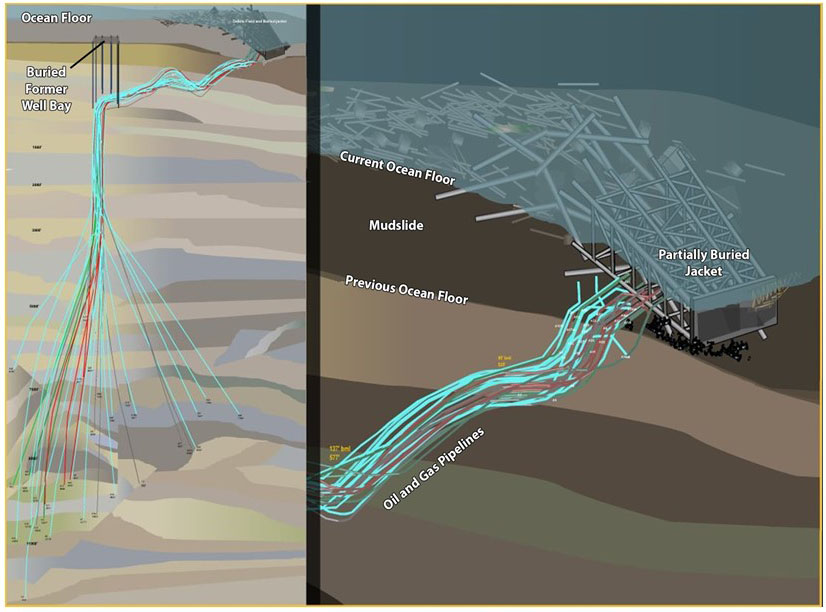
Taylor Energy’s Mississippi Canyon Block 20 “A” platform was destroyed by a massive mudslide during Hurricane Ivan in 2004 (see illustrations below). Per Naval Research Laboratory sensors, “Ivan the Terrible” generated freak waves as high as 91 feet, and NRL computer models suggest that wave heights may have exceeded 130 feet. The changes in pressure resulting from the motion of the huge waves triggered the flow of the unstable Mississippi delta sediments. The platform was swept 500 feet downslope and the wells were severed and buried under a deep layer of sediment. That was essentially the end for Taylor Energy, as the company would spend the next 17 years locating and plugging wells, decommissioning piping, collecting seepage, and mitigating pollution. Since 2008, when Taylor sold its remaining oil and gas assets, the company has been solely engaged in the MC-20 response.

Illustration of the collapsed well jacket and damaged pipes from Taylor Energy’s Mississippi Canyon 20 Platform in the Gulf of Mexico.
NOAA illustration

Last week, Taylor and the Justice Department signed a consent degree that transfers the company’s remaining assets and control of the decommissioning trust fund to the Federal government. Questions remain as to whether the platform and wells could have been better designed to withstand the mudslide (note that the platform was installed and operated by BP prior to being sold to Taylor), and whether more should have been done to mitigate the seepage. Taylor does a good job of making its case at their response website.

Few offshore operators would argue that what happened to Taylor couldn’t happen to them. That would be brash and foolish. Hopefully, the companies that remain have absorbed the lessons of MC-20 and are applying them to their operations and management programs.

Read Full Post »

An old offshore platform in the U.S. Gulf of Mexico is set to be converted into a working fish farm, creating a blueprint for future aquaculture re-use projects and providing repurposing options for old oil and gas assets.

offshore-energy.biz
Creating blueprint for reusing old oil & gas assets in Gulf of Mexico
Station Padre

Congratulations to the Gulf Offshore Research Institute (GORI) and Innovasea on their plans to transform an offshore Texas gas platform into a working fish farm.

For the complete list of alternative uses for offshore oil and gas platforms, see our Rigs-to-Reefs+++ page.

Read Full Post »

Carbon capture and storage
NPD

Several actors have approached the ministry with a desire to be allocated two specific areas for storage of CO 2 . One area in the North Sea and one in the Barents Sea were therefore announced on 10 September in accordance with the storage regulations.

By the application deadline of 9 December, the ministry had received applications from five companies. The Ministry will process the received applications and allocate area in accordance with the storage regulations during the first half of 2022.

Ministry of Petroleum and Energy, Norway

Contrast the situation in Norway with Exxon’s apparent attempt to acquire 94 Gulf of Mexico leases at Oil and Gas Lease Sale 257 solely for CCS purposes. BOEM’s Notice of Sale made no mention of CCS, and there had been no environmental or economic assessment of CCS activity.

And how much will the public pay for grand CCS ventures that (although interim measures) will take years to initiate, add new safety and environmental risks, and may never achieve their objectives? The public burden will no doubt include direct subsidies, tax credits, increased petrochemical prices, and the erosion of purchasing power associated with the resulting inflation pressures.

More on Sale 257 and the CCS bidding.

Read Full Post »

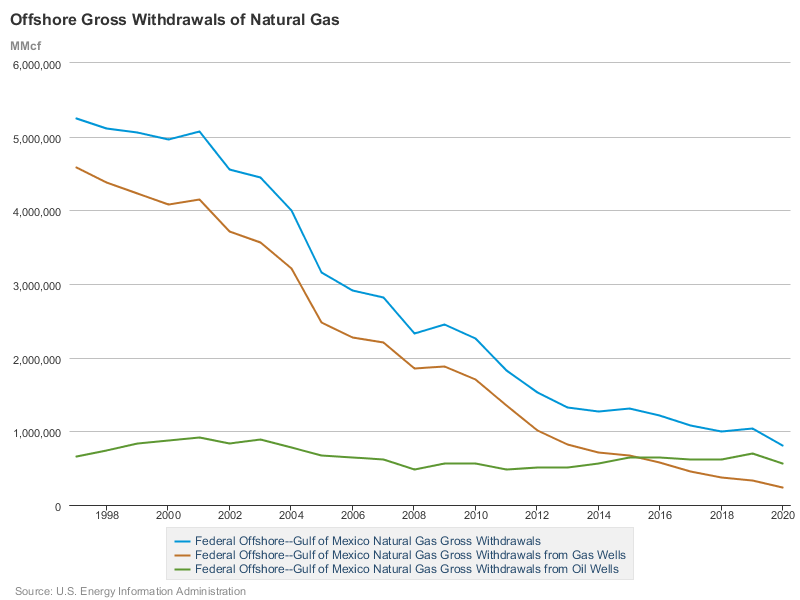
Offshore gas production (see chart below) has declined for the past 20 years and now accounts for only 4% of total US gas production, down from 20% in 2005 and 25% in the 1990s. Associated gas production (oil-well gas) has remained relatively constant owing to the strength in deepwater GoM oil production. 73% of 2020 gas production was from deepwater wells, and was mostly oil-well gas. Associated gas production surpassed nonassociated gas production (gas-well gas) in 2016 and the latter has continued to decline.

The case for natural gas has been well documented (see the EQT letter linked below). Recent natural gas advocacy has emphasized the carbon/GHG advantages given that methane (CH4) is essentially a hydrogen transporter that emits far less CO2 than other fossil fuels when burned. However, natural gas’s other important air quality advantages – low NOx. SO2, and particulate emissions – have greater local significance from a human health standpoint. Those who have ridden a bike behind a natural gas powered bus have no doubt experienced the natural gas advantage firsthand. These buses are literally a breath of fresh air!

Other environmental advantages of offshore natural gas, particularly nonassociated gas, receive less attention but are nonetheless significant. Advantages of nonassociated offshore gas include the following:

  • Fewer wells required than for shale gas
  • No risk of fresh water contamination
  • Platforms provide beneficial reef effects
  • Minimal space preemption and land disturbance relative to onshore gas production and wind/solar operations
  • Low facility density and navigation risks relative to wind operations;
  • Lower elevation and fewer view-shed, aesthetic, and aviation issues than for wind
  • Minimal avian risks relative to on- and offshore wind operations
  • Minimal spill risk relative to oil and associated gas production
  • Significantly less flaring than for oil well gas. While the overall % of US offshore gas production that is flared is low (approx. 1.0 -1.5% from 2016-2020 per EIA data), the % of gas-well gas that is flared has historically been less than 0.5%.

Low natural gas prices and competition from nimble and efficient shale operations have constrained offshore gas exploration. Ultradeep (subsurface) drilling has shown promise from a gas resource perspective but has proven to be expensive and operationally challenging. Some independent producers are still acquiring gas prone shelf tracts and that needs to be encouraged. Consideration should be given to incentives such as making nonassociated gas production royalty free. That would certainly seem preferable to subsidizing complex, expensive, and uncertain carbon disposal operations on offshore leases.

Read Full Post »

What, if anything, will the Judge say about the leases that are intended to be carbon sequestration sites? How can BOEM sell OCS leases for purposes that were neither announced nor environmentally assessed? What do EarthJustice and the other plaintiffs think about the sequestration bids given that the environmental community is split on CCS?

Who is going to pay the enormous cost of sequestration on the Outer Continental Shelf – platforms, wells, pipelines, processing equipment, maintenance, monitoring, decommissioning, and more? The Federal government (i.e. taxpayers) features large in this grand scheme, and will no doubt be assuming most of the economic and performance risks. And all of these costs are for disposal purposes, not for offshore energy production of any kind.

Together with the bipartisan infrastructure bill enacted in November, which included more than $12 billion in funding for carbon capture and carbon removal technologies, the Build Back Better legislation would hand fossil fuel companies nearly every item on their carbon capture wishlist.

Inside Climate News

The reality of offshore CCS is not anywhere near as simple as portrayed in the slick graphic below:

houston ccs hub
ExxonMobil

Read Full Post »

Data from EIA

More than half of GoM oil production was shut-in for 13 days in September and several hundred thousand BOPD were shut-in for the rest of the month. The result was a 42% reduction in production from pre-Ida (July) levels.

All production has now been restored so the December EIA figures should give us a good read on stablized post-Ida production.

Read Full Post »

Observations and comments on the offshore findings and recommendations in the Dept. of the Interior’s report:

  • From an offshore perspective, this report is more moderate than expected. No major complaints.
  • The report was issued the Friday after Thanksgiving. Was there a desire to minimize attention?
  • The report does not include a recommendation on raising royalty rates. DOI will continue to study such actions (prudent decision).
  • BSEE estimates current liability for “orphaned infrastructure” at only $65 million. They must be using a very narrow definition of orphaned infrastructure.
  • “Financial assurance coverage should be strengthened.” (Few would argue with that statement.)
  • “BSEE and BOEM will carefully consider comments on the 2020 proposed financial assurance rule.” (Deja vu? Expect a long, slow process.)
  • BOEM will establish a “fitness to operate standard.” Comments: (1) This is an old concept that has proven to be difficult to execute. Hold companies accountable, make them demonstrate financial assurance, and don’t pander to bad actors (see the case of Hogan and Houchin) (2) Why is BOEM establishing this standard and not BSEE, the safety bureau? (The division of responsibilities between BOEM and BSEE has created serious overlap, inefficiency, and confusion and needs to be addressed.)
  • “BOEM should consider advancing alternatives to the practice of area-wide leasing.” Tract selection makes sense in frontier areas with little operational history. It would have been perfect for the Mid- or South Atlantic or the EGoM, all of which were cynically removed from future leasing consideration by the previous President just before the 2020 election. The Central and Western Gulf of Mexico is too mature for a return to tract selection; employing that approach after 40 years of area-wide leasing is likely to generate less revenue and production.

Read Full Post »

The text below, excerpted from the Infrastructure Bill (signed 2 days before Sale 257), requires the Federal government to provide funding for commercial CCS projects. $2.5 billion is appropriated. Given these incentives, how does BOEM possibly issue leases for CCS purposes when there was no public notice (as required by 30 CFR § 556.308) that CCS bids would be accepted at the oil and gas lease sale?

SEC. 40305. 
e) Large-scale Carbon Storage Commercialization Program.--
        ``(1) In general.--The Secretary shall establish a commercialization program under which the Secretary shall provide funding for the development of new or expanded commercial large-scale carbon sequestration projects and associated carbon dioxide transport infrastructure, including funding for the feasibility,site characterization, permitting, and construction stages of project development.
(h) Authorization of Appropriations.--There is authorized to be appropriated to the Secretary to carry out this section $2,500,000,000 for the period of fiscal years 2022 through 2026.

Read Full Post »

Were it not for the surprising CCS bidding, which was accomplished without public notice, last week’s Gulf of Mexico sale would have been pretty ordinary – $177 million on 214 tracts.

A 1981 lease sale offshore California was quite another matter. That sale (no. 53) set records that will never be surpassed. A single lease (OCS-P 0450) encompassing a little more than 5000 acres was sold to Chevron and Phillips for an astounding $333 million. This equates to $1.013 billion in 2021 dollars. That single bid (in 1981 dollars) exceeds the total high bids for any Gulf of Mexico sale since 2015.

High bids for Sale 53 totaled $2.3 billion ($7.0 billion in 2021 dollars!) for only 81 tracts. A GoM sale in 2008 received $3.7 billion in high bids, but that was for 603 tracts.

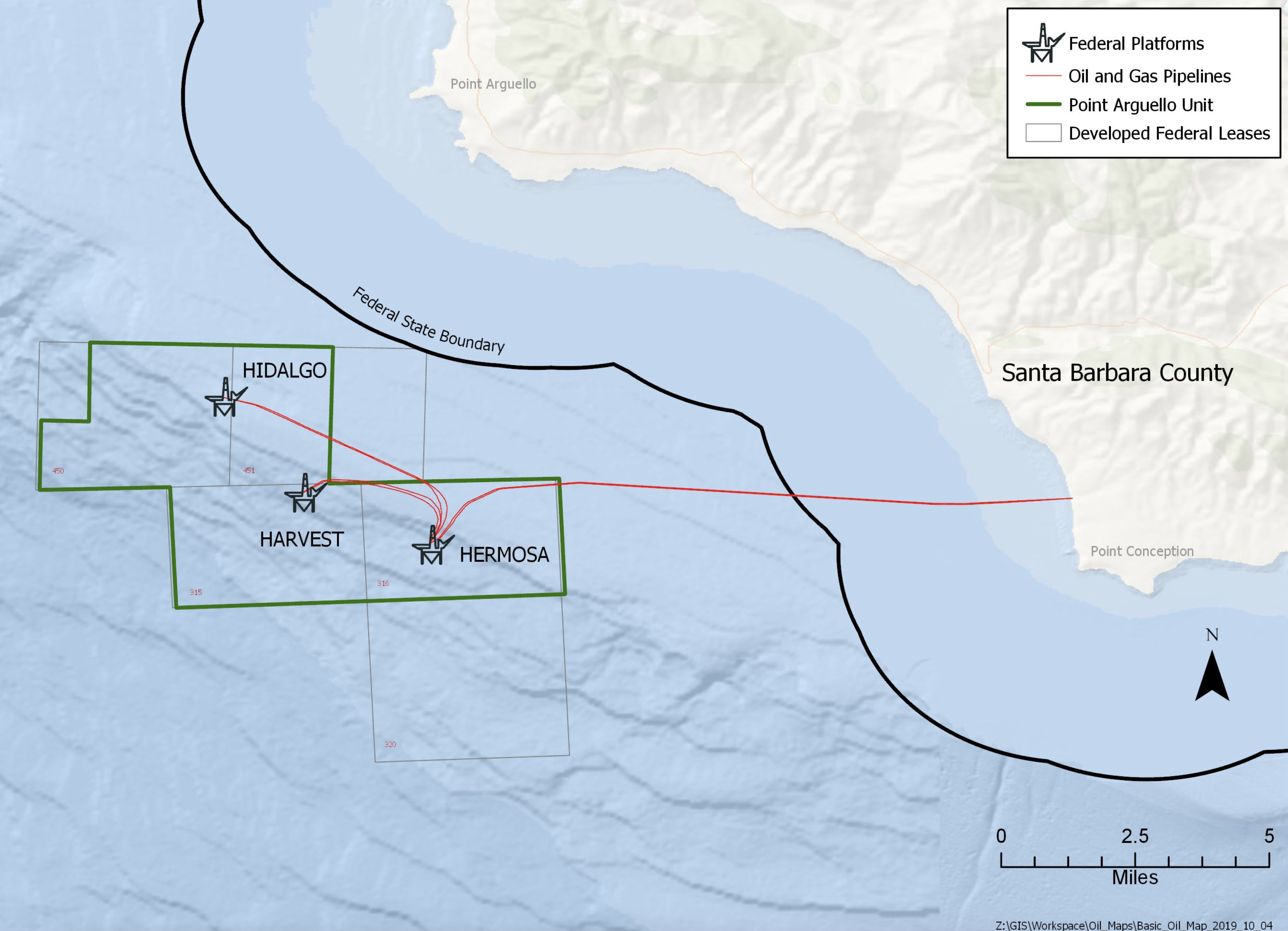
Unfortunately, production from lease 0450 never met expectations. Platform Hidalgo (0450) and the other two Pt. Arguello field platforms (Harvest and Hermosa) are no longer producing and are in the process of being decommissioned. An interesting criminal case involving Platform Harvest, then operated by Texaco, will be discussed at a later date.

Pt. Arguello Field

OCS Sale data

Pacific only data

John Smith’s Pacific decommissioning update

Read Full Post »

« Newer Posts - Older Posts »