Feeds:
Posts
Comments

Archive for the ‘Gulf of Mexico’ Category

The judge correctly dismissed the unfounded claim that new oil and gas leasing would preclude wind development in the Gulf. BOE comments:

  • The number of GoM platforms is down 75% from its peak and continuing to decline.
  • Most new production is in the deepwater GoM and is accomplished with very few, remote and widely dispersed facilities. There are currently only 57 deepwater platforms across the entire Gulf.
  • The wind industry appreciates the synergy between offshore oil and gas and offshore wind operations. Indeed the oil industry has been very supportive of offshore wind, and some of the same operating companies and contractors are major players in both industries.
  • t has been 17 years since the enabling legislation was passed, yet we are still awaiting the first commercial wind project in the US Atlantic. You can’t blame the oil and gas industry for that delay. To the contrary, one can make the case that the presence of oil and gas operations would have accelerated Atlantic wind development.
  • The enabling legislation for offshore wind was drafted by the agency that managed the offshore oil and gas program and recognized the compatibility of oil and wind development. Wind development is clearly a high priority for BOEM, the current OCS land manager.

Will the Administration appeal the court decision to vacate the lease sale or does the decision assist them by reinstating their leasing pause? How will the conflict between the DC court decision and the injunction invalidating the leasing pause (Federal Court for the Western District of Louisiana) be resolved?

What does this mean for the 94 leases that were to have been acquired for carbon sequestration purposes? Will BOEM have a proper CCS sale after conducting an environmental assessment, determining bidding terms and evaluation criteria, and publishing a Notice of Sale? Or will there be a legislative end run that authorizes the issuance of the leases without these steps?

Read Full Post »

Our last GoM update predicted November oil production of 1.8 million BOPD. The EIA figure released yesterday came in slightly less than that at 1.795 million BOPD.

Will 2022 startups push oil production back up to the 2.044 record achieved in August 2019? Possibly, but the longer term outlook is not compelling given reduced drilling activity and the dearth of recent discoveries. The long leasing pause will further compromise exploration by limiting opportunities to test new geologic interpretations and assess promising prospects.

Read Full Post »

The very disappointing 68 page ruling on Lease Sale 257 boils down to the following:

  1. BOEM had correctly determined that, from a GHG standpoint, US offshore production was preferable to more carbon intensive foreign production.
  2. The plaintiffs, who are seemingly intent on stopping all oil and gas production regardless of the economic consequences, argued that BOEM failed to consider the “positive” effect that higher prices (the logical result of lower production) would have on reducing demand.
  3. In particular, the plaintiffs asserted that BOEM failed to consider the effect that reduced production (and higher prices) would have on foreign consumption and the associated GHG emissions.
  4. The judge not only decided in favor of the plaintiffs, but ruled that BOEM’s omission was so serious that the lease sale had to be vacated.
  5. The judge reached this decision even though (1) the five year leasing plan expires in June leaving the timing of any future sale very much in doubt and (2) all of the sale 257 bids are now public information compromising the integrity of the leasing process at the next sale (if and when that occurs).

So, if BOEM has to consider the environmental benefits of higher oil and gas prices, shouldn’t they also have to consider the negative economic and environmental effects from the resulting price inflation and energy poverty? Are higher prices, which are most detrimental to the poor and to developing nations, “energy justice?”

If your only objective is the destruction of the US offshore oil and gas program, this was a great decision. For everyone else, this is yet another reason to be concerned about our energy future.

Read Full Post »

The Court VACATES and REMANDS the Record of Decision for Lease Sale 257 to the Department of the Interior.

Rudolph Contreras, US District Judge

The decision is yet another victory for OPEC+, which is doing quite well of late, and a loss for our economy and energy security.

So here is where we are:

  • June 15, 2021: The U.S. District Court for the Western District of Louisiana issues injunction invalidating Federal oil and gas leasing “pause”
  • September 30, 2021: BOEM announces Sale 257 for the Gulf of Mexico
  • November 17, 2021: BOEM holds Sale 257
  • January 27. 2022: The U.S. District Court for DC vacates Sale 257 and remands the Record of Decision to the Dept. of the Interior
  • Five year leasing plan expires in June 2022
  • So is the ball in Louisiana’s (Federal) court?

Read Full Post »

While the Fieldwood Energy violations drove up the number of Incidents of Non-Compliance (INCs) in the Gulf of Mexico in 2021, most operating companies appear to have had good compliance records. Among companies that were subjected to at least 10 facility inspection and drilled at least one well, BHP Billiton, Eni US, and Murphy (listed alphabetically) had the most impressive compliance records. These three operators were cited for 7 or fewer INCs, none of which required a facility to be shut-in. Other operators that exceeded those activity thresholds and had excellent compliance records were (listed alphabetically) Anadarko, ANKOR Energy, Chevron, EnVen, Shell, and Walter Oil and Gas.

In the Pacific Region, Beta Operating Co., Chevron (now overseeing the former Signal Hill properties), and Exxon had excellent compliance records, although none of these facilities produced for the full year. In Alaska, Hillcorp had an excellent record at the Northstar Unit. (This is a gravel island facility in the State waters of the Beaufort Sea, but some of the wells produce from portions of the reservoir that are in the Federal sector).

Unfortunately, only summary inspection data are posted online. Without knowing the specific violations and circumstances, it’s not possible to fully assess the risk exposure. These oil and gas operations are conducted on public lands and are monitored by Federal employees. Inspection data and reports should be publicly accessible without having to submit Freedom of Information Act requests.

As has previously been discussed, incident updates should also be posted in a timely manner. Reference is made to this important recommendation in the 2016 National Academies report entitled Strengthening the Safety Culture of the Offshore Oil and Gas Industry:

Recommendation 4.2.2: Because accident, incident, and inspection data all are needed to identify and understand safety risks and corrective actions, the committee recommends full transparency such that regulators make all these data readily available to the public in a timely way, taking into consideration applicable confidentiality requirements.

Read Full Post »

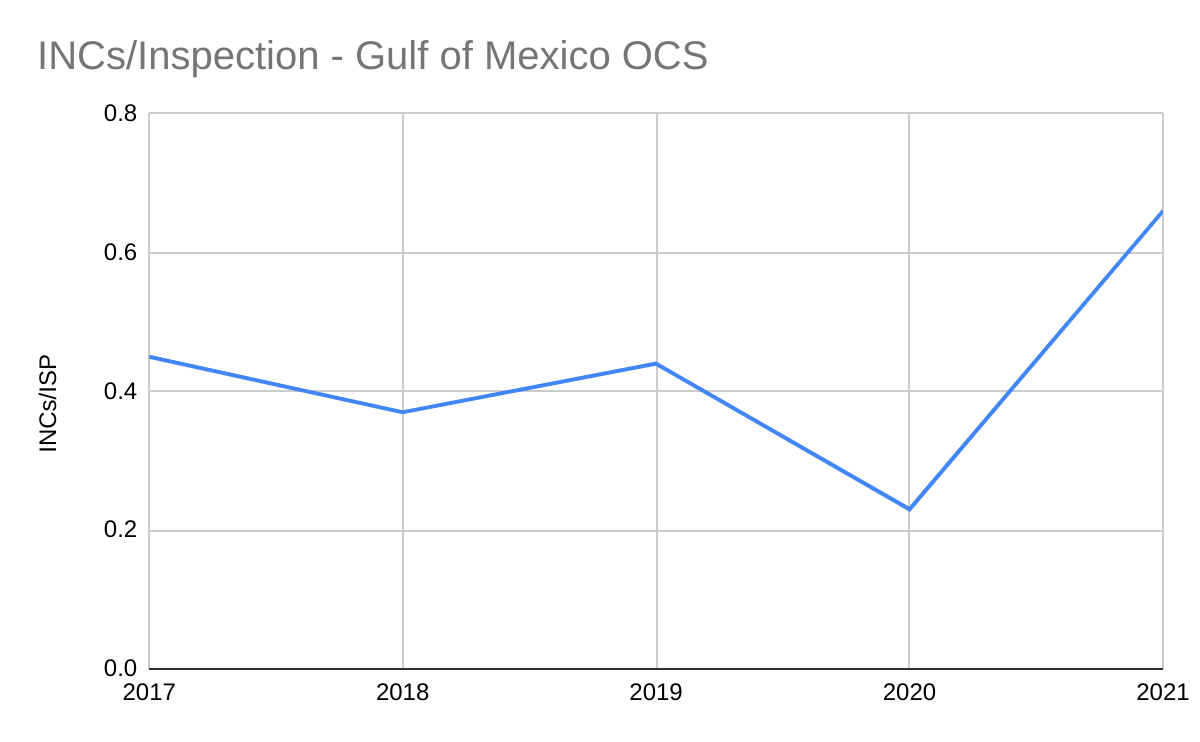
Per BSEE’s Incidents of Non-Compliance (INC) data base, the number of violations surged in 2021, both in terms of the total number of INCs and the INCs/inspection ratio (see chart below). Remarkably, a single company – Fieldwood Energy – was responsible for 845 INCs or 44% of the total number issued. Normalizing for the number of inspections, Fieldwood facilities were cited for 1.46 INCs/inspection versus 0.46 INCs/inspection for all other companies. An unprecedented 61 of Fieldwood’s 2021 INCs called for facility shut-ins, many times more than any other operator. Through the first 17 days of 2022, Fieldwood has already been cited for 21 INCs, 5 of which required facilities to be shut-in.

Fieldwood and its affiliates have experienced multiple bankruptcies and the company has once again been reorganized with the blessing of the courts. Chevron’s comprehensive objection to the reorganization plan asserted that Fieldwood has $9 billion in current and anticipated decommissioning obligations. These enormous decommissioning liabilities and their implications for predecessor lessees (former facility owners) and the Federal government were the main issue in these proceedings, and the bankruptcy plan includes settlements with predecessor companies and the government.

Even more significant than the financial matters and INCs are the following:

While BSEE regulations provide for the removal of operating rights for poor safety performance, companies can reorganize and problem managers can reappear elsewhere. As a result, marginally financed and ineffective operating companies are a major challenge for BSEE as evidenced by the INCs, civil penalties, and investigations. (See the related saga of Platforms Hogan and Houchin in the Pacific Region.)

Poor safety performers drag down the entire industry. The costs of mega-disasters like the Santa Barbara and Macondo blowouts have been widely discussed. However, chronic poor performance and the associated incidents also weaken the industry and damage the integrity of the offshore oil and gas program. These performance issues can’t be left entirely to BSEE and the Coast Guard to resolve. The industry needs to do a better job of self-evaluation, calling out poor performers, and exercising judgement in the assignment of offshore properties.

Read Full Post »

Yesterday, BSEE issued investigation reports for 2 of the fatal 2020 incidents. Both of these incidents involved falls, a chronic and preventable cause of offshore worker casualties. Not enough industry and trade association attention is given to such incidents, which have been trivialized in the past by categorizing them as “slips, trips, and falls.” The reports are linked below:

The reports describe how the incidents occurred and what we can do better to prevent similar events in the future. Despite the advance in safety management programs over the past 30 years, there has been no discernible improvement in preventing these incidents. We need to rethink training programs, planning, and methods. Deadly falls are not inevitable.

Read Full Post »

Last month (12/2021), BSEE finally posted the 2020 incident statistics. Unfortunately, no details or incident summaries are provided for the 6 fatalities. The fatalities are simply classified as “occupational” (4) or “non-occupational” (2). As a result, we still know very little about these fatal incidents 13 – 24 months after they occurred.

The BSEE spreadsheet advises that 3 of the 4 “non-occupational” fatalities are being investigated, but the reports are still “pending.” Why the long delay? The National Commission, BOEMRE-CG, and NAE investigations of the Macondo tragedy were completed (and reports published) in less time.

No explanation is provided as to why the 4th occupational fatality is not being investigated.

Also, investigations of the preparedness and response aspects of the 2 non-occupational fatalities would have been beneficial. What was the cause of death? What medical screening procedures were in place? What treatment capabilities were available at the facility? How much time was required to transport the workers to hospitals? These are important considerations for the offshore community.

Below is a summary of the publicly available information for the 6 fatalities:

  • 1/14/2020: A worker died on a Diamond drillship on a lease (Mississippi Canyon 822) operated by BP. According to BSEE this was a non-occupational fatality. Per the listing of investigations, no investigation was conducted.
  • 5/16/2020: A worker died on a Fieldwood platform (Ewing Bank 826 A). Per BSEE, this was an occupational fatality and the investigation is still pending. There were no media reports or company announcements.
  • 6/2/2020: A worker died on the Valaris DS-18 drillship working for EnVen Energy at Green Canyon 767. Per BSEE, this was a non-occupational fatality and no investigation was conducted.
  • 6/20/2020: A worker died on at the Green Canyon 18 A platform operated by Talos. Per BSEE, this was an occupational fatality but no investigation is indicated for this incident. No media reports or company announcements could be found.
  • 8/23/2020: A worker died on the Pacific Khamsin drillship working for Total at Garden Banks 1003. A month later, at an Investors’ Day presentation, Total announced that the incident occurred while the crew was preparing to move the rig to avoid Tropical Storm Laura. Total’s statement included this defensive statement: “This is a routine operation that was executed with no time pressure as the rig disconnection had been decided well in advance.” Per Total, the findings of their investigation were shared with the regulators in Sept. 2020, but BSEE advises that their investigation is still pending.
  • 12/2/2020: A worker died on DCOR’s Platform Gilda in the Santa Barbara Channel offshore California. The BSEE investigations update provides no information on the status of the investigation. Per local media, 3 men fell from the platform and others jumped into the water to assist. No information is provided on the reason why the 3 men fell.

The number of US OCS fatalities remains unacceptably high, and timely data sharing and investigations are needed to better assess causes and trends. In that regard, this recommendation from the 2016 National Academies report entitled “Strengthening the Safety Culture of the Offshore Oil and Gas Industry” merits further industry/government attention and action:

Recommendation 4.2.2: Because accident, incident, and inspection data all are needed to identify and understand safety risks and corrective actions, the committee recommends full transparency such that regulators make all these data readily available to the public in a timely way, taking into consideration applicable confidentiality requirements.

Read Full Post »

Declines in drilling activity and discoveries suggest that higher real oil prices are on the horizon. We may be fortunate enough to escape significant price hikes and supply disruptions over the next couple of years, but they are coming.

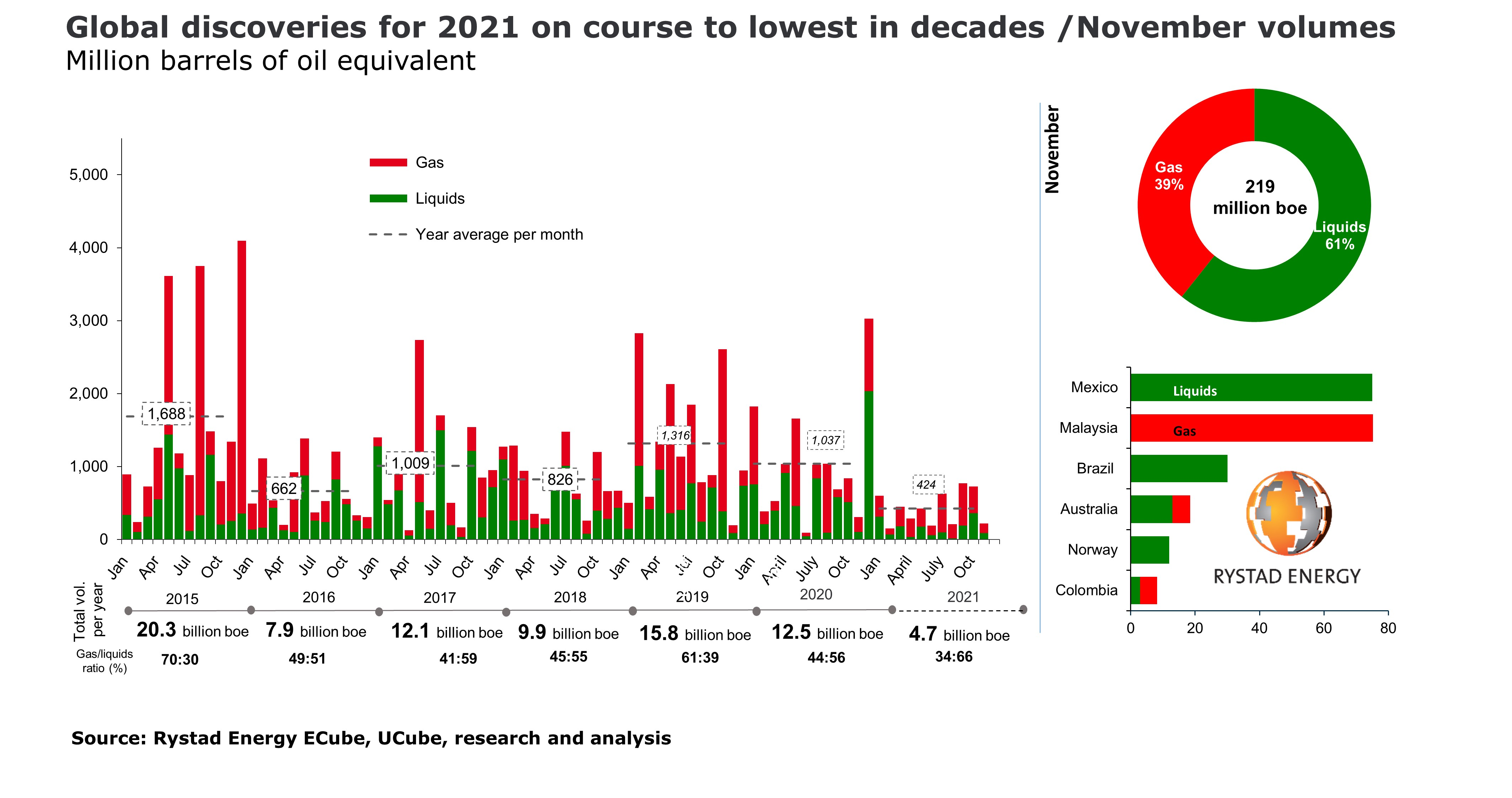
Rystad’s not-so-cheery pre-Christmas press release reported that, on a volume basis, 2021 oil and gas discoveries had sunk to the lowest level in 75 years.

20211220 OG global discoveries PR chart.png
Rystad Energy

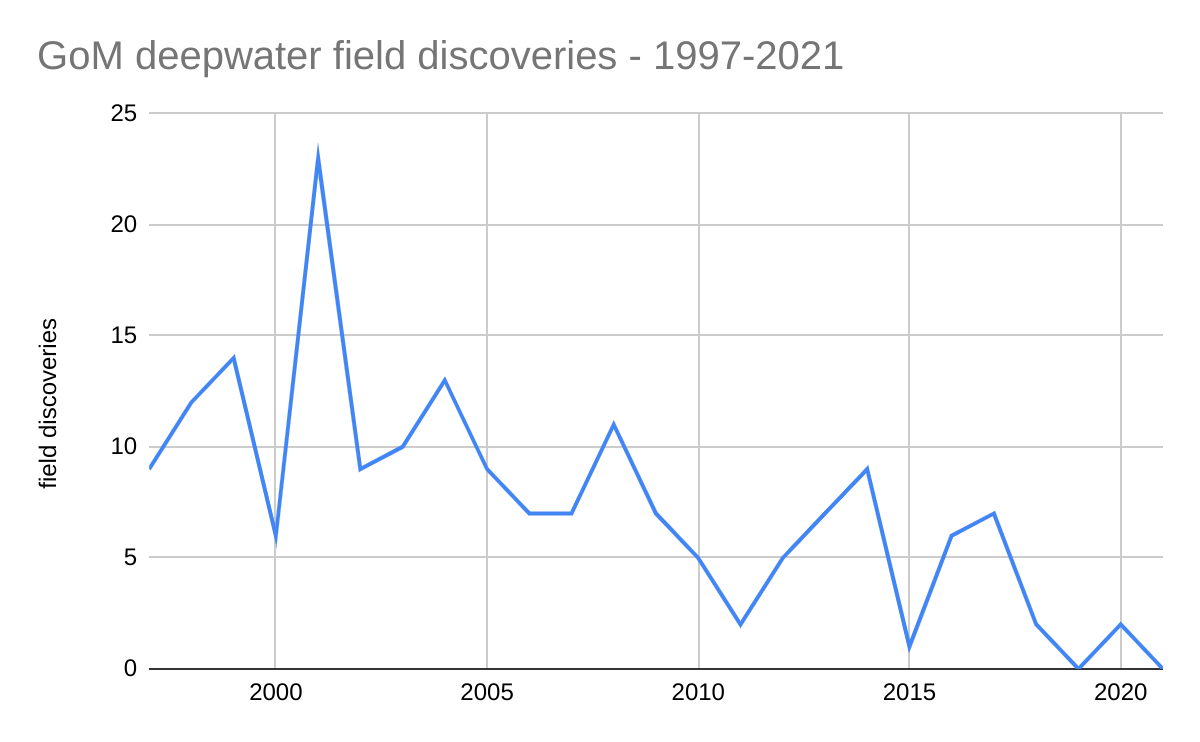
US offshore trends are even more troubling. Per BOEM’s database, no deepwater fields were discovered in 2021 and there were only 2 discoveries in the past 3 years (see chart below). HartEnergy reports 5 announced discoveries in 2021, none of which has been determined by BOEM to be commercially producible. Regardless of the status of those 2021 determinations, recent discoveries have not been sufficient to reach and sustain GoM production volumes at the 2019 peak (August) of 2.044 million BOPD. 2019 was the first year since 1982 without a confirmed deepwater discovery and the trend (below) is not encouraging. Schlumberger data through 2016 indicated GoM depletion rates greater than 20%, and the subsequent low discovery rates do not bode well for future production trends.

from BOEM data

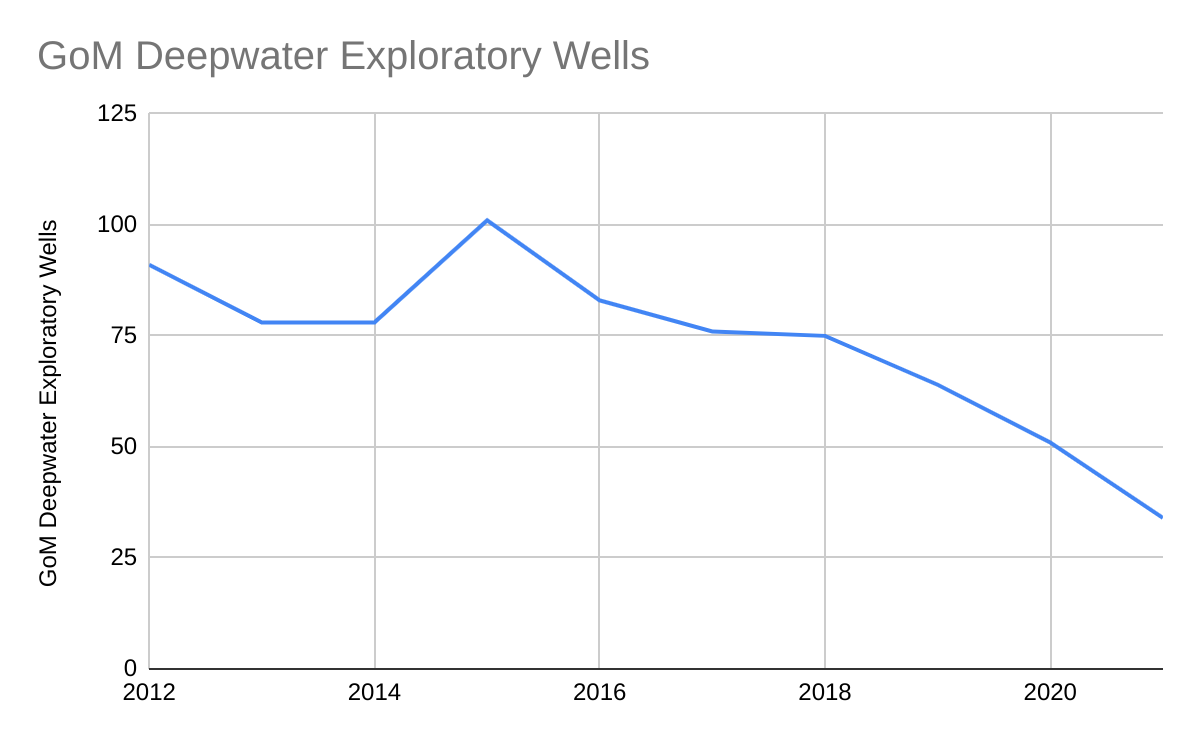
You can’t make discoveries without drilling and only 9 companies drilled deepwater GoM exploratory wells in 2021 (34 wells total). With the Pacific in decommissioning mode, the Atlantic and Eastern GoM off-limits, limited options offshore Alaska, and the decline of the GoM shelf, the deepwater GoM is the only important US offshore production option. The exploration numbers below are therefore concerning.

The shale revolution made the US a net oil exporter, but skepticism about shale production forecasts suggests the need for other supply sources. Given the shale uncertainty and the unrealistic expectations regarding the energy transition, greater US dependence on imported oil is on the horizon. This bodes well for OPEC, but not so well for US and international consumers.

Meanwhile, the US Dept. of Energy shows no evidence of concern about oil and gas production. Although oil and gas account for about 70% of our energy consumption, there has been no mention of either on the DOE homepage for months. DOE does express a strong interest in “energy justice.” Perhaps they can explain how increased imports and higher energy prices benefit the poor. They should also explain how oil imports are environmentally and economically superior to domestic oil and gas production, when the reality is exactly the opposite.

Read Full Post »

EIA data

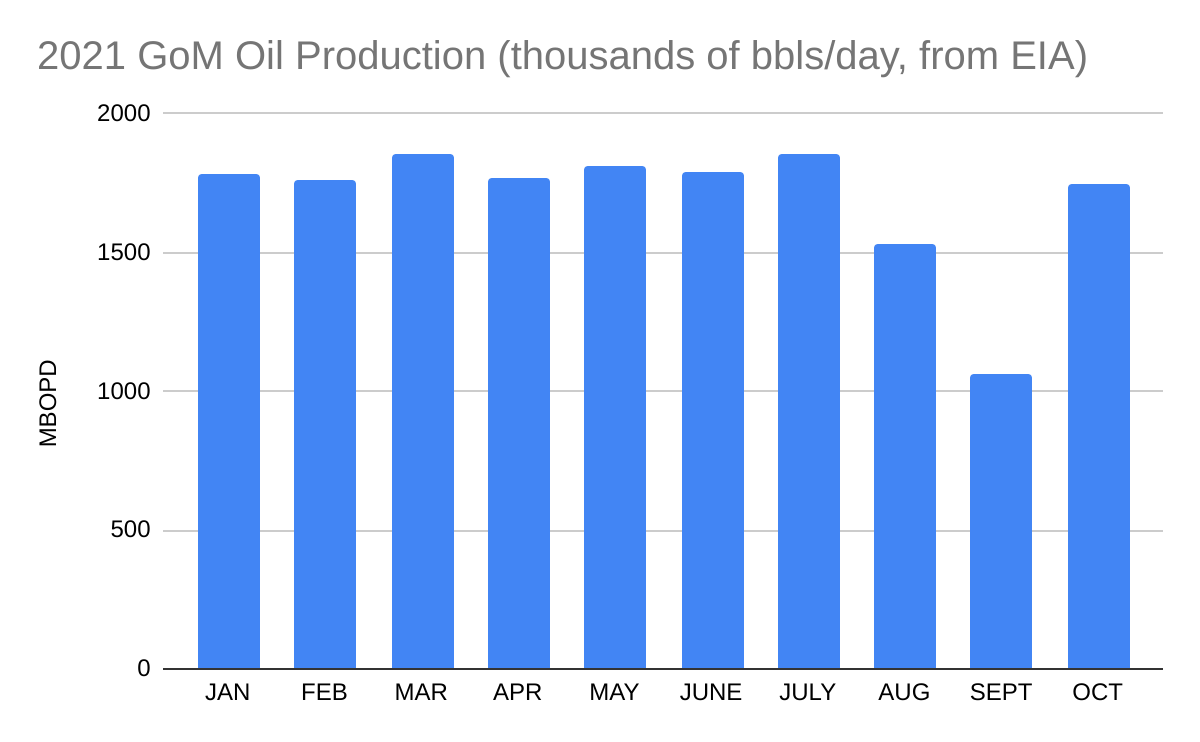
October production rebounded to 1.744 million BOPD from the 2021 low of 1.064 million BOPD in September (Hurricane Ida). November and December production should exceed 1.8 million BOPD.

Read Full Post »

« Newer Posts - Older Posts »