Feeds:
Posts
Comments

Posts Tagged ‘national academies’

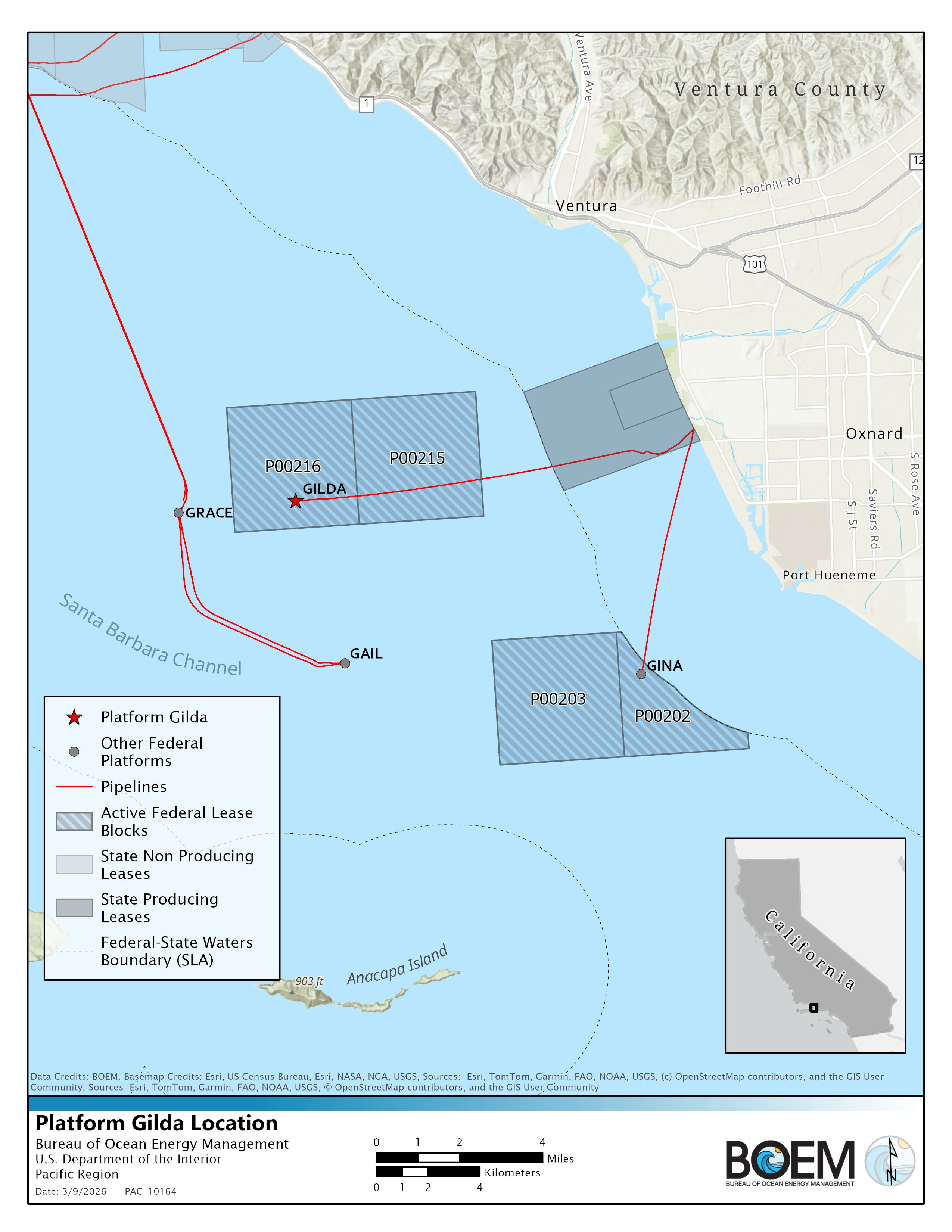
Despite favorable environmental reviews from both the Obama and Trump Administrations, the California Coastal Commission, empowered by the Courts, voted last week to prohibit the resumption of hydraulic well stimulation at DCOR’s Platform Gilda (map above).

Of course, as is always the case offshore California, the regulatory and legal battles will continue. The Secretary of Commerce may choose to overrule the CCC, in which case further litigation is certain.

This dispute comes at a time when the CCC, which operates with extraordinary autonomy, is undergoing a performance review by Commerce. Needless to say, the Commission and its supporters are not thrilled with the oversight.

In light of the spotlight on “offshore fracking,” I wanted to draw attention to a 2019 National Academies workshop that considered this very issue. I had the opportunity to participate in this workshop and was impressed by the input from industry and govt representatives.

Key points from the workshop:

  • If wells are not completed effectively, the value of drilling is negated, and it is impossible to deliver the oil or gas production needed to make the wells economically sustainable.
  • The frac pack (as is proposed for Platform Gilda) is one of the most commonly used completion techniques worldwide.
  • A gravel pack uses sieved sand as a filter to prevent formation sand from entering the wellbore, while the frac pack combines the gravel pack with hydraulic fracturing to create wide fractures filled with sieved sand that aid in connecting the reservoir to the wellbore.
  • Frac packs can create 50- to 250-foot fractures to stimulate production in a well.
  • Well stimulation offshore, which has been in practice for decades, has far less negative impact potential than well stimulation onshore.
  • Hydraulic fracturing minimizes the number of wells needed to develop a reservoir with the result being less environmental impact potential. This completion technique allows for the development of natural resources not previously considered commercially viable.
  • Offshore California, oil and gas formations typically have low permeability, and production is dependent on natural fractures. The objective is to enhance the flow of oil and gas from the tight matrix pores into the fractures.

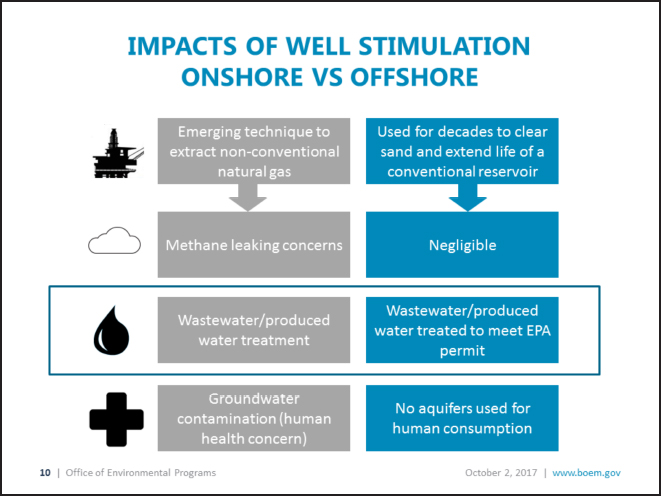
The workshop graphic below highlights the differences in well stimulation risks onshore vs. offshore. The graphic is a bit unfair in that the onshore risks are being effectively mitigated. The main point is that much of the onshore risk potential doesn’t exist for offshore well stimulation.

Read Full Post »

Last month (12/2021), BSEE finally posted the 2020 incident statistics. Unfortunately, no details or incident summaries are provided for the 6 fatalities. The fatalities are simply classified as “occupational” (4) or “non-occupational” (2). As a result, we still know very little about these fatal incidents 13 – 24 months after they occurred.

The BSEE spreadsheet advises that 3 of the 4 “non-occupational” fatalities are being investigated, but the reports are still “pending.” Why the long delay? The National Commission, BOEMRE-CG, and NAE investigations of the Macondo tragedy were completed (and reports published) in less time.

No explanation is provided as to why the 4th occupational fatality is not being investigated.

Also, investigations of the preparedness and response aspects of the 2 non-occupational fatalities would have been beneficial. What was the cause of death? What medical screening procedures were in place? What treatment capabilities were available at the facility? How much time was required to transport the workers to hospitals? These are important considerations for the offshore community.

Below is a summary of the publicly available information for the 6 fatalities:

  • 1/14/2020: A worker died on a Diamond drillship on a lease (Mississippi Canyon 822) operated by BP. According to BSEE this was a non-occupational fatality. Per the listing of investigations, no investigation was conducted.
  • 5/16/2020: A worker died on a Fieldwood platform (Ewing Bank 826 A). Per BSEE, this was an occupational fatality and the investigation is still pending. There were no media reports or company announcements.
  • 6/2/2020: A worker died on the Valaris DS-18 drillship working for EnVen Energy at Green Canyon 767. Per BSEE, this was a non-occupational fatality and no investigation was conducted.
  • 6/20/2020: A worker died on at the Green Canyon 18 A platform operated by Talos. Per BSEE, this was an occupational fatality but no investigation is indicated for this incident. No media reports or company announcements could be found.
  • 8/23/2020: A worker died on the Pacific Khamsin drillship working for Total at Garden Banks 1003. A month later, at an Investors’ Day presentation, Total announced that the incident occurred while the crew was preparing to move the rig to avoid Tropical Storm Laura. Total’s statement included this defensive statement: “This is a routine operation that was executed with no time pressure as the rig disconnection had been decided well in advance.” Per Total, the findings of their investigation were shared with the regulators in Sept. 2020, but BSEE advises that their investigation is still pending.
  • 12/2/2020: A worker died on DCOR’s Platform Gilda in the Santa Barbara Channel offshore California. The BSEE investigations update provides no information on the status of the investigation. Per local media, 3 men fell from the platform and others jumped into the water to assist. No information is provided on the reason why the 3 men fell.

The number of US OCS fatalities remains unacceptably high, and timely data sharing and investigations are needed to better assess causes and trends. In that regard, this recommendation from the 2016 National Academies report entitled “Strengthening the Safety Culture of the Offshore Oil and Gas Industry” merits further industry/government attention and action:

Recommendation 4.2.2: Because accident, incident, and inspection data all are needed to identify and understand safety risks and corrective actions, the committee recommends full transparency such that regulators make all these data readily available to the public in a timely way, taking into consideration applicable confidentiality requirements.

Read Full Post »

Link

The National Academy of Engineering and the National Research Council have released the interim report of the Committee on the Analysis of Causes of the Deepwater Horizon Explosion, Fire, and Oil Spill to Identify Measures to Prevent Similar Accidents in the Future. The interim report includes the committee’s preliminary findings and observations on various actions and decisions including well design, cementing operations, well monitoring, and well control actions. The interim report also considers management, oversight, and regulation of offshore operations.

Comment: No significant surprises.

Read Full Post »

Some readers have suggested links and information on the official US investigations of the Macondo blowout.  Some basic information is provided below.  The links will be added to the blogroll in the right column.

We will be examining the relevant facts and circumstances concerning the root causes of the Deepwater Horizon explosion and developing options to guard against, and mitigate the impact of, any oil spills associated with offshore drilling in the future.  This may include recommending improvements to federal laws, regulations, and industry practices.

Joint BOMRE – Coast Guard Investigation

The purpose of this joint investigation is to develop conclusions and recommendations as they relate to the Deepwater Horizon Mobile Offshore Drilling Unit (MODU) explosion and loss of life on April 20, 2010. The facts collected at this hearing, along with the lead investigators’ conclusions and recommendations will be forwarded to Coast Guard Headquarters and Minerals Management Service (MMS) for approval. Once approved, the final investigative report will be made available to the public and the media. No analysis or conclusions will be presented during the hearing.

This study will address the performance of technologies and practices involved in the probable causes of the Macondo well blowout and explosion on the Deepwater Horizon. It will also identify and recommend available technology, industry best practices, best available standards, and other measures in use around the world in deepwater exploratory drilling and well completion to avoid future occurrence of such events.

The CSB intends to proceed with an investigation of the root causes of the accidental chemical release that destroyed the Deepwater Horizon rig and took the lives of 11 workers. The investigation will include the key investigators who were involved in the CSB’s 2005-2007 investigation of the March 23, 2005, explosion at the BP Texas City refinery.

Various congressional committees are also reviewing issues associated with the blowout, most notably the Senate Committee on Energy and Natural Resources and the House Committee on Energy and Commerce.  As time permits, BOE will post updates on post-Macondo legislative actions.

Read Full Post »

