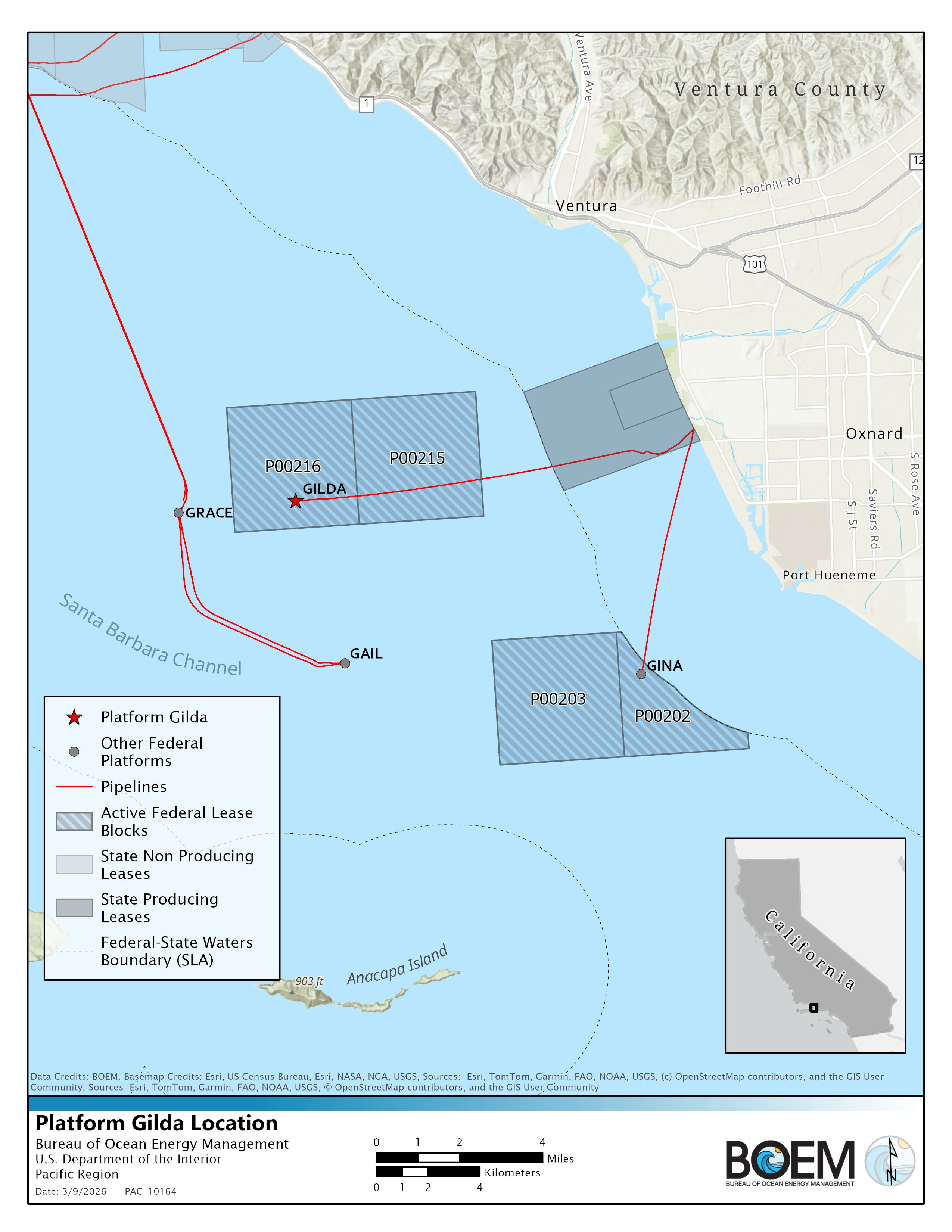
Despite favorable environmental reviews from both the Obama and Trump Administrations, the California Coastal Commission, empowered by the Courts, voted last week to prohibit the resumption of hydraulic well stimulation at DCOR’s Platform Gilda (map above).
Of course, as is always the case offshore California, the regulatory and legal battles will continue. The Secretary of Commerce may choose to overrule the CCC, in which case further litigation is certain.
This dispute comes at a time when the CCC, which operates with extraordinary autonomy, is undergoing a performance review by Commerce. Needless to say, the Commission and its supporters are not thrilled with the oversight.
In light of the spotlight on “offshore fracking,” I wanted to draw attention to a 2019 National Academies workshop that considered this very issue. I had the opportunity to participate in this workshop and was impressed by the input from industry and govt representatives.
Key points from the workshop:
- If wells are not completed effectively, the value of drilling is negated, and it is impossible to deliver the oil or gas production needed to make the wells economically sustainable.
- The frac pack (as is proposed for Platform Gilda) is one of the most commonly used completion techniques worldwide.
- A gravel pack uses sieved sand as a filter to prevent formation sand from entering the wellbore, while the frac pack combines the gravel pack with hydraulic fracturing to create wide fractures filled with sieved sand that aid in connecting the reservoir to the wellbore.
- Frac packs can create 50- to 250-foot fractures to stimulate production in a well.
- Well stimulation offshore, which has been in practice for decades, has far less negative impact potential than well stimulation onshore.
- Hydraulic fracturing minimizes the number of wells needed to develop a reservoir with the result being less environmental impact potential. This completion technique allows for the development of natural resources not previously considered commercially viable.
- Offshore California, oil and gas formations typically have low permeability, and production is dependent on natural fractures. The objective is to enhance the flow of oil and gas from the tight matrix pores into the fractures.
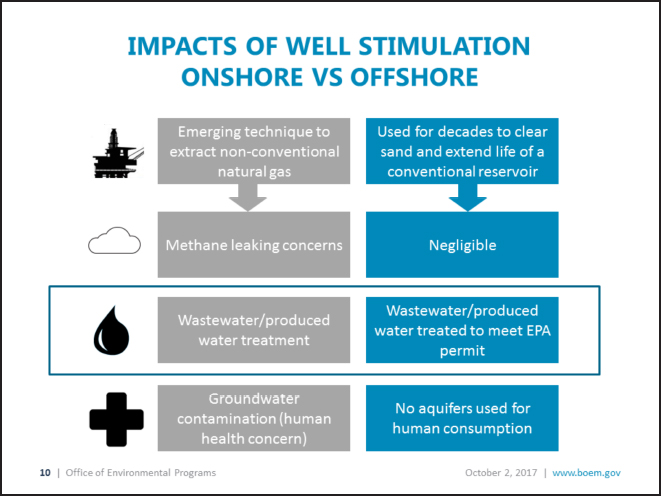
The workshop graphic below highlights the differences in well stimulation risks onshore vs. offshore. The graphic is a bit unfair in that the onshore risks are being effectively mitigated. The main point is that much of the onshore risk potential doesn’t exist for offshore well stimulation.


Leave a Reply