John Smith shared an outstanding paper (attached) that was presented by co-author Robert Byrd at the SPE Regional Meeting in Garden Grove, CA last week.
John Smith: “My objective in writing the paper is to hopefully spur legislators to recognize the benefits of reefing and the legislative fixes required to facilitate reefing and the removal of aging infrastructure. The California Department of Fish and Wildlife Habitat Lead was very complimentary of the paper and has distributed it to the Interagency Team which is developing a California Artificial Reefing Plan.”
John adds: “They are in the process of creating a statewide artificial reef plan and you can sign up for updates and get more information. The California Artificial Reef Program (CARP) Plan won’t discuss the specifics of Rigs-to-Reefs but will be compliant with the National Fisheries Enhancement Act and National Artificial Reef Plan and meet the BSEE requirement of having an adopted state artificial reef plan. The intent is to add an addendum to the plan when resources become available to move Rigs-to-Reefs forward in California. You can check out the latest program update that further discusses the CARP Plan and Rigs-to-Reefs.”
California Attorney General Rob Bonta unsuccessfully requested that a Santa Barbara Superior Court judge issue a temporary restraining order on the Texas-based oil company for defying a cease-and-desist order issued last week by the California Coastal Commission.
Initially, Judge Anderle planned on granting the restraining order at Bonta’s request in his tentative ruling. However, his opinion changed after reading Sable’s opposition documents in the courtroom on April 17.
Arguments for a preliminary injunction will be heard on May 14.
Meanwhile, in an “All Hands on Deck” message to their mailing list, the Environmental Defense Center (EDC) predicts doom and gloom unless supporters answer their fundraising call:
This fight is now in a critical phase. We need your help to ensure EDC can continue to present the strongest defense against Sable’s dangerous proposal.
EDC photo
Lastly, Market Beat reports the following large purchases of Sable shares. Those investors better have a high risk tolerance!
Harraden Circle Investments LLC bought 220,000 shares of Sable Offshore stock. Sable now accounts for approximately 4.6% of Harraden’s investment portfolio, making the stock its 9th largest position.
State Street Corp boosted its stake in shares of Sable by 74.3% during the 3rd quarter. State Street Corp now owns 1,589,395 shares of the company’s stock after acquiring an additional 677,426 shares in the last quarter.
Vanguard Group Inc. boosted its holdings in Sable Offshore by 23.6% in the 4th quarter. Vanguard now owns 3,486,126 shares of the company’s stock.
Emerald Advisers LLC bought a new stake in shares of Sable Offshore in the fourth quarter valued at about $6,700,000.
Bridgewater Associates LP acquired a new position in Sable Offshore in the 4th quarter valued at approximately $4,693,000.
Renaissance Technologies LLC grew its holdings in shares of Sable Offshore by 313.8% during the 4th quarter. Renaissance now owns 269,800 shares of the company’s stock worth $6,178,000 after purchasing an additional 204,600 shares in the last quarter.
26.19% of Sable’s stock is owned by hedge funds and other institutional investors.
The Santa Barbara Independent doesn’t pull any punches in this article about the once invincible California Coastal Commission. I recommend that you read the entire article, but here are some choice excerpts (emphasis added):
Lastly, it’s totally unprecedented for members of the commission to verbally eviscerate energy planners with Santa Barbara County at a public hearing for refusing to provide them requested planning documents having to do with Sable no fewer than seven times. While the county has denied this charge, no one from the county showed up for last week’s meeting to explain their actions. One commissioner termed this absence a “dereliction of duty.”
What actions and outcomes ultimately emerge from this rancor remain far from obvious. That’s in part because the political support enjoyed by the Coastal Commission — long regarded as one of California’s many “third rails” of state politics — has never been so uncertain. By “uncertain,” I mean rarely has any state agency been so reviled by such a wide swath of political players and stakeholder groups.
The question has become not so much who hates the Coastal Commission — it’s who doesn’t. Donald Trump has hated the commission since it objected to a 70-foot flagpole Trump planted on a beachfront golf course he owned back before he became president.
Elon Musk, Trump’s alter ego, sued the Coastal Commission — and lost — over the commission’s outspoken refusal to grant him the “consistency determination” he needed to increase the number of SpaceX rocket launches from Vandenberg Space Force Base from 35 to 50. Although a federal judge would rule in the commission’s favor, Governor Gavin Newsom, a noted Democrat, announced he was siding with Musk on this one.
So, what happens if Sable doesn’t pay the fine? Or keeps on working despite three cease-and-desist orders? The key question — still loudly unanswered — is what Attorney General Rob Bonta will do. Will Bonta throw his considerable heft behind the commission? He hasn’t yet. And it’s been several months. Does the governor want to pick his battles with the Trump-Musk White House for causes that enjoy more broad public support?
Yesterday, the California Coastal Commission voted 8-3 to fine Sable Offshore $18,022,500 for performing pipeline repairs necessary to minimize operating risks and comply with the FIre Marshall’s requirements.
“We have not gotten a foothold with Sable, and we’ve not gotten a foothold with Santa Barbara County either. So, we are where we are, and because of this absolute failure of communication and Sable’s, to be frank, absolute failure to follow the law, this hearing has become necessary,” Harmon said.
We’ll see how this gets sorted out in the courts. Sable appears to have a strong case against the Commission, but litigation in California courts is not exactly ideal for oil companies.
BOE contributor John Smith has shared (attached) his highlighted version of the 89 page California Coastal Commission staff report recommending imposition of a $15 million fine.
John finds it noteworthy that the report documents that Santa Barbara County did not concur with the CCC, and that the California State Lands Commission approved the span remediation work. John thinks this raises legitimate questions as to whether the CCC is overreaching in terms of asserting permitting authority for the repair and maintenance work.
John thinks it will be interesting to see how the Courts rule on this and expects an appeal regardless of the outcome. He points to the Court ruling against the CCC on Pismo Beach offroading case as being pertinent to the Sable-CCC dispute. (“Is the Friends of Oceano Dunes court victory a good omen for Sable?“)
In particular, note the text John has highlighted in green. These issues will likely be central to the Court deliberations.
In a peer reviewed paper, AI (Grok-3) debunks the man-made climate crisis narrative.
Doug Burgum: Hydraulic fracturing technology is “one of the reasons why the U.S. shale revolution is a miracle. But that miracle keeps on getting better and better. It’s the thing that has literally turned around the economy.” Posted here 15 years ago: Natural Gas Bonanza – Why Aren’t We Celebrating?
“The State Fire Marshal stated on February 25 — during a packed-house meeting at La Cumbre Junior High School — that he would not issue Sable authorization to restart production at the Santa Ynez Unit until all outstanding permit issues between Sable and the eight state agencies with oversight authority are resolved.“
Although Sable has a good defense against the Coastal Commission’s accusations, that statement by the Fire Marshal is ominous.
More bad news for Sable: The Center for Biological Diversity suit challenging the Federal government’s extension of the 16 Santa Ynez Unit leases is not going well. The government requested a voluntary remand of BSEE’s 2023 approval because “BSEE plans to reconsider its decision in light of Plaintiffs’ claims and conduct additional analysis, as warranted, under OCSLA and NEPA.”
In the attached decision, shared by John Smith, the judge denied the Federal government’s request. This does not bode well for the Federal government’s case going forward.
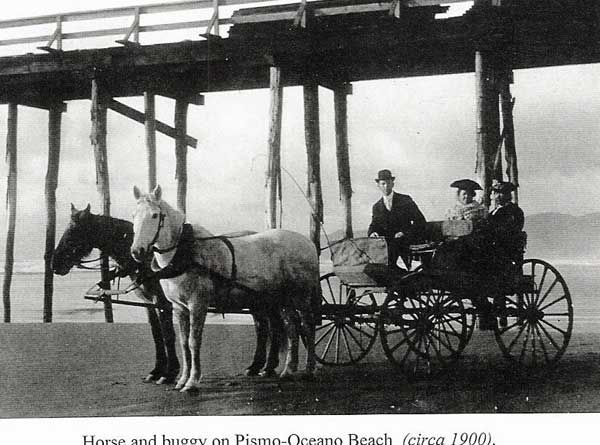
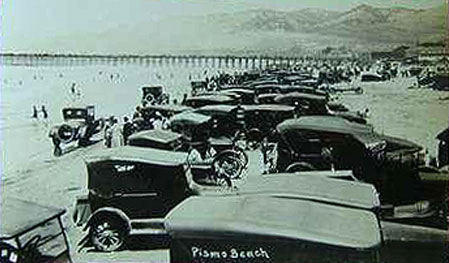
The organization Friends of Oceano Dunes is determined to preserve the long history of off-road vehicle use on Pismo-Oceano beach. See the video below and the historic photos from Bob2000.com.
The Coastal Commission, which dislikes off-road vehicles as much as they dislike offshore oil and gas operations (well maybe not quite that much! 😉) lost a court case with some similarities to the suit filed by Sable Offshore.
Noozhawk: In an opinion filed Monday, the Second Circuit Court of Appeals found that the commission’s attempt to ban off-road vehicles at the Dunes contradicts the language of the Local Coastal Plan put in place by San Luis Obispo County.
The Court ruled that the decision to open or close the Dunes to vehicles fell under the jurisdiction of the county, not the Coastal Commission.
Sable’s dispute with the Commission is similar in that Sable contends that their pipeline repair and maintenance activities are in compliance with Santa Barbara County’s Coastal Zoning Ordinance, Local Coastal Program (LCP), and the Coastal Act. Will Sable also be victorious in Court?
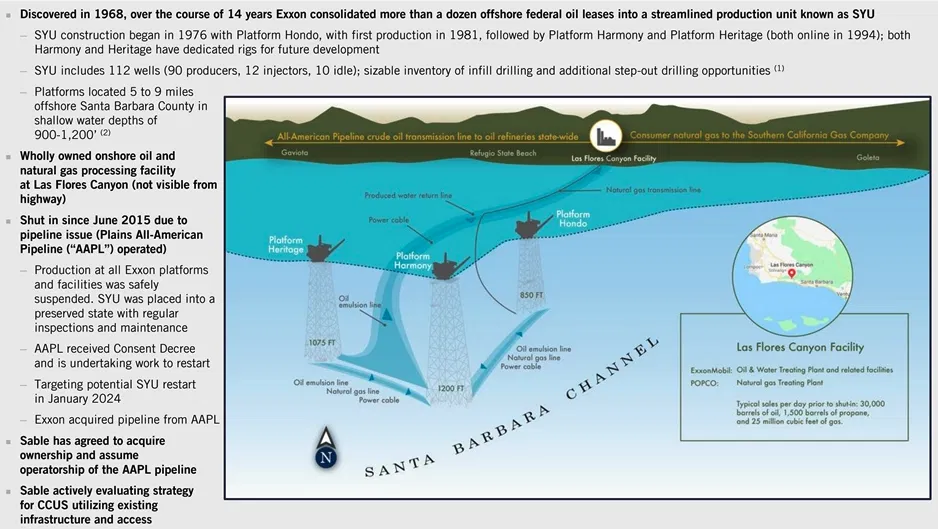
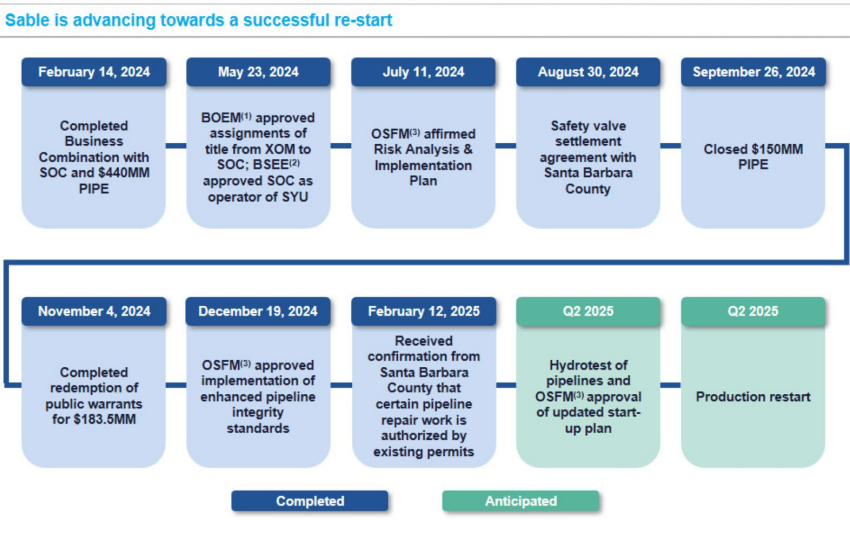
Attached is a recent Sable Offshore presentation for investors. Notably, Sable is now projecting to resume Santa Ynez Unit production in Q2 2025 (see slide below). John Smith thinks this is unrealistic, and I have to agree.
It’s tough for an offshore producer to succeed in California, but Sable is making a strong effort. Exxon must agree, because they have extended Sable’s first production deadline to 3/1/2026, which reflects a more plausible Q1 2026 restart. Additional extensions seem likely if necessary given that Exxon’s other options aren’t very attractive.
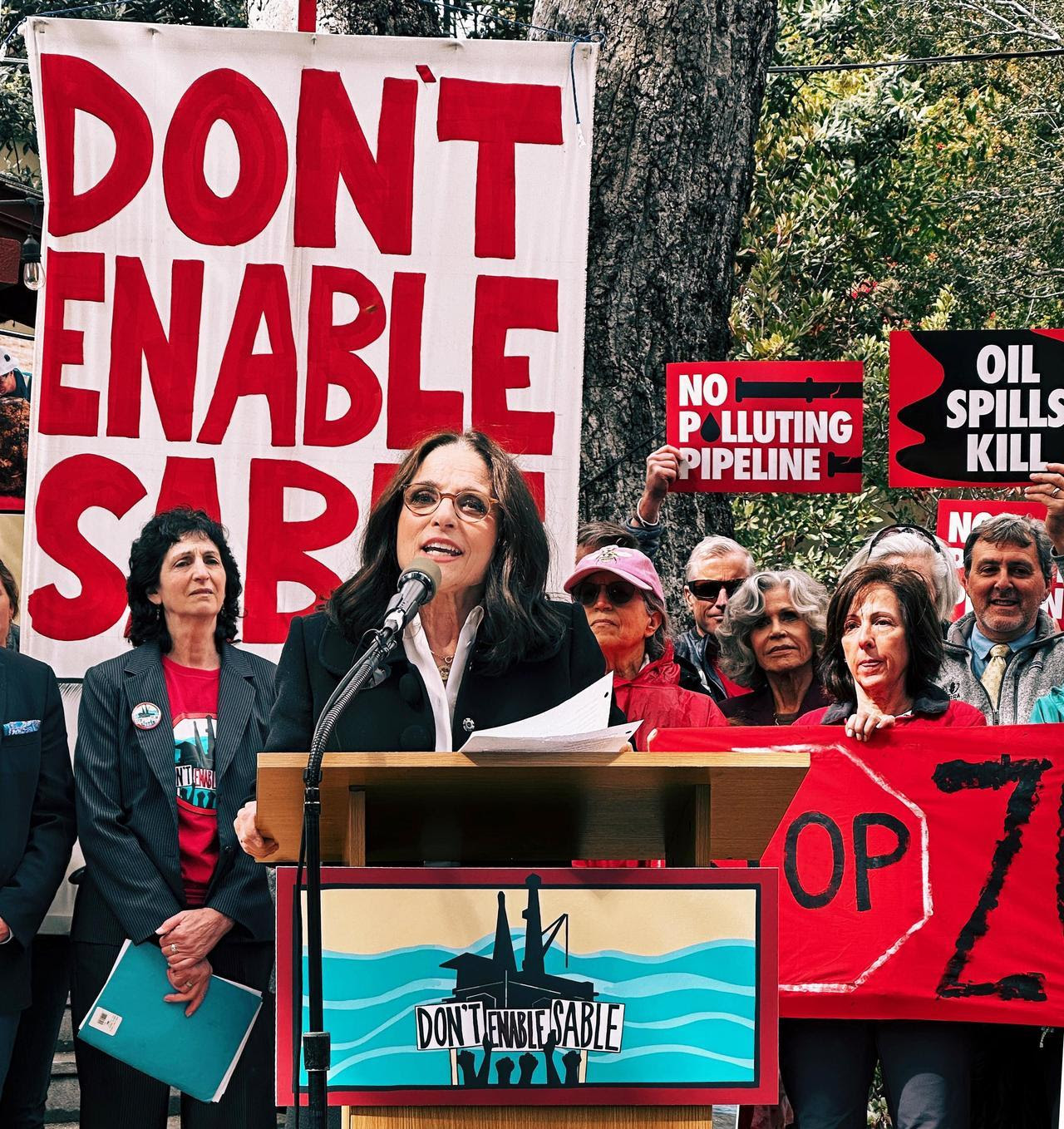
Santa Barbara resident Julia-Louis Dreyfus fires up the crowd. Photo Credit: Ingrid Bostrom, Independent
The Santa Barbara Independent and Noozhawk have closely followed the Sable saga and provided good coverage of the “Information Meeting.” BOE contributor John Smith followed the meeting online and shares his impressions.
Independent: “What was advertised as an informational meeting with eight state agencies that oversee Sable’s operations quickly became emotionally charged when the Environmental Defense Center’s Linda Krop and resident actor Julia Louis-Dreyfus were surprisingly called onto the stage to voice their opposition to the oil project.“
John Smith reports that the meeting got off to a good start before deteriorating:
Smith: “The CCC (Coastal Commission) presentation was interesting because it highlights their position and disagreement with SBC (Santa Barbara County) who determined permits were not required by Sable for maintenance and repair work. I think the agencies did a good job in sharing information on the status of permits, which if people were objective, may have alleviated many of their major concerns. Unfortunately, it went downhill at the end when EDC and Hollywood types were given the floor.”
Unsurprisingly, a State Senator facilitated the ambush:
Independent: “When Senator Limón’s staff called to the stage the Environmental Defense Center’s chief counsel, Linda Krop — who hosted a star-studded press conference beforehand with state legislators, actors Julia Louis-Dreyfus and Jane Fonda, and Ventura-based Patagonia CEO Ryan Gellert, among others, outside the EDC’s headquarters — the town hall shifted gears from an info-session into a quasi-rally. Krop’s emotion-inciting words, followed by an angry, passionate speech from Louis-Dreyfus, put the room into a cacophony of cheers and jeers.“
Sable supporters (workers, not movie stars) were also in the house:
Independent: “Sable Offshore management, employees, contractors, labor, and supporters showed up today in good faith to participate in a town hall meeting where only government officials were on the agenda to present,” said Steve Rusch, Sable’s vice president of environmental and governmental affairs, in a statement. “Project opponents forced the moderators to give them dedicated time to present biased information and smear the project. The opponents’ self-serving fundraiser and rally was not an appropriate use of public resources.”
“Not one word was said about the working people,” a Sable employee and union member told the Independent after he walked out. “This is my home, too, and I’m going to fight, too…. Without this, we’re just unemployed.”
Interestingly, regulatory fragmentation, a topic that this blog has railed about, was mentioned by one of the Sable opponents, and I suspect the Sable supporters agree!:
Noozhawk: “One of the audience members was Ravid Raphael, who has lived in Goleta for the past 11 years. One of his concerns was that there are too many departments and that they are too fragmented.“
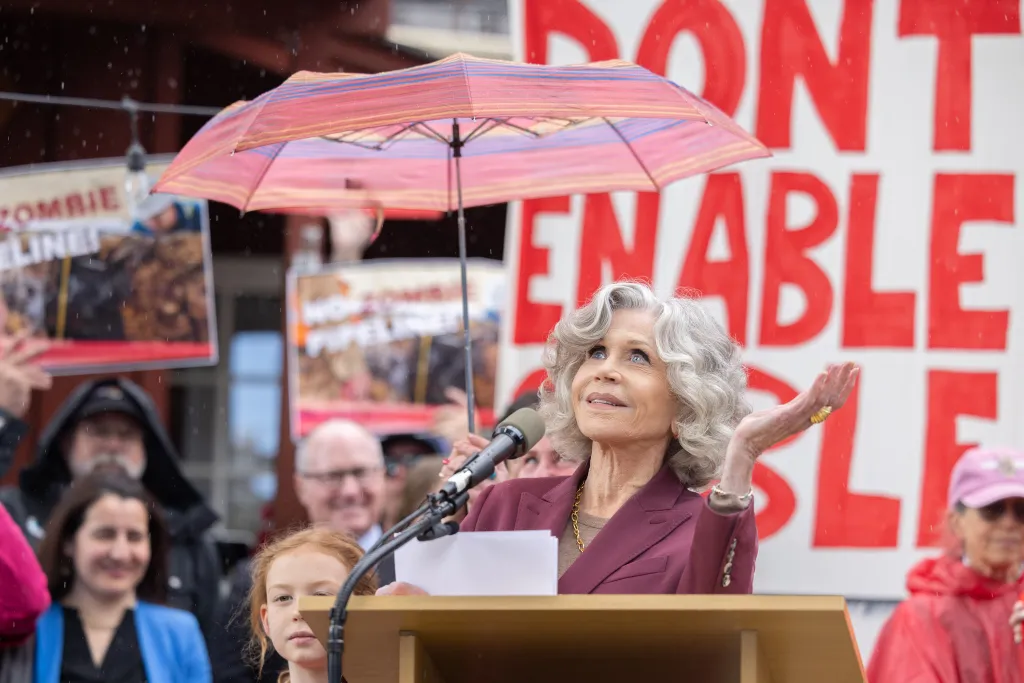
Jane Fonda (no one would question her credibility😉) – Photo Credit: Ingrid Bostrom, Independent




 Bud's Offshore Energy (BOE)