In 2025, NRW/Array operations accounted for 486 incidents of non-compliance (INCs), 36.2% of the Gulf of America total. Array and NRW had INC/facility inspection rates of 2.1 and 7.0 respectively, well above the Gulf average of 0.42 and the top performers’ rates of 0.05 to 0.13.
In Array’s defense, their violations declined sharply in the second half of 2025. However, the number of inspections of their facilities declined even more sharply, so the INCs/facility inspection ratio actually increased in the second half.
For the 2025 data in the table below:W=warning, CSI=component shut-in, FSI=facility shut-in. The 3 numbers for Array in each box are full year 2025 data (top), first half 2025 (middle), and second half 2025 (bottom)
operator
W
CSI
FSI
total INCs
Facility Insp.
INCs/isp
Array
352 311 41
93 46 47
6 6 0
451 363 88
218 184 34
2.1 2.0 2.6
NRW
10
24
1
35
5
7.0
Three other companies had more than 10 shelf platforms and INC/facility inspection ratios >1.0: Greyhound Energy (23 platforms), Renaissance (21 platforms) and Sanare Energy (38 platforms).
operator
W
CSI
FSI
total INCs
facility insp
INCs/ fac. insp
Greyhound Energy
32
1
0
33
23
1.4
Renaissance Offshore
26
19
3
47
44
1.1
Sanare Energy
60
20
2
82
75
1.1
The table below provides 2025 oil and gas production through Oct (with Gulf of America rank) for the 5 companies mentioned in this post. In determining rankings, subsidiaries and affiliates were counted as a single company (e.g. Chevron, Unocal, and Hess counted as one company).
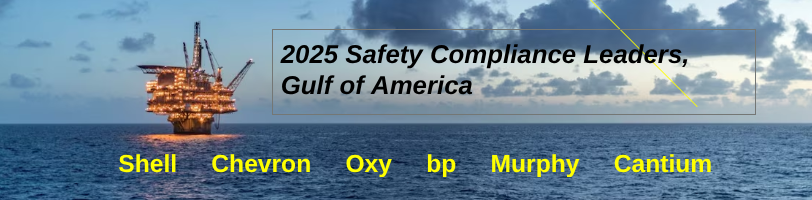
The 2025 Gulf of America Safety Compliance Leaders are ranked below according to the number of incidents of non-compliance (INCs) per facility inspection. To be ranked, a company must:
operate at least 2 production platforms
have drilled at least 2 wells during the year
average <1 INC for every 5 facility inspections (0.20 INCs/facility inspection). This is a higher standard (fewer INCs) than in previous years.
average <1 INC for every 10 inspections (0.1 INCs/inspection). Note that each facility inspection may include multiple types of inspections (e.g. production, pipeline, pollution, Coast Guard, site security, etc). In 2025, there were on average 3.2 inspections for every facility inspection.
operator
W
CSI
FSI
total INCs
facility insp
INCs/ fac insp
insp
INCs/ insp
Shell
3
8
1
12
231
0.05
557
0.02
Chevron
10
8
0
18
260
0.07
772
0.02
Oxy
2
6
1
9
133
0.07
325
0.03
BP
8
2
0
10
122
0.08
304
0.03
Murphy
6
2
0
8
70
0.11
177
0.05
Cantium
5
7
4
16
121
0.13
488
0.03
Gulf-wide 2025
815
445
84
1344
3179
0.42
10218
0.13
Gulf-wide 2024
957
398
109
1464
3133
0.47
10664
0.14
Notes: Numbers are from published BSEE data; INC=incident of non-compliance; W=warning INC; CSI=component shut-in INC; FSI=facility shut-in INC; INCs/fac insp= INCs issued per facility inspection; each facility-inspection may include multiple types of inspections (e.g. production, pipeline, pollution, Coast Guard, site security, etc), in 2025, there were on average 3.2 inspections for every facility inspection
Criteria: This ranking is based solely on BSEE’s published compliance data. The absence of timely public information on safety incidents (e.g. injuries, fires, pollution, gas releases, property damage) precludes inclusion of these data. Although Panel Investigations are conducted for fatalities, serious injuries, and significant pollution events, the last panel report was for an incident on 3/25/2022, and no information is available for any ongoing investigations. BSEE District offices investigate the more significant incidents that don’t qualify for panel investigations. These District Investigation reports are more timely, but some are not issued within 90 days of the incident. The District reports will be reviewed later in the year. Note that there were no occupational fatalities in 2025.
Observations:
The overall inspection and INC results for 2025 were similar to those for 2024.
The top companies performed better in 2025 than in 2024. In 2024, only 2 companies had INC/facility inspection ratios of <0.10 and only 3 had ratios <0.15. In 2025, all 6 of the performance leaders had ratios <0.15.
Shell’s total INCs and INCs/facility inspection decreased by 73% and 78% respectively vs. 2024
Cantium, which operates 85 shallow water platforms, has demonstrated that a shelf operator can be an outstanding safety performer. Cantium’s total INCs and INCs/facility inspection decreased by 50% vs. 2024
Should fewer inspections be conducted at facilities that have such low INC rates? On the one hand, fewer inspections would reduce regulatory costs and transportation risks. On the other hand, there are benefits from BSEE inspection visits besides compliance enforcement. These include direct communication with offshore workers (including contractors) regarding regulatory policies and safety practices, witnessing safety tests, evaluating new technology, and assessing management system implementation and corporate culture at the facility level.
Absent specific details on the violations, no attempt was made to weight the INCs. Although shut-in INCs are generally considered to be more significant than warnings, that is not always the case. For example, a component shut-in INC for a safety device that is marginally out of tolerance and is corrected on the spot may be less serious than a warning that is indicative of structural deterioration, poor maintenance, or organizational shortcomings.
Not meeting one of the activity level requirements, but nonetheless noteworthy, were the compliance records of LLOG and BOE Exploration & Production (younger than and unrelated to the BOE blog 😀). See their impressive results below:
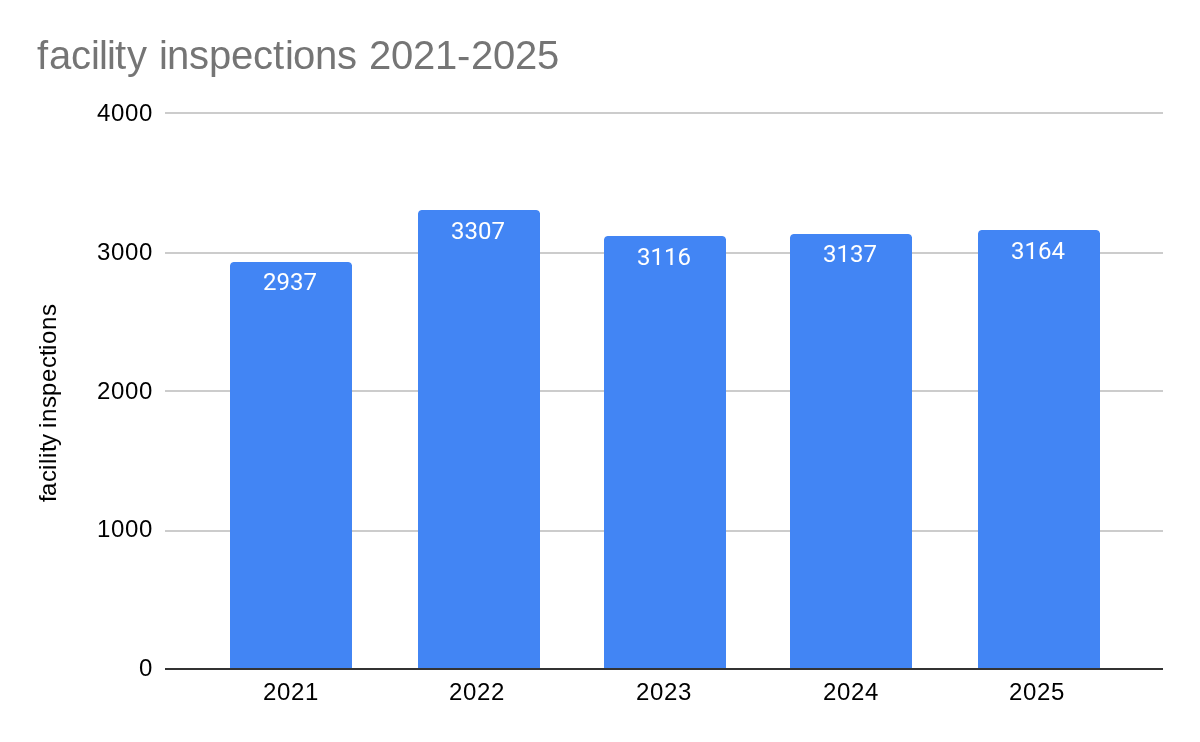
The number of BSEE inspections in 2025 (first chart) remained relatively constant despite the extended government shutdown.
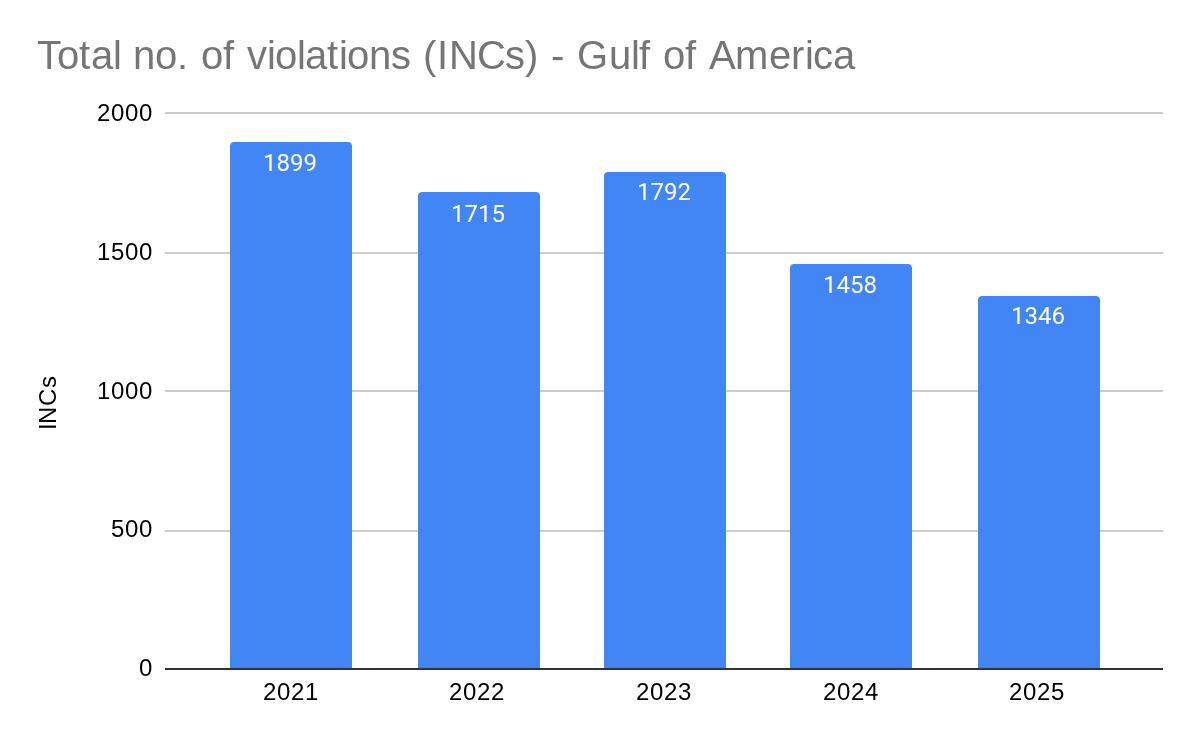
The decline in the number of Incidents of Noncompliance (INCs) in 2025 is encouraging (chart 2).
Given that BSEE’s tables have yet to be updated to include 2024 incidents, let alone 2025, it’s difficult to assess whether there have been similar declines in the number and severity of incidents. We do know that there were no occupational fatalities in 2025. (Note that OCS incident tables were once updated within 30 days at the end of each quarter. The public has a right to timely information on the type of incidents that are occurring, the operating companies, and the resulting casualties, pollution, and property damage.)
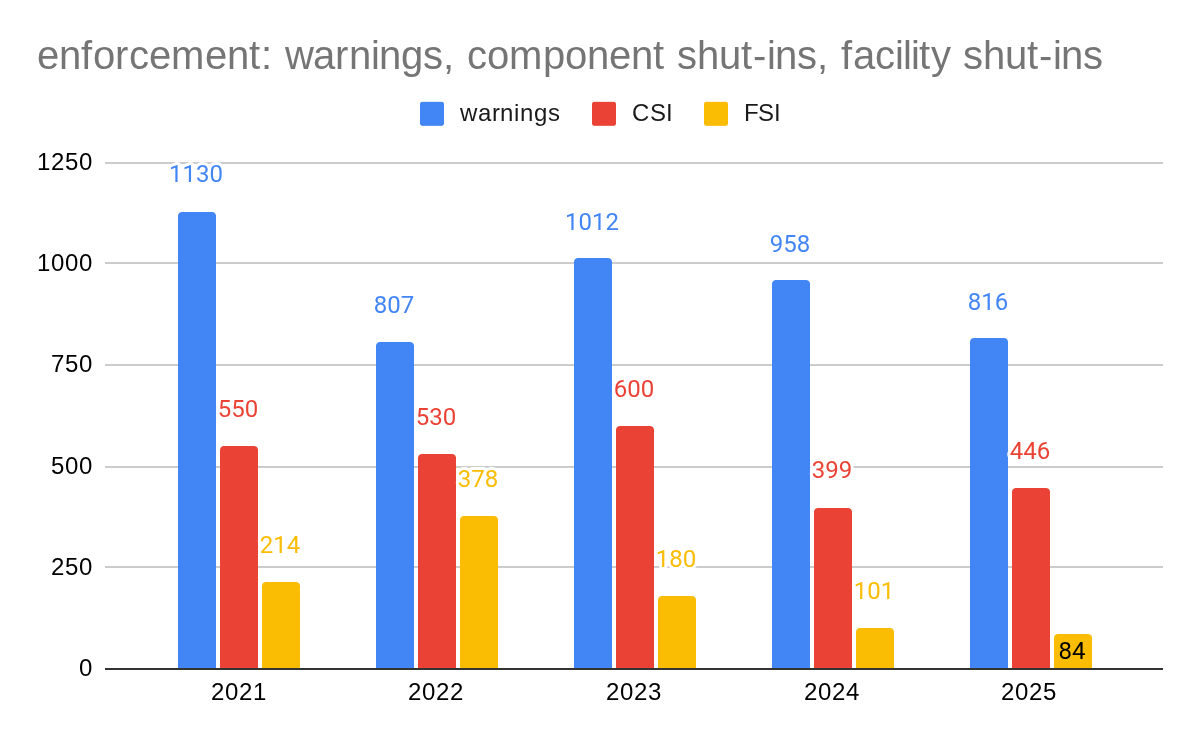
Chart 3 shows the decline in INCs by type – warnings, component shut-ins, and facility shut-ins
As is typically the case, a few companies accounted for a disproportionate number of violations, most notably the Cox legacy operators. More on this in a subsequent post.
The top 6 oil producers all had excellent compliance records, as did a leading shelf operator. More to follow.
Sable Offshore, California’s most notorious operator, fared well during 77 inspections of their three platforms in the Santa Barbara Channel.
Good: OCS oil and gas permitting and inspections appear not to be significantly affected by the govt shutdown to-date. 14 planning documents were approved on Oct. 21, and 37 drilling permits have been approved in Oct. (through 10/21).
Bad: This level of effort is not sustainable given limits on offsetting funds from fees, rentals, etc.
Ugly: The personnel who are performing these duties are not being paid during the shutdown. The longer the shutdown drags on, the greater the hardship on those individuals and their families. Shameful!
Warren Buffett’s proposal would stop deficit spending and address the root cause of shutdowns:
Buffett: “I could end the deficit in five minutes. You just pass a law that says that any time there’s a deficit of more than three percent of GDP, all sitting members of Congress are ineligible for re-election.“
The 2024 Gulf of America Safety Compliance Leaders are ranked below according to the number of incidents of non-compliance (INCs) per facility inspection. To be ranked, a company must:
operate at least 2 production platforms
have drilled at least 2 wells during the year
average <1 INC for every 3 facility inspections (0.33 INCs/facility inspection)
average <1 INC for every 10 inspections (0.1 INCs/inspection). Note that each facility inspection may include multiple types of inspections (e.g. production, pipeline, pollution, Coast Guard, site security, etc). In 2024, there were on average 3.4 inspections for every facility inspection.
District investigation reports are more timely and provide additional insights into safety performance. Impressively, Hess had no incidents warranting a District investigation, and was the only ranked operator with this distinction. I will comment more on the District reports in a future post
Chevron’s 2024 compliance record was among the best in the history of the US OCS oil and gas program. Was it the absolute best? Were it not for the FSI INC at a Unocal (Chevron) facility, one could unequivocally assert that it was. Further evaluation of that INC would be helpful. However, details on specific INCs are not publicly available, so the significance of that violation cannot be evaluated.
operator
W
CSI
FSI
total INCs
facility insp
INCs/ fac insp
insp
INCs/ insp
Chevron
1
0
1
2
117
0.02
311
0.006
BP
2
3
0
5
93
0.05
251
0.02
Anadarko
8
9
1
18
143
0.13
344
0.05
Hess
2
3
0
5
26
0.19
67
0.07
Walter
6
4
1
11
50
0.22
161
0.07
Shell
23
17
5
45
199
0.23
495
0.09
Cantium
24
8
0
32
123
0.26
537
0.06
Murphy
8
9
1
18
70
0.26
191
0.09
Arena
29
28
3
60
189
0.32
803
0.07
Gulf-wide
957
398
109
1464
3133
0.47
10664
0.14
Notes: Numbers are from published BSEE data; INC=incident of non-compliance; W=warning INC; CSI=component shut-in INC; FSI=facility shut-in INC; INCs/fac insp= INCs issued per facility inspection; each facility-inspection may include multiple types of inspections (e.g. production, pipeline, pollution, Coast Guard, site security, etc), in 2024, there were on average 3.4 inspections for every facility inspection
Not meeting the production facilities requirement to be ranked among the top performers, but nonetheless noteworthy, was the compliance record of BOE Exploration & Production (no relation to the BOE blog 😀). See their impressive inspection results below:
W
CSI
FSI
total INCs
facility insp
INCs/ fac insp
insp
INCs/ insp
BOE
1
1
0
2
21
0.1
48
0.04
Transparency on inspections and incidents is important for a program that is dependent on public confidence. For independent observers to better evaluate industry-wide and company-specific safety performance, publication of the following information should be considered:
quarterly updates of the incident tables, as was once common practice
posting of violation summaries for inspections resulting in the issuance of one or more INCs
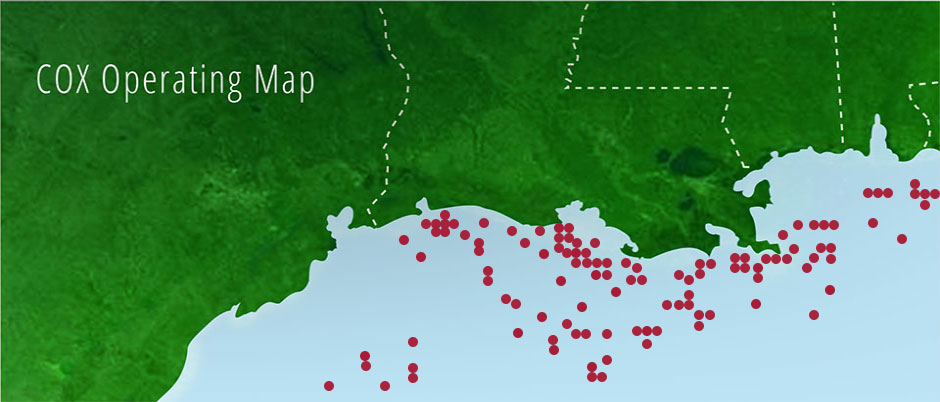
In June 2023, Cox and affiliates operated 435 platforms in the Gulf.That number is now only 46, all of which are on relinquished or terminated leases.
Cox Operating LLC and affiliates were once again the violations leaders in 2024 accounting for 50% (479/957) of the warnings, 12% (47/398) of the component shut-ins, and 7.3% (8/109) of the facility shut-ins.
All but 3 of the Cox enforcement actions were during the first half of the year. This is presumably because of the termination of Cox operations and the ongoing divestiture of their assets.
According to BOEM’s platform data base, Cox (43) and affiliates Energy XXI (3) and EPL (0) now operate only 46 platforms. This is a big decline from Sept. 2024 and June 2023 when the Cox companies operated 243 and 435 platforms respectively. All of the remaining Cox platforms are non-producing and are on relinquished or terminated leases.
The curtailment of Cox operations is no doubt an important factor in the sharp decline in Gulf of America violations in the second half of 2024. Per the data below, total GoA wide violations declined by 58% (1031 vs. 433) in the second half of 2024 as Cox violations essentially disappeared:
Gulf of America inspection data
warnings
component shut-ins
facility shut-ins
facility inspections
first half 2024
725
243
63
1586
2nd half 2024
232
155
46
1546
reduction
493 (68%)
88 (36%)
17 (27%)
40 (2.5%)
Cox companies inspection data
warnings
component shut-ins
facility shut-ins
facility inspections
first half 2024
478
46
7
404
2nd half 2024
1
1
1
174
Some Cox assets have been acquired by W&T and Natural Resources Worldwide. BOEM records indicate that 8 record title assignments and 3 operating rights assignments from Cox to W&T were approved in the first half of 2024. W&T currently operates 116 platforms, but it’s unclear how many are former Cox facilities.
The acquisition of Cox properties does not appear to have significantly affected W&T 2024 inspection results, which were respectable:
W&T insp. data
warnings
component shut-ins
facility shut-ins
facility inspections
first half 2024
12
31
0
83
2nd half 2024
17
14
2
105
Additional record title and operating rights assignments to Natural Resources Worldwide (NRW) were approved in 2025, but NRW does not appear to be operating any platforms.
Ironically, NRW was cited for 1 warning and 1 facility shut-in without a single inspection. Presumably, these violations were the result of administrative issues.
Online data are insufficient to account for the 435 platforms that were on the Cox ledger in June 2023 or determine the remaining decommissioning liabilities. Per the platform database, no Cox, Energy XXI, or EPL platforms were removed in 2023, 2024, or 2025.
On a more positive note, most GoA operators had good safety and compliance records in 2024. One major producer had a historically significant record. More on that to follow.
The previously discussed sale of Cox assets in 6 GoM fields to W&T was completed in January for $72 million, $16.5 million less than the proposed price. W&T, an established GoM operator, believes they can increase the pre-bankruptcy production (8300 boepd) through workovers, recompletions, and facility repairs.
The extent to which W&T is assuming decommissioning liability for the Cox assets is unclear to this observer. Decommissioning information from W&T’s SEC filing is pasted at the end of this post.
In February, Cox won court approval to sell “about a dozen oil fields to Natural Resources Worldwide LLC for about $20 million following a bankruptcy court auction.” This sale is more concerning given that the purchaser has no operating history in the GoM, and scant information about the company can be found online. Perhaps they are affiliated with Natural Resources Partners L.P., an energy investment firm which “owns mineral interests and other rights that are leased to companies engaged in the extraction of minerals,” but “does not mine, drill, or produce minerals, has no operations, and conducts business solely in an office environment.”
Per BOEM data, Cox filed requests to assign a number of leases to Natural Resources Worldwide (NRW) in May, but those requests have yet to be approved. Hopefully, BOEM is taking a hard look at these requests and their obligations following the court auction. Decommissioning liabilities should be their number one concern. (Note: NRW was just listed as the operator of the former Cox platform at EI 361, so presumably at least some of those assignments have now been approved.)
According to BOEM’s platform data base, Cox and affiliates Energy XXI and EPL still operate 243 platforms, down from 435 in June 2023. Also per the data base, the Cox companies have not removed any platforms during 2023 or 2024 YTD, so the reduction in platforms is presumably the result of the W&T transaction. Most of the remaining Cox platforms are old – 16 of their 77 major platforms were installed in the 1950s!
Meanwhile, Cox and affiliates continue to be the GoM violations leader by far with 549 incidents of non-compliance (INCs) in 2024 YTD, 45% of the GoM total for all operators. No other company has more than 100 INCs (although Whitney Oil and Gas has a disappointing 93 INCs, including 33 facility shut-ins on only 65 inspections!)
operator
platforms/ major platforms
warning INCs
component shut-in INCs
facility shut-in INCs
Cox
209/69
407
44
4
Energy XXI
19/7
73
1
2
EPL
5/1
16
1
1
Total Cox
233/77
496
46
7
Total GoM
1519/736
831
317
68
INCs are for 2024 as of 9/17/2024. A major platform has at least 6 well completions or more than 2 pieces of production equipment.
The Company may be subject to retained liabilities with respect to certain divested property interests by operation of law. Certain counterparties in past divestiture transactions or third parties in existing leases that have filed for bankruptcy protection or undergone associated reorganizations may not be able to perform required abandonment obligations. Due to operation of law, the Company may be required to assume decommissioning obligations for those interests. The Company may be held jointly and severally liable for the decommissioning of various facilities and related wells. The Company no longer owns these assets, nor are they related to current operations.
During the three months ended March 31, 2024, the Company incurred $2.6 million in costs related to these decommissioning obligations and reassessed the existing decommissioning obligations, recording an additional $5.3 million. As of March 31, 2024, the remaining loss contingency recorded related to the anticipated decommissioning obligations was $20.8 million.
Although it is reasonably possible that the Company could receive state or federal decommissioning orders in the future or be notified of defaulting third parties in existing leases, the Company cannot predict with certainty, if, how or when such orders or notices will be resolved or estimate a possible loss or range of loss that may result from such orders. However, the Company could incur judgments, enter into settlements or revise the Company’s opinion regarding the outcome of certain notices or matters, and such developments could have a material adverse effect on the Company’s results of operations in the period in which the amounts are accrued and the Company’s cash flows in the period in which the amounts are paid. To the extent that the Company does incur costs associated with these properties in future periods, the Company intends to seek contribution from other parties that owned an interest in the facilities.
BOE is reviewing BSEE compliance data and available incident reports for 2022. The Honor Roll companies will be announced later this month. Our preliminary finding is that 9 of the more than 120 operating companies met the high standard that we have established for this recognition. Our criteria:
Must average <0.3 incidents of noncompliance (INCs) per facility-inspection. Note that each facility-inspection may include multiple types of inspections (e.g. production, pipeline, pollution, Coast Guard, site security, etc). On average, each facility-inspection included 3.25 types of inspections in 2022. (Here is a list of the types of inspections that may be performed.)
Must operate at least 3 production platforms and have drilled at least one well (i.e. you need operational activity to demonstrate compliance and safety achievement).
May not have a disqualifying event (e.g. fatal or life-threatening incident, significant fire, major oil spill). Due to the extreme lag in updates to BSEE’s incident tables, investigation and news reports are used to make this determination.
Pacific and Alaska operations are considered separately.
Operating companies that produced >1 million bbls of oil or >1 BCF of gas in 2021 are listed in descending order based on oil production.
Both the total number of well starts and the number of exploratory wells are indicated
An INC is an Incident of Noncompliance (i.e. a violation). W=warning, CSI=component shut-in, and FSI=facility shut-in are the enforcement actions.
All of the below data are publicly available on the BSEE-BOEM websites.
2021 oil (MMbbls)
2021 gas (BCF)
2021/22 well starts total-expl
2021/22 INCs W-CSI-FSI
Shell
149.8
190.8
28-12
11-14-4
bp
114.0
82.7
5-2
6-3-4
Chevron
83.7
42.2
8-8
1-1-3
Anadarko (Oxy)
67.7
57.8
8-6
8-5-1
Hess
27.5
61.7
2-2
7-4-0
Murphy
25.1
50.0
7-7
4-8-1
LLOG
20.4
29.0
3-0
1-1-1
Talos
17.7
23.0
5-0
25-26-14
BHP
14.5
5.9
3-2
2-3-0
Exxon
13.2
2.3
–
1-1-1
Beacon
10.5
15.7
1-0
0-0-0
Fieldwood
10.4
24.7
–
685-235-91
EnVen
9.6
12.6
6-0
2-6-3
Kosmos
9.4
8.4
1-1
1-0-0
Arena
8.6
27.9
32-0
68-45-19
Walter
8.1
36.2
2-2
3-1-2
Cox
6.2
30.3
–
237-169-3
Eni
4.7
13.6
2-0
8-0-2
W&T
5.0
27.2
1-0
65-40-7
Cantium
4.5
5.5
18-0
23-15-2
QuarterNorth
4.2
8.3
–
no data
GoM Shelf
2.3
4.8
–
52-5-2
ANKOR
1.4
2.5
–
0-0-1
Byron
1.0
4.4
–
5-8-2
Renaissance
0.7
1.6
–
20-9-3
Sanare
0.3
4.5
–
38-20-3
Helis
0.2
1.2
–
1-0-2
Contango
0.03
5.0
–
4-0-0
Samchully
0.02
1.2
–
no data
Comments:
“Energy transition” companies Shell and bp still love the Gulf of Mexico, which is a good thing for them and us. Together they accounted for 42.4% of the 2021 oil production.
The top 4 producers, Shell, bp, Chevron (includes Unocal), and Anadarko accounted for 2/3 of GoM oil production, nearly all of which was from deepwater leases.
Those are impressive production numbers for Anadarko (Oxy). No wonder Warren Buffett likes Oxy stock.
The relative number of deepwater exploratory wells is mildly encouraging given our concerns about sustaining production.
Exploratory well determinations are rather subjective and may not be entirely consistent.
Understandably, no exploratory wells were drilled by Arena or Cantium, the companies responsible for most well operations on shelf (shallow water) leases.
Overall, the INC numbers are impressively low for the deepwater operators, with Chevron and LLOG standing out. BSEE does not post the specific violation information (more on this in an upcoming post), so it’s difficult to properly assess a company’s compliance record.
Unfortunately, incident data could not be included on the scoreboard. BSEE’s incident tables are badly out of date, and no 2021/2022 summaries have been posted.
Exxon production is limited to the Hoover Diana spar, which was installed 22 years ago. The largest US oil company has only drilled one GoM exploratory well (2018) in the past 5 years. Currently, their main GoM interest seems to be the sequestration (disposal) of onshore emissions. (More on this topic in an upcoming post.)


 Bud's Offshore Energy (BOE)