Feeds:
Posts
Comments

Posts Tagged ‘exploration’

Some of us remember when the UK and Norway were friendly North Sea oil and gas rivals – competing to be tops in production, technology, safety, and even promotion at conferences like OTC. Take a look at the production chart below and note the UK’s production leadership followed by the extraordinary decline.
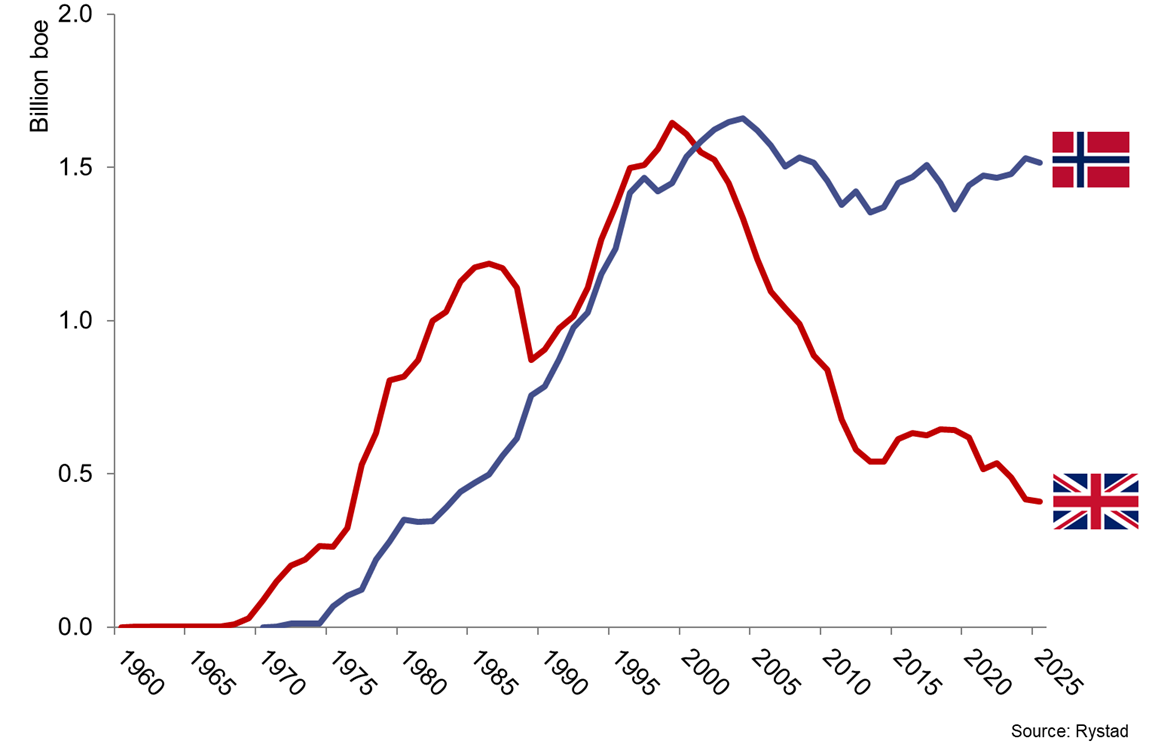
So what happened? Norway may have better oil and gas resource potential, but that is only part of the story. While Norway was managing their offshore sector to succeed, the UK was seemingly managing theirs to fail.

Norway’s North Sea remains far more active because the government promotes exploration through predictable licensing, cost-recovery incentives, and a focus on adding resources to existing infrastructure.

The UK, by contrast, has shifted toward limited development and decommissioning. In recent years, the UK’s windfall tax on oil and gas profits was raised to 78 percent, and licences for exploratory drilling in new areas were banned.

In 2022, the UK government even changed the name of the Oil and Gas Authority to the more trendy North Sea Transition Authority. (Changing names is one thing; delivering reliable energy at reasonable prices is quite something else.)

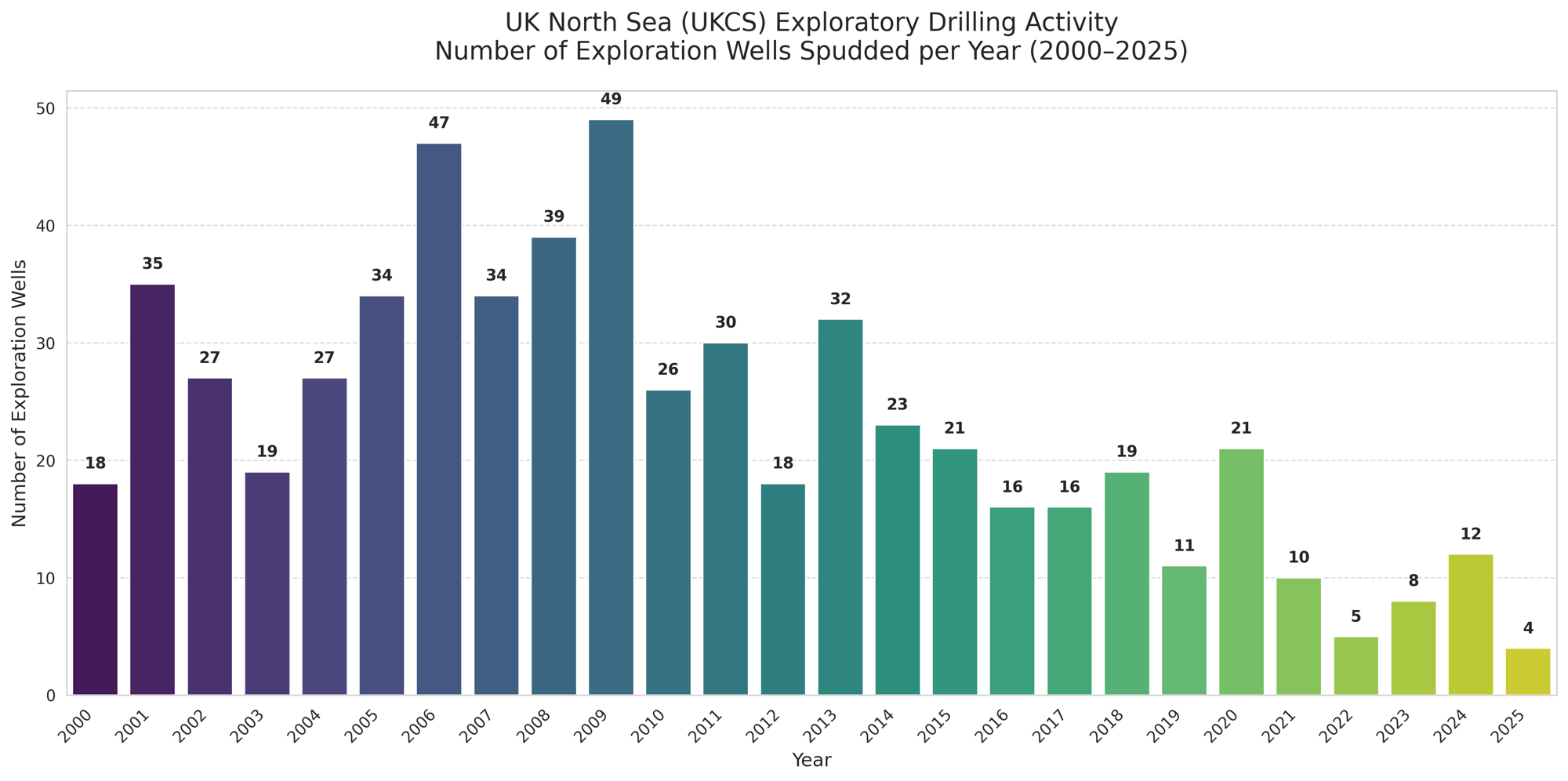
The stark policy differences are evident in the exploration drilling numbers – sustained drilling vs. sustained decline (charts below).
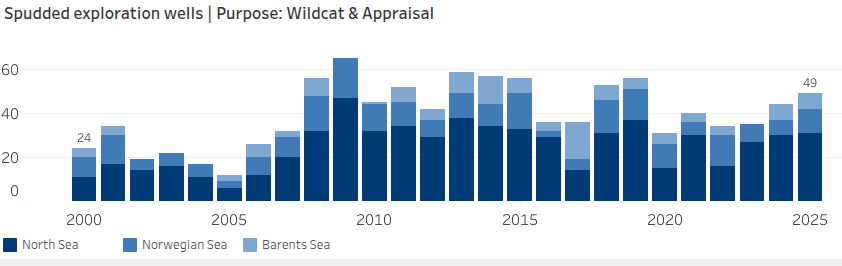
Norwegian Continental Shelf Directorate data
UK NSTA data:exploration wells spudded with original wellbore intent classified as “exploration” (offshore UK includes geological sidetracks).

JL Daeschler shared this excellent response by Natalie Coupar (excerpts below) to tired anti-exploration arguments that are popular in the UK and elsewhere:

Claim: Hundreds of North Sea licences have delivered only “36 days of gas”, proving new drilling does not improve energy security.

This actually proves the opposite. In a mature basin like the North Sea, you need a constant churn of investment and new licences just to stand still. Without ongoing activity, decline accelerates and import dependence rises faster. That is why countries like Norway continue to license and develop new projects. Their approach allows them to replace what they produce and manage decline more effectively. In industry terms, this is measured through the reserves replacement ratio – how much new resource is added compared with what is produced. Norway consistently produces a higher reserves replacement ratio than the UK. Over the 5 year period 2019-2024, through exploration, Norway replaced on average 46% of the reserves that were produced, the UK however, replaced just 14%.

Today, the North Sea still provides over half of the UK’s oil and gas needs. With the right conditions, we can sustain production for longer, reduce exposure to imports, and manage the transition more securely. Without licensing and investment, the UK simply becomes reliant on overseas supplies sooner – regardless of demand falling.

Claim: 93% of UK North Sea oil and gas has already been extracted, so new drilling makes little difference.

Official projections show several billion barrels of oil and gas still expected to be produced between now and 2050. Independent analysis commissioned by OEUK shows that, with the right conditions, significantly more could be delivered from known projects and discoveries.

And even beyond that, the UK’s own regulator identifies large volumes of oil and gas in:

  • approved projects
  • existing discoveries
  • areas that haven’t yet been developed

Pressure is mounting on the UK govt to approve the Rosebank and Jackdaw projects and ease exploration restrictions. Will it work?

Read Full Post »

Attached is a good update on the Walton Morant license offshore Jamaica. Note that the large Exxon deepwater block offshore Trinidad (7765 sq km) is only 1/3 the size of the massive Walton Morant license (22,400 sq km), and that the Walton Morant license is nearly 1000 times the size of a deepwater Gulf of America lease block.

Read Full Post »

  • Operating companies that produced >1 million bbls of oil or >1 BCF of gas in 2021 are listed in descending order based on oil production.
  • Both the total number of well starts and the number of exploratory wells are indicated
  • An INC is an Incident of Noncompliance (i.e. a violation). W=warning, CSI=component shut-in, and FSI=facility shut-in are the enforcement actions.
  • All of the below data are publicly available on the BSEE-BOEM websites.
2021
oil (MMbbls)
2021
gas (BCF)
2021/22
well starts

total-expl
2021/22
INCs
W-CSI-FSI
Shell149.8190.828-1211-14-4
bp114.082.75-26-3-4
Chevron83.742.28-81-1-3
Anadarko (Oxy)67.757.88-68-5-1
Hess27.561.72-27-4-0
Murphy25.150.07-74-8-1
LLOG20.429.03-01-1-1
Talos17.723.05-025-26-14
BHP14.55.93-22-3-0
Exxon13.22.31-1-1
Beacon10.515.71-00-0-0
Fieldwood10.424.7685-235-91
EnVen9.612.66-02-6-3
Kosmos9.48.41-11-0-0
Arena8.627.932-068-45-19
Walter8.136.22-23-1-2
Cox6.230.3237-169-3
Eni4.713.62-08-0-2
W&T5.027.21-065-40-7
Cantium4.55.518-023-15-2
QuarterNorth4.28.3no data
GoM Shelf2.34.852-5-2
ANKOR1.42.50-0-1
Byron1.04.45-8-2
Renaissance0.71.620-9-3
Sanare0.34.538-20-3
Helis0.21.21-0-2
Contango0.035.04-0-0
Samchully0.021.2no data

Comments:

  • “Energy transition” companies Shell and bp still love the Gulf of Mexico, which is a good thing for them and us. Together they accounted for 42.4% of the 2021 oil production.
  • The top 4 producers, Shell, bp, Chevron (includes Unocal), and Anadarko accounted for 2/3 of GoM oil production, nearly all of which was from deepwater leases.
  • Those are impressive production numbers for Anadarko (Oxy). No wonder Warren Buffett likes Oxy stock.
  • The relative number of deepwater exploratory wells is mildly encouraging given our concerns about sustaining production.
  • Exploratory well determinations are rather subjective and may not be entirely consistent.
  • Understandably, no exploratory wells were drilled by Arena or Cantium, the companies responsible for most well operations on shelf (shallow water) leases.
  • Overall, the INC numbers are impressively low for the deepwater operators, with Chevron and LLOG standing out. BSEE does not post the specific violation information (more on this in an upcoming post), so it’s difficult to properly assess a company’s compliance record.
  • Unfortunately, incident data could not be included on the scoreboard. BSEE’s incident tables are badly out of date, and no 2021/2022 summaries have been posted.
  • Fieldwood’s disturbing INC numbers were discussed earlier this year. High INC rates for 3 other operators have also were noted last month.
  • Exxon production is limited to the Hoover Diana spar, which was installed 22 years ago. The largest US oil company has only drilled one GoM exploratory well (2018) in the past 5 years. Currently, their main GoM interest seems to be the sequestration (disposal) of onshore emissions. (More on this topic in an upcoming post.)

Read Full Post »