Feeds:
Posts
Comments

Posts Tagged ‘Exxon’

Offshore California, the best that most facility operators and their predecessors (to the extent they continue to hold decommissioning liabilities) can hope for is a graceful exit with manageable financial losses. (The situation is a bit different for Exxon’s Santa Ynez Unit, which has been shut-in since 2015 while the company seeks to resolve oil transportation issues resulting from an onshore pipeline rupture. Here is the latest episode of that amazing saga.)

California’s Federal offshore, where 9 mobile drilling units (MODUs) were operating concurrently in the early 1980s, hasn’t seen a MODU in over 30 years. However, 23 production platforms, some of which are massive structures, remain (see the presentation below). At this point, these platforms are expensive monuments given that their combined production (per EIA) is only 7000 BOPD.

Regardless of their production status, the California offshore platforms continue to be ecologically significant. Dr. Jerry Schubel is among the many marine scientists who understand the importance of the life that has grown on and around these structures. The scientific community also sees other research, educational, and recreational uses for these platforms as per our Rigs-to-Reefs +++ page

In the absence of workable State reefing/reuse legislation, not much is going to happen. Questionable Federal decisions on the management of decommissioning funds are another impediment to timely action. (See “The troubling case of Platforms Hogan and Houchin.”)

To their credit, State and Federal agencies, trade organizations, and interested third parties continue to discuss the issues and consider alternatives. A recent workshop was helpful in that regard. Attached is the excellent presentation by Bob Byrd and John Smith, who have been at the vanguard in addressing California decommissioning issues. Embedded below is the YouTube video of the presentations from their session. These are excellent updates for those who have an interest in decommissioning issues.
Read Full Post »

From Reuters article:

  • bp: Only 15% of shareholder votes backed a call for the company to accelerate its energy transition, compared with the 21% in favor in a similar vote last year.
  • Oxy: Only 17% of investors backed a call for emissions-reduction targets. (I wonder how Buffett voted 😀)
  • Marathon: 16% supported a measure calling for the company to report on how its transition plans affected workers and communities
  • ConocoPhillips: 42% supported an emissions-reductions targeting measure vs. 58% last year.

Exxon, Shell, and Chevron are on deck!

Read Full Post »

Background:

Questions:

  • What are the costs per ton of offshore carbon sequestration including emissions collection, offshore wells and platforms, the associated pipeline infrastructure, ongoing operational and maintenance costs, and decommissioning?
  • What is the timeframe given that the starting point is likely years away?
  • How long would CO2 sequestration continue.
  • Who pays? Polluters? Federal subsidies? Tax credits?
  • Who is liable for:
    • safety and environmental incidents associated with these projects?
    • CO2 that escapes from reservoirs, wells, and pipelines (now and centuries from now)?
    • decommissioning?
    • hurricane preparedness and damage?
  • For Gulf of Mexico sequestration, how much energy would be consumed per ton of CO2 injected? Power source? Emissions?
  • To what extent will these operations interfere with other offshore activities?
  • Relatively speaking, how important is US sequestration given:
  • What are the benefits of offshore sequestration relative to investments in other carbon reduction alternatives?
  • Will BOEM conduct a proper carbon sequestration lease sale with public notice (as required by BOEM regulations) such that all interested parties can bid?
    • What will be the lease terms?
    • Environmental assessment?
    • How will bids be evaluated?
  • What happens to the Exxon bids if the Judge’s Sale 257 decision is reversed?
  • What is the status of the DOI regulations mandated in the legislation with an 11/15/2022 deadline?
    • When will we see an Advanced Notice or Notice of Proposed Rulemaking?
    • Given that DOI has no jurisdiction over the State waters and onshore aspects of these projects, what is the status of parallel regulatory initiatives?
  • Finally and most importantly, how does drilling offshore sequestration wells instead of exploration and development wells increase oil and gas production?
highly simplified conceptual diagram

Read Full Post »

  • Operating companies that produced >1 million bbls of oil or >1 BCF of gas in 2021 are listed in descending order based on oil production.
  • Both the total number of well starts and the number of exploratory wells are indicated
  • An INC is an Incident of Noncompliance (i.e. a violation). W=warning, CSI=component shut-in, and FSI=facility shut-in are the enforcement actions.
  • All of the below data are publicly available on the BSEE-BOEM websites.
2021
oil (MMbbls)
2021
gas (BCF)
2021/22
well starts

total-expl
2021/22
INCs
W-CSI-FSI
Shell149.8190.828-1211-14-4
bp114.082.75-26-3-4
Chevron83.742.28-81-1-3
Anadarko (Oxy)67.757.88-68-5-1
Hess27.561.72-27-4-0
Murphy25.150.07-74-8-1
LLOG20.429.03-01-1-1
Talos17.723.05-025-26-14
BHP14.55.93-22-3-0
Exxon13.22.31-1-1
Beacon10.515.71-00-0-0
Fieldwood10.424.7685-235-91
EnVen9.612.66-02-6-3
Kosmos9.48.41-11-0-0
Arena8.627.932-068-45-19
Walter8.136.22-23-1-2
Cox6.230.3237-169-3
Eni4.713.62-08-0-2
W&T5.027.21-065-40-7
Cantium4.55.518-023-15-2
QuarterNorth4.28.3no data
GoM Shelf2.34.852-5-2
ANKOR1.42.50-0-1
Byron1.04.45-8-2
Renaissance0.71.620-9-3
Sanare0.34.538-20-3
Helis0.21.21-0-2
Contango0.035.04-0-0
Samchully0.021.2no data

Comments:

  • “Energy transition” companies Shell and bp still love the Gulf of Mexico, which is a good thing for them and us. Together they accounted for 42.4% of the 2021 oil production.
  • The top 4 producers, Shell, bp, Chevron (includes Unocal), and Anadarko accounted for 2/3 of GoM oil production, nearly all of which was from deepwater leases.
  • Those are impressive production numbers for Anadarko (Oxy). No wonder Warren Buffett likes Oxy stock.
  • The relative number of deepwater exploratory wells is mildly encouraging given our concerns about sustaining production.
  • Exploratory well determinations are rather subjective and may not be entirely consistent.
  • Understandably, no exploratory wells were drilled by Arena or Cantium, the companies responsible for most well operations on shelf (shallow water) leases.
  • Overall, the INC numbers are impressively low for the deepwater operators, with Chevron and LLOG standing out. BSEE does not post the specific violation information (more on this in an upcoming post), so it’s difficult to properly assess a company’s compliance record.
  • Unfortunately, incident data could not be included on the scoreboard. BSEE’s incident tables are badly out of date, and no 2021/2022 summaries have been posted.
  • Fieldwood’s disturbing INC numbers were discussed earlier this year. High INC rates for 3 other operators have also were noted last month.
  • Exxon production is limited to the Hoover Diana spar, which was installed 22 years ago. The largest US oil company has only drilled one GoM exploratory well (2018) in the past 5 years. Currently, their main GoM interest seems to be the sequestration (disposal) of onshore emissions. (More on this topic in an upcoming post.)

Read Full Post »

BP, Equinor, and Shell are exiting Russia, but Exxon’s response seems to be something less. Per Upstream:

US supermajor ExxonMobil is scaling back its operations on its flagship offshore development project in Russia’s Sakhalin Island region in response to the fallout from the crisis in Ukraine, according to the Sakhalin Online news website.

A consortium source cited by the Russian website claimed that foreign managers have been told to leave the project for an initial period of one month.

Upstream

Exxon accepted the political risks associated with lucrative Russian production, and they now have a massive moral and public relations dilemma. Will they try to wait this crisis out or take more permanent actions?

It would be nice to see Exxon return to the Gulf of Mexico where they haven’t drilled a well since 2019. Currently, Exxon’s primary interest in the Gulf is for carbon sequestration purposes. Perhaps they can focus more on the Gulf’s still promising production potential and less on its potential as a disposal site.

Read Full Post »

While the Fieldwood Energy violations drove up the number of Incidents of Non-Compliance (INCs) in the Gulf of Mexico in 2021, most operating companies appear to have had good compliance records. Among companies that were subjected to at least 10 facility inspection and drilled at least one well, BHP Billiton, Eni US, and Murphy (listed alphabetically) had the most impressive compliance records. These three operators were cited for 7 or fewer INCs, none of which required a facility to be shut-in. Other operators that exceeded those activity thresholds and had excellent compliance records were (listed alphabetically) Anadarko, ANKOR Energy, Chevron, EnVen, Shell, and Walter Oil and Gas.

In the Pacific Region, Beta Operating Co., Chevron (now overseeing the former Signal Hill properties), and Exxon had excellent compliance records, although none of these facilities produced for the full year. In Alaska, Hillcorp had an excellent record at the Northstar Unit. (This is a gravel island facility in the State waters of the Beaufort Sea, but some of the wells produce from portions of the reservoir that are in the Federal sector).

Unfortunately, only summary inspection data are posted online. Without knowing the specific violations and circumstances, it’s not possible to fully assess the risk exposure. These oil and gas operations are conducted on public lands and are monitored by Federal employees. Inspection data and reports should be publicly accessible without having to submit Freedom of Information Act requests.

As has previously been discussed, incident updates should also be posted in a timely manner. Reference is made to this important recommendation in the 2016 National Academies report entitled Strengthening the Safety Culture of the Offshore Oil and Gas Industry:

Recommendation 4.2.2: Because accident, incident, and inspection data all are needed to identify and understand safety risks and corrective actions, the committee recommends full transparency such that regulators make all these data readily available to the public in a timely way, taking into consideration applicable confidentiality requirements.

Read Full Post »

Carbon capture and storage
NPD

Several actors have approached the ministry with a desire to be allocated two specific areas for storage of CO 2 . One area in the North Sea and one in the Barents Sea were therefore announced on 10 September in accordance with the storage regulations.

By the application deadline of 9 December, the ministry had received applications from five companies. The Ministry will process the received applications and allocate area in accordance with the storage regulations during the first half of 2022.

Ministry of Petroleum and Energy, Norway

Contrast the situation in Norway with Exxon’s apparent attempt to acquire 94 Gulf of Mexico leases at Oil and Gas Lease Sale 257 solely for CCS purposes. BOEM’s Notice of Sale made no mention of CCS, and there had been no environmental or economic assessment of CCS activity.

And how much will the public pay for grand CCS ventures that (although interim measures) will take years to initiate, add new safety and environmental risks, and may never achieve their objectives? The public burden will no doubt include direct subsidies, tax credits, increased petrochemical prices, and the erosion of purchasing power associated with the resulting inflation pressures.

More on Sale 257 and the CCS bidding.

Read Full Post »

What, if anything, will the Judge say about the leases that are intended to be carbon sequestration sites? How can BOEM sell OCS leases for purposes that were neither announced nor environmentally assessed? What do EarthJustice and the other plaintiffs think about the sequestration bids given that the environmental community is split on CCS?

Who is going to pay the enormous cost of sequestration on the Outer Continental Shelf – platforms, wells, pipelines, processing equipment, maintenance, monitoring, decommissioning, and more? The Federal government (i.e. taxpayers) features large in this grand scheme, and will no doubt be assuming most of the economic and performance risks. And all of these costs are for disposal purposes, not for offshore energy production of any kind.

Together with the bipartisan infrastructure bill enacted in November, which included more than $12 billion in funding for carbon capture and carbon removal technologies, the Build Back Better legislation would hand fossil fuel companies nearly every item on their carbon capture wishlist.

Inside Climate News

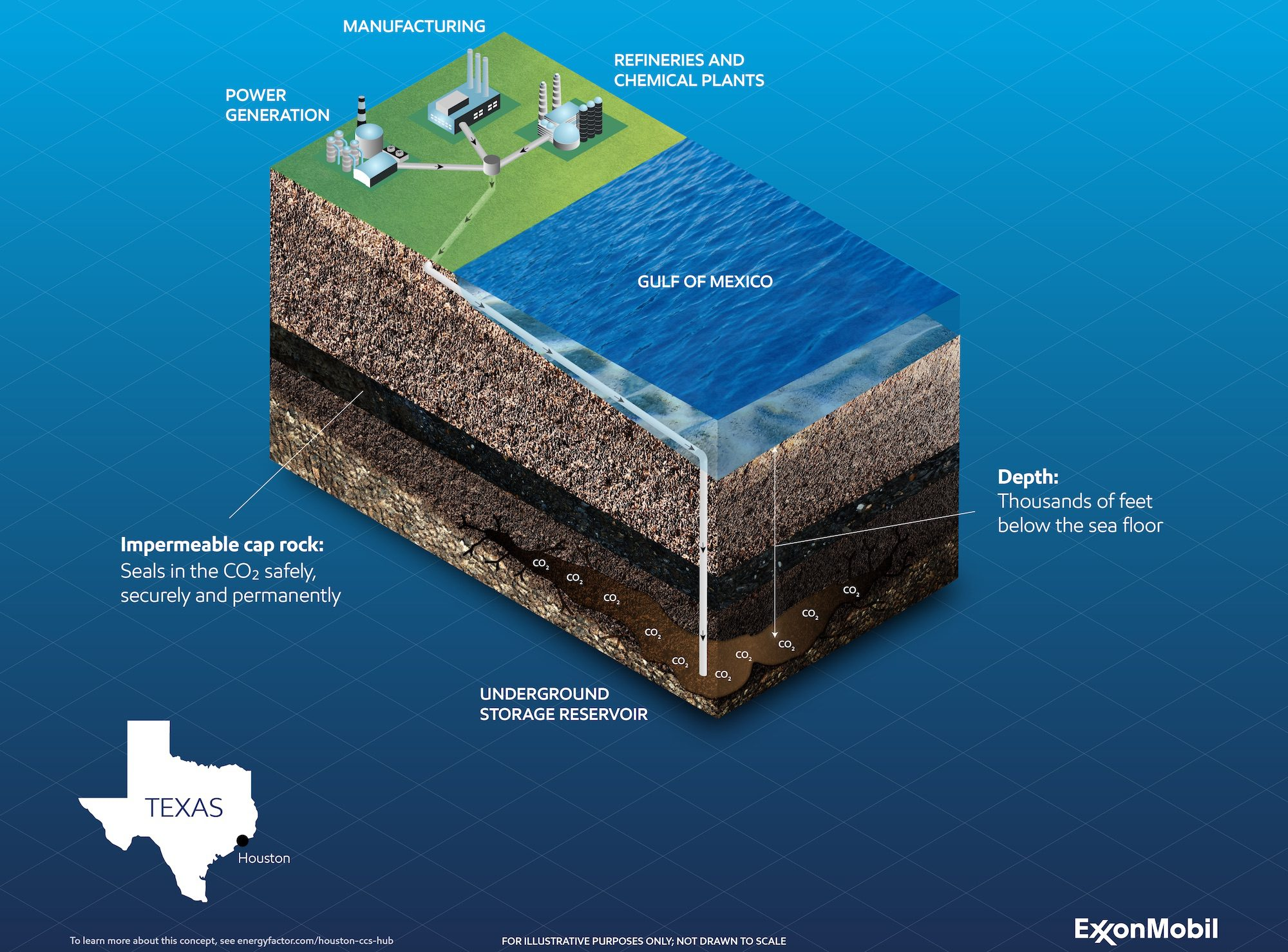
The reality of offshore CCS is not anywhere near as simple as portrayed in the slick graphic below:

houston ccs hub
ExxonMobil

Read Full Post »

  • Should CCS leases have been offered in a separate sale as is the case for salt, sulfur, and wind operations?
  • Was CCS activity considered in the environmental reviews for this sale?
  • Was CCS mentioned in the Notice of Sale?
  • How will these CCS bids be evaluated?
  • Will the CCS bidding influence the Judge’s decision on the pending Sale 257 litigation?

Read Full Post »

Excerpt from SEC. 40307. GEOLOGIC CARBON SEQUESTRATION ON THE OUTER CONTINENTAL SHELF:
(b) Leases, Easements, or Rights-of-way for Energy and Related Purposes.--Section 8(p)(1) of the Outer Continental Shelf Lands Act (43 U.S.C. 1337(p)(1)) is amended--
        (1) in subparagraph (C), by striking ``or'' after the semicolon;
        (2) in subparagraph (D), by striking the period at the end and inserting ``; or''; and
        (3) by adding at the end the following:
            ``(E) provide for, support, or are directly related to the injection of a carbon dioxide stream to sub-seabed geologic formations for the purpose of long-term carbon sequestration.''.
    (c) Clarification.--A carbon dioxide stream injected for the purpose of carbon sequestration under subparagraph (E) of section 8(p)(1) of the Outer Continental Shelf Lands Act (43 U.S.C. 1337(p)(1))  shall not be considered to be material (as defined in section 3 of the Marine Protection, Research, and Sanctuaries Act of 1972 (33 U.S.C. 1402)) for purposes of that Act (33 U.S.C. 1401 et seq.).
    (d) Regulations.--Not later than 1 year after the date of enactment of this Act, the Secretary of the Interior shall promulgate regulations to carry out the amendments made by this section.

This will be an interesting challenge for the DOI folks (BSEE/BOEM?) charged with writing the regulation given the jurisdictional issues related to capturing onshore CO2 and transporting it to the OCS. Also, when was this provision added to the infrastructure bill and did its apparent obscurity and delayed enactment give certain parties some type of competitive advantage at the sale?

Read Full Post »

« Newer Posts - Older Posts »