Feeds:
Posts
Comments

Archive for the ‘Regulation’ Category

….for continuing to recognize the Conservation Division of the Geological Survey (USGS) as the US offshore safety regulator, even though 40 years have passed since that was the case and there have been 3 successor bureaus. 😀

33 CFR § 140.4 Relationship to other law. (current text excerpted from Coast Guard Subchapter N regulations)

(a) Design and equipment requirements of this subchapter for OCS facilities, including mobile offshore drilling units in contact with the seabed of the OCS for exploration or exploitation of subsea resources, are in addition to the regulations and orders of the U.S. Geological Survey applicable to those facilities.
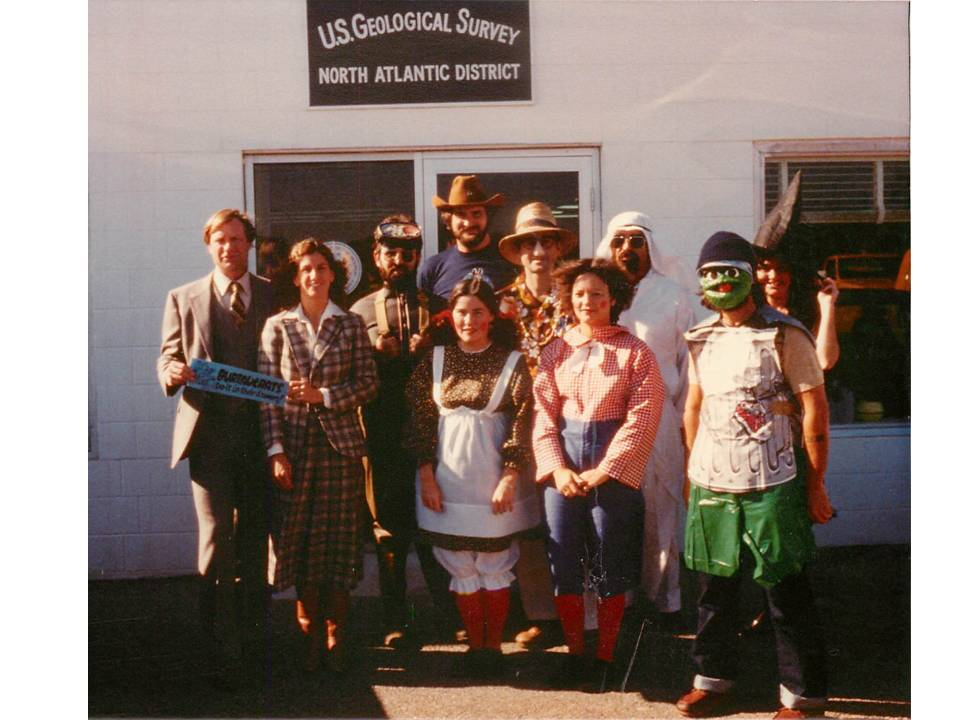
USGS North Atlantic District, Hyannis, MA, Halloween 1980

Most of us old-timers think the best regulatory framework for the offshore program was in the USGS days (pre-1982). Some of this may be nostalgia, but there are some good reasons for this thinking:

  • USGS was/is an internationally acclaimed scientific organization that was always headed by a renowned geologist. The regulatory program was thus somewhat insulated from political pressures. Vince McKelvey, Bill Menard, and Dallas Peck were the Directors when I worked for USGS. Their credentials are linked. Bill and Dallas visited our Hyannis office (not at Halloween 😀) and were very supportive.
  • The Conservation Division was responsible for onshore operations on Federal lands as well as offshore activity. This facilitated information sharing and offered diverse career opportunities. My first bosses in New Orleans had worked previously in the Farmington and Roswell, NM offices.
  • We had excellent synergy with the other USGS divisions. The Marine Science Center in Woods Hole was an incredible resource for our Hyannis office. The Woods Hole office, particularly Mike Bothner and Brad Butman, had a critical role in the Georges Bank Monitoring Program, the best ever (in my biased opinion) environmental study of exploratory drilling operations in a frontier area.
  • The USGS Conservation Division had a very small and supportive headquarter’s staff, which minimized the potential for conflict with field offices.
  • Prior to the formation of the Minerals Management Service (MMS) in 1982, the Bureau of Land Management was responsible for leasing, but all regulatory functions were under USGS. This included resource evaluation/conservation, plan review and approval, permitting, inspections and enforcement, and investigations. The division of MMS responsibilities, most notably the assignment of plan approval to the leasing bureau (BOEM) rather than the regulatory bureau (BSEE), complicates the work of both bureaus and is a prescription for inefficiency, confusion, overlap, and conflict.

Read Full Post »

While the previously discussed planning, cementing, and well suspension issues allowed the well to flow, there were many other equipment, operational, and management deficiencies that elevated the incident to a disaster. Below are those that bother me the most:

  • Blowout Preventers
    • The Deepwater Horizon BOP stack had a single blind shear ram. Regardless of what the regulations allowed, you don’t drill a complex well like this without redundant shearing capability (and at the time of the blowout most deepwater drillers were using rigs with dual shear rams). All well control emergencies requiring the emergency disconnect sequence, deadman, and autoshear functions are dependent on effective shearing capability. You can have redundancy in every other BOP element, but without dual shear rams, you don’t have a redundant BOP system. Further, for full redundancy both shear rams should be capable of sealing the well bore after shearing. In that regard, the present regulations and the applicable standard (API S 53) require only one shear ram capable of sealing. They are thus deficient and should be updated.
    • The DWH BOP system did not have full bore shearing capability (available at the time) which may have sheared the deflected drill pipe.
    • The DWH BOP system was not properly maintained and recertified as required by regulation.
    • Transocean’s “condition based maintenance” was a euphenism for “fix it when it fails.” Perhaps worse, BP authorized the continuation of operations knowing that an annular preventer was leaking.
  • The initial flow from the well was directed to the mud-gas separator instead of being routed overboard via the diverter. Routing the flow to the diverter would have provided additional time for the crew to safely evacuate.
  • Gas detectors
    • Not all gas detectors were fully operational. As justification, Transocean’s report expressed concerns about alarm fatigue, a weak excuse. Alarm issues can be effectively managed without disabling the devices.
    • The gas detectors did not automatically shutdown the generators, the source of the initial explosion. This is somewhat understandable on a dynamically positioned rig that is dependent on power to maintain position. However, someone should have shut down the generators as soon as gas was detected.
  • Engine overspeed devices didn’t work, and apparently weren’t tested regularly. Had they worked, the engine room explosion may have been prevented.
  • The crew had time to activate the Emergency Disconnect Sequence, but did not.
    • Deficient training
    • Uncertain chain of command
    • Fear of repercussions?

Read Full Post »

Per BSEE’s online Incident of Non-Compliance (INC) data, 4 operating companies accounted for 64% of the INCs during Q1 of 2022 (see chart below). Fieldwood was once again cited for the most INCs (132), but GOM Shelf LLC had the highest INC/inspection ratio (1.53). All 55 of the Whitney Oil & Gas INCs resulted in Facility Shut-In orders. Whitney was cited for failing to comply with damage inspection and records requirements following Hurricane Ida.

The overall violations rate during Q1 of 2022 was essentially unchanged from 2021. A number of companies had outstanding records. We’ll comment on them later in the year.

Read Full Post »

500 days (and counting) since the last US offshore oil and gas lease sale. Abbreviated chronology:

Read Full Post »

Mr. Domangue began his career with BSEE in 1997 and has more than 30 years of experience in the oil and gas industry. He has served as the Deputy Regional Director for Districts, Investigations, Environmental, and Enforcement (DIEE), as Senior Technical Advisor for the BSEE Gulf of Mexico Region and was the Acting Chief of the National Offshore Training Center. Mr. Domangue also previously served as Office Supervisor for Regional Operations, and as District Manager for the Houma District Office of the BSEE Gulf of Mexico OCS Region. He holds a BS degree in petroleum engineering from Louisiana State University.

BSEE

Read Full Post »

Below and linked is the most recent C-NLOPB incident posting:

  • Timely
  • Front page
  • Advises about any casualties or pollution (none in this case)
  • Briefly describes incident without speculating on causes
  • Informs about next steps
  • Well done

INCIDENT DISCLOSURE 2022

NEAR MISS ON THE HIBERNIA PLATFORM

March 25, 2022

Hibernia Management and Development Company (HMDC) has reported that on March 20, 2022 a crane on the Hibernia Platform was lifting a mini container when it made contact with a scaffold hoarding. There were three people working inside the hoarding at the time of contact. No one was injured and there was no damage to the scaffold hoarding.

West pedestal crane operations were halted and HMDC has initiated an investigation to determine the potential classification of the incident.

C-NLOPB Safety Officers were already scheduled to travel to the Hibernia Platform in the coming days and will follow up with HMDC to review this incident and the near miss that occurred on March 15.

The C-NLOPB is also monitoring HMDC’s investigations of these incidents.

Read Full Post »

This useful SafeOCS report summarizes and itemizes well control equipment failures associated with well operations on the Gulf of Mexico OCS in 2020. Of particular note was the absence of any loss of containment (leak of wellbore fluids) events in 2020 or the prior two years.

Unfortunately, there appear to be significant reporting gaps despite the fact that reporting of these data is required by regulation (30 CFR 250.730(c)). The reporting issues are particularly serious for surface systems (surface BOP and associated equipment). Per SafeOCS, surface rig reports were received from less than 50% of active operators and rigs. Reporting for subsea systems (subsea BOP and associated equipment) was much better with 85% of the active rigs represented.

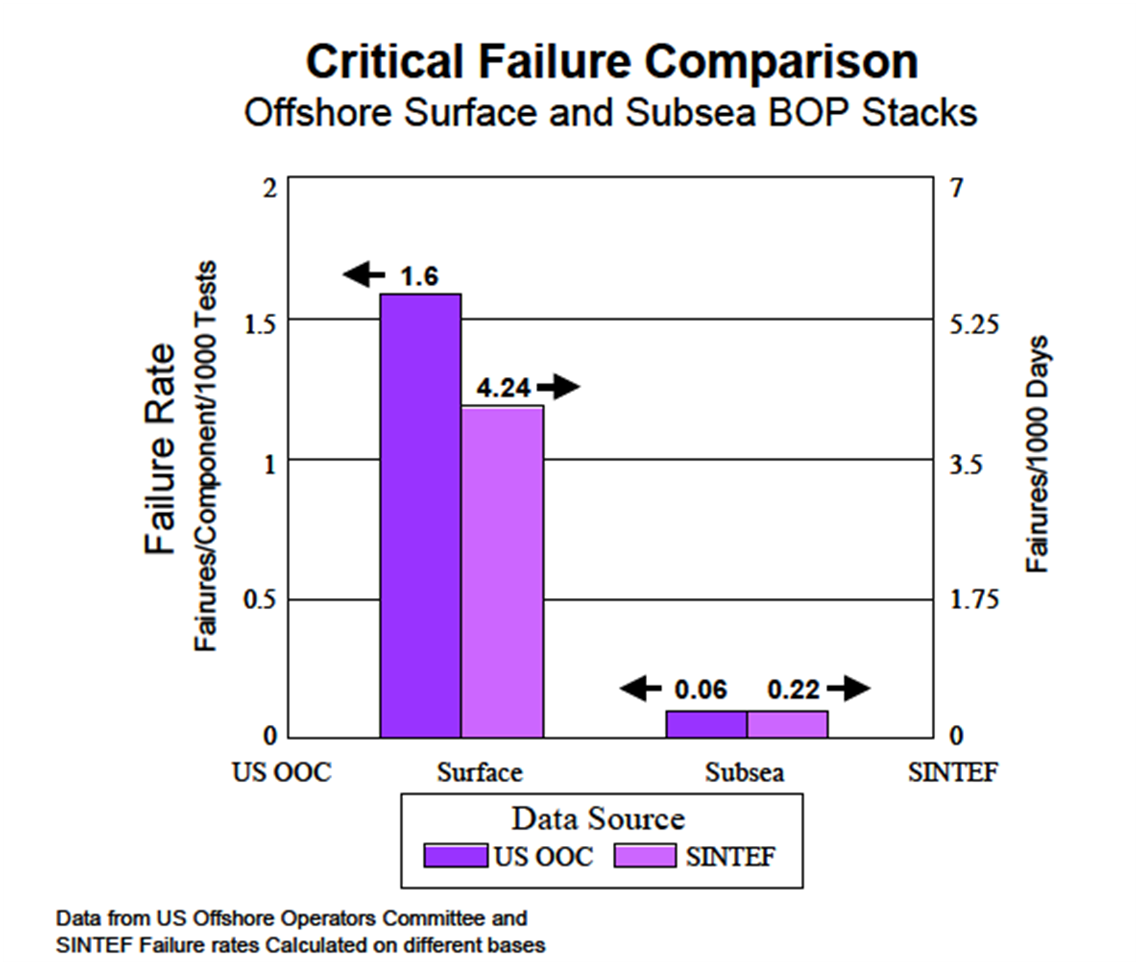
Of further concern with regard to the reporting of surface equipment events, the data indicate only 5.3 events per 1000 hours for surface systems vs. 71.5 for subsea systems. While subsea systems are more complex, the cost of pulling and repairing subsea equipment dictates newer, better maintained equipment. As a result, surface BOPs have historically had higher failure rates than subsea BOPs. The data below are from a presentation to MMS approximately 15 years ago. Both the Sintef and OOC data show higher failure rates for surface BOPs.

The SafeOCS team did a very good job of analyzing the reports and presenting the data. However, the reporting issues need to be investigated and resolved to get maximum value from this very important work.

Read Full Post »

Although OSHA is withdrawing the Vaccination and Testing ETS as an enforceable emergency temporary standard, OSHA is not withdrawing the ETS to the extent that it serves as a proposed rule

OHSA Notice

Should we call the proposed rule an ETS variant?

Read Full Post »

While the Fieldwood Energy violations drove up the number of Incidents of Non-Compliance (INCs) in the Gulf of Mexico in 2021, most operating companies appear to have had good compliance records. Among companies that were subjected to at least 10 facility inspection and drilled at least one well, BHP Billiton, Eni US, and Murphy (listed alphabetically) had the most impressive compliance records. These three operators were cited for 7 or fewer INCs, none of which required a facility to be shut-in. Other operators that exceeded those activity thresholds and had excellent compliance records were (listed alphabetically) Anadarko, ANKOR Energy, Chevron, EnVen, Shell, and Walter Oil and Gas.

In the Pacific Region, Beta Operating Co., Chevron (now overseeing the former Signal Hill properties), and Exxon had excellent compliance records, although none of these facilities produced for the full year. In Alaska, Hillcorp had an excellent record at the Northstar Unit. (This is a gravel island facility in the State waters of the Beaufort Sea, but some of the wells produce from portions of the reservoir that are in the Federal sector).

Unfortunately, only summary inspection data are posted online. Without knowing the specific violations and circumstances, it’s not possible to fully assess the risk exposure. These oil and gas operations are conducted on public lands and are monitored by Federal employees. Inspection data and reports should be publicly accessible without having to submit Freedom of Information Act requests.

As has previously been discussed, incident updates should also be posted in a timely manner. Reference is made to this important recommendation in the 2016 National Academies report entitled Strengthening the Safety Culture of the Offshore Oil and Gas Industry:

Recommendation 4.2.2: Because accident, incident, and inspection data all are needed to identify and understand safety risks and corrective actions, the committee recommends full transparency such that regulators make all these data readily available to the public in a timely way, taking into consideration applicable confidentiality requirements.

Read Full Post »

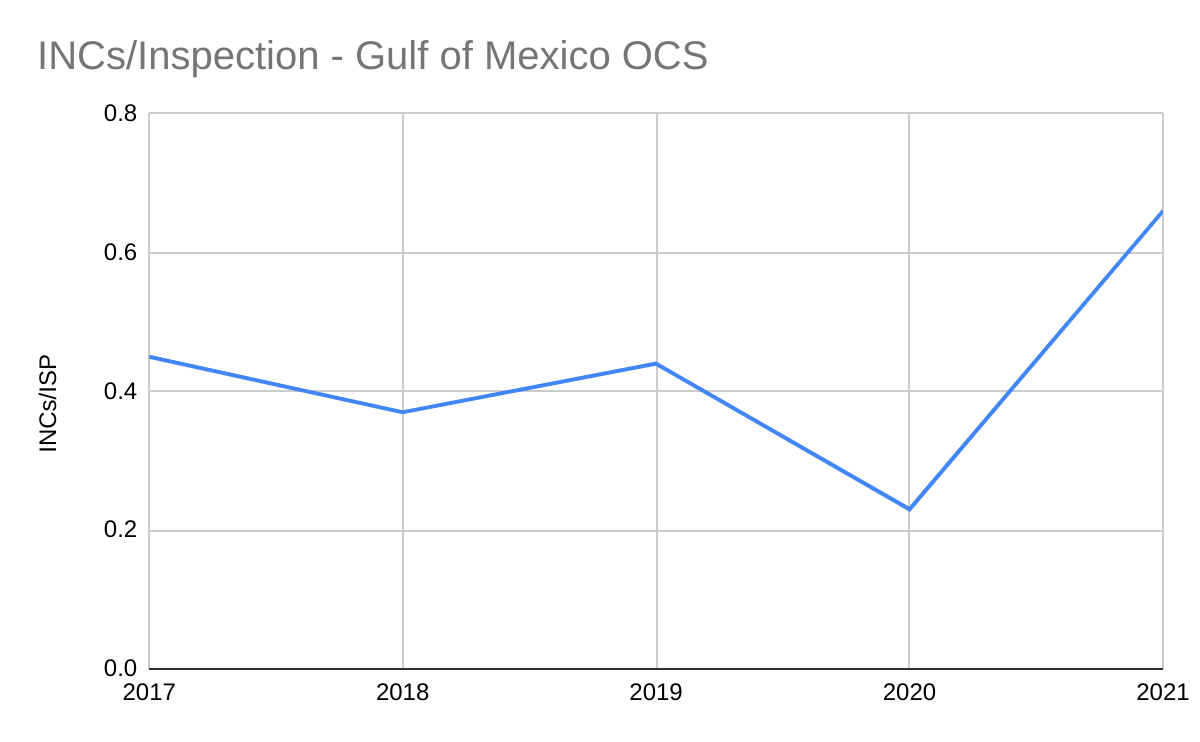
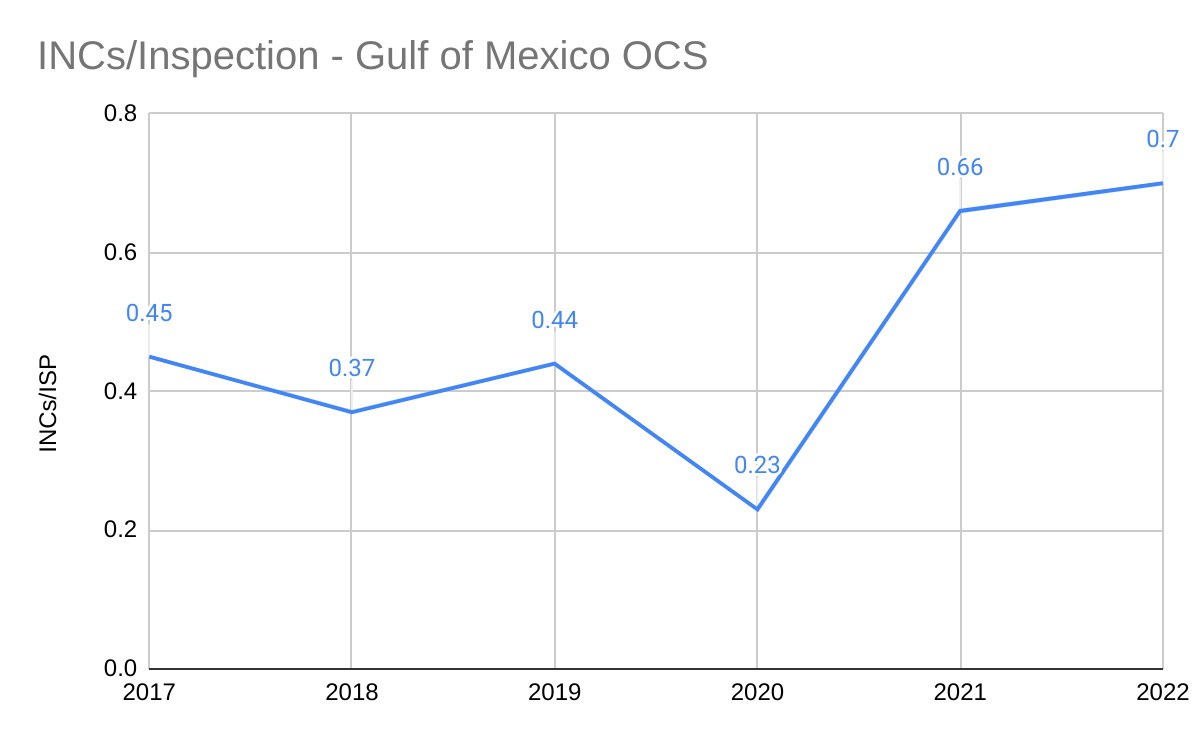
Per BSEE’s Incidents of Non-Compliance (INC) data base, the number of violations surged in 2021, both in terms of the total number of INCs and the INCs/inspection ratio (see chart below). Remarkably, a single company – Fieldwood Energy – was responsible for 845 INCs or 44% of the total number issued. Normalizing for the number of inspections, Fieldwood facilities were cited for 1.46 INCs/inspection versus 0.46 INCs/inspection for all other companies. An unprecedented 61 of Fieldwood’s 2021 INCs called for facility shut-ins, many times more than any other operator. Through the first 17 days of 2022, Fieldwood has already been cited for 21 INCs, 5 of which required facilities to be shut-in.

Fieldwood and its affiliates have experienced multiple bankruptcies and the company has once again been reorganized with the blessing of the courts. Chevron’s comprehensive objection to the reorganization plan asserted that Fieldwood has $9 billion in current and anticipated decommissioning obligations. These enormous decommissioning liabilities and their implications for predecessor lessees (former facility owners) and the Federal government were the main issue in these proceedings, and the bankruptcy plan includes settlements with predecessor companies and the government.

Even more significant than the financial matters and INCs are the following:

While BSEE regulations provide for the removal of operating rights for poor safety performance, companies can reorganize and problem managers can reappear elsewhere. As a result, marginally financed and ineffective operating companies are a major challenge for BSEE as evidenced by the INCs, civil penalties, and investigations. (See the related saga of Platforms Hogan and Houchin in the Pacific Region.)

Poor safety performers drag down the entire industry. The costs of mega-disasters like the Santa Barbara and Macondo blowouts have been widely discussed. However, chronic poor performance and the associated incidents also weaken the industry and damage the integrity of the offshore oil and gas program. These performance issues can’t be left entirely to BSEE and the Coast Guard to resolve. The industry needs to do a better job of self-evaluation, calling out poor performers, and exercising judgement in the assignment of offshore properties.

Read Full Post »

« Newer Posts - Older Posts »