IT IS ORDERED that appellants’ opposed motion for partial stay pending appeal is GRANTED in part. The preliminary injunction that was entered by the Memorandum Order of September 21, 2023, is hereby AMENDED only in that the sale that was set for September 27, 2023, is ORDERED to take place by November 8, 2023. No extension will be granted. That is to say: Insofar as the preliminary injunction is concerned, the final paragraph of the Memorandum Order remains in effect, pending appeal of the preliminary injunction, with the exception that “September 30, 2023,” is changed to “November 8, 2023.”
BOEM is allowed to delay the sale until Nov. 8, which is consistent with the Federal government’s request.
All other aspects of the Preliminary Injunction remain in place, but the 5th Cir. still needs to hear and decide the government’s appeal of the PI. Monday’s decision was on the emergency motion and not the merits of the Preliminary Injunction.
Assuming the Gulf of Mexico oil and gas lease sale proceeds tomorrow in accordance with Judge Cain’s order, some interesting questions and issues remain:
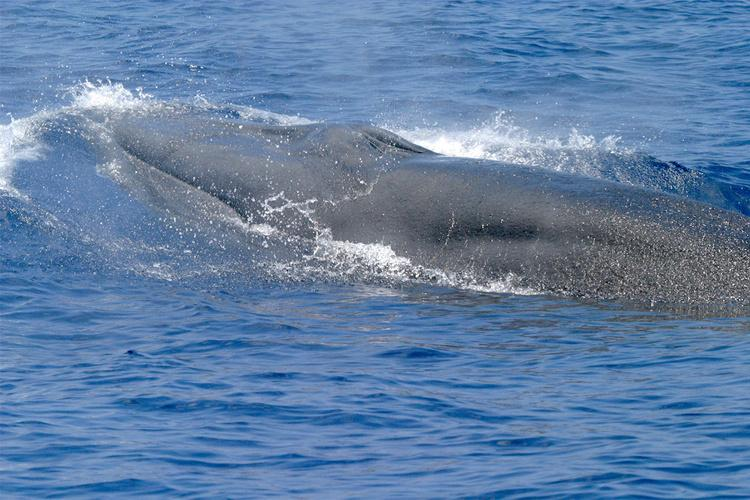
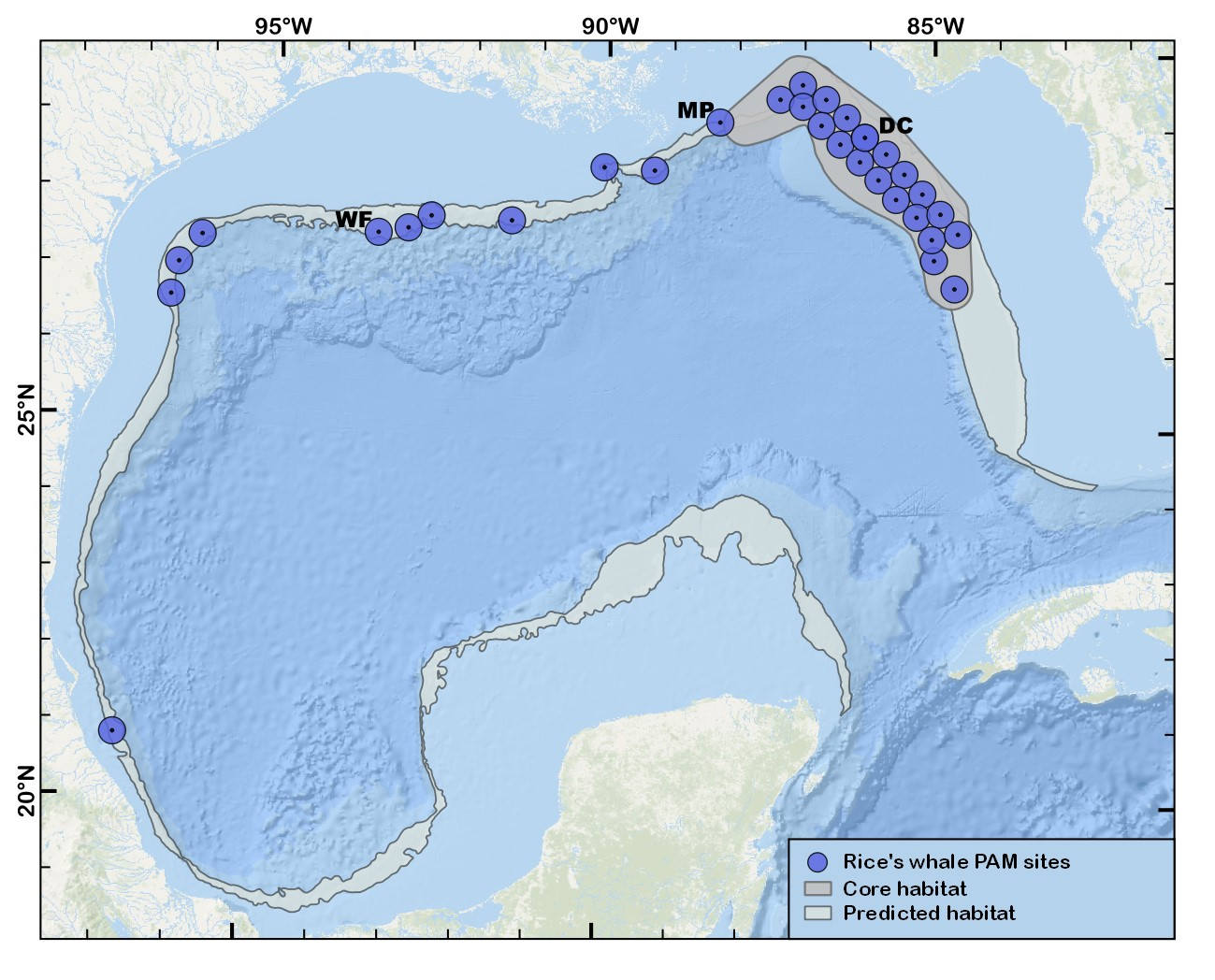
Will the lingering Rice’s whale issues affect bidding for deepwater leases? Friday’s court order is not a final resolution of those issues, either legally or administratively. While the Rice’s whale stipulation, at the direction of the Federal court, will not be included in the Sale 261 leases, BOEM’s Notice to Lessees and Operators (NTL) includes the same provisions and still stands pending further consultations with NOAA. Although the NTL is a “guidance document” (wink-wink), there are ways of making it stick through the exploration plan approval process. Even without binding requirements, companies might choose to fully comply to minimize legal risks.
When will the next GoM lease sale be held? Will the uncertainty spur or constrain bidding?
BOEM is taking steps to comply with an order issued on September 21, 2023, by the U.S. District Court for the Western District of Louisiana regarding Gulf of Mexico Outer Continental Shelf Oil and Gas Lease Sale 261.
Lease Sale 261 will be conducted on September 27, 2023. In accordance with the court’s order, BOEM will include lease blocks in Lease Sale 261 that were previously excluded due to concerns regarding potential impacts to the Rice’s whale distribution in the Gulf of Mexico.
BOEM is also extending the bid submission period to 3 p.m. CST on September 26, 2023.
The challenged lease term for the expanded Rice’s whale area only arose in a July 2023 district court filing and then appeared in the FNOS for Lease Sale 261 on August 25, 2023—one month before the statutory deadline for the sale. BOEM failed to follow its own procedures by making significant changes to the FNOS, thereby depriving both affected states and the public the opportunity for meaningful review and comment. The procedural error is particularly grave here, because of both the compressed timeline and BOEM’s inexplicable about-face on the scientific record it had previously developed. (p.19)
The challenged provisions inserted into these leases at the eleventh hour, and the acreage withdrawal, are based only on an unexplained change in position by BOEM on a single study a few months after that supplemental EIS. The process followed here looks more like a weaponization of the Endangered Species Act than the collaborative, reasoned approach prescribed by the applicable laws and regulations. (p.22).
According to an affidavit from Shell’s commercial manager, the new restrictions on vessel traffic apply to an area of the northern Gulf that separates Shell’s existing offshore leases from the onshore infrastructure that supports them. Shell Offshore Inc., No. 2:23-cv-1167, at doc. 4, att. 2, ¶¶ 23–27. (p. 23).
Given the shaky justification offered by BOEM, the court cannot find that the challenged provisions are so necessary that withholding them even on a preliminary basis will outweigh the risk of irreparable economic harm shown by plaintiffs. Additionally, “there is generally no public interest in the perpetuation of unlawful agency action.” (p. 26)
For the reasons stated above, the court hereby ORDERS that the Motions for Preliminary Injunction be GRANTED. Accordingly, the government defendants are enjoined from implementing the acreage withdrawal and Stipulation 4(B)(4) as described in the Final Notice of Sale and Record of Decision for Lease Sale 261. Government defendants are ordered to proceed with Lease Sale 261, absent the challenged terms, by September 30, 2023.
Cantium’s record is especially impressive given that most of their platforms were installed more than 40 years ago and some date back to the 1950s. They have also been a very active development well driller.
While Kosmos and Beacon have somewhat lower violation and penalty exposure because their production is via subsea wells tied back to surface facilities operated by other companies, they are demonstrating that entrepreneurial deepwater independents can also be safety leaders.
“The Pickerel-1 prospect was our first (exploration well on the Mississippi Canyon 727) and we are delighted that it was an oil discovery. Black Pearl will be the next and that will hopefully be a tieback (to Tubular Bells with first oil expected mid-2024).
“Then we have a wildcat opportunity (the Vancouver exploration prospect) later in the year in the Green Canyon. With the other 80 exploratory blocks that we have in the Gulf, we will be actively drilling for the next several years,” Hess said.
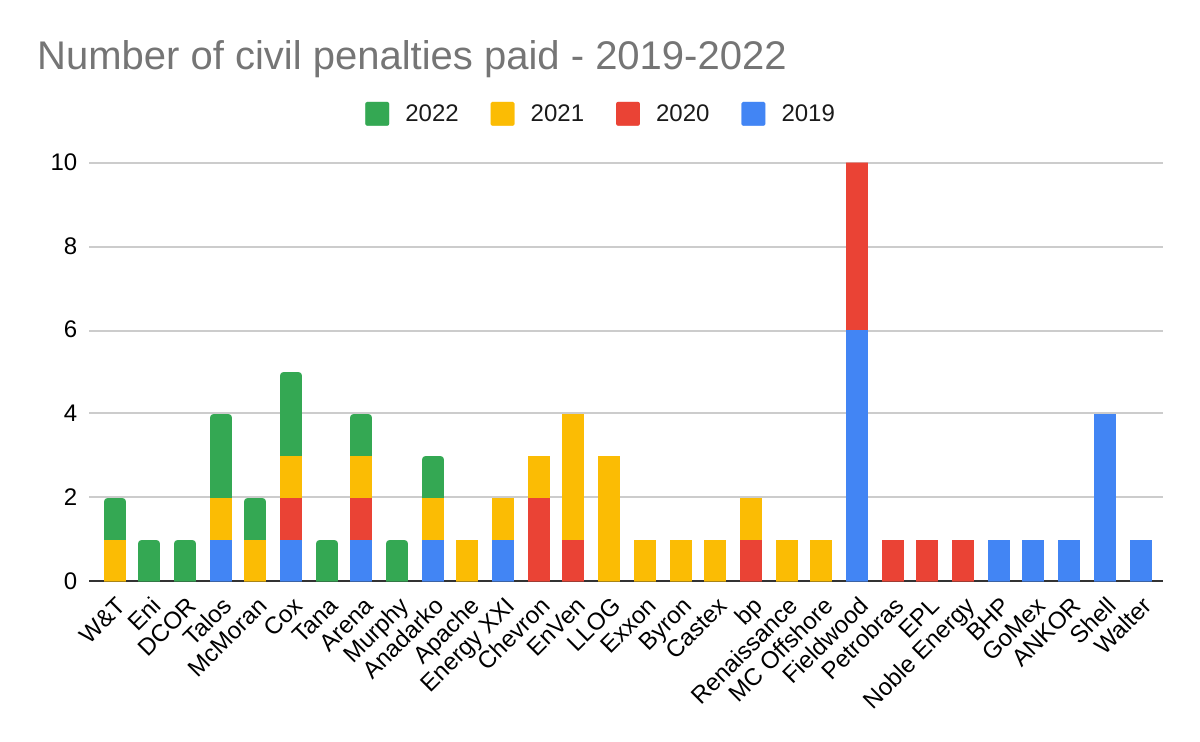
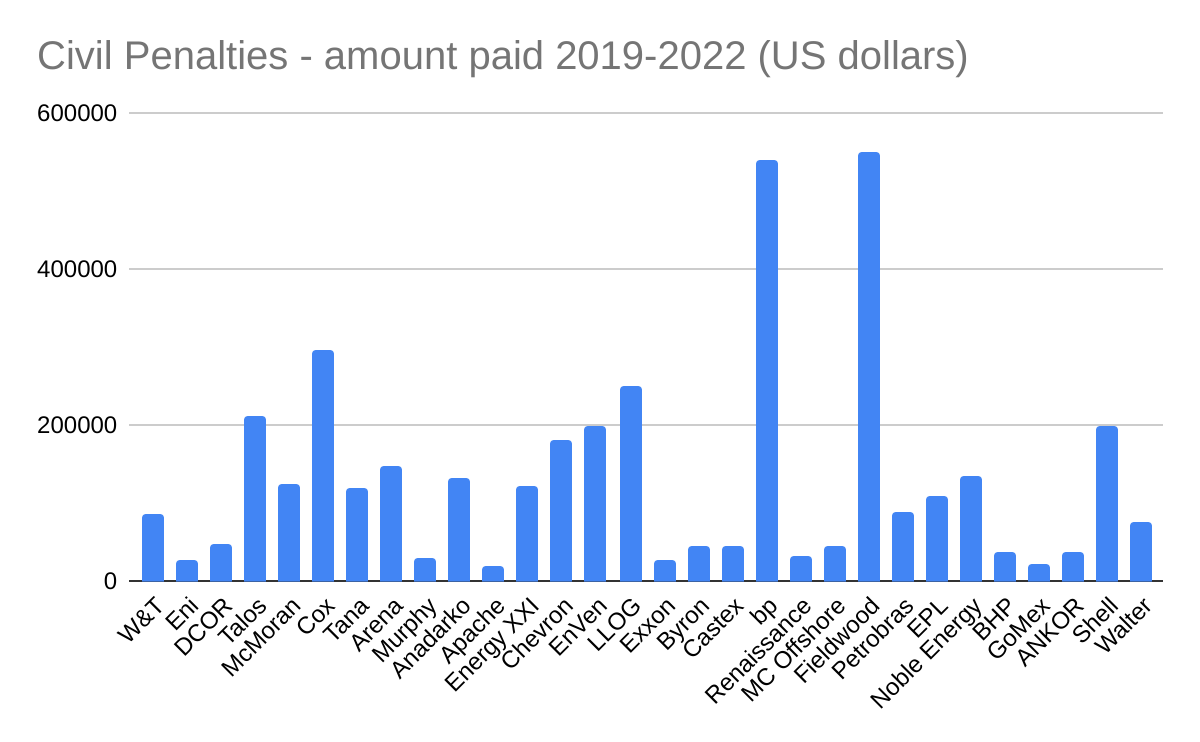
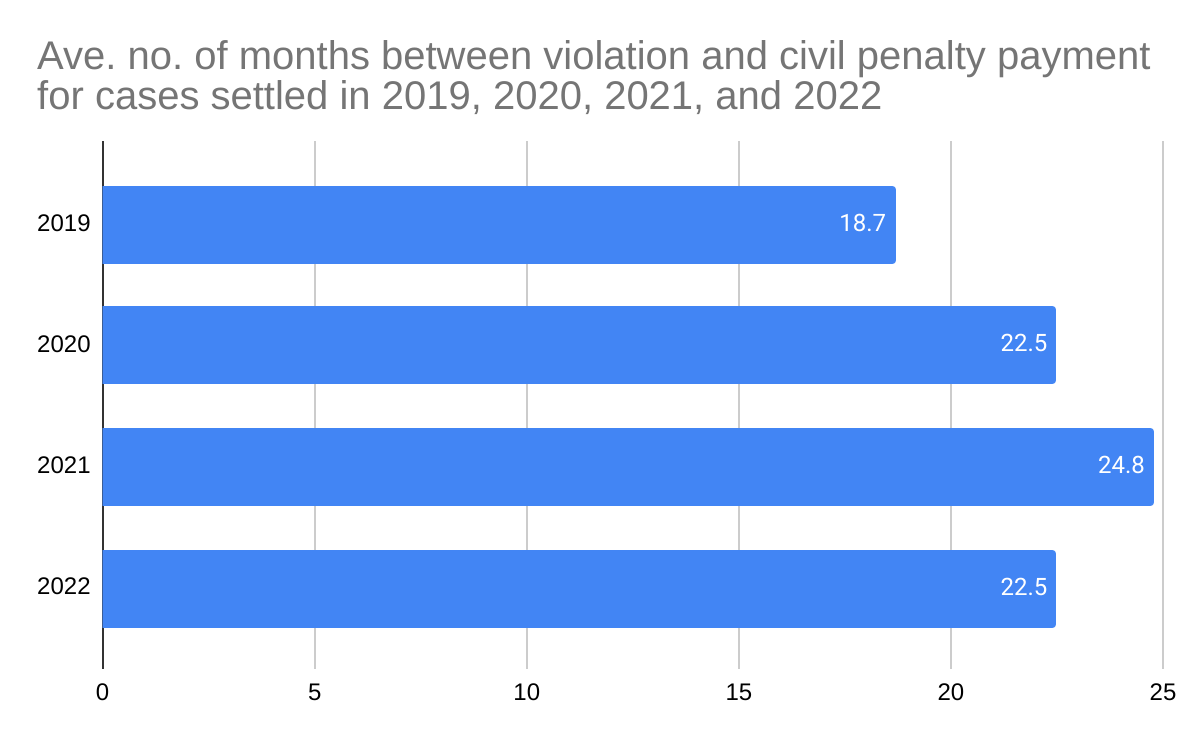
Data are on a fiscal year basis (i.e. 2022 started on 10/1/2021 and ended on 9/30/2022)
These data are only for civil penalties paid in that year. Data for civil penalties referrals are not publicly available.
Nothing terribly surprising in the data. Fieldwood’s issues have been discussed at length.
Note (last chart) the lag between the date violations were observed and the date penalties were paid. This lag is significant but understandable given due process considerations.
Fastest payment: 6 months by Shell for an open hole that was not properly barricaded ($26,750 penalty, 2018).
Slowest payment: 54 months by LLOG for failing to install and maintain equipment properly (three 2016 violations)
Largest civil penalty paid: $512,900 by bp for a high-pressure gas release caused by the use of improper seals (May 8, 2018 violation).
Smallest civil penalty paid: $16,300 by Arena for the release of 1000 psi gas on October 16, 2018
The civil penalties provision in the 1978 OCS Lands Act (OCSLA) Amendments was flawed in that it stipulated that operators must be given time to take corrective action before a civil penalty could be assessed. The “time to take corrective action” requirement was confirmed by a 1983 Federal Court decision in Louisiana:
The Court agrees with Chevron’s construction of Section 24(b) and holds that civil penalties may only be imposed under Section 24(b) for violations which continue after the violator has been notified of the breach and has failed to correct it within a reasonable period allowed. This conclusion is based primarily upon a careful review of the pertinent statute. The first sentence sets forth the conditions of liability:
If any person fails to comply with any [provision of the Act] after notice of such failure and expiration of any reasonable period allowed for corrective action, such person shall be liable for a civil penalty of not more than $10,000 for each day of the continuance of such failure.
The court decision gutted the Minerals Management Service (MMS) civil penalties program. Civil penalties could no longer be assessed until the operators had been given time to correct their violations, even those that endangered workers and the environment.
Ironically, Congressman George Miller (D-CA), an ardent opponent of the offshore oil and gas program, proved to be an important MMS ally by adding language to the Oil Pollution Act of 1990 that amended the OCSLA civil penalties provision. The first draft of that language expanded the civil penalties authority to include violations that may constitute a threat of serious, irreparable, or immediate harm or damage to life, property, or the environment.
We were able to revise that draft by adding the words “or constituted” after “constitute” to cover situations where the threat was no longer present. For example, if an inspector found that a well had been drilled without required elements of the well control system in place, the threat may no longer be present at the time the violation was detected but it certainly was when the well was drilled.
The revived MMS civil penalties program was fair and effective, and BSEE seems to be administering the program in a similar manner. Civil penalties data for the past 4 years will be posted next week.