Below is a report summary that was referenced in the Office of the Inspector General, Dept. of the Interior, Semiannual Report to Congress (9/30/2023). The summary does not identify the company that committed the violations.
Failing to identify the responsible company is not in the best interest of the OCS program or the many operators and contractors that are committed to safe operations and compliance with the regulations.
Presumably, BSEE has issued civil penalties, so we may be able to piece this case together when those penalties have finally been paid.
Summary: Offshore Servicing Company Failed to Conduct Mandated Safety Tests and Submitted False Information to BSEE Report Date: August 29, 2023 Report Number: 20-0425
The OIG investigated allegations that an offshore oil and gas servicing company bypassed safety valves and falsified mandated safety tests associated with an oil and gas production platform located in the Gulf of Mexico. The safety tests are required by Federal regulations enforced by the Bureau of Safety and Environmental Enforcement (BSEE) to ensure that equipment aboard the platform functions properly and prevents the discharge of hydrocarbons into Federal waters.
We found that the servicing company did not perform the mandated safety tests but submitted documentation to BSEE that falsely represented that the safety tests had been conducted. We also determined that multiple safety valves aboard the offshore platform were bypassed and remained in that condition for at least 59 days but potentially as long as 223 days. We presented our findings to the U.S. Department of Justice, which declined prosecution.
This is a summary of an investigative report we issued to the Director of BSEE for action as deemed appropriate.
Firstly, taking 2.5 years to publish an investigation report is unacceptable for an organization with BSEE’s talent, resources, and safety mandate. Unfortunately, such delays now seem to be the rule as the summary table (below) for the last 4 panel reports demonstrates. The most recent report implies that the actual investigation was completed in 2-3 months. Why were another 2+ years needed to publish the report? (Note that the lengthy and complex National Commission, BOEMRE, Chief Counsel, and NAE reports on the Macondo blowout were published 6 to to 17 months after the well was shut-in.)
incident date
report date
elapsed time (months)
incident type
5/15/2021
10/31/2023
29.5
fatality
1/24/2021
7/24/2023
30
fatality
8/23/2020
2/15/2023
30
fatality
7/25/2020
2/15/2023
31
spill
Four most recent BSEE panel reports
The subject (May 2021) fatality occurred during a casing integrity pressure test, and some of the risk factors were familiar:
The platform was installed 52 years prior to the incident, and had been shut-in for more than a year.
The well of concern (#27) was drilled in 1970, sidetracked in 1995, and last produced in February 2013.
Diagnostic tests clearly demonstrated communication between the tubing, production casing, and surface casing.
In light of the known well integrity issues and the absence of production for more than 8 years, the prudent action would have been to plug and abandon the well in a timely manner. However, under 30 CFR 250.526 as interpreted at the time, Fieldwood had another option – submit a casing pressure request to BSEE to confirm the integrity of the outermost 16″ casing and (per p. 10 of the report) “continue to operate the well in its existing condition.” Given that the well had not produced for 8 years and that the platform had been shut-in for more than a year, the option to continue operating the well should not have been applicable.
The only issue for Fieldwood to resolve with the regulator should have been the timing of the plugging operation. Additional well diagnostics would only serve to create new risks and further delay the well’s abandonment.
The resulting pressure test of the outermost (16″) casing was solely for the purpose of confirming a second well bore barrier. Per the report (p.10), there is a “known frequency of outermost casings in the GOM experiencing a loss of integrity as a result of corrosion.” Whether or not the 16″ casing passed the test, the inactive well had clear integrity issues and should have been plugged.
Fieldwood proceeded with the pressure test rather than correcting the problem. The regulations, as interpreted, thus facilitated the unsafe actions that followed. These factors heightened the operational risks:
Extensive scaffolding and a standby boat were needed for the test.
Process gas via temporary test equipment was used to conduct the test.
The Field-Person In Charge (PIC) heard about the test for the first time on the morning of the incident.
The PIC and victim had no procedures to follow, and had to figure out how to conduct the test on the fly.
A high pressure hose was connected without a pressure regulator or pressure safety valve.
The digital pressure gauge had two measurement modes, one to display pressure in psi and the other in bars. (One bar is equivalent to 14.5 psi. Assuming that the readings were in psi rather than bars would thus result in serious overpressure of the casing.)
Seconds after the victim told the field-PIC the pressure was 175 psi (presumably 175 bar and 2538 psi), the casing ruptured. The force of the explosion propelled the victim into the handrail approximately 4 feet away, which bent from the impact. The victim’s hardhat was projected 60 to 80 feet upwards, lodging into the piping.
The investigation report fails to address the wisdom of conducting the pressure test and the regulatory weaknesses that enabled Fieldwood to defer safety critical well plugging operations. The pressure test option in 30 CFR § 250.526, was not intended for long out-of-service wells with demonstrated well integrity issues. The only acceptable option was corrective action (plugging the well) without further delay. The pressure test option added risks without addressing the fundamental problem and helped enable the operator to further delay decommissioning obligations.
Postscript: According to BOEM data, the lease where the fatal incident occurred expired on 7/31/2021. Per the BSEE Borehole and structures files, neither the platform (#14) nor any of the other 4 structures remaining on the lease have been removed, and the well (#27) has yet to be plugged.
An excellent compliance and incident update by Jason Mathews is attached. BSEE’s focus on risk assessment, compliance and incident trends, high potential near-misses, medivac capabilities, hot work safety, lifting operations, and gas releases is encouraging. Good work by the folks in BSEE’s Gulf of Mexico Region.
Observations:
Zero 2023 occupational fatalities through Q3. Hoping this holds through the end of the year and beyond.
INCs/component are down but INCs/inspection are slightly higher. This may imply a relative increase in the inspection of high component deepwater facilities.
No. of hours worked is increasing; good sign for the offshore program.
Hand and finger injuries are driving up the injury count.
Well control incidents are stable at a low level.
Improved fire data help facilitate risk assessments
No YTD explosions
No. of collisions is down
10 YTD spills> 1 barrel (total volume not specified)
Some evidence of decline in lifting incidents in Q2 and Q3
Gas releases are up (aging facilities, decommissioning related?)
BSEE shouldn’t have to issue guidance about helicopter loading precautions that every worker and visitor should be taught before going offshore, but apparently they do. See the safety alert that is attached below.
In this alarming near-miss event, a helicopter was stationed on the facility’s helideck and a crew member approached the aircraft from the rear, entering the rotor arc area before the rotor blades had come to a complete stop. This unsafe action posed a significant threat to the safety of all personnel involved. An offshore helideck assistant repeated the unsafe behavior by approaching the helicopter from the rear, entering the vicinity of the tail rotor, and positioning themselves within the main rotor’s danger zone immediately after the helicopter had landed on the facility’s helideck.
I take it that since the 5th Circuit stayed both the 9/21 and 9/25 orders, the mandate to hold the sale by 11/8 is also stayed. Ergo, it is assumed that the sale will be delayed pending a decision on the merits of the injunction. Oral arguments are scheduled for 11/13.
If the 5th Circuit’s decision facilitates timely resolution of the Rice’s whale deletions and stipulations, delaying the sale is probably the best outcome. Otherwise, the level of uncertainty would be unacceptable for many bidders.
Not a lawyer, but I take this to mean that the Judge’s injunction has been suspended and DOI may delete acreage and include the Rice’s whale stipulations in Sale 261 leases. The sale will be held on Nov. 8.
ORDER: IT IS ORDERED that the preliminary injunction entered by the Memorandum Order of September 21, 2023, as amended by the motions panel’s order of September 25, 2023, is STAYED pending the merits panel’s decision on appeal. LYLE W. CAYCE, CLERK United States Court of Appeals
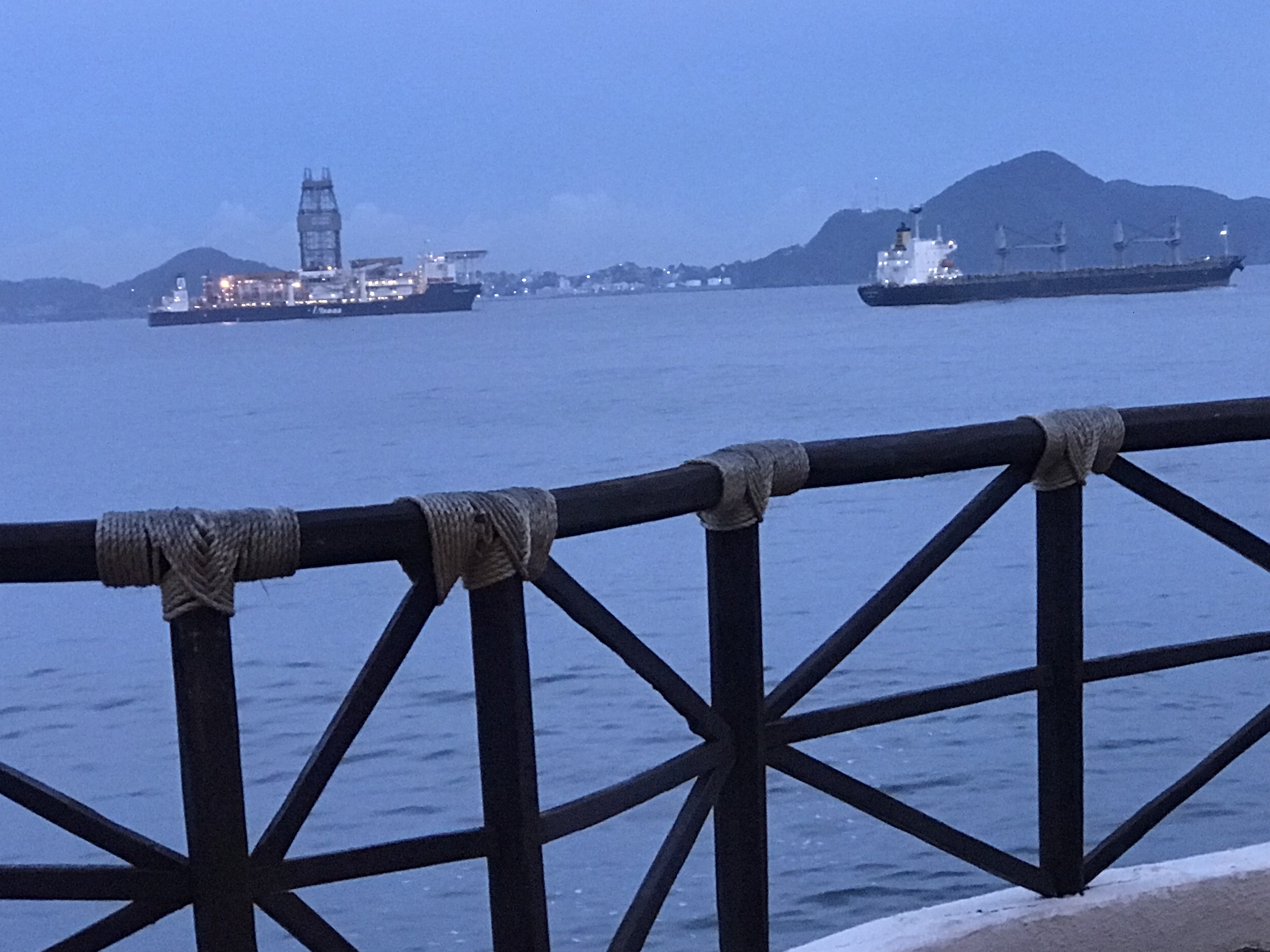
Andrew Konczvald’s reports from Manzanillo, Mexico about the presence of the Hidden Gem (pictured above), a converted deepwater drillship, have renewed BOE interest in deep sea mining, a topic that is full of political, environmental, legal, and operational intrigue:
Ocean mining has served as cover for a CIA mission! The Glomar Explorer was built by Howard Hughes to recover a Russian submarine beneath 16,500′ of water in the Pacific. Interestingly, some manganese, the material the Glomar Explorer was supposedly researching, was also recovered. (As a young engineer, I read fascinating trade journal articles about the Glomar Explorer and its mining capabilities. Little did I know that it was all a ruse!)
The US is not a party to the UN Law of the Seas (UNCLOS) Convention under which the International Seabed Authority (ISA) was established in 1994 to oversee deep sea mining. Purportedly, the US is reluctant to cede any high seas authority to the UN. Doing so might preclude escapades like the recovery of the Russian submarine 😉
Despite the need for metals to support their electrification goals, some environmental groups are staunchly opposed to deep sea mining. Their concerns range from disturbing the ocean’s natural carbon sink to impacts associated with noise and pollution from mineral recovery and transportation.
TMC contends that the environmental impacts and social costs associated with deep sea mining are far less than for onshore mining.
Meanwhile the Hidden Gem remains parked near Manzanillo. Stay tuned.
Consistent with the findings of their inspections and data gathering (as discussed further here), BSEE has published a safety alert (attached) that identifies significant shortcomings in medical evacuation planning and performance.
The findings suggest that a renewed focus on medevac preparedness should be an immediate industry priority. Note the evacuation time, supply, training, and other planning issues summarized in the BSEE alert. Also note the helideck safety issues that were identified. These issues are particularly troubling in light of last December’s fatal crash.
The plan looks good. It appears to be consistent with previous contingency plans. Offshore operations should not be impacted.
“During the shutdown BSEE will continue critical permitting, oversight, preparedness verification, and related activities that are necessary to protect workers and the environment from operations associated with conventional and renewable energy development on the Outer Continental Shelf. Approximately 40% of the 851 BSEE employees will be retained to accomplish these activities and will be designated as exempt, as their salaries will be funded from non-lapsing prior year carryover. Should an extended shutdown occur, exhausting current funding sources, all the exempt personnel would be designated as excepted as they are essential for life and safety.”
Federal funding lapses, real or threatened, are rather common. They range from false alarms to the extended shutdown of 35 days that occurred in 2018-19. In no case have offshore oil and gas operations been significantly affected. BSEE and its predecessors developed and implemented contingency plans that identified “essential employees” needed to monitor operations and review necessary permits.
Hopefully, DOI will provide clarity on these matters today, since a Federal government shutdown could begin at midnight tomorrow. Needless to say, any disruption in ongoing oil and gas production operations would have significant safety and economic implications.