California Attorney General Bonta asks the Court to stay Energy Secretary Wright’s Order directing Sable, under the Defense Production Act to restart production and preliminarily enjoin Defendants, and all those acting in concert with Defendants (i.e. Sable), from enforcing or relying on it. See the attached Federal Court filing.
The AG’s irreparable harm and public interest arguments seem particularly weak, and this may not be the best time to attempt to halt a 20+% increase in California oil production.
Attached are my comments on BOEM’s proposed revisions to the decommissioning financial assurance regulations. These comments were submitted to Regulations.gov yesterday (3 days early 😀). Bud
Concluding Remarks
MMA’s highest priority must be assuring that facilities are safely decommissioned without public funding. Supplemental financial assurance determinations and lease assignment approvals must be consistent with that priority.
Predecessor liability is an important financial assurance principle, but legal boundaries and administrative procedures must be clearly established.
Safety and compliance are inextricably related to financial performance, and must be considered in determining supplemental assurance requirements.
Using reserve estimates to reduce supplemental assurance exposes taxpayers to geologic and accounting risks.
Unacceptable public risks have resulted from financial assurance decisions intended to advance offshore wind development.
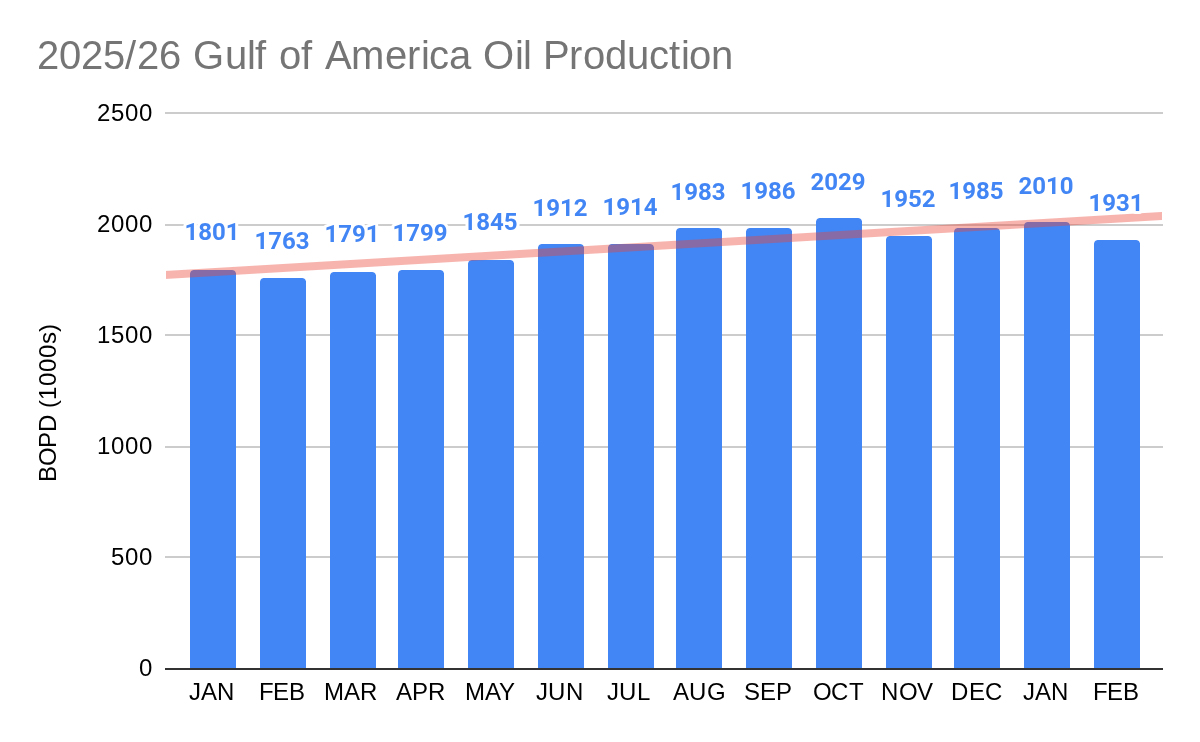
Update: Another EIA revision to Gulf of America oil production for Dec. 2025 (1.994 to 1.985 million bopd) means that 2019 retains the production record by the narrowest of margins – 1.898 to 1.897 million bopd. Stay tuned because this may not be the final word 😉.
Per EIA, Feb. 2026 production dipped a bit to 1.931 million bopd (chart below).
Meanwhile, California OCS oil production for FEB continued at about 10,000 bopd. This number may increase a bit for March, and more for April data when the first Sable sales are included. A big increase, by as much as 500%, should be apparent in the June report barring a court ordered shutdown.
Sable’s updated PowerPoint presentation is attached.
Also, the 2025 compensation package for Sable CEO Jim Flores is attracting attention. Flores received $76 million in total compensation. The bulk of his pay came from more than $69 million in stock awards, alongside a $1.3 million salary and a $3.9 million bonus.
Equinor has cut planned investments in renewable energy by roughly EUR 3.5bn for 2026–2027, while the company maintains and expects growth in oil and gas production.
Perhaps the premium for climate virtue signaling has shrunk, and Equinor, like other energy giants, is making a prudent business decision for its shareholders, which include the Norwegian govt.
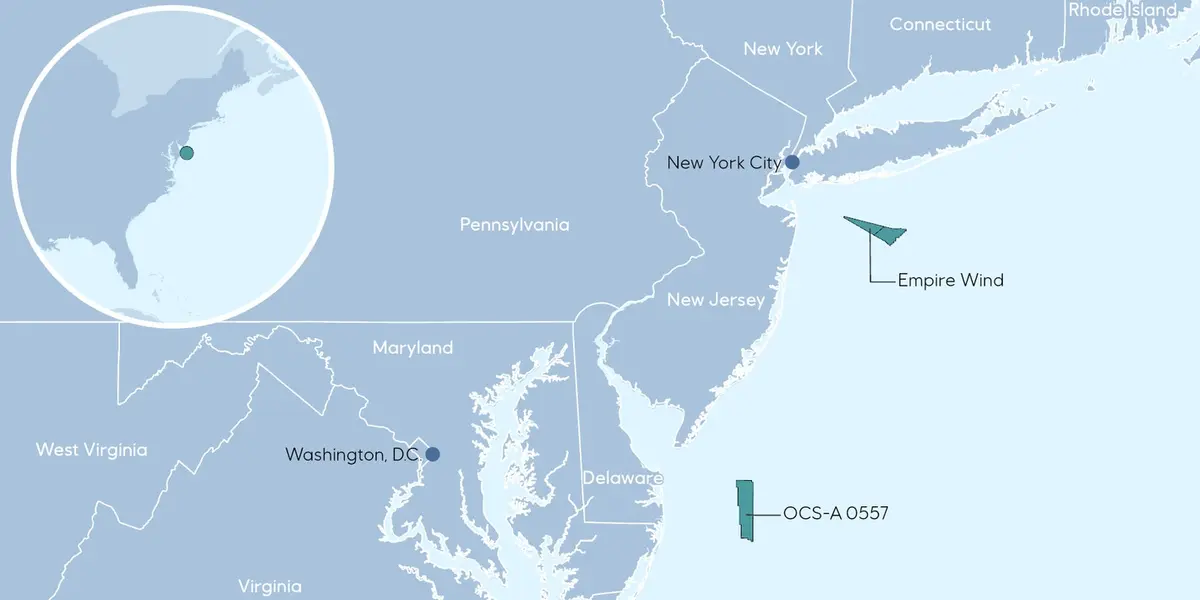
Meanwhile, what are the implications for Equinor’s offshore wind investments in the US? Equinor’s embattled Empire Wind project is probably too far along to reverse course. Their Central Atlantic (Lease 0557) and California (Lease 0563, Atlas Wind) may be a different story. However, buyback negotiations would be complicated by the Empire Wind situation, and perhaps by the Norwegian government’s 2/3 ownership. On the other hand, Equinor is a significant oil and gas leaseholder in the Gulf of America, so they would have ample options for investing wind lease rebates.
The transition reflects more than a decade of operational experience managing offshore resources. By consolidating the planning, permitting, inspection, and enforcement responsibilities currently divided between BOEM and BSEE, the Department aims to:
Improve coordination and consistency
Reduce duplication of efforts
Strengthen oversight and environmental safeguards
Modernize organizational structure
All current regulatory responsibilities and protections will remain in place throughout the transition. There will be no disruption to permitting, environmental reviews, or enforcement activities.
What to Expect
Phased Transition: Internal alignment activities begin soon.
No Regulatory Rollbacks: Existing requirements remain in full effect.
New Website and Branding: The Marine Minerals Administration’s full digital presence will launch in the coming months.
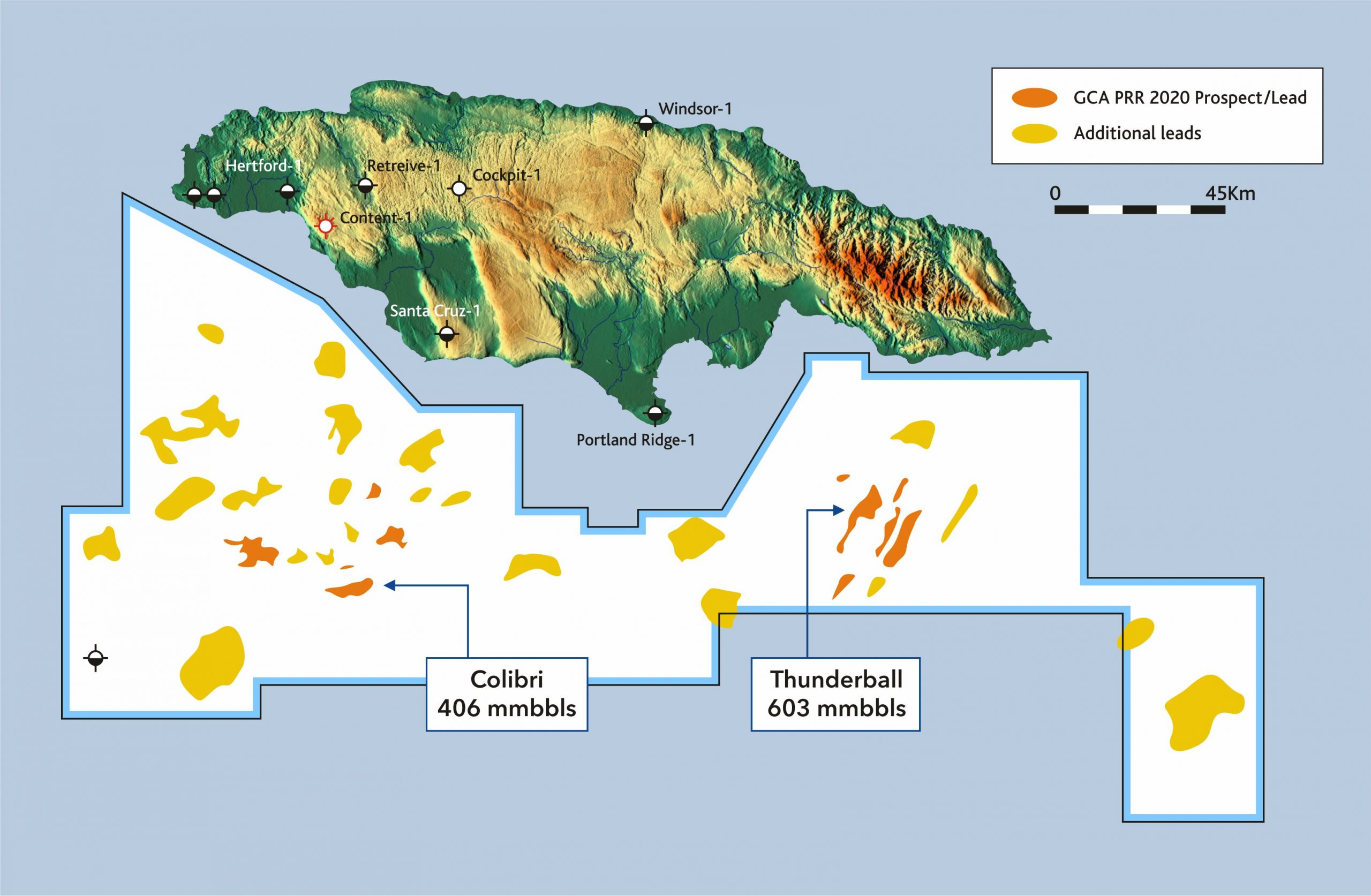
United’s 22,400 sq km offshore Walton-Morant exploration license offshore Jamaica. Typical US offshore leases are only 23.3 sq km. The Jamaican license is thus nearly 1000 times larger than a US offshore lease!
“United has undertaken a geochemical analysis on the 42 piston cores acquired across the Walton-Morant Licence. The analysis has identified C4 and C5 hydrocarbons, including butanes and pentanes, in select piston cores within the headspace gas dataset. United note that these higher order hydrocarbons are not typically associated with biogenic gas systems and are therefore consistent with a potential thermogenic contribution. (This is true.)
There is an established body of evidence for an active petroleum system in Jamaica in general, and on the licence in particular, including repeat satellite slick anomalies, thermogenic hydrocarbon geochemistry from existing onshore and offshore wells, onshore and offshore oil seeps, and onshore surface outcrops. Furthermore, petroleum systems modelling suggests the presence of oil-mature source rocks. The 2026 SGE survey is the first on the licence to be optimally positioned using 3D seismic, multibeam echosounder (MBES) seabed mapping, and satellite-derived slick anomaly data. Taken together, the data are interpreted as consistent with an active petroleum system offshore Jamaica.“
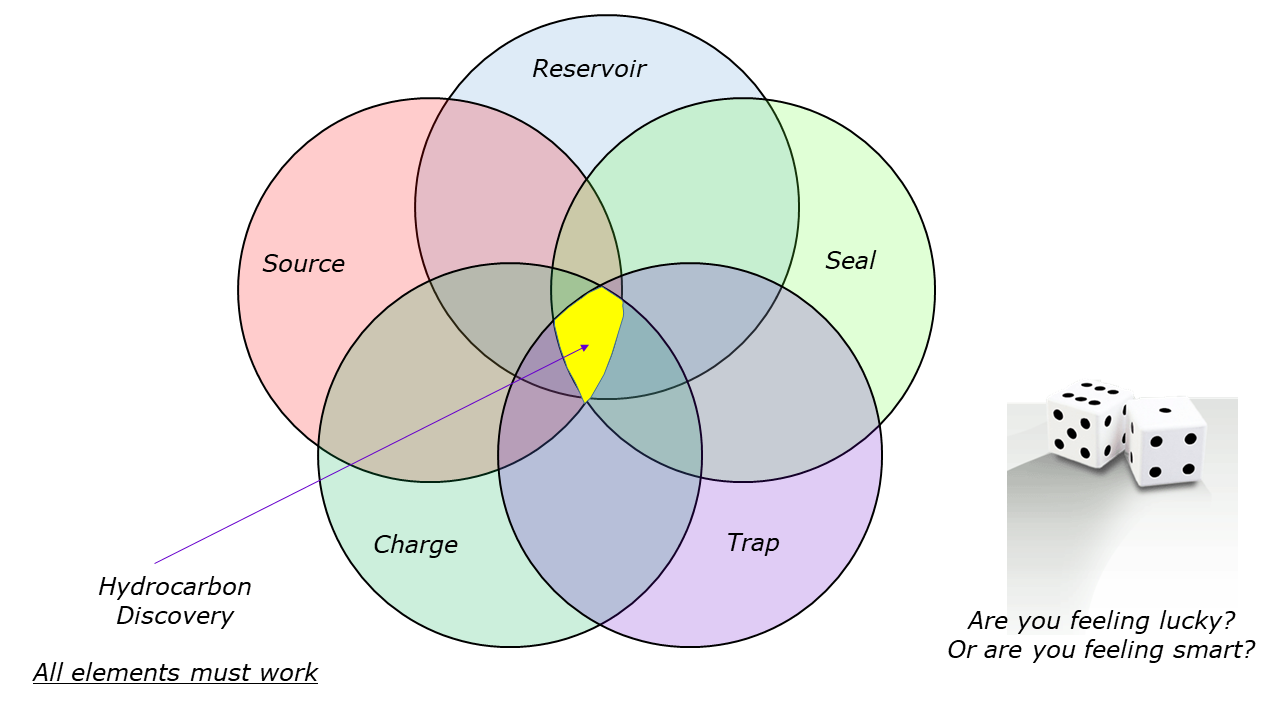
United estimates that the piston coring results boost the Geological Chance of Success (i.e. the source rock, reservoir, trap, and seal—are present and working) for the flagship Colibri prospect from 19% to 32%, which is quite good for frontier exploration.
Will these new data help entice majors to fund exploratory drilling? In the video below (ignore the click-bait title cover 😉), Energy Minister Daryl Vaz does a good job of adding perspective.
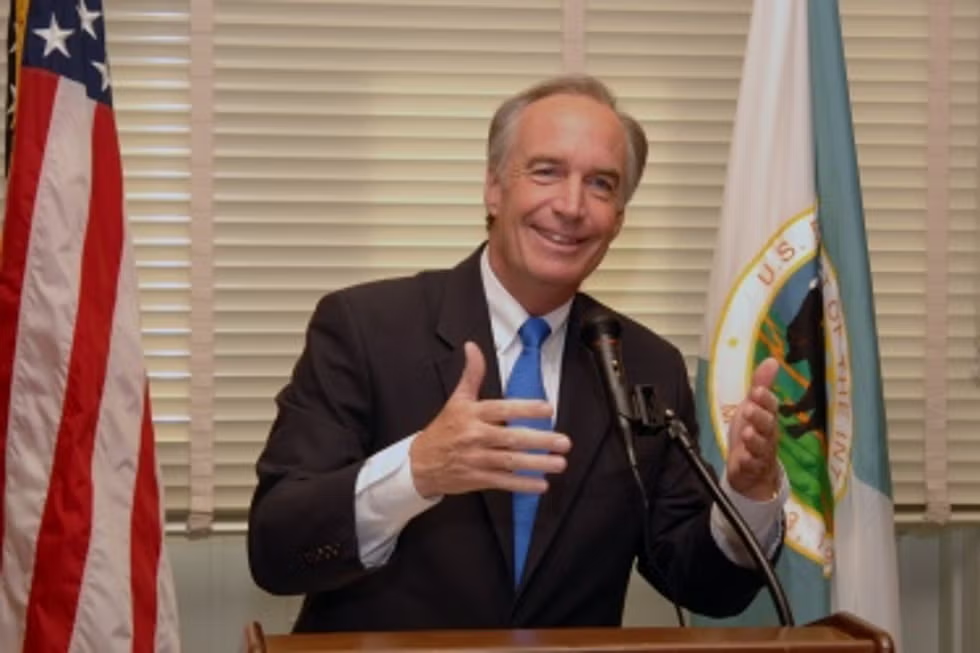
Dirk Kempthorne participating in Lease Sale 206 which garnered a record $3.7 billion in high bids!
I was saddened to learn about the passing of Dirk Kempthorne, Secretary of the Interior from 2006-2009. He was a supporter of responsible offshore oil and gas development, and oversaw six lease sales and the continued growth of the deepwater sector.
One of those lease sales generated a record $3.7 billion in high bids (photo above). Lars Herbst was the Minerals Management Service’s Regional Director at the time.
I had the pleasure of briefing the Secretary on a couple of occasions and found him to be very personable, attentive, and intelligent. My colleagues were similarly impressed.
The Secretary was also known to ride his motorcycle to the Interior building on occasion. He is pictured on his Harley below, but this photo was taken in Idaho, not Washington. 😀
The organizers of the 2007 IRF Offshore Safety Conference were most pleased when Secretary Kempthorne agreed to participate as a keynote speaker. Our many international guests were impressed by his remarks and his interaction with the conference delegates. His conference bio and those of the other speakers are attached.
RIP Mr. Secretary! You served the country well. Enjoy cruising on that big motorcycle in the sky!
A New York Times article suggests that the consolidation of BOEM and BSEE into the Marine Minerals Administration will weaken environmental oversight. It will not. On the contrary, regulation is likely to be strengthened as resources shift from inter-bureau coordination and redundancy management to the primary safety and environmental protection missions.
Given the challenges associated with Federal reorganizations, agency heads often opt for the status quo. I’m pleased that the current DOI leadership team, with whom I disagree on some issues, chose to merge the bureaus.
Quotes from the NYT article followed by my comments:
NYT:The Trump administration is creating a new office that critics say could weaken the environmental oversight of oil drilling and seabed mining in territorial waters.
Comment: The functional overlap and associated uncertainty that permeates the offshore regulatory regime is a weakness, not a strength. Virtually every element of the regulatory program requires coordination between the two bureaus. This includes plan and permit approvals, decommissioning and financial assurance, spill response plans, lease stipulations, assignments, pipeline regulation, environmental reviews, enforcement actions, and geologic data collection and review. Note the list of MOUs that are intended to coordinate BOEM and BSEE redundancy. The documents often do more to confuse than clarify. For example, see the MOU entitled “Environmental and NEPA.”
Multi-bureau organizational complexity is not in the best interest of safety and environmental protection. Overlapping responsibilities, coordination challenges, and “turf” issues distract the technical staff from their important risk management duties, the work they are good at and enjoy doing. BSEE and BOEM should be overseeing the offshore industry, not each other.
NYT:The new agency, the Marine Minerals Administration, will be formed by reunifying two offices that had been split up after the 2010 Deepwater Horizon oil spill in an effort to increase environmental oversight of the energy industry and prevent future oil disasters. After the split, the Interior Department’s oil-leasing activities were separated from environmental regulation and financial management. (emphasis added)
Comment: The assertion that the leasing and environmental regulation were separated is false. The leasing bureau (BOEM) was assigned lead responsibility for the review and approval of the fundamental operational planning documents – Exploration Plans, Development and Production Plans, and Development Operations Coordination Documents. This includes the environmental reviews pursuant to NEPA.
NYT:The move is “worrisome because it has the potential of bringing things back where they were, where there was this inherent conflict of interest between promotion of offshore oil and gas, and oversight safety,” according to Donald Boesch, emeritus professor at the University of Maryland Center for Environmental Science.
“In recent years various bodies have concluded that certain MMS offices and programs have violated ethical rules or guidelines. In the wake of the Deepwater Horizon disaster, some questioned whether ethical lapses played any role in causing the blowout. The Chief Counsel‘s team found no evidence of any such lapses.“
NYT:The new bureau will also take on oversight of the Trump administration’s plans to lease waters in U.S. territories to deep-sea mining companies. The first of these sales, according to the spokeswoman for the Interior Department, are likely to happen next year.
Comment: DOI’s marine minerals program is decades old and is a priority for the current administration. Reorganization should not affect the MMA’s capability to oversee these activities.







My comments on BOEM’s proposed revisions to decommissioning financial assurance requirements
Posted in California, decommissioning, energy policy, Gulf of Mexico, Offshore Energy - General, Regulation, tagged BOEM, comments, decommissioning, financial assurance, predecessor liability, proposed regulation, reserve estimates, safety and compliance on May 6, 2026| 1 Comment »
Attached are my comments on BOEM’s proposed revisions to the decommissioning financial assurance regulations. These comments were submitted to Regulations.gov yesterday (3 days early 😀). Bud
Concluding Remarks
Read Full Post »