The table in the Sale 259 bid rejections post has been corrected below. That table incorrectly reported that subsequent bids for Keathley Canyon Blocks 745 and 789 were rejected at Sale 261. Those bids were in fact accepted. Houston Energy was identified as the submitter rather than Beacon Offshore Energy, the company that, per the bidding data, had the largest ownership share. (See the bidding partnership pasted below.)
The acceptance of those 2 bids significantly increases the net gain to the government as a result of the Sale 259 bid rejections. See the corrections in red to the table:
The active rig count in the GoM in 2001 was 148 (AL-4, LA-119, TX-25), which is >8 times the current Baker Hughes rig count of 18. The 2001 rig count was not a one year blip; the number of rigs active in the GoM exceeded 100 for the ten year period from 1994-2003.
While the current rig count is anemic by comparison, the capabilities of the fleet are anything but. Below is a list derived from drilling contractor status reports of deepwater rigs now operating in the Gulf.
All of these rigs are dynamically positioned and are capable of drilling in 12,000′ of water. They have dual derricks and 15,000 psi rated BOP rams (one has a 20,000 psi stack, and another can be upgraded to 20,000 psi). The annular preventers are rated at 10,000 psi. All have impressive storage and hook load capacities, the latest tubular handling equipment, advanced control systems, and efficient power generation.
Note that most of the rigs fly the flag of the Marshall Islands. This “flag of convenience” registration is preferred for reasons related to taxation and operational freedom. For the record, the fact that the Deepwater Horizon was registered in the Marshall Islands had little to do with the Macondo blowout. The DWH was subject to all Coast Guard and MMS regulations under the OCS Lands Act.
The main cause of the Macondo blowout was the poorly planned and executed well suspension operation. Certain equipment capability, maintenance, and employee training issues were contributing factors. However, with that said, the Marshall Islands report on the blowout candidly acknowledges that “the complexity of and interdependence between the drilling and marine systems and personnel suggests a need for increased communication and coordination between the flag State and coastal State drilling regulators.” Hopefully, that coordination is being achieved and the risks associated with the fragmented regulationof mobile drilling units are being effectively managed.
Contractor
Rig
Operator
Est. end date
Flag
Transocean
Deepwater Titan
Chevron
3/2028
Marshall Islands
Transocean
Deepwater Atlas
Beacon
4/2025
Marshall Islands
Transocean
Deepwater Poseidon
Shell
4/2028
Marshall Islands
Transocean
Deepwater Pontus
Shell
10/2027
Marshall Islands
Transocean
Deepwater Conqueror
Chevron
3/2025
Marshall Islands
Transocean
Deepwater Proteus
Shell
5/2026
Marshall Islands
Transocean
Deepwater Thalassa
Shell
2/2026
Marshall Islands
Transocean
Deepwater Asgard
Hess
4/2024
Marshall Islands
Stena
Evolution
Shell
4/2029
Marshall Islands
Noble
Stanley Lafosse
???
11/2024
Liberia
Noble
Valiant
LLOG
2/2025
Marshall Islands
Noble
Globetrotter I
Shell
5/2024
Liberia
Noble
Globetrotter II
Shell
5/2024
Liberia
Valaris
DS-18
Chevron
8/2025
Marshall Islands
Valaris
DS-16
Oxy
6/2026
Marshall Islands
Diamond Offshore
BlackHawk
Oxy
10/2024
Marshall Islands
Diamond Offshore
BlackHornet
bp
3/2027
Marshall Islands
Diamond Offshore
BlackLion
bp
9/2026
Marshall Islands
Short video about the Stena Evolution, the newest entry to the Gulf of Mexico fleet:
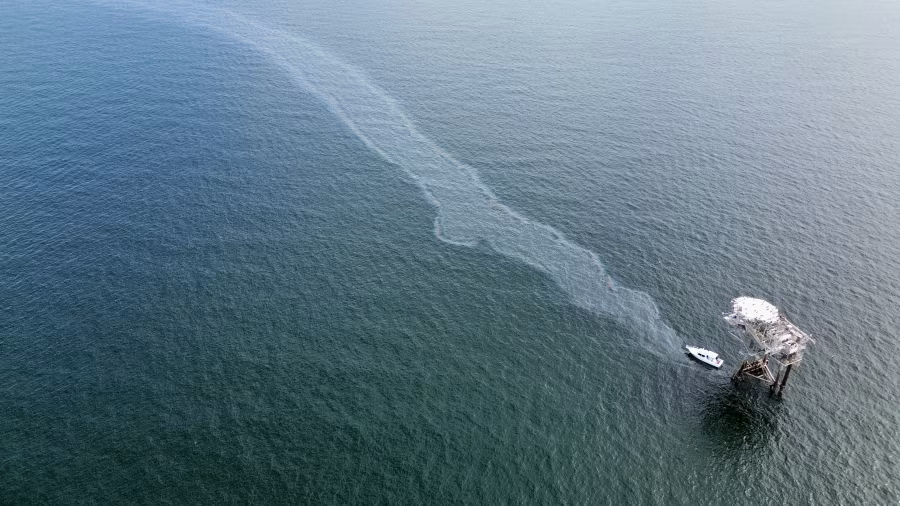
After 5 months of investigation, the Main Pass Oil Gathering (MPOG) system has finally been cleared for production. (The Coast Guard update only says that the pipeline passed the integrity test, but I assume the operators may resume production though the MPOG system.)
So what was the source of the November sheen and what was the basis for the 1.1 million gallon spill volume estimate? The sheen was not indicative of a spill of that magnitude. Did the Coast Guard et al assume a worst case loss from the MPOG system, even though no leak had been identified?
Is this the most oversight ever for a pipeline integrity test?
The removal and replacement of the spool piece and the subsequent integrity test of the MPOG line were conducted under the close supervision of the Unified Command and Pipeline and Hazardous Materials Safety Administration. During both operations, spill response vessels were on site, along with divers, remotely operated vehicles, helicopters equipped with trained oil observers and multi-spectral imaging cameras, and other containment and recovery equipment. No material discharge of oil was observed during these operations.
Houston, TX, March 29, 2024. Beacon Offshore Energy LLC (“Beacon”) announced today the completion of the divestment of its non-operated interests in certain fields in the deepwater Gulf of Mexico in accordance with a previously executed definitive agreement with GOM 1 Holdings Inc., an affiliate of O.G. Oil & Gas Limited. The divestment includes Beacon’s 18.7% interest in the Buckskin producing field, 17% interest in the Leon development, 16.15% interest in the Castile development, 0.5% interest in the Salamanca FPS/lateral infrastructure, and 32.83% interest in the Sicily discovery.
According to BOEM records, GOM 1 HOLDINGS INC, a Delaware company, registered with BOEM effective 3/15/2024. The parent entity, O.G. Oil & Gas Limited, is a privately held E&P company incorporated in 2017 and based in Singapore.
O.G. Oil & Gas Ltd is part of the Ofer Global Group, “a private portfolio of international businesses active in maritime shipping, real estate and hotels, technology, banking, energy and large public investments.”
After a partial takeover by O.G Oil & Gas Limited in 2018, New Zealand Oil and Gas is now 70% owned by the Ofer Global Group. Among other interests, NZ Oil and Gas produces from fields offshore Taranaki, NZ.
Because they are jointly and severally liable for safe operations and decommissioning, minority investors should take a strong interest in safety management and financial assurance. Investors should remember that partners are adversely affected by the mistakes of the operating company. Anadarko and Mitsubishi took a hit following the Macondo blowout. To what extent had they been monitoring bp’s risk and safety management programs for drilling operations?
… and you deniers are fully responsible. There’s a reason why Texas is the most affected state 😉
But fear not, we will line our shores with wind turbines, restrict offshore oil and gas leasing, and subsidize carbon disposal in the Gulf of Mexico. All of this “help” will have a negligible effect on the climate, which will continue to change as it always has and always will.
14 of the high bids at Gulf of Mexico Lease Sale 259 were rejected. Did those tracts receive bids at sale 261? What was the net gain or loss of revenue? See the summary bullets and table below
6 of the 14 tracts received no bids whatsoever
5 of the 14 tracts received higher bids that were accepted.
2 tracts received substantially higher bids that were again rejected
1 tract received a lower bid that was accepted
net bonus revenue gain to the govt from the bid rejections (pending re-offering at future sales): $1,032,877
net bonus revenue gain = 0.27% of the total high bids at sale 261
net loss in future rental and royalty payments: ????
For a net bonus revenue gain to date of only 1/4 of one per cent, 8 of the 14 sale 259 tracts with rejected high bids remain closed to exploration. The timing of any future sales is very much in doubt given the minimalist 5 year leasing plan and the associated legal challenges.
Current bid evaluation practices only make sense if regular lease sales are held on a predictable schedule, as has historically been the case.
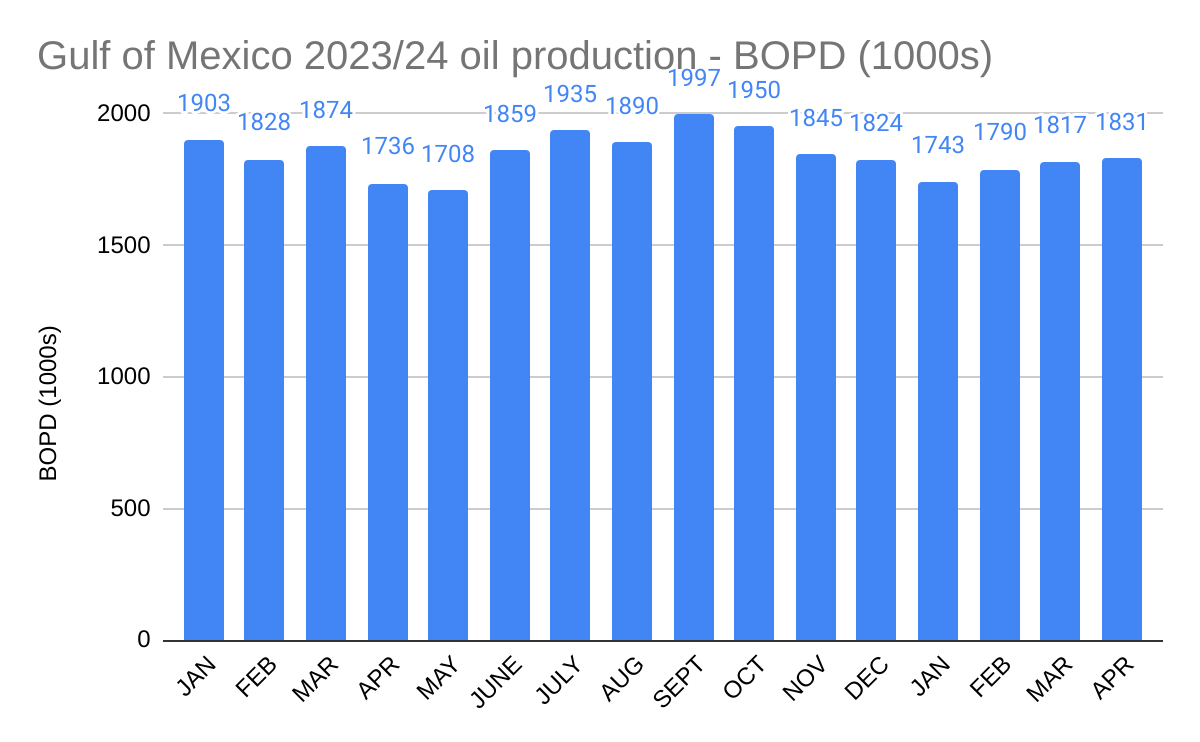
Average GoM oil production from Nov. to Jan. was more than 130,000 BOPD below the July to Oct. average. Production in Jan. 2024 was 245,000 BOPD lower than Sept. 2023 production. (See the table and chart below.)
The production shut-ins associated with the mysterious November sheen in the Main Pass area were no doubt a contributing factor to the decline, but the magnitude and duration of those shut-ins has not been disclosed. The source of the sheen has apparently still not been determined, nor has any information been provided on the status of the Federal investigation. The absence of transparency is disappointing.
Swimming upstream against the Federal policy current, Gulf of Mexico drilling is demonstrating impressive forward progress. Baker Hughes reports 22 active GoM rigs on 3/15/2024, an increase of 3 from the previous week.
Glancing at the charts, this appears to be the highest GoM rig count since Nov. 2019, and is double the recent low of 11 in 2022.
It’s unclear whether Baker Hughes is including the CCS drilling operation offshore Texas. If so, the actual oil and gas rig count is 21 rather than 22.
Baker Hughes also reports 1 active rig offshore California (decommissioning?) and 1 active rig offshore Alaska (Endicott or Northstar?)
Per Baker Hughes, no rigs are currently active offshore Canada.
In 2023, LLOG was the 6th biggest oil producer in the Gulf of Mexico trailing only Shell, bp, Anadarko, Chevron, and Murphy. As a natural gas producer, LLOG ranked fifth ahead of major GoM operators like Chevron and Hess.
Boelte built LLOG into a company with a strong commitment to safety and environmental protection. In that regard, the company achieved BOE Honor Roll status in 2023 and 2022.
A post from last March discussed the high and seemingly unfair royalty and rental rates for new leases in the shallow waters of the Gulf of Mexico shelf. A 50% increase in the shelf royalty rate for lease sales 259 and 261 combined with rather punitive rental rates have likely contributed to the sharp decline in bidding for shelf lease blocks (see table below).
This decline in shelf bidding is unfortunate because the smaller companies that operate in the shallow waters of the Gulf are critical to sustaining the production infrastructure. These companies are also significant producers of environmentally favorable nonassociated (gas-well) natural gas.
lease sale
shelf blocks with bids (excluding CCS bids)
sum of high shelf bids ($million, excluding CCS bids)
BOEM has completed their evaluation of the Sale 261 shelf bids (see below). Each of these blocks received only a single bid, and every bid was accepted. Ironically, the invalid CCS bids for blocks that have no oil and gas value, were the first to be accepted. This was also the case for Sales 257 and 259.
Company
Block
high bid ($) per acre ($)
date accepted
Byron
SM 60
128,750 25.75
2/2
Byron
SM 70
182,235 33.32
2/20
Cantium
GI 35
125,000 25.00
2/20
Cantium
GI 36
125,000 25.00
2/20
Cantium
MP 314
125,000 25.00
3/12
Cantium
SP 63
125,000 25.00
3/12
Arena
EI 231
135,000 27.18
2/20
Arena
EI 277
135,000 27.18
2/20
Arena
EI 281
135,000 27.18
2/20
Arena
EI 340
135,000 27.18
2/20
Arena
EI 343
135,000 27.18
2/20
Arena
WD 119
135,000 26.75
3/12
Focus
V 152
121,152 25.16
2/20
Repsol
36 CCS bids
187,200 (1) 32.50
1/23
(1) All of the Repsol bids were $32.50/ac. Total bids varied by block size, but were $187,200 for the 5760 acre blocks.
Suggestions:
Seek a legislative fix to the Inflation Reduction Act😉 provision that established a 1/6 royalty rate floor for all OCS leases (formerly the royalty rate was 1/8 for leases on the shelf).
In the interim, administratively lower the royalty for shelf leases to 1/6 (from 18 3/4%).
For future oil and gas lease sales, accept all high bids that exceed the specified minimum bid (currently $25/ac for the shelf). The Gulf of Mexico shelf has been extensively explored and developed for 70 years. While prospects remain, they are generally marginal as evidenced by the recent lease sale results. Fair market value is what any company is willing to bid (above the specified minimum).
Focus on assuring that lease purchasers are technically qualified to minimize safety risks, and that financial assurance for decommissioning (for new and existing leases owned by the high bidder) has been fully addressed.