Ikemefuna Okafor, the executive officer of Shebah Exploration & Production Company Ltd (SEPCOL), the vessel owner, said late Sunday “three crew members have been found alive in the community”.
Barron’s
Archive for the ‘accidents’ Category
SEPCOL: 3 crew members found alive, 7 still missing
Posted in accidents, Uncategorized, tagged FPSO fire, Nigeria, SEPCOL on February 7, 2022| Leave a Comment »
Nigerian FPSO fire: the conflicting casualty information is troubling
Posted in accidents, tagged casualties, FPSO fire, Nigeria, NUPRC, Trinity Spirit on February 7, 2022| Leave a Comment »
The incident occurred last Wednesday (2/2), but the only public statement from the operator was the following day:
“At this time there are no reported fatalities but we can confirm that there were 10 crewmen on board the vessel prior to the incident and we are prioritising investigations with respect to their safety and security,” SEPCOL Chief Executive Ikemefuna Okafor said in a statement.
That statement has been contradicted by at least 2 Nigerian press reports:
Meanwhile, three persons have been confirmed dead while eleven others declared missing following the explosion. Sources told reporters in Warri yesterday that three bodies had been recovered while 12 others were yet to be accounted for at the time of filing this report.
This Day
Daily Trust had, however, gathered that three Seafarers working onboard the Floating Production Storage and Offloading (FPSO) facility may have lost their lives in the fire
Daily Trust
The only public statement by the Nigerian regulator (NUPRC) echoed the SEPCOL statement:
“There has been no report of any casualties or fatalities and the Commission will take necessary measures to ensure that all safety and environmental measures in line with global best practices to safeguard lives and the environment are put in place.”
Comments:
- Apparently, the fate of the workers was unknown, and the “no report of any casualties” comments were misleading and inappropriate given the gravity of the situation.
- Neither the operator nor the regulator have provided any update on the number of workers safely recovered or missing, or the status of any ongoing search.
- There is not a single mention of the fire on either the operator or regulator website.
- There seems to be uncertainty about the size of the crew at the time of the incident.
Troubling comment from a ship captain quoted in the Daily Trust article:
It was an accident waiting to happen since 2017. It should not even have been allowed to stay or operate in Nigerian waters.

Update No. 2: Nigerian FPSO fire
Posted in accidents, tagged fatalities, FPSO fire, Nigeria, SEPCOL on February 4, 2022| Leave a Comment »
This Nigerian source is now reporting that there are 3 confirmed deaths, and 11 workers declared missing. No other sources are reporting casualties at this time.
The latest AFP report indicates that the fire has been extinguished.
Update on FPSO fire: Nigerian regulator to investigate; operator’s production license had been revoked
Posted in accidents, tagged FPSO fire, Nigeria, NUPRC, SEPCOL on February 3, 2022| Leave a Comment »
The Nigerian Upstream Petroleum Regulatory Commission (NUPRC) Thursday disclosed that it had commenced an investigation into the circumstances surrounding the explosion of a Floating Production, Storage and Offloading (FPSO) vessel in Warri, Delta State.
This Day, Lagos
- Still no report of any casualties
- Industry source indicated that the FPSO was not producing at the time and had about 50,000 barrels in storage
- No indication that any wells are on fire
- Per Rystad the FPSO has not been producing since 2019 and was being used solely for storage.
- Per Reuters, SEPCOL is the technical operator of the block though the production licence was held by consortium member Express Petroleum. SEPCOL’s production license had reportedly been revoked in 2019 for legacy debts.
- Lots of important technical, operational, and management aspects to this major incident. Hopefully, NUPRC’s report will be publicly available at the conclusion of their investigation.
FPSO fire offshore Nigeria
Posted in accidents, well control incidents, tagged FPSO fire, Nigeria, Shebah E&P on February 3, 2022| Leave a Comment »
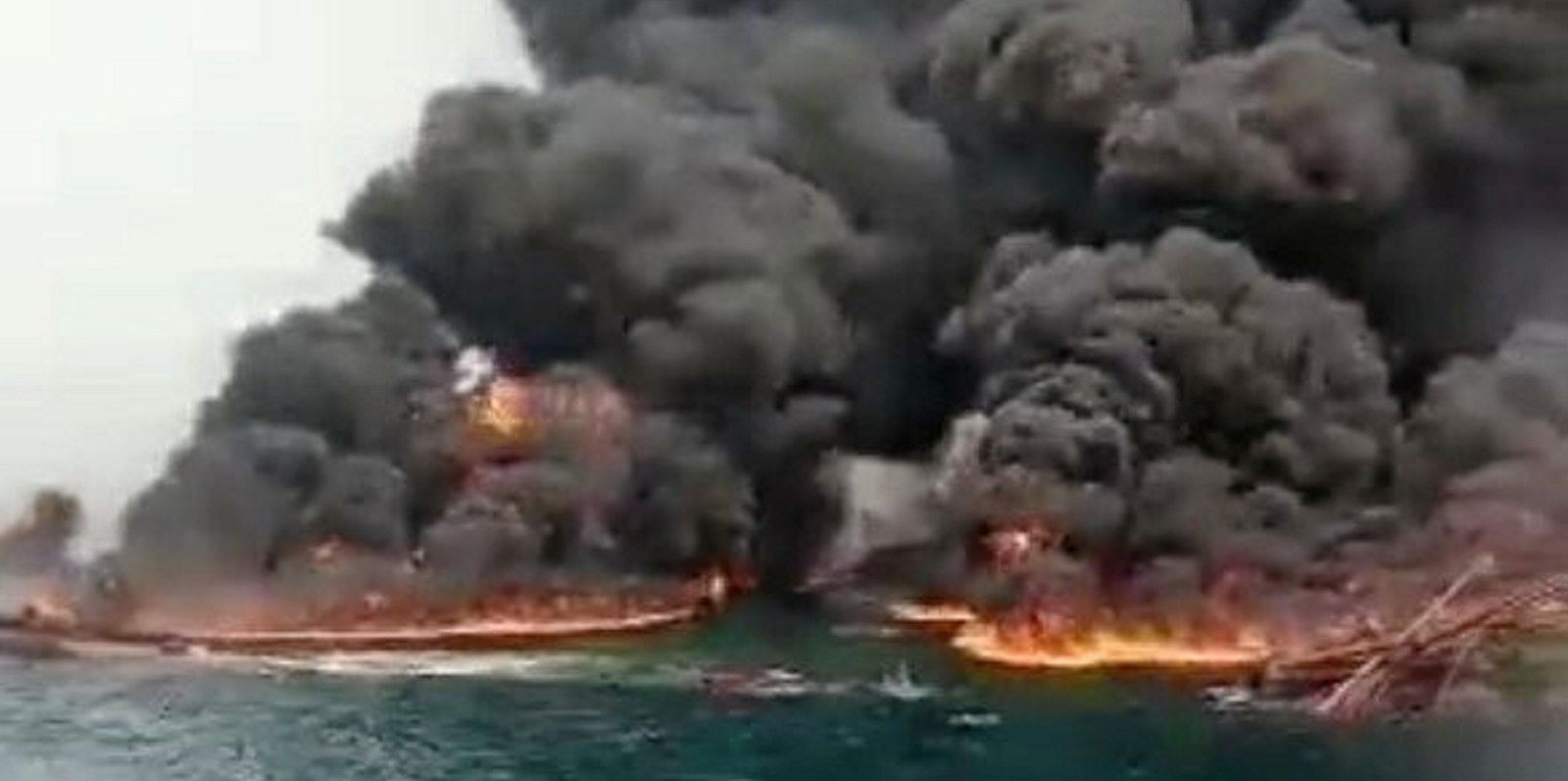
- 10 workers onboard; no fatalities reported at this time
- Bankrupt operator: Shebah Exploration & Production Company Ltd
- Trinity Spirit FPSO moored in only 80′ of water
- 22,000 bopd maximum production
- 2 million bbls max. storage
- Aging vessel: built in 1976; last upgrade in 1997
53 years ago today a reckless well plan scarred the US offshore program and ignited the environmental movement
Posted in accidents, California, well control incidents, tagged Platform A, Santa Barbara blowout, Union Oil Company on January 28, 2022| Leave a Comment »

On January 28, 1969, well A-21, the 5th well to be drilled from Union Oil Company’s “A” platform began flowing uncontrollably through fractures into the Santa Barbara Channel.
The absence of any well casing to protect the permeable, fractured cap rock meant that the operator couldn’t safely shut-in a sudden influx of hydrocarbons into the well bore (i.e. a “kick”). Shutting-in the well at the surface would create well bore fractures through which oil and gas could migrate to shallow strata and the sea floor. The probability of an oil blowout was thus essentially the same as the probability of a kick (>10-2). Compare this with the historical US offshore oil blowout probability (<10-4) and the probability of <10-5 for wells with optimal barrier management.
Here, in brief, is the well A-21 story:
- Well drilled to total depth of 3203′ below the ocean floor (BOF).
- 13 3/8″ casing had been set at 238′ BOF. The well was unprotected from the base of this casing string to total depth.
- Evidence of natural seeps near the site suggested the presence of fracture channels
- The well was drilled through permeable cap rock and a small high pressured gas reservoir before penetrating the target oil sands.
- When the well reached total depth, the crew started pulling drill pipe out of hole to in preparation for well logging.
- The first 5 stands of drill pipe pulled tight; the next 3 pulled free suggesting the swabbing of fluids into the well bore..
- The well started flowing through the drill pipe. The crew attempted to stab an inside preventer into the drill pipe, but the well was blowing too hard. The crew then attempted unsuccessfully to stab the kelly into the drill pipe and halt the flow.
- The crew dropped the drill pipe into the well bore and closed the blind ram to shut-in the well.
- Boils of gas began to appear on the water surface. Oil flowed to the surface through numerous fracture channels. The sketch below by a former colleague depicts the fracturing, which greatly complicated mitigation of the flow.
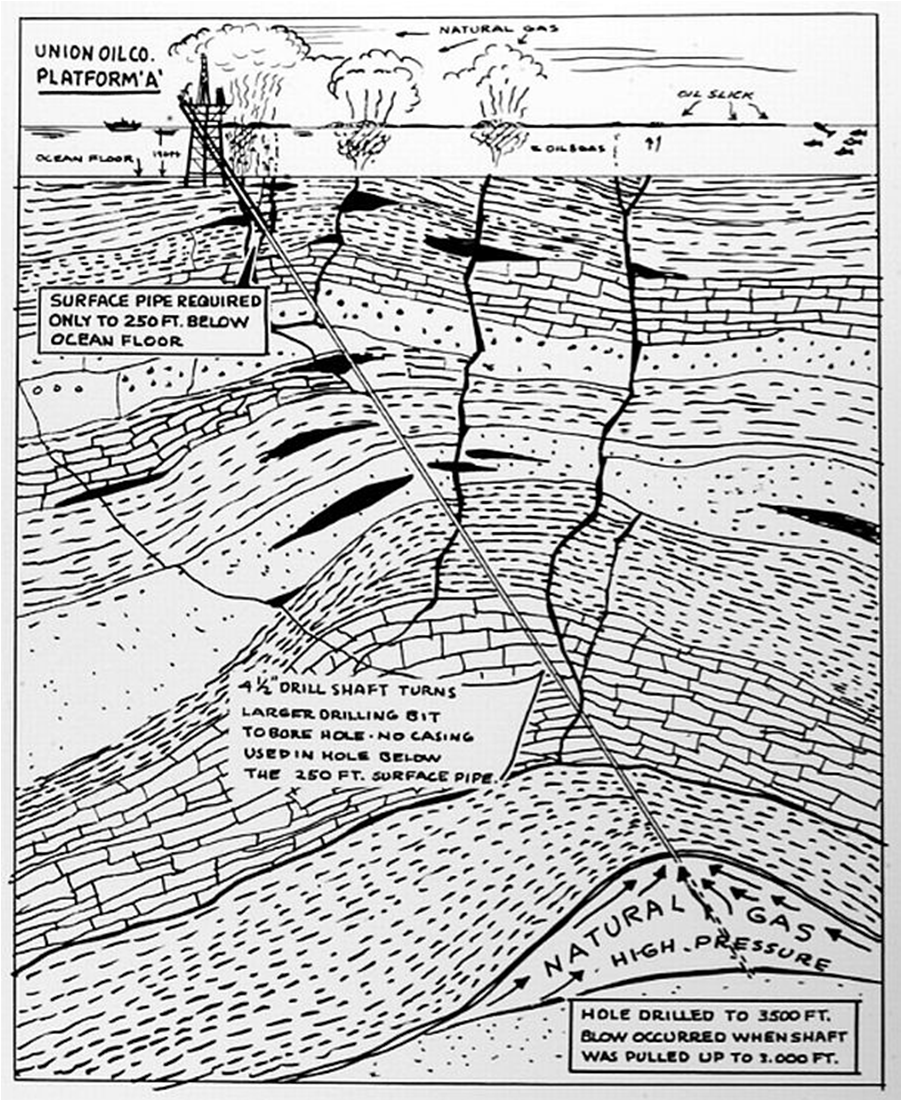
Here is the link to an excellent US Geological Survey report from 1969 that describes the geologic setting, well activities, and remedial measures after the blowout.
We need to continue studying these historically important incidents, not just the technical details but also the human and organizational factors that allowed such safety and environmental disasters to occur. The idea is not to shame, but to remember and better understand.
Gulf of Mexico violations surged in 2021; one company is largely responsible
Posted in accidents, Gulf of Mexico, Offshore Energy - General, Regulation, tagged Chevron, Fieldwood Energy, Hogan and Houchin, INCs, safety leadership, safety violations on January 20, 2022| Leave a Comment »
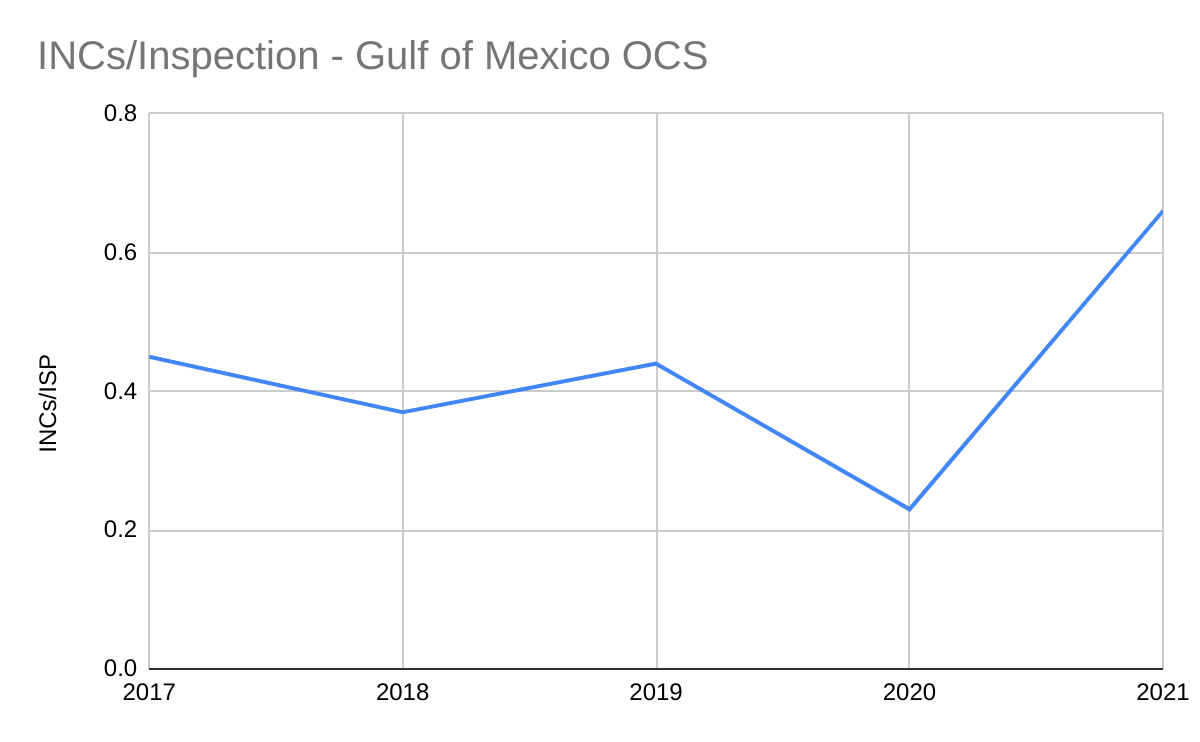
Per BSEE’s Incidents of Non-Compliance (INC) data base, the number of violations surged in 2021, both in terms of the total number of INCs and the INCs/inspection ratio (see chart below). Remarkably, a single company – Fieldwood Energy – was responsible for 845 INCs or 44% of the total number issued. Normalizing for the number of inspections, Fieldwood facilities were cited for 1.46 INCs/inspection versus 0.46 INCs/inspection for all other companies. An unprecedented 61 of Fieldwood’s 2021 INCs called for facility shut-ins, many times more than any other operator. Through the first 17 days of 2022, Fieldwood has already been cited for 21 INCs, 5 of which required facilities to be shut-in.
Fieldwood and its affiliates have experienced multiple bankruptcies and the company has once again been reorganized with the blessing of the courts. Chevron’s comprehensive objection to the reorganization plan asserted that Fieldwood has $9 billion in current and anticipated decommissioning obligations. These enormous decommissioning liabilities and their implications for predecessor lessees (former facility owners) and the Federal government were the main issue in these proceedings, and the bankruptcy plan includes settlements with predecessor companies and the government.
Even more significant than the financial matters and INCs are the following:
- A worker died while repairing a badly corroded Fieldwood facility in May 2020.
- Per BSEE, Fieldwood was the responsible party in 4 of the 13 civil penalty cases settled in FY 2020.
- In January 2021, two Fieldwood employees were indicted for allegedly allowing oil to spill into the Gulf.
While BSEE regulations provide for the removal of operating rights for poor safety performance, companies can reorganize and problem managers can reappear elsewhere. As a result, marginally financed and ineffective operating companies are a major challenge for BSEE as evidenced by the INCs, civil penalties, and investigations. (See the related saga of Platforms Hogan and Houchin in the Pacific Region.)
Poor safety performers drag down the entire industry. The costs of mega-disasters like the Santa Barbara and Macondo blowouts have been widely discussed. However, chronic poor performance and the associated incidents also weaken the industry and damage the integrity of the offshore oil and gas program. These performance issues can’t be left entirely to BSEE and the Coast Guard to resolve. The industry needs to do a better job of self-evaluation, calling out poor performers, and exercising judgement in the assignment of offshore properties.
Important reading for offshore safety leaders
Posted in accidents, California, Gulf of Mexico, Regulation, tagged corrosion, falls, Gulf of Mexico, offshore platforms, Pacific, safety on January 11, 2022| Leave a Comment »
Yesterday, BSEE issued investigation reports for 2 of the fatal 2020 incidents. Both of these incidents involved falls, a chronic and preventable cause of offshore worker casualties. Not enough industry and trade association attention is given to such incidents, which have been trivialized in the past by categorizing them as “slips, trips, and falls.” The reports are linked below:
- Fatality at DCOR’s Platform Gilda, Pacific Region: While repairing a section of the galley floor, the victim stepped into the unbarricaded work area and fell 80 feet into the Pacific. .
- Fatality at Fieldwood’s Ewing Bank 826 A Platform, Gulf of Mexico: While the crew was replacing badly corroded grating on the platform. the victim fell through a section landing 50 feet below on the +10 deck.
The reports describe how the incidents occurred and what we can do better to prevent similar events in the future. Despite the advance in safety management programs over the past 30 years, there has been no discernible improvement in preventing these incidents. We need to rethink training programs, planning, and methods. Deadly falls are not inevitable.
Decisions, investigations, reports, and trends that BOE will be tracking in 2022
Posted in accidents, decommissioning, energy policy, hurricanes, Offshore Energy - General, tagged 2020 offshore fatalities, Beta Unit pipeline, Globetrotter II, Hogan and Houchin, Huntington Beach, Khamsin, Lease Sale 257, offshore production, Russell Peterson on January 10, 2022| Leave a Comment »
- DC Federal Court decision on Gulf of Mexico Oil and Gas Lease Sale 257: Will the Court uphold the 11/17/2022 sale? If the Court upholds the sale, will BOEM accept the carbon sequestration bids without having announced that tracts would be offered for those purposes, and without advising about lease terms and bid analysis procedures?
- Investigation reports for the 6 fatal US offshore incidents in 2020: When will these overdue reports be issued? Also, we know that there were at least two 2021 fatalities? When will those reports be issued?
- Platforms Hogan and Houchin, Santa Barbara Channel: When will we learn more about the Inspector General’s findings regarding the improper use of decommissioning funds? Why was the lessee, Signal Hill, allowed to withdraw funds from those accounts for purposes unrelated to decommissioning? How does this affect the liability of predecessor lessees?
- Investigation of the Huntington Beach pipeline spill: When will the the joint investigation team report be issued? To what extent can the pipeline operator be held liable for a leak caused by anchor dragging, particularly given the leak detection limitations for low pressure pipelines?
- Globetrotter 2 incident during Hurricane Ida: When will the Coast Guard issue their report on the delayed relocation of the Noble Globetrotter 2 drillship during Hurricane Ida? In light of this incident, the fatality on the Pacific Khamsin prior to Tropical Storm Laura (2020), and similar incidents, further attention to the timely relocation of dynamically positioned drillships would seem to be in order.
- US offshore drilling and production trends: With several deepwater fields scheduled to begin producing in 2022, will GoM oil production meet or exceed the August 2019 peak of 2.044 million BOPD, at least temporarily? Will exploratory drilling activity increase to levels needed for reserve replacement? Will the prolonged decline in US offshore gas production be reversed?
- Russell Peterson liftboat tragedy (2008): Will the Coast Guard ever explain why their investigation report in unavailable?
6 US offshore workers died in 2020; when will we find out what happened and why?
Posted in accidents, California, Gulf of Mexico, Offshore Energy - General, tagged bp, BSEE, DCOR, EnVen, Fieldwood, national academies, offshore fatalities, safety culture, Talos, Total on January 6, 2022| Leave a Comment »
Last month (12/2021), BSEE finally posted the 2020 incident statistics. Unfortunately, no details or incident summaries are provided for the 6 fatalities. The fatalities are simply classified as “occupational” (4) or “non-occupational” (2). As a result, we still know very little about these fatal incidents 13 – 24 months after they occurred.
The BSEE spreadsheet advises that 3 of the 4 “non-occupational” fatalities are being investigated, but the reports are still “pending.” Why the long delay? The National Commission, BOEMRE-CG, and NAE investigations of the Macondo tragedy were completed (and reports published) in less time.
No explanation is provided as to why the 4th occupational fatality is not being investigated.
Also, investigations of the preparedness and response aspects of the 2 non-occupational fatalities would have been beneficial. What was the cause of death? What medical screening procedures were in place? What treatment capabilities were available at the facility? How much time was required to transport the workers to hospitals? These are important considerations for the offshore community.
Below is a summary of the publicly available information for the 6 fatalities:
- 1/14/2020: A worker died on a Diamond drillship on a lease (Mississippi Canyon 822) operated by BP. According to BSEE this was a non-occupational fatality. Per the listing of investigations, no investigation was conducted.
- 5/16/2020: A worker died on a Fieldwood platform (Ewing Bank 826 A). Per BSEE, this was an occupational fatality and the investigation is still pending. There were no media reports or company announcements.
- 6/2/2020: A worker died on the Valaris DS-18 drillship working for EnVen Energy at Green Canyon 767. Per BSEE, this was a non-occupational fatality and no investigation was conducted.
- 6/20/2020: A worker died on at the Green Canyon 18 A platform operated by Talos. Per BSEE, this was an occupational fatality but no investigation is indicated for this incident. No media reports or company announcements could be found.
- 8/23/2020: A worker died on the Pacific Khamsin drillship working for Total at Garden Banks 1003. A month later, at an Investors’ Day presentation, Total announced that the incident occurred while the crew was preparing to move the rig to avoid Tropical Storm Laura. Total’s statement included this defensive statement: “This is a routine operation that was executed with no time pressure as the rig disconnection had been decided well in advance.” Per Total, the findings of their investigation were shared with the regulators in Sept. 2020, but BSEE advises that their investigation is still pending.
- 12/2/2020: A worker died on DCOR’s Platform Gilda in the Santa Barbara Channel offshore California. The BSEE investigations update provides no information on the status of the investigation. Per local media, 3 men fell from the platform and others jumped into the water to assist. No information is provided on the reason why the 3 men fell.
The number of US OCS fatalities remains unacceptably high, and timely data sharing and investigations are needed to better assess causes and trends. In that regard, this recommendation from the 2016 National Academies report entitled “Strengthening the Safety Culture of the Offshore Oil and Gas Industry” merits further industry/government attention and action:
Recommendation 4.2.2: Because accident, incident, and inspection data all are needed to identify and understand safety risks and corrective actions, the committee recommends full transparency such that regulators make all these data readily available to the public in a timely way, taking into consideration applicable confidentiality requirements.
 Bud's Offshore Energy (BOE)