Posts Tagged ‘oil production’
Updated OPEC+ production table as a result of today’s 2 million bopd reduction
Posted in energy policy, tagged decrease, oil production, OPEC+ on October 5, 2022| Leave a Comment »
EIA short term production forecast for the Gulf of Mexico looks about right
Posted in energy policy, Gulf of Mexico, Offshore Energy - General, tagged EIA short term forecast, gas production, Gulf of Mexico, longer term concerns, oil production on June 23, 2022| Leave a Comment »
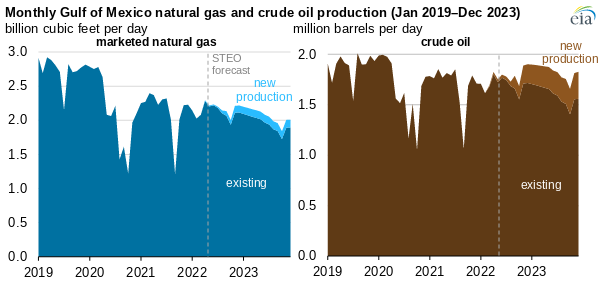
The EIA forecast looks about right. Production from new projects should offset existing field declines and maintain relatively stable volumes over the next 2-3 years. In the intermediate and longer terms we have problems given the dearth of exploratory drilling and new discoveries, and the complete absence of leasing.
A supply chain we should be worried about
Posted in energy policy, Gulf of Mexico, Offshore Energy - General, tagged leasing, offshore energy, oil production, supply chain on June 7, 2022| Leave a Comment »
active leases ➡ producible leases ➡ energy production
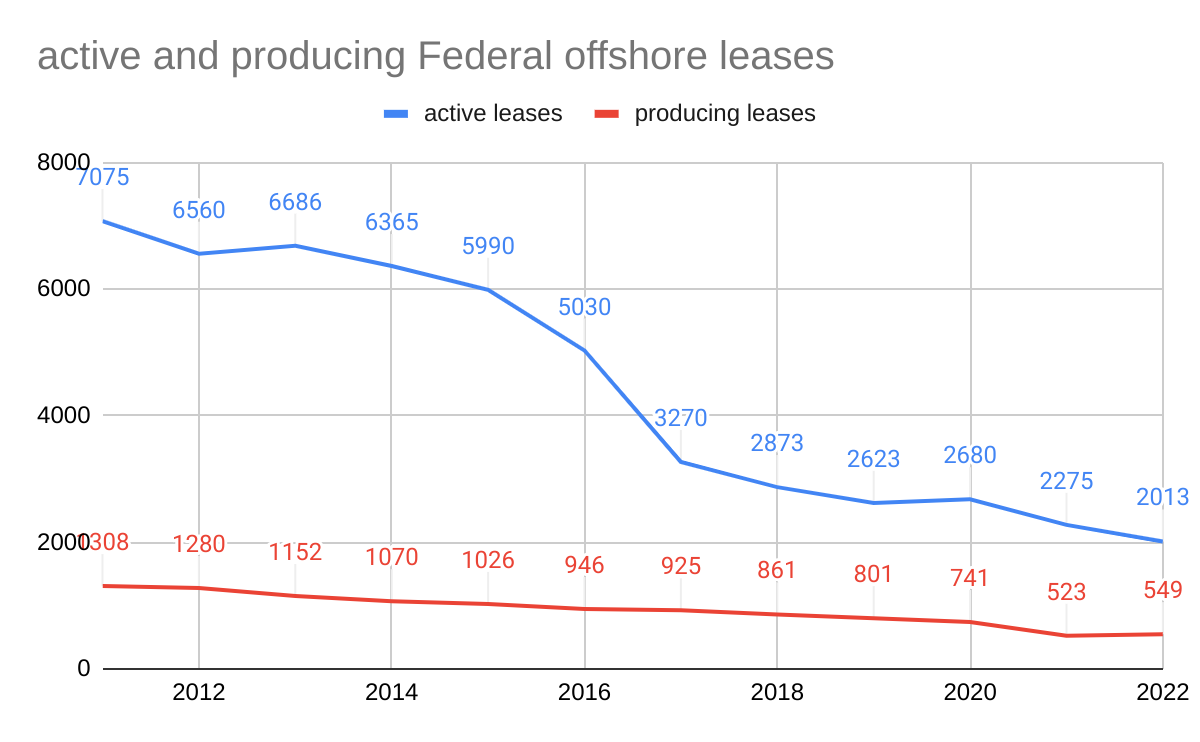
The future of US offshore energy production is in jeopardy. As is clear in the first chart below, the problem is the precipitous decline in opportunities (l.e. leases), not the will to produce. At 27.3% (6/2022 data), the % of active leases that are producing is near the historic high of 30%. The spin doctors really need to drop the old and tired nonproducing leases excuse.
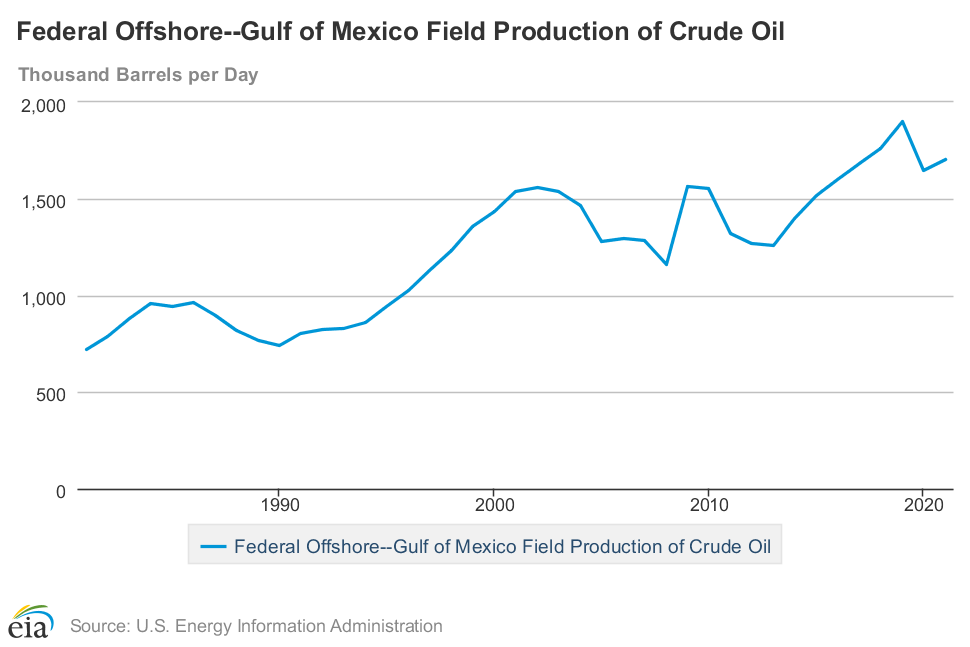
While not nearly as high as it could be with better lease management, offshore production has held up relatively well thanks to deepwater discoveries that were made years ago and technical innovation that makes projects more cost-effective, safer, and cleaner. Gulf of Mexico production should be relatively stable for several years as production from these projects offsets declines elsewhere. However, in the intermediate and longer term, reserve depletion and the absence of new exploration opportunities ensure a downward production trend.
Gulf of Mexico production is still meh
Posted in Gulf of Mexico, Offshore Energy - General, tagged deepwater production, floating production units, Gulf of Mexico, oil production on May 31, 2022| Leave a Comment »
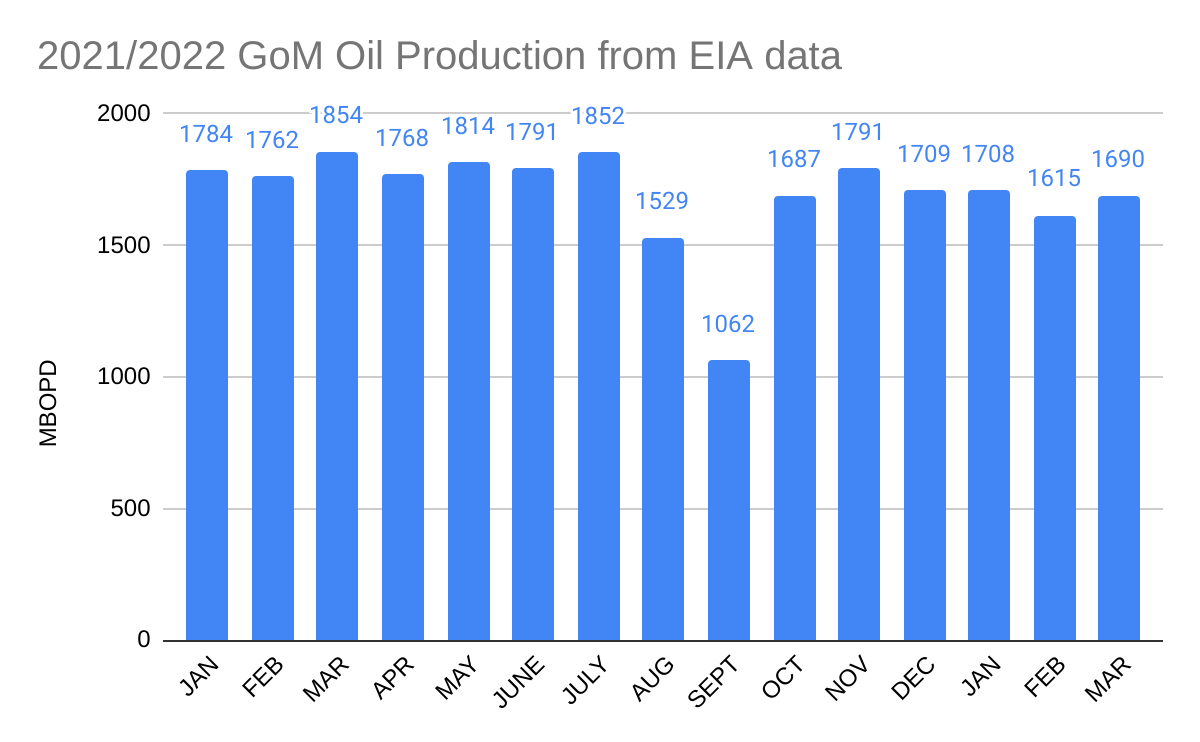
Waiting for a boost from the deepwater startups. The first of that group, King’s Quay did not begin producing until April.
Gulf of Mexico scoreboard
Posted in drilling, Gulf of Mexico, Offshore Energy - General, tagged AnadarkoOxy, Arena, bp, Cantium, Chevron, exploration, Exxon, Gulf of Mexico, Hess, INCs, LLOG, Murphy, natural gas production, oil production, Shell, violations, well starts on May 10, 2022| Leave a Comment »
- Operating companies that produced >1 million bbls of oil or >1 BCF of gas in 2021 are listed in descending order based on oil production.
- Both the total number of well starts and the number of exploratory wells are indicated
- An INC is an Incident of Noncompliance (i.e. a violation). W=warning, CSI=component shut-in, and FSI=facility shut-in are the enforcement actions.
- All of the below data are publicly available on the BSEE-BOEM websites.
| 2021 oil (MMbbls) | 2021 gas (BCF) | 2021/22 well starts total-expl | 2021/22 INCs W-CSI-FSI | |
| Shell | 149.8 | 190.8 | 28-12 | 11-14-4 |
| bp | 114.0 | 82.7 | 5-2 | 6-3-4 |
| Chevron | 83.7 | 42.2 | 8-8 | 1-1-3 |
| Anadarko (Oxy) | 67.7 | 57.8 | 8-6 | 8-5-1 |
| Hess | 27.5 | 61.7 | 2-2 | 7-4-0 |
| Murphy | 25.1 | 50.0 | 7-7 | 4-8-1 |
| LLOG | 20.4 | 29.0 | 3-0 | 1-1-1 |
| Talos | 17.7 | 23.0 | 5-0 | 25-26-14 |
| BHP | 14.5 | 5.9 | 3-2 | 2-3-0 |
| Exxon | 13.2 | 2.3 | – | 1-1-1 |
| Beacon | 10.5 | 15.7 | 1-0 | 0-0-0 |
| Fieldwood | 10.4 | 24.7 | – | 685-235-91 |
| EnVen | 9.6 | 12.6 | 6-0 | 2-6-3 |
| Kosmos | 9.4 | 8.4 | 1-1 | 1-0-0 |
| Arena | 8.6 | 27.9 | 32-0 | 68-45-19 |
| Walter | 8.1 | 36.2 | 2-2 | 3-1-2 |
| Cox | 6.2 | 30.3 | – | 237-169-3 |
| Eni | 4.7 | 13.6 | 2-0 | 8-0-2 |
| W&T | 5.0 | 27.2 | 1-0 | 65-40-7 |
| Cantium | 4.5 | 5.5 | 18-0 | 23-15-2 |
| QuarterNorth | 4.2 | 8.3 | – | no data |
| GoM Shelf | 2.3 | 4.8 | – | 52-5-2 |
| ANKOR | 1.4 | 2.5 | – | 0-0-1 |
| Byron | 1.0 | 4.4 | – | 5-8-2 |
| Renaissance | 0.7 | 1.6 | – | 20-9-3 |
| Sanare | 0.3 | 4.5 | – | 38-20-3 |
| Helis | 0.2 | 1.2 | – | 1-0-2 |
| Contango | 0.03 | 5.0 | – | 4-0-0 |
| Samchully | 0.02 | 1.2 | – | no data |
Comments:
- “Energy transition” companies Shell and bp still love the Gulf of Mexico, which is a good thing for them and us. Together they accounted for 42.4% of the 2021 oil production.
- The top 4 producers, Shell, bp, Chevron (includes Unocal), and Anadarko accounted for 2/3 of GoM oil production, nearly all of which was from deepwater leases.
- Those are impressive production numbers for Anadarko (Oxy). No wonder Warren Buffett likes Oxy stock.
- The relative number of deepwater exploratory wells is mildly encouraging given our concerns about sustaining production.
- Exploratory well determinations are rather subjective and may not be entirely consistent.
- Understandably, no exploratory wells were drilled by Arena or Cantium, the companies responsible for most well operations on shelf (shallow water) leases.
- Overall, the INC numbers are impressively low for the deepwater operators, with Chevron and LLOG standing out. BSEE does not post the specific violation information (more on this in an upcoming post), so it’s difficult to properly assess a company’s compliance record.
- Unfortunately, incident data could not be included on the scoreboard. BSEE’s incident tables are badly out of date, and no 2021/2022 summaries have been posted.
- Fieldwood’s disturbing INC numbers were discussed earlier this year. High INC rates for 3 other operators have also were noted last month.
- Exxon production is limited to the Hoover Diana spar, which was installed 22 years ago. The largest US oil company has only drilled one GoM exploratory well (2018) in the past 5 years. Currently, their main GoM interest seems to be the sequestration (disposal) of onshore emissions. (More on this topic in an upcoming post.)
January GoM oil production held steady at ~1.7 million BOPD
Posted in Gulf of Mexico, Offshore Energy - General, tagged EIA, Gulf of Mexico, oil production on April 1, 2022| Leave a Comment »
Even after full recovery from Hurricane Ida, Gulf of Mexico production remained well below the August 2019 monthly peak of 2.044 million BOPD. Production should trend upward in the near term as the Vito, Anchor, Argos, King’s Quay, and Whale floating production units come online. However, to sustain production near or above 2 million BOPD, exploration activity needs to be stimulated. This will be difficult given the suspension of leasing, and the continuous legal and administrative challenges.
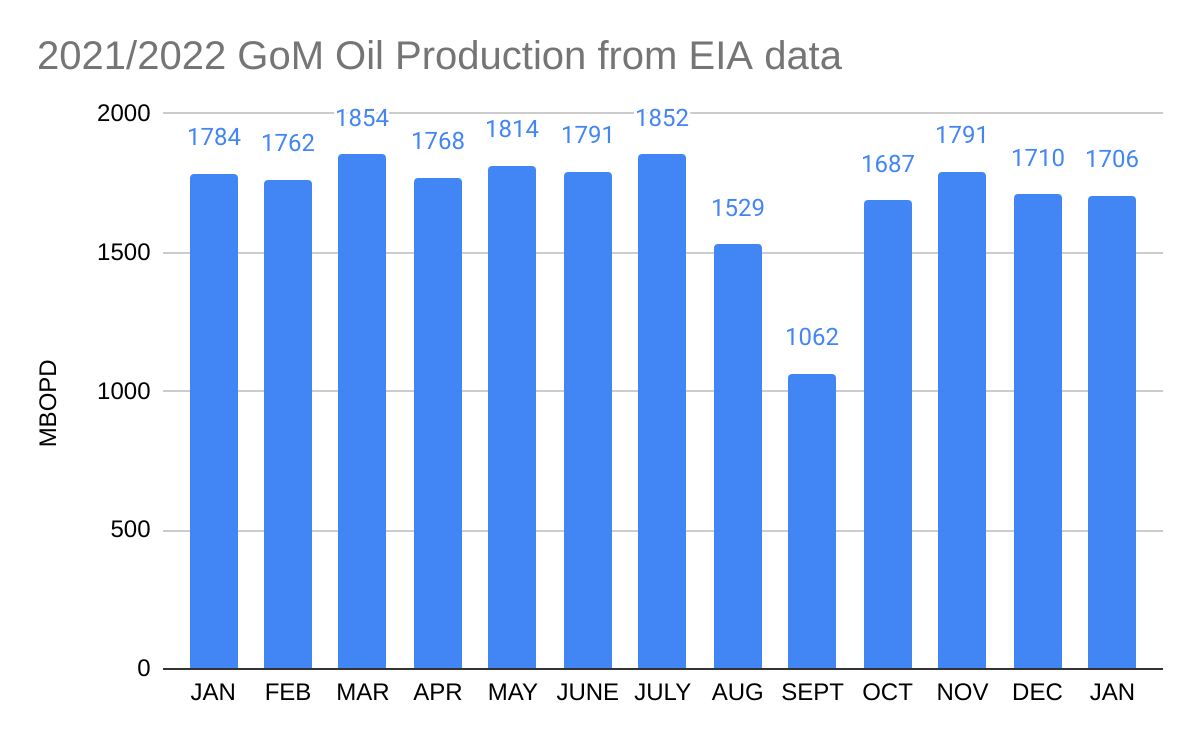
Meanwhile the April 1 rig count held steady at 14.

Is this the same IEA that said more oil and gas exploration was unnecessary?
Posted in energy policy, tagged IEA, net zero, oil production, OPEC on February 16, 2022| Leave a Comment »
February 2022:
For a second time this week, Fatih Birol, the executive director of the International Energy Agency (IEA), called on the OPEC+ group on Wednesday to narrow the widening gap between its production quotas and the much lower actual supply to the market.
OilPrice.com
May 2021:
There is no need for investment in new fossil fuel supply in our net zero pathway
IEA Roadmap for the Global Energy Sector
So much for what remains of the IEA’s credibility.
It’s a good thing most US shale production is on private land
Posted in energy policy, natural gas, Offshore Energy - General, tagged EIA', natural gas production, oil production, US OCS vs. PA, US OCS vs. TX on February 11, 2022| Leave a Comment »
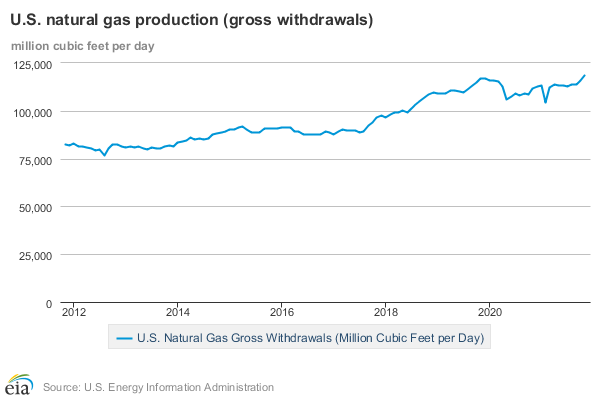
- My home State (Commonwealth) of Pennsylvania is producing nearly 10 times as much natural gas as the US OCS (Federal offshore). Who would have dreamed this was possible 20 years ago? Among the states, PA is second to Texas in gas production.
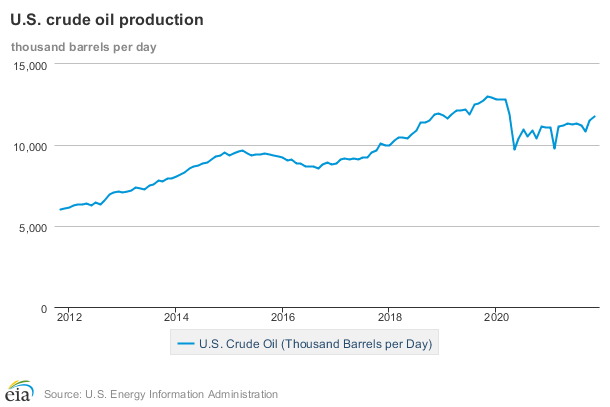
- Oil production in Texas is now nearly 3 times as high as on the OCS. In 2010, US offshore production was substantially higher (567 million barrels vs. 427 million barrels).
- Thanks largely to Texas, North Dakota, and New Mexico, US oil production is rebounding.
- Thanks to TX, PA, LA, AK, WV, OK, NM, and OH, US gas production has also strengthened.
EIA production data through 11/20/2021:
November GoM production was close to the predicted 1.8 million BOPD
Posted in Gulf of Mexico, Offshore Energy - General, tagged Gulf of Mexico, November 2021, oil production on February 1, 2022| Leave a Comment »
Our last GoM update predicted November oil production of 1.8 million BOPD. The EIA figure released yesterday came in slightly less than that at 1.795 million BOPD.
Will 2022 startups push oil production back up to the 2.044 record achieved in August 2019? Possibly, but the longer term outlook is not compelling given reduced drilling activity and the dearth of recent discoveries. The long leasing pause will further compromise exploration by limiting opportunities to test new geologic interpretations and assess promising prospects.

GoM production for September reflects Ida shut-ins
Posted in Gulf of Mexico, hurricanes, Offshore Energy - General, tagged EIA, Gulf of Mexico, Hurricane Ida, oil production on November 30, 2021| Leave a Comment »

More than half of GoM oil production was shut-in for 13 days in September and several hundred thousand BOPD were shut-in for the rest of the month. The result was a 42% reduction in production from pre-Ida (July) levels.
All production has now been restored so the December EIA figures should give us a good read on stablized post-Ida production.

