Prior to the installation of these platforms, the last deepwater platform addition was Shell’s Appomattox in 2018. That gap in deepwater platform installations was the longest since Bullwinkle was installed in 1988.
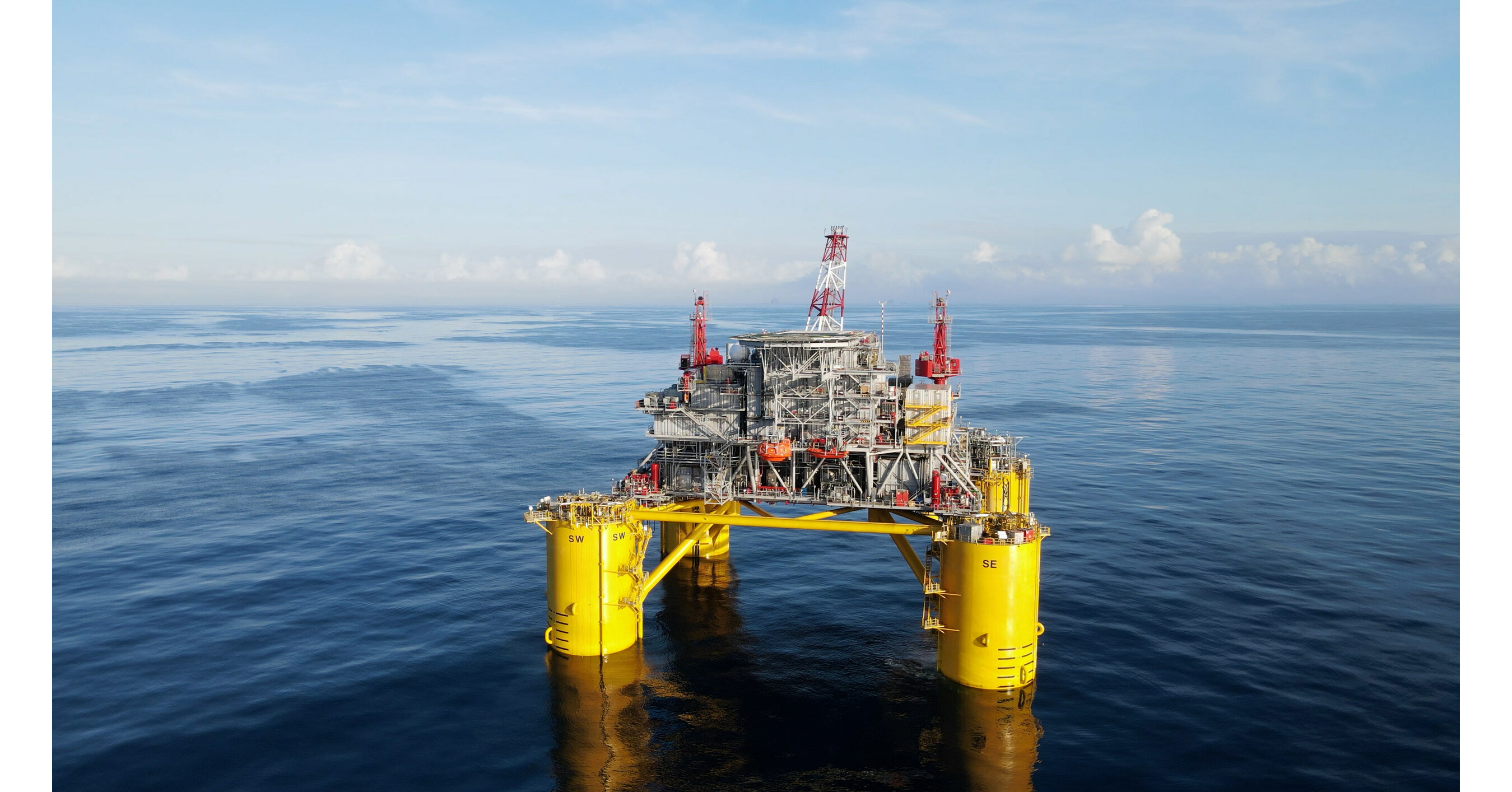
The 5 new structures will increase the deepwater platform count by 9% from 56 to 61, and in the next few years should account for approximately 1/4 of GoM oil production.
This picture was posted by MaritmePhoto. The”Blue Marlin” heavy lift vessel is arriving in Texas (2005) with the massive semisubmersible production platform “Thunder Horse” on board.
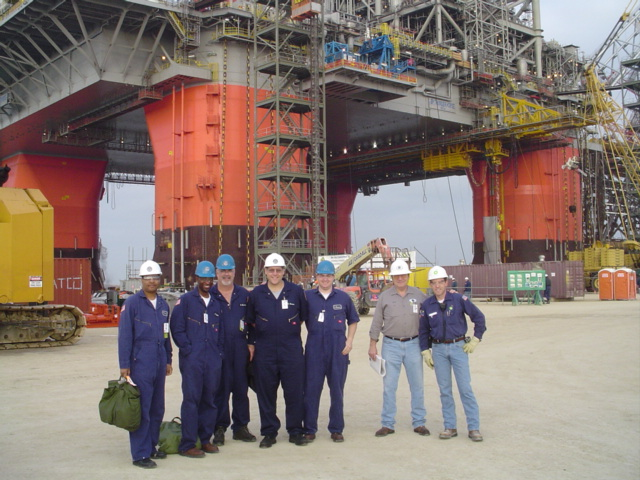
Above (from BOE archives): Pre-commissioning inspection of Thunder Horse
Thunder Horse has a most interesting history. The project was initially named Crazy Horse, but the name was changed out of respect for concerns raised by the Lakota nation. The massive structure is 136 m in length and 113 m in width, and is located in 6300′ of water in the Mississippi Canyon area of the Gulf of Mexico.
Many of you no doubt remember the near disaster during Hurricane Dennis (2005) when the platform was being commissioned. In light of the extensive pre-production hype for the “world’s largest production platform,” this was a costly and embarrassing incident for BP and the OCS program.
Findings indicate that failures associated with the hydraulic control system and its isolation on evacuation led to the partial opening of multiple hydraulically actuated valves in the ballast and bilge systems of the vessel. This allowed ballast water migration to take place, causing the initial listing (to approximately 16 degrees) of the vessel shortly after the hydraulic system was isolated.
The findings also indicate that ballast water migrated into manned spaces in the lower hull, via faulty and improperly installed check valves in the integrated ballast/bilge piping system. As the degree of list increased beyond the 16 degree mark, downflooding of seawater occurred, initially through overboard discharge lines and/or vents, and possibly later through the deck box as it entered the water. Since the PDQ was already listing at a 16 degree angle prior to the passage of Hurricane Dennis, wave action associated with the passage of the hurricane may also have contributed to the downflooding of seawater.
Although not an initiating event, failed Multiple Cable Transits (MCTs) and two unintended openings in the bulkheads allowed water transfer between watertight compartments, which led to extensive flooding and water damage in the lower hull.
Fortunately, there were no injuries. Repairs were made and production was finally initiated in June 2008.
Deepwater (>1000′) activity continues to dominate, accounting for 61% of the well starts.
Not a single company drilled both shelf and deepwater wells.
While shelf facilities currently account for only about 7% of GoM oil production, 1122 of the 1179 remaining platforms are on the shelf and they account for 24% of GoM gas production, most of which is environmentally favorable nonassociated gas.
Two companies, Arena and Cantium, accounted for 75% of the shelf well starts. Excluding the CCS bids, Arena and Cantium were the most active shelf bidders in Sale 279. Arena bid alone on 7 blocks. Cantium was the high bidder on 5 blocks. (Focus Exploration was high bidder on 4 shelf blocks and was “outbid” by Exxon for High Island 177.)
One company, Shell, accounted for 39% of the deepwater well starts
One of BP’s exploratory wells (drilled subsequent to Sale 257) was in Green Canyon 821, immediately south of GC 777, the block that BP/Talos bid $1.8 million for in Sale 257. That bid was rejected by BOEM. In sale 259, BP was the sole bidder for GC 777, and their bid was only $583,000, less than 1/3 of their Sale 257 bid. Perhaps the GC 821 exploratory well reduced the value of GC 777? Will this lower bid now be accepted?
DW expl
DW dev
shelf expl
shelf dev
Anadarko
5
1
Arena
22
BOE
1
4
BP
2
3
Byron
2
Cantium
20
Chevron
3
Contango
2
Cox
2
Eni
2
5
EnVen
5
Greyhound
2
Hess
2
Kosmos
1
LLOG
3
1
Murphy
4
QuarterNorth
2
Shell
25
9
Talos
2
8
Walter
1
Woodside
3
1
Gulf of Mexico well starts during 2022 and the first quarter of 2023
Green Canyon 79 received a bid of $3.6 million at Sale 257, but no lease was ever issued. No explanation was provided and there were no bids for this block at Sale 259.
There was actually a second bidder, Focus Exploration, for one of the 69 “CCS blocks,” that Exxon seeks to acquire (see below). Exxon’s bid was higher. Does this mean that Focus, a company that is presumably interested in exploring for oil and gas, will lose the block to a company that bid on the block for purposes not authorized in the Notice of Sale?
Exxon doubled down on their strategic CCS bidding; their only bids (69 in total) again appeared to be solely for carbon sequestration purposes. As previously noted, acquiring tracts for CCS purposes is not authorized in an oil and gas sale. Arguably, these bids should be rejected.
The other super-majors, BP, Chevron, and Shell, were active participants as were many independents.
It was good to see BOEM Director Liz Klein announcing bids. This shows respect for the OCS oil and gas program.
“I am of a firm view that the world will need oil and gas for a long time to come,” (Shell Chief Executive) Sawan, who started the job on Jan. 1, told Times Radio in the U.K. on Friday. “As such, cutting oil and gas production is not healthy.”
Back in 2021, Shell predicted that its own oil production would decline every year and drop by as much as 18% by 2030. BP had a similar outlook, but CEO Bernard Looney rolled back its climate targets this year and said it will increase investment in exploration and production.
BP and Shell have trailed their U.S. peers in price to earnings ratios. Analysts have said investors interested in exposure to oil and gas have shunned them for putting more money into renewables, while investors focusing on environmental concerns haven’t rewarded them. That’s kept European energy firms trading at a discount.
BOEM published their Sale 257 Decision Matrix on Friday (2/24/2023), and my previous speculation regarding the rejected Sale 257 high bid has proven to be partially incorrect. The rejected high bid was submitted by BP and Talos and was for Green Canyon Block 777. BOEM’s analytics assigned a Mean of the Range-of-Value (MROV) of $4.4 million to that tract, which tied for the highest MROV for any tract receiving a bid. The BP/Talos bid was $1.8 million or just 40% of BOEM’s MROV. BOEM’s tract evaluation is interesting given that the other bid on this wildcat tract (by Chevron, $1.185 million) was considerably lower than the rejected BP/Talos bid.
The Sale 257 bid that I thought might have been rejected was for lease G37261. This lease was never issued per the lease inquiry data base and the final bid recap. BHP’s bid of $3.6 million for that tract (Green Canyon Block 79) was more than 5 times BOEM’s MROV of $576,000, and was accepted per the decision matrix. Why was the lease never issued?
Both Green Canyon 79 and 777 should again be for sale in legislatively mandated Sale 259, which will be held in just a few weeks on March 29, 2023, just 2 days prior to the deadline. It will be interesting to see what the bidding on those tracts looks like.
Meanwhile, Exxon and BOEM are still mum about the 94 Sale 257 oil and gas leases that Exxon acquired for carbon sequestration purposes.Note the large patches of blue just offshore Texas on the map above. These leases were all valued by BOEM at only $144,000 each, which is equivalent to the minimum bid of $25/acre. This valuation reflects the absence of perceived value for oil and gas production purposes. Exxon bid $158,400 for each tract, $27.50/acre or 10% higher than the minimum bid. Given that (1) the Notice of Sale only provided for lease acquisition for oil and gas exploration and production purposes, and (2) it was common knowledge that these tracts were acquired for carbon sequestration, should these bids have been rejected?
Last year, BOE featured 5 deepwater platforms that were under construction: Shell’s Vito and Whale, Murphy’s King’s Quay, bp’s Argos, and Chevron’s Anchor. These floating production units are noteworthy for their lighter, smaller designs. King’s Quay was the first to produce, beginning last April. The spotlight is now on Vito which began producing today. Vito’s peak production should reach 100,000 boe. The other 3 platforms are expected to begin production this year or next.
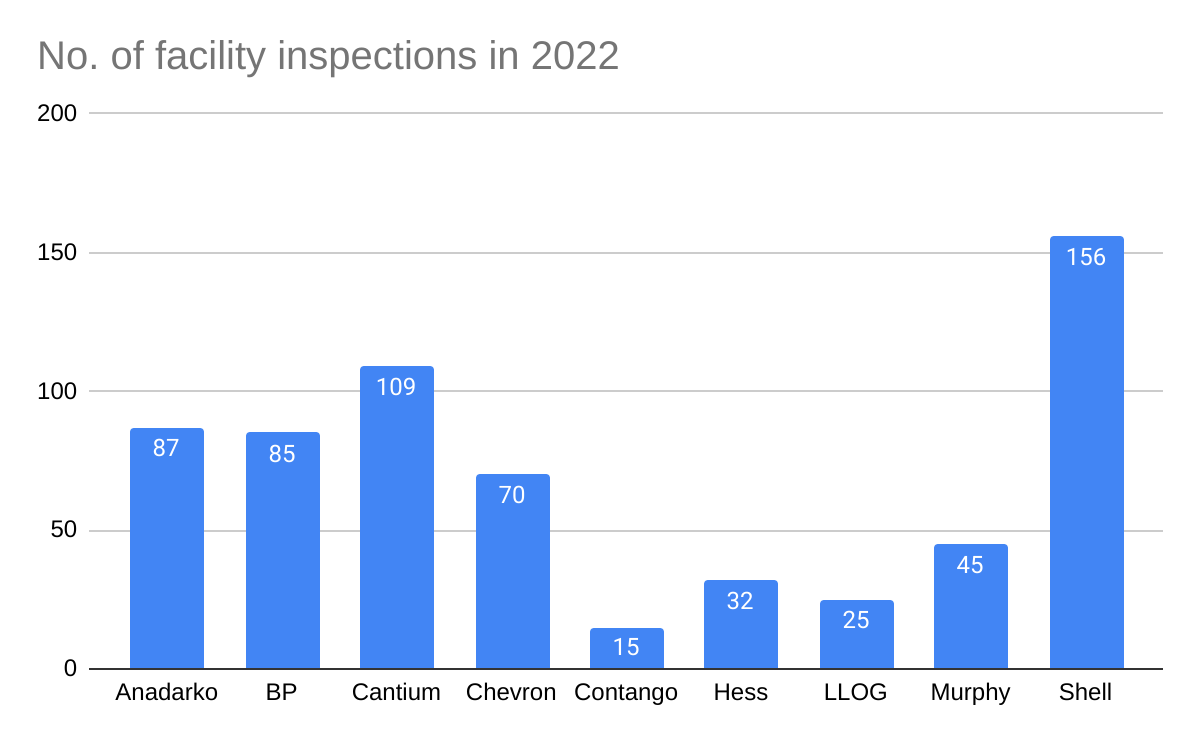
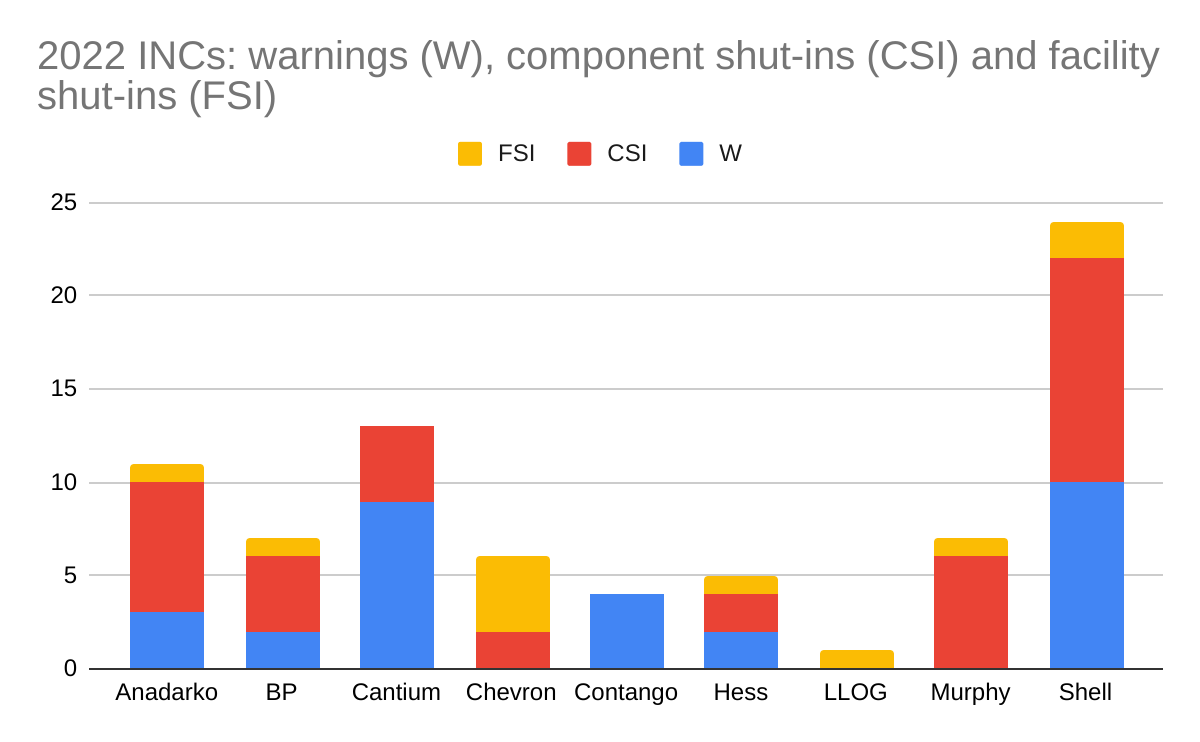
The Honor Roll companies for 2022 (listed alphabetically) are Anadarko (Oxy), bp, Cantium, Chevron, Contango, Hess, LLOG, Murphy, and Shell.
Our criteria:
Must average <0.3 incidents of noncompliance (INCs) per facility-inspection.
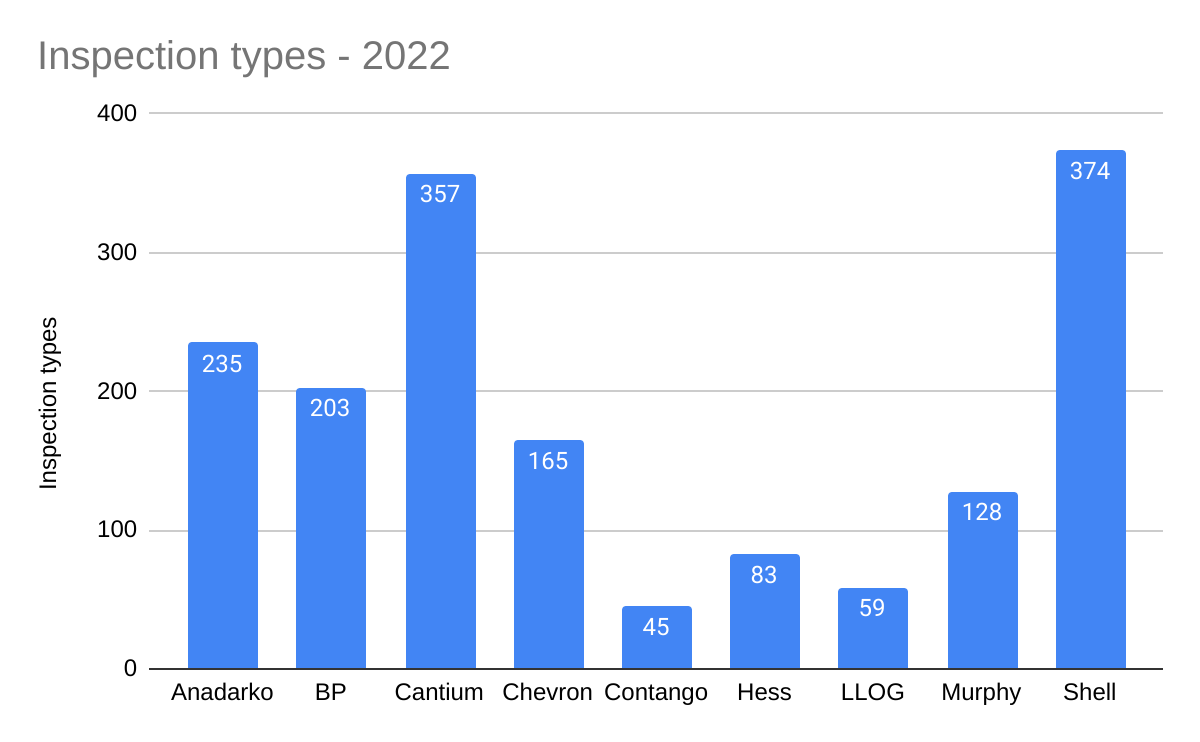
Must average <0.1 INCs per inspection-type. (Note that each facility-inspection may include multiple types of inspections (e.g. production, pipeline, pollution, Coast Guard, site security, etc). On average, each facility-inspection included 3.25 types of inspections in 2022. Here is a list of the types of inspections that may be performed.)
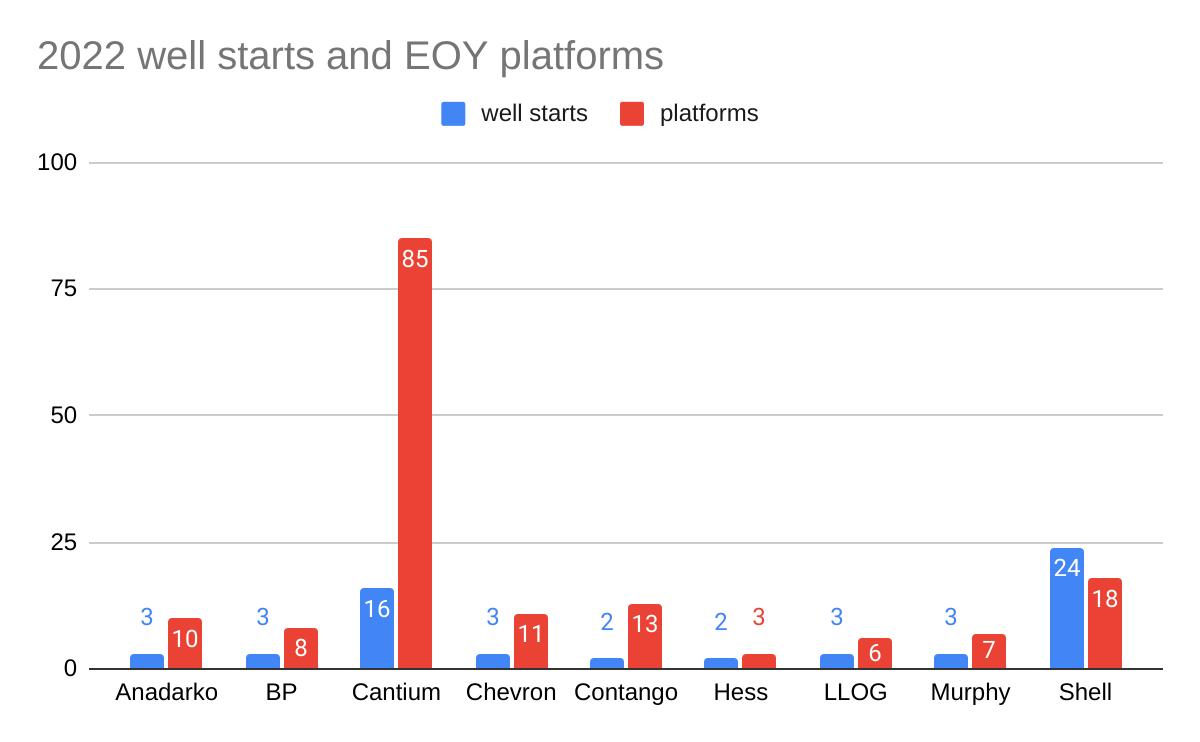
Must operate at least 3 production platforms and have drilled at least one well (i.e. you need operational activity to demonstrate compliance and safety achievement).
May not have a disqualifying event (e.g. fatal or life-threatening incident, significant fire, major oil spill). Due to the extreme lag in updates to BSEE’s incident tables, investigation and news reports are used to make this determination.
Pacific and Alaska operations will be considered separately.