Feeds:
Posts
Comments

Posts Tagged ‘Focus Exploration’

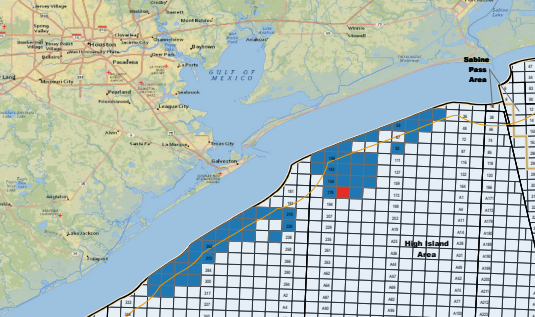
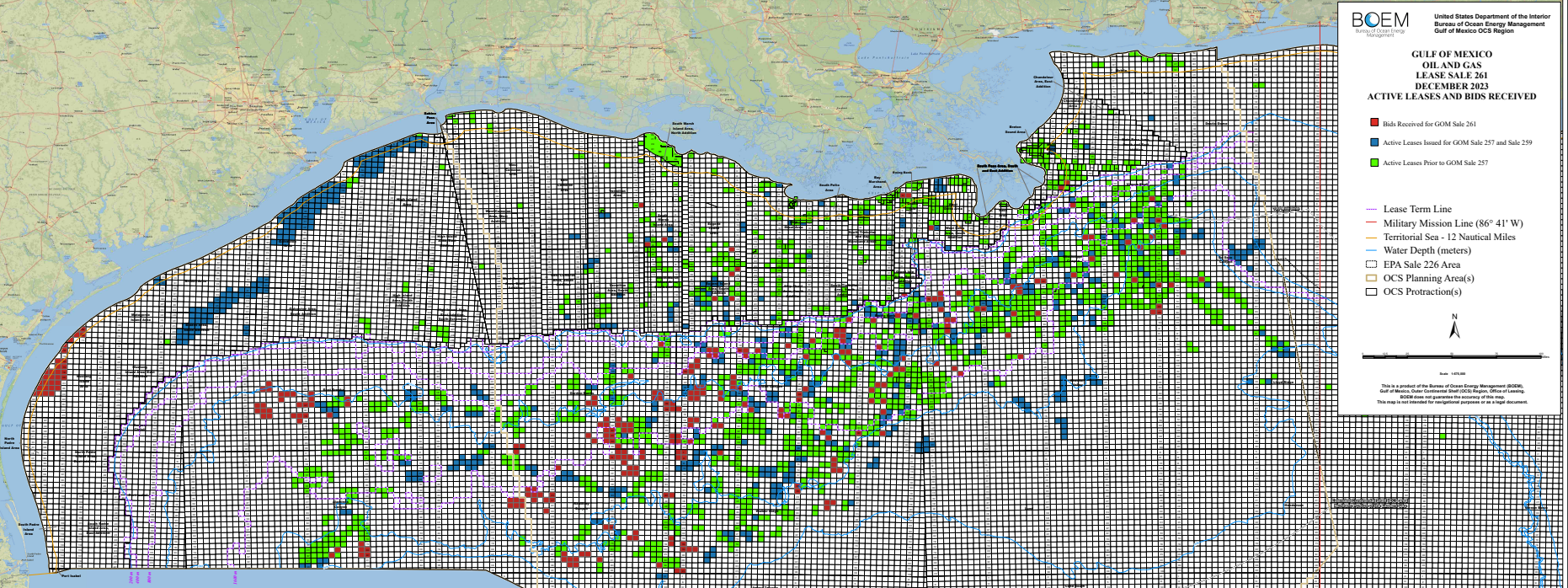
Gulf of America lease map: 199 oil and gas leases were wrongfully acquired for carbon disposal purposes. At Sale 261, Repsol acquired 36 nearshore Texas tracts in the Mustang Island and Matagorda Island areas (red blocks at the western end of the map above). Exxon had acquired 163 nearshore Texas tracts (blue in map above) at Sales 257 (94) and 259 (69).

In pursuit of a “$4 trillion industry” funded by tax credits and energy consumers, Exxon tarnished the corporation’s impressive Gulf of Mexico legacy by acquiring oil and gas leases solely for carbon disposal purposes (see caption above). That gambit and Repsol’s copycat strategy have apparently failed.

On June 29, 2026, Energy Intelligence reported that Exxon had begun relinquishing those leases. Kudos to those in the Administration who refused to buckle under pressure from lobbyists seeking to convert the leases to authorize carbon disposal.

That said, this sad chapter in OCS program history may not be over. 94 of the disposal leases have yet to be relinquished. Here is the current status of the improperly acquired leases:

  • All 36 of the Repsol’s Sale 261 leases were relinquished effective 2/19/2026.
  • All 69 of Exxon’s Sale 259 leases were relinquished effective 6/11/2026.
  • None of Exxon’s 94 Sale 257 leases have been relinquished to date. Perhaps these leases are being held as a hedge in case there is another legislative end run or a policy decision that would facilitate conversion of the leases, or for tax/accounting purposes? As things stand, the leases expire in Oct. 2027.

Exxon and Repsol attempted to gain an unfair advantage by acquiring their preferred disposal leases without competition and before leasing and regulatory processes had been established. One could argue that they were fortunate to have avoided criminal penalty consideration given that they knowingly and willfully violated the terms of the sale notices.

The companies will lose their bonus payments which amounted to approximately $25 million for Exxon and $4 million for Repsol. They have also been paying rental fees of $10/acre/year for the Sale 259 and 261 leases, and $7/acre/year for the Sale 257 leases.

Lastly, one company was directly affected by the improper bidding.  Focus Exploration was a second bidder for one of the blocks acquired by Exxon in Sale 259 (red in map below). Presumably, Focus was interested in acquiring the tract for oil and gas exploration purposes, but their bid was a bit lower than Exxon’s. Should Focus be compensated in some manner?
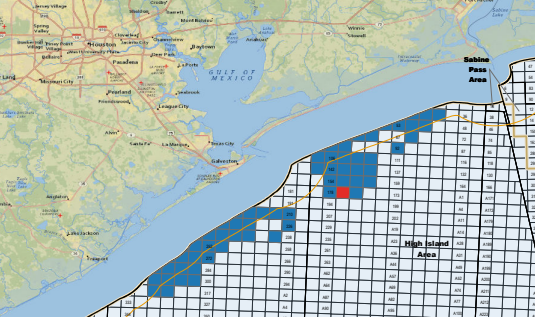
History of the Exxon and Repsol CCS lease acquisitions.

Read Full Post »

A post from last March discussed the high and seemingly unfair royalty and rental rates for new leases in the shallow waters of the Gulf of Mexico shelf. A 50% increase in the shelf royalty rate for lease sales 259 and 261 combined with rather punitive rental rates have likely contributed to the sharp decline in bidding for shelf lease blocks (see table below).

This decline in shelf bidding is unfortunate because the smaller companies that operate in the shallow waters of the Gulf are critical to sustaining the production infrastructure. These companies are also significant producers of environmentally favorable nonassociated (gas-well) natural gas.

lease saleshelf blocks with bids
(excluding CCS bids)
sum of high shelf bids
($million, excluding CCS bids)
25746$8.1
25929$4.1
26113$1.7
The royalty rate for shelf production jumped 50% from sale 257 to sales 259 and 261

BOEM has completed their evaluation of the Sale 261 shelf bids (see below). Each of these blocks received only a single bid, and every bid was accepted. Ironically, the invalid CCS bids for blocks that have no oil and gas value, were the first to be accepted. This was also the case for Sales 257 and 259.

(1) All of the Repsol bids were $32.50/ac. Total bids varied by block size, but were $187,200 for the 5760 acre blocks.
  • Seek a legislative fix to the Inflation Reduction Act😉 provision that established a 1/6 royalty rate floor for all OCS leases (formerly the royalty rate was 1/8 for leases on the shelf).
  • In the interim, administratively lower the royalty for shelf leases to 1/6 (from 18 3/4%).
  • Reconsider the rental rate scheme for shelf leases.
  • For future oil and gas lease sales, accept all high bids that exceed the specified minimum bid (currently $25/ac for the shelf). The Gulf of Mexico shelf has been extensively explored and developed for 70 years. While prospects remain, they are generally marginal as evidenced by the recent lease sale results. Fair market value is what any company is willing to bid (above the specified minimum).
  • Focus on assuring that lease purchasers are technically qualified to minimize safety risks, and that financial assurance for decommissioning (for new and existing leases owned by the high bidder) has been fully addressed.

Read Full Post »

Last week, BOEM announced the acceptance of all 69 of Exxon’s Sale 259 carbon sequestration bids. This is despite these facts: (1) Exxon’s intentions were known, (2) there were no provisions for CCS bidding in the Notice of Sale, (3) no environmental review of CCS leasing was conducted, and (4) there are no procedures for evaluating CCS bids.

Absent some type of legislative maneuver, carbon sequestration is not authorized under these leases. If Exxon is just acquiring the leases for evaluation purposes in preparation for a possible CCS sale in the future, their lease acquisitions may be okay. If they are planning on retaining these leases for actual sequestration operations, that is not okay, at least not until a competitive process has been established for awarding or reclassifying such leases.

It’s also noteworthy that there was a second bidder for one of the blocks (in red above). Presumably that company, Focus Exploration, was interested in acquiring the tract for oil and gas exploration purposes. However, the Focus bid was a bit lower, so Exxon got the tract.

Read Full Post »

In addition to the 94 nearshore Texas leases Exxon acquired in Sale 257, the company was the sole Sale 259 bidder for all but one of 69 nearshore Texas blocks. The exception was High Island 177 (in red above). So who gets that lease?

  • the company (Exxon) that was the sole participant in a de facto CCS sale (bid of $182,750)
  • the company (Focus Exploration) that was participating in the announced oil and gas lease sale (bid of $145,177)

If Exxon is just acquiring these leases for evaluation purposes in preparation for a possible CCS sale in the future, their lease acquisitions may be okay. If they are planning on retaining these leases for actual sequestration operations, that is not okay, at least not until a competitive process has been established for awarding or reclassifying such leases. To date, no lease terms or bid evaluation procedures have been proposed for carbon sequestration leases; nor has an environmental review been conducted pursuant to NEPA.

Questions about Gulf of Mexico carbon sequestration

Read Full Post »

Read Full Post »

Some of the lesser known Sale 257 bidders are intriguing. These companies have a clear and refreshing sense of identity and mission. Observations:

Red Willow Offshore LLC, high bidder on 5 blocks, is a private oil and gas exploration and production company owned by the Southern Ute tribe and headquartered in Ignacio, Colorado. Great mission statement: “Our mission is to create value for the Southern Ute Indian Tribe by exploring for and developing oil and gas resources while prioritizing safety, fiscal responsibility and respect for the environment and Tribal Cultural resources.”

Otto Energy was high bidder on 1 block. If you wonder about the company name, Otto Energy was known as Ottoman Energy until 2006. Otto’s vision is to achieve outstanding business delivery as a partner of choice in the Gulf of Mexico. Their production base includes the South Marsh Island Block 71 field and interest in the Green Canyon 21 Bulleit field.

DG Exploration focuses on new play concepts for the mature continental shelf of the US Gulf of Mexico. They were the high bidder on 14 blocks. According to DG, these blocks control 5 of the best prospects in their portfolio. All the blocks are located in a prolific part of the basin where new high potential exploration has been absent since the early 1990s. By bringing in new technology and ideas, they aim to fundamentally reset the creaming curve for the Louisiana shelf.

Juneau Oil and Gas was high bidder on 4 blocks. Juneau was formed to focus a world class team of professionals on exploring the shallow waters of the Gulf of Mexico.  Juneau Oil & Gas has returned to the roots of the founding members’ past success at an opportune and strategic time in the ever-evolving oil and gas industry. Juneau correctly notes that “lease acquisition costs and royalty rates in the shallow water Gulf of Mexico are low relative to other basins, and there has been little competition for these leases after the steep and sustained decline in activity over the past decade.” 

Focus Exploration LLC was high bidder on 7 blocks. Like other GoM shelf companies, Focus’ principals created the company with the purpose of identifying and participating in high quality, low to moderate risk oil and gas projects.  

CSL Exploration LP was high bidder on 1 block. CSL Capital Management, L.P. is an SEC registered investment firm focused on energy services and equipment businesses.  Headquartered in Houston, the CSL team has deep sector expertise in the energy industry and takes a hands-on approach to investments, relying on organic growth and strategic thinking to generate investment success.

Blackcomb Energy LLC was the high bidder on 1 block. Information on this company is limited, but it looks like they have onshore production in Colorado.

Read Full Post »