Feeds:
Posts
Comments

Posts Tagged ‘Arena Energy’

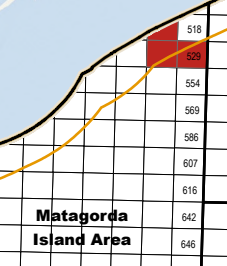
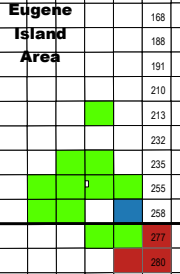
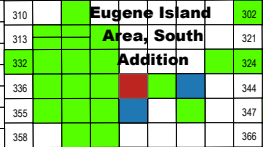
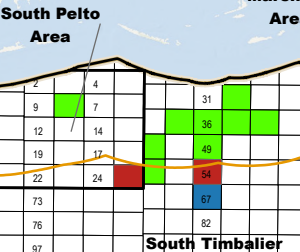
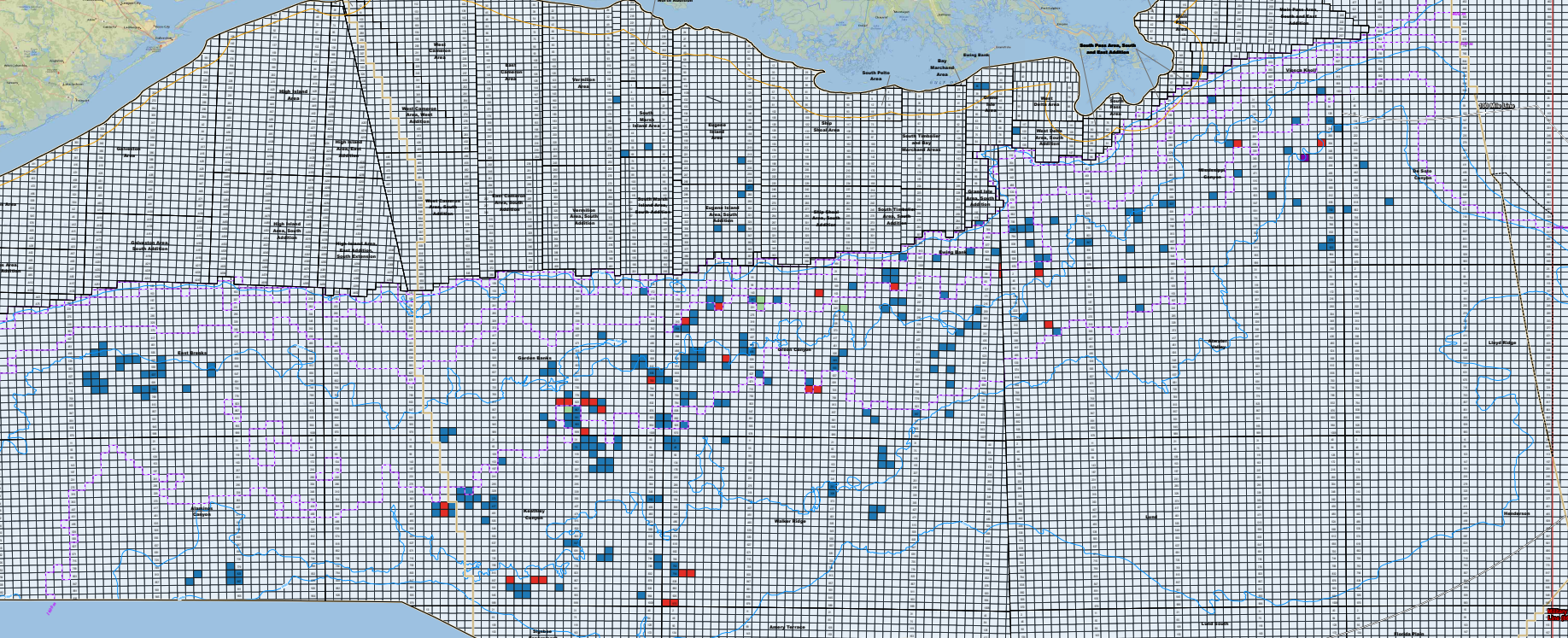
Led by Arena’s 9 high bids, shelf operators made a strong showing at Sale BBG3. As illustrated below, the acquiring companies see good opportunities in or near old fields. The BBG3 leases are colored red.

Arena bid on MI 519, 528, and 529. MI 519 produced 152 bcf of gas and 336,536 bbls of condensate between 1988 and 2012..
Arena bid on EI 277, 280, and 281, blocks that produced 8.3 million bbls and 39.2 bcf between 1990 and 2016.
Since 1973, 24 million bbls and 53 bcf have been produced in EI 339 where Arena drilled 62 wells. They no doubt had good reasons for bidding on adjacent block EI 340.
3.2 million bbls and 18.7 bcf were produced in PL 25 between 1997 and 2016. 27 million bbls and 56.3 bcf were produced between 1955 and 2024 in ST 54. Arena bid on both blocks at Sale BBG3.
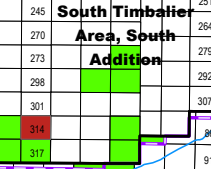
Renaissance bid on ST 314, which had minor production between 2015 and 2019. Renaissance acquired block 317 at Sale BBG2.
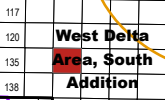
Renaissance bid on WD 133, where 12 million bbls of oil and 31 BCF were produced between 1966 and 2023. Five companies, including Arena, had drilled 63 wells on the block.

Listed in the table below are the shelf blocks receiving bids. According to Marine Minerals Administration (MMA) online data, wells have been drilled on all 12 blocks and production structures were installed on 7.

According to the online structures file, 5 platforms remain on 2 of the blocks. Production and quarters platforms installed by Exxon in 1982 and 1987 remain on ST 54 along with a caisson structure installed by Walter in 2007. Production platforms installed by GOM Shelf (1966) and Arena (2005) remain on WD 133.

Per the borehole file, 3 of the WD 133 wells have not been plugged. These wells were drilled by Arena and are on the F platform, which is one of the two WD 133 platforms that have not been decommissioned.

Also noteworthy, one well that bottoms on ST 314 has not been plugged. That well was drilled by Renaissance from ST 317, which was reacquired by Renaissance at Sale BBG2. The well ceased production in 2019, but the platform from which it was drilled remains in place on the reacquired lease.

Reuse options and decommissioning obligations for the remaining wells and platforms on leases reissued following BBG3 are no doubt topics for discussion between MMA and the operators.

Blockhigh bidderplatforms removedplatforms remainingwells drilled
on lease
completed/
unplugged wells
EI 277Arena20140
EI 280Arena1020
EI 281Arena2080
EI 340Arena0030
EI 389W&T0030
ST 54Arena53698
ST 314Renaissance0081
PL 25Arena50280
WD 133Renaissance12633
MI 519Arena2030
MI 528Arena0020
MI 529Arena0010

Read Full Post »

Official BBG3 stats are attached. Below is a comparison of the three BBG sales.

Link to more stats.

Notes: The Gulf keeps on rollin’ – this was the 137th Gulf lease sale. Congrats to Bryan Domangue on being named Gulf of America Regional Director for the Marine Minerals Administration! The WWII Museum in New Orleans was a nice venue for the sale.

Sale No.BBG1BBG2BBG3
date12/10/20253/11/20268/12/2026
companies
participating
301316
total bids2193869
tracts receiving bids1812559
sum of all bids
$millions
371.969.999.5
sum of high bids
($millions)
279.447.082.7
highest bid
company
block
$18,592,086
Chevron
KC 25
$21,009,990
bp
GC 404
$7,701,011
Murphy
AC 380
most high bids
company
sum ($millions)
50
bp
61.0
6
Anadarko (Oxy)
4.0
9
Chevron/Arena
$15.6 (Chevron)
1.3 (Arena)
sum of high bids ($millions)
company
61.0
bp
22.6
bp
21.5
Murphy
most high bids by independent14-Murphy5-LLOG9-Arena

Read Full Post »

A post from last March discussed the high and seemingly unfair royalty and rental rates for new leases in the shallow waters of the Gulf of Mexico shelf. A 50% increase in the shelf royalty rate for lease sales 259 and 261 combined with rather punitive rental rates have likely contributed to the sharp decline in bidding for shelf lease blocks (see table below).

This decline in shelf bidding is unfortunate because the smaller companies that operate in the shallow waters of the Gulf are critical to sustaining the production infrastructure. These companies are also significant producers of environmentally favorable nonassociated (gas-well) natural gas.

lease saleshelf blocks with bids
(excluding CCS bids)
sum of high shelf bids
($million, excluding CCS bids)
25746$8.1
25929$4.1
26113$1.7
The royalty rate for shelf production jumped 50% from sale 257 to sales 259 and 261

BOEM has completed their evaluation of the Sale 261 shelf bids (see below). Each of these blocks received only a single bid, and every bid was accepted. Ironically, the invalid CCS bids for blocks that have no oil and gas value, were the first to be accepted. This was also the case for Sales 257 and 259.

(1) All of the Repsol bids were $32.50/ac. Total bids varied by block size, but were $187,200 for the 5760 acre blocks.
  • Seek a legislative fix to the Inflation Reduction Act😉 provision that established a 1/6 royalty rate floor for all OCS leases (formerly the royalty rate was 1/8 for leases on the shelf).
  • In the interim, administratively lower the royalty for shelf leases to 1/6 (from 18 3/4%).
  • Reconsider the rental rate scheme for shelf leases.
  • For future oil and gas lease sales, accept all high bids that exceed the specified minimum bid (currently $25/ac for the shelf). The Gulf of Mexico shelf has been extensively explored and developed for 70 years. While prospects remain, they are generally marginal as evidenced by the recent lease sale results. Fair market value is what any company is willing to bid (above the specified minimum).
  • Focus on assuring that lease purchasers are technically qualified to minimize safety risks, and that financial assurance for decommissioning (for new and existing leases owned by the high bidder) has been fully addressed.

Read Full Post »

Sale 261: single bid tracts in blue, multi-bid tracts in red (2), green (3), and purple (5)

The interest of the majors and most independents has shifted entirely to deepwater prospects, as evidenced by the above graphic and sale data. Nonetheless, a few resourceful companies continue to find value in the shallow waters of the continental shelf.

There’s an art to finding oil—particularly in the Gulf of Mexico. After decades of drilling, this world-class basin still holds vast potential for those skilled enough to unlock it. Arena energy is applying expert insight and advanced technology to identify new Gulf of Mexico oil and gas exploration opportunities. This is the art of oil finding in the 21st century.

Arena Energy

Arena Energy, a successful shelf operator for a quarter of a century, was the leading shelf bidder with 6 high bids. In 2023 Arena was once again the most active shelf driller with 20 well starts. They claim a 94% drilling success rate. Arena currently operates 123 platforms and is the GoM’s 7th ranked natural gas producer and the 11th ranked oil producer.

Cantium, another leading shelf operator, was the high bidder on 4 tracts. Cantium drilled 10 wells in 2023 and currently operates 86 platforms. Cantium claims to maintain “the highest level of operational safety and regulatory compliance by maximizing efficiencies and empowering employees,” and publicly available compliance data bear that out. Cantium was a BOE Honor Roll company for 2022, and a preliminary look at the data indicates that their 2023 performance was also excellent. Cantium is ranked 18th in both oil and natural gas production.

Byron Energy, which is headquartered in Australia, is the only international company investing in the GoM shelf. Byron was the high bidder on 2 tracts and currently operates 2 platforms. The company drilled 3 wells in 2023. Byron intends to continue focusing on the shallow waters of the Gulf. 

Thoughts on the attributes of a successful shelf operator:

  • Bid alone and conduct operations independently to facilitate efficiency and timely decisions.
  • Lean and flat organizational structure for optimal communication and effective project management.
  • Skilled staff and state-of-the art exploration technology.
  • Outstanding contractor selection and oversight.
  • Safety, environmental, and compliance leadership, absent which your company won’t be around for long.
  • Think small. Gleaning old fields and producing modest new discoveries can be profitable!
  • Control growth and debt. Busts follow booms and highly leveraged companies are the most vulnerable.
  • Study the successful shelf operators and the failures. What did they do right and wrong?

Read Full Post »