Attached are PHMSA’s Christmas week Emergency Special Permit and Permit Analysis document. Is the path clear to restart SYU production before New Year’s day?
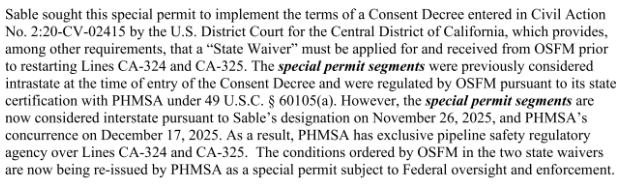
Three excerpts from the first attachment are pasted below. The last paragraph on p. 2 succinctly explains PHMSA’a emergency permit:
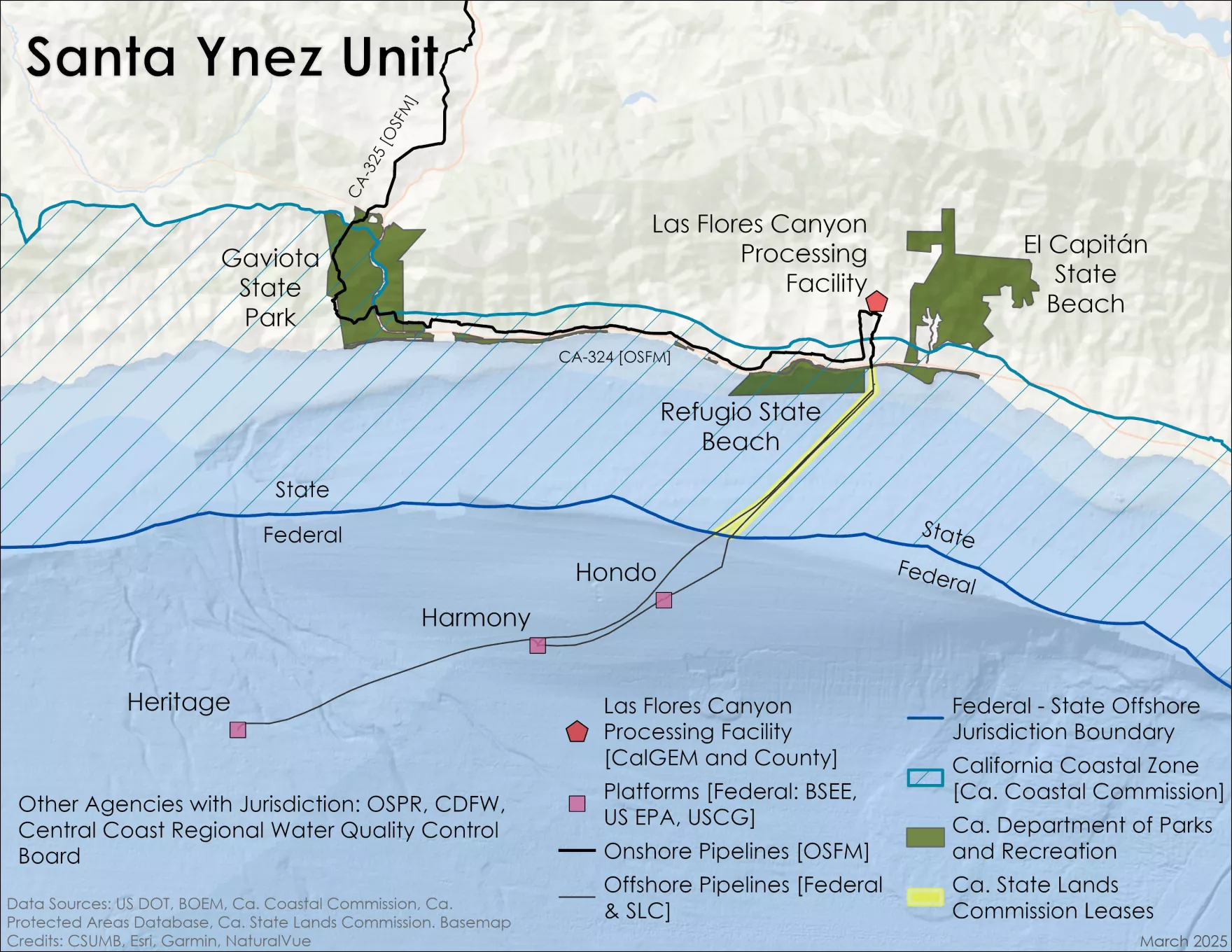
PHMSA was able to assume jurisdiction from the State because the pipeline transports Federal OCS oil and is thus inherently interstate. The perceived problem with a PHMSA takeover had been the court approved Consent Decree that was executed following the 2015 Refugio pipeline spill. That Decree specifies that the State Fire Marshal must approve a restart of the pipeline. The first paragraph on p. 2 of the permit explains PHMSA’s position that the Consent Decree has been superseded.
The provision pasted below (p. 4 of the permit) seems contradictory in that it stipulates compliance with the Consent Decree. However, PHMSA apparently sees no contradiction in that references to the Fire Marshal (OSFM) should now be read as references to PHMSA. PHMSA presumably included this provision to reaffirm the need to comply with the technical requirements in the Decree.
The second attachment is PHMSA’s analysis of the special permit. Note that the permit expires in 60 days. Public notice and opportunity for comment would be required for a renewal.
Environmental organizations reacted quickly to the PHMSA permit, filing an emergency motion in the 9th circuit (third attachment). Observations:
Impressive effort given the time crunch. The PHMSA permit was issued on 12/23, just 3 days prior to the court filing. No Christmas break for those folks!
If you wonder why the petition was filed with the 9th Circuit (seemed convenient given the 9th Circuit’s reputation), a filing at the Circuit level is required for appeals of PHMSA orders.
Petitioners strongest argument: Sable is not entitled to emergency relief, as there is no real emergency. PHMSA asserts that EO 14156, which declared a National Energy Emergency, supports the emergency permit.
The petitioners environmental doom prediction is not compelling. PHMSA’s position is that the mitigations they are imposing (reduced operating pressure, inline inspections, testing and sampling, etc) provide protection equal to or greater than than the corrosion remediation requirement that is being waived.
The petitioners asked the Court for relief no later than 12/26. That date has passed. Will there be a ruling today?
Barring an injunction, odds are that Sable restarts production prior to New Year’s Day, when a requirement (SB 237) for a new Coastal Development Plan, takes effect.
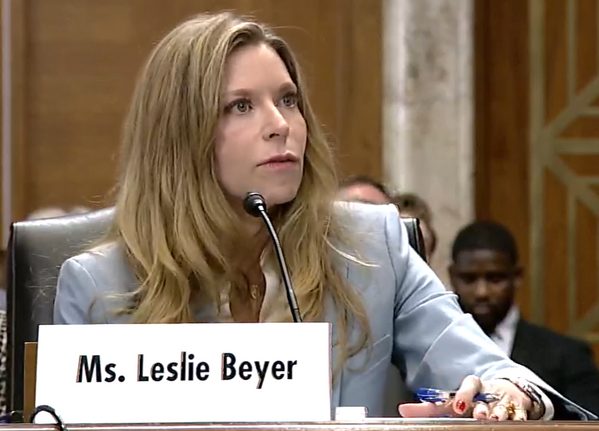
Leslie Beyer, Assistant Secretary for Land and Minerals Management (ASLM), has stepped down from her post as the leader of the Dept of the Interior’s offshore energy programs. She was the senior official at this month’s BGG1 lease sale, and made strong remarks about the importance of the offshore oil and gas program. Ms. Beyer was confirmed by the Senate in September.
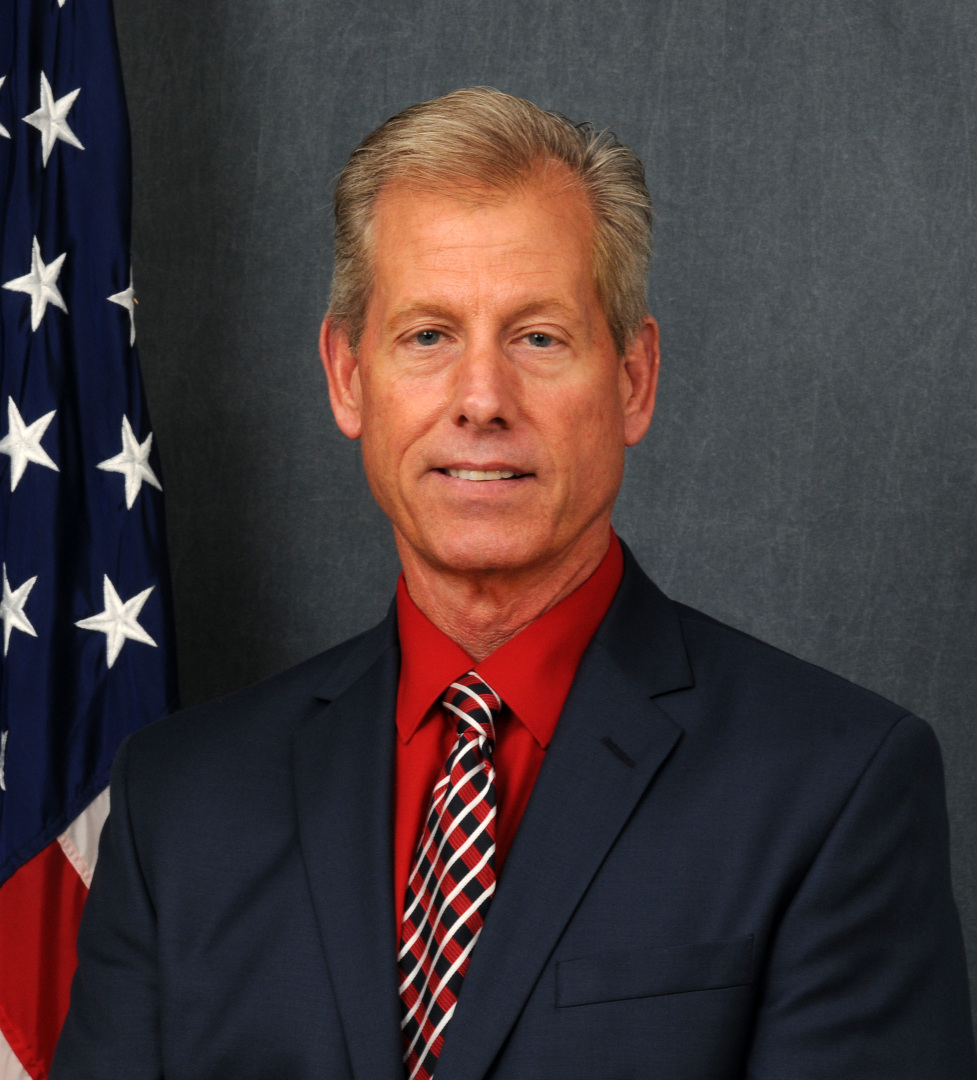
Lanny Erdos, Director, Office of Surface Mining Reclamation and Enforcement, has been named Acting ASLM.
This leaves the offshore energy program without a confirmed Asst. Secretary and with Acting Directors at both BOEM (Matthew Giacona) and BSEE (Kenny Stevens).
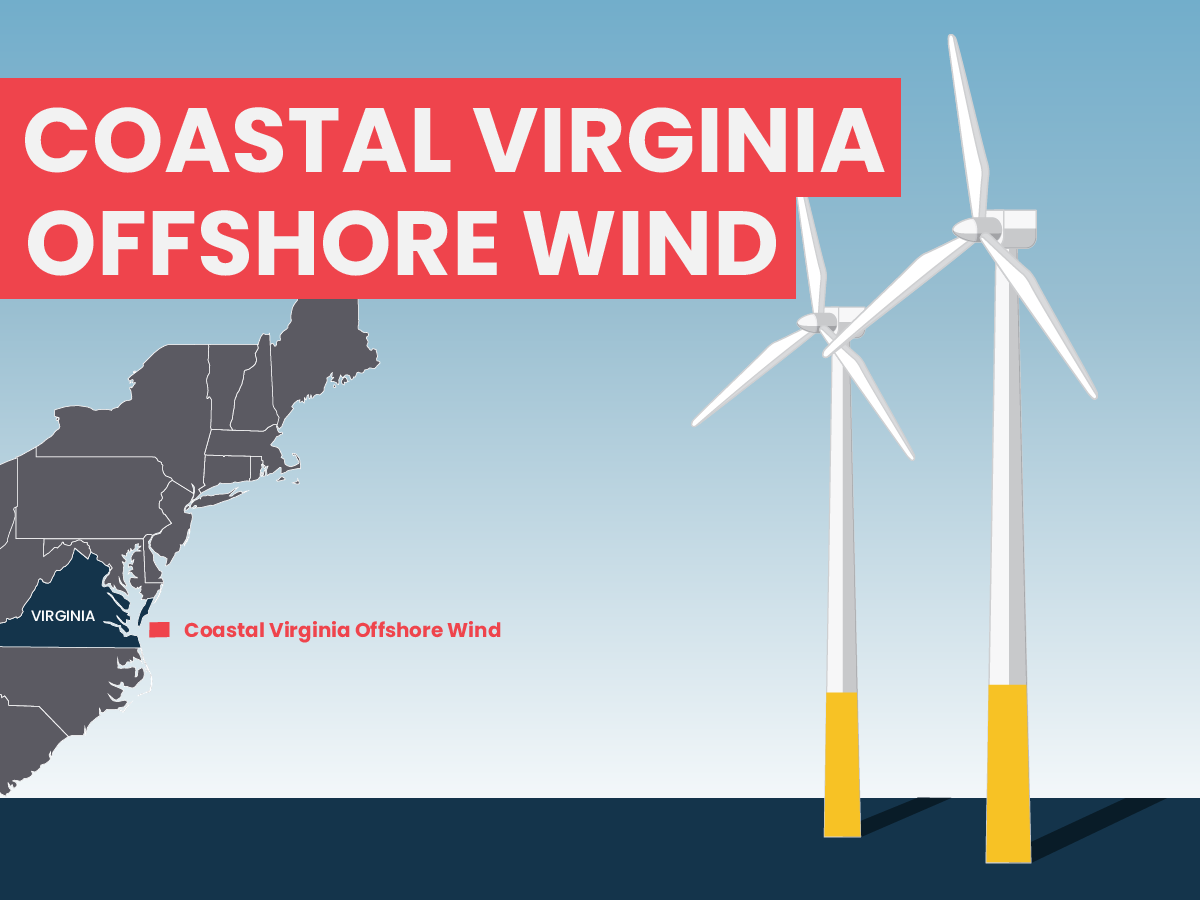
Coastal Virginia Offshore Wind (CVOW) is no ordinary renewable project. It was created by legislative command. The 2020 Virginia Clean Economy Act (VCEA) declared Dominion’s 2.6-gigawatt wind farm “in the public interest,” effectively tying the hands of the State Corporation Commission and guaranteeing Dominion full cost recovery and profit. The risk doesn’t sit with shareholders — it sits with Virginia’s ratepayers.
The Thomas Jefferson Institute opposed that structure from the start. We warned that forcing captive customers to underwrite an unproven, high-cost project located in a hurricane prone region would expose Virginians to escalating bills with little accountability. Yet when a group recently asked the federal government to shut CVOW down, we declined to join. Why? Because government shouldn’t pick winners and losers — not when it mandates projects, and not when it stops them. Especially when a project is in its final stretch and no economic analysis of such a decision has been completed (or shared).
Virginia’s offshore wind story shows how risky it is when government drives energy decisions by decree. One administration mandates a massive buildout; the next halts it over security fears. Businesses can’t plan around that. Ratepayers shouldn’t have to pay for it.
“Today’s announcement delivers on Harbour’s long-standing ambition to establish a presence in the deepwater Gulf of America. With LLOG, we found the right combination of high-quality assets and a talented team, providing a strong strategic and cultural fit with our company. The transaction positions us as a leading player in a region with well-established infrastructure, a supportive fiscal and regulatory environment and opportunities for additional growth.”
LLOG was the 6th largest Gulf of America producer of both oil and gas in 2024 with production of 27 million bbls of oil and 34 BCF of gas. LLOG was the high bidder on 11 tracts in the recent BBG1 sale.
Harbour is not currently a Gulf of America leaseholder.
Reuters had reported that Shell was in advanced talks to acquire LLOG. Apparently, either Shell lost interest or Harbour made a more attractive offer.
🚨BREAKING: Sec. @DougBurgum announces he will PAUSE leases for ALL large-scale offshore Wind projects immediately.
"Today we're sending notifications to the five large offshore wind projects that are under construction, that their leases are being suspended due to national… pic.twitter.com/lFPyMscALr
This picture was posted on the “Rig Pigs” Facebook page by Huston Funk. Per Huston: “First crew photo from the Deepwater Horizon. Taken in the Indian Ocean after we had left Singapore.”
Commenters identified 3 Macondo victims in the photo: Jason Anderson, Don Clark, and Stephen Curtis 🙏







 Bud's Offshore Energy (BOE)