- 2021 (entire year) and 2022 (first half) BSEE incident tables. If safety is the highest priority, these data should be updated quarterly.
- IRF 2021 safety performance data
- An international treaty (accompanied by a standard) on disclosing major offshore accidents and the collection and release of incident data. (Also, see this related post.)
- Hogan and Houchin decommissioning update, most notably the financial responsibility aspects
- Huntington Beach pipeline spill report
- Workable California decommissioning legislation
- ONRR flaring and venting data (update: ONRR advises that they anticipate publication of these data in September.)
- DOI statement on the Sale 257 carbon sequestration bids
- Definitive casualty information and report on the 2-2-2022 Trinity Spirit FPSO fire
- Updated DOI-DOT offshore pipeline regulations
- Coast Guard report on the May 2008 Russell Peterson liftboat tragedy
- Updated US Coast Guard Subchapter N regulations
- Information on the mysterious sinking of the Aban Pearl semi-submersible in May 2010.
Archive for the ‘decommissioning’ Category
Still waiting for…
Posted in accidents, CCS, decommissioning, Offshore Energy - General, pipelines, Regulation, tagged aban pearl, BSEE, CCS, flaring, Hogan and Houchin, Huntington Beach, incident data, offshore pipelines, Russell Peterson, Trinity Spirit, USCG on August 11, 2022| Leave a Comment »
Decommissioning update (not directed at any BOE reader😀)
Posted in decommissioning, Offshore Energy - General, Uncategorized, tagged decommissioning, offshore platforms, retirement on July 8, 2022| Leave a Comment »

California decommissioning – the band plays on
Posted in California, decommissioning, energy policy, rigs-to-reefs, tagged Bob Byrd, California platforms, decommissioning, Exxon, Hogan, Houchin, John Smith, OC Coastkeeper, rigs to reefs, Santa Ynez Unit on May 31, 2022| Leave a Comment »
Offshore California, the best that most facility operators and their predecessors (to the extent they continue to hold decommissioning liabilities) can hope for is a graceful exit with manageable financial losses. (The situation is a bit different for Exxon’s Santa Ynez Unit, which has been shut-in since 2015 while the company seeks to resolve oil transportation issues resulting from an onshore pipeline rupture. Here is the latest episode of that amazing saga.)
California’s Federal offshore, where 9 mobile drilling units (MODUs) were operating concurrently in the early 1980s, hasn’t seen a MODU in over 30 years. However, 23 production platforms, some of which are massive structures, remain (see the presentation below). At this point, these platforms are expensive monuments given that their combined production (per EIA) is only 7000 BOPD.
Regardless of their production status, the California offshore platforms continue to be ecologically significant. Dr. Jerry Schubel is among the many marine scientists who understand the importance of the life that has grown on and around these structures. The scientific community also sees other research, educational, and recreational uses for these platforms as per our Rigs-to-Reefs +++ page.
In the absence of workable State reefing/reuse legislation, not much is going to happen. Questionable Federal decisions on the management of decommissioning funds are another impediment to timely action. (See “The troubling case of Platforms Hogan and Houchin.”)
To their credit, State and Federal agencies, trade organizations, and interested third parties continue to discuss the issues and consider alternatives. A recent workshop was helpful in that regard. Attached is the excellent presentation by Bob Byrd and John Smith, who have been at the vanguard in addressing California decommissioning issues. Embedded below is the YouTube video of the presentations from their session. These are excellent updates for those who have an interest in decommissioning issues.
Will California platforms continue to serve as productive marine habitat?
Posted in California, decommissioning, Offshore Energy - General, tagged California platforms, decommissioning, rigs-to-reefs on March 10, 2022| Leave a Comment »
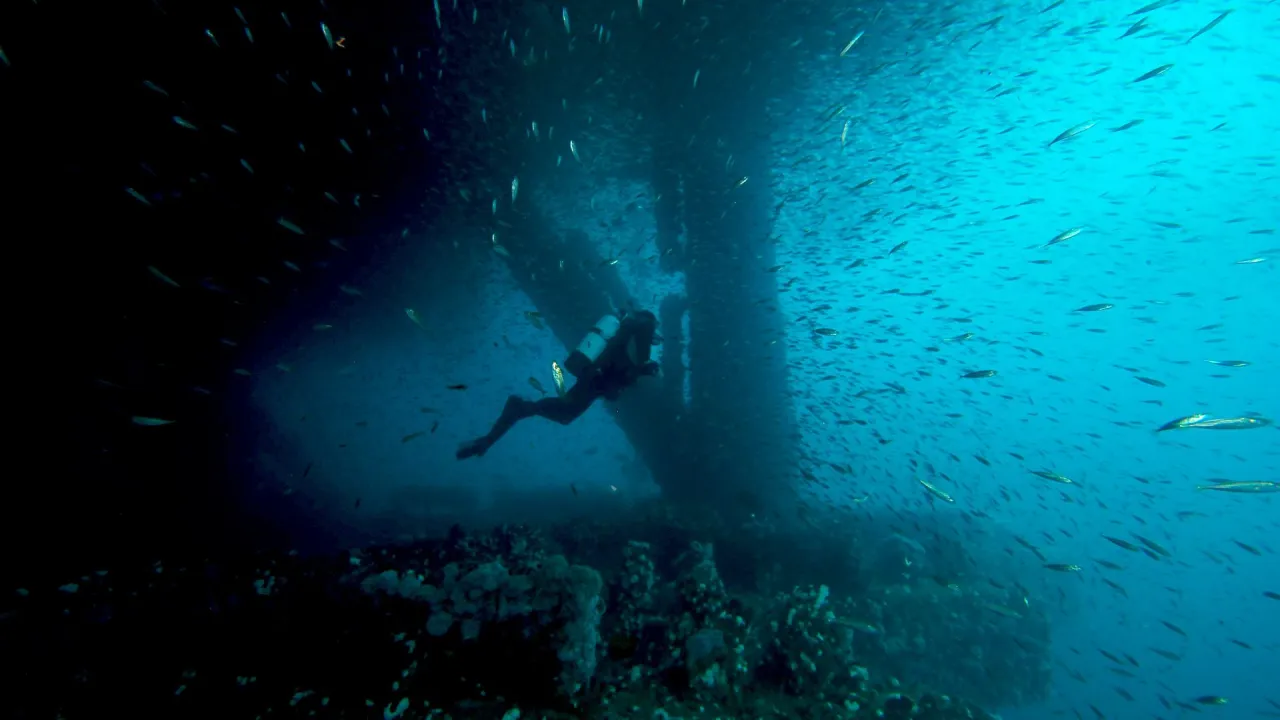
Excerpts from a good OC Register article on the ecological significance of the 27 platforms in State and Federal waters offshore California:
“All the (California) platforms having booming ecosystems underwater,” marine scientist Amber Sparks said at an Aquarium of the Pacific lecture in Long Beach on Wednesday, March 2.
“There’s a lot of real estate; a lot of nooks and crannies for marine life,” she said. “Scientists at the National Academy for the Sciences have found California’s platforms are some of the most productive marine habitat in the world.”
The Gulf of Mexico is the poster child for rigs-to-reefs, with more than 500 decommissioned oil platforms turned into full-time artificial reefs over the past 30 years. It’s bold testament to the habitat potential of the rigs, transforming the relatively sterile, sandy bottom ecosystem there into one with hundreds of prime locations for marine life.
Taxpayer funded decommissioning – troubling precedent for the US offshore program
Posted in decommissioning, Gulf of Mexico, Offshore Energy - General, Offshore Wind, Wind Energy, tagged decommissioning, Gulf of Mexico, liability on March 3, 2022| Leave a Comment »
BSEE has posted the slides and presentation video announcing their draft Request For Proposals (RFP) to contract for the decommissioning of facilities on five Gulf of Mexico leases. Phase 1 involves the plugging of 15 wells. Per the presentation, this work would be paid for using “orphan well” funds appropriated in the 2021 Infrastucture bill.
Per BSEE’s online borehole file, the wells in question were drilled by Matagorda Island Gas Operations, Anglo-Suisse Offshore Partners, and Bennu Oil and Gas. Matagorda and Bennu declared bankruptcy and are no longer in business. The status of Anglo-Suisse is not entirely clear, but presumably they are no longer financially accountable.
Looking at BOEM online data, these leases had other owners including two US super-majors. However, the wells identified by BSEE were drilled after these and other financially strong companies had assigned their interest. They are thus not legally accountable, which is presumably why these wells were chosen for the RFP.
The unprecedented use of Federal funds for decommissioning reflects poorly on the offshore industry and Federal lease management practices. The financial risks associated with decommissioning have been apparent for more than 30 years (see the July 1991 Forbes article below). Why have these issues not been effectively addressed? Some thoughts:
- Operating companies showed little interest in private industry-wide solutions. Rod Pearcy, one of the most respected managers in the history of the Federal offshore program, advocated an industry funded and managed entity to ensure financial assurance and guarantee well and facility decommissioning. This concept never gained traction.
- Industry factions disagreed strongly on the regulatory approach that the Federal government should take. Simply put, “majors” wanted to limit future liability for leases they assigned. “Independents” wanted the assigning companies to retain liability such that their financial assurance requirements were minimized. These divisions continue to this day and are the main reason financial assurance regulations are so difficult to update.
- Decommissioning costs vary wildly depending on the particular circumstances, making it difficult to establish the amounts of financial assurance to be required. For example, storm damage typically increases well and structure decommissioning costs by a factor of at least 10. Requiring worst case financial assurance amounts would preclude many assignments and the associated increase in oil and gas recovery.
- Realistic amounts of bonding and other forms of financial assurance are routinely challenged by lessees and their political representatives.
- Poor lease assignment and financial management decisions have significantly increased the risk exposure of predecessor lease owners and taxpayers. The troubling case of Platforms Hogan and Houchin, Santa Barbara Channel, demonstrates the implications of questionable lease assignments and the irresponsible use of decommissioning funds.
- Government funded decommissioning will likely be more expensive and will subject the public to unforeseen costs and future liabilities should the operations not go as planned.
- The future decommissioning of wind turbines is already a major issue, and measures must be taken to ensure that liability is clearly established and operator funding is assured.
In the past, the regulators, operating companies, and insurers have found ways to ensure that decommissioning costs did not fall on the taxpayer. BSEE continues to be resourceful in that regard. Private solutions should always be the objective. The proposed RFP opens the door to the potential for far greater Federal liabilities down the road, particularly given the uncertainty about predecessor liability in some important cases.

Another California law suit: Center for Biological Diversity sues BOEM, BSEE, NMFS for failure to protect endangered species
Posted in California, decommissioning, Offshore Energy - General, pipelines, tagged BOEM, BSEE, Center for Biological Diversity, endangered species, law suit, NMFS on January 26, 2022| Leave a Comment »
The law suit makes reference to the aging offshore facilities and the Huntington Beach pipeline spill:
Oil companies have been drilling off California for more than 50 years. The first platforms were installed in 1968 and production continues today. Much of this infrastructure has outlived its expected lifespan and is well beyond the age scientists say significantly increase the risk of oil spills.
Indeed, just months ago a pipeline connected to a platform in federal waters off Huntington Beach ruptured and spilled tens of thousands of gallons of oil into the marine environment. The spill fouled sensitive marine, beach, and wetland habitat; forced closure of fisheries; and harmed and killed birds, fish, plants, invertebrates, and marine mammals.
CBD law suit
Workshop to advance California offshore decommissioning, April 21, 2022, Newport Beach
Posted in California, conferences, decommissioning, tagged California, decommissioning, Orange County Coastkeeper on January 25, 2022| Leave a Comment »
Per our post about old disputes preventing common sense decommissioning solutions for offshore California facilities, we were pleased to learn that an Orange County Coastkeeper’s workshop will address the flaws in the California’s unworkable rigs-to-reefs program with the objective of advancing decommissioning programs.
Coastkeeper’s upcoming Retiring Offshore Rigs Summit, or ROR, comes roughly ten years after Coastkeeper’s Rigs to Reef Conference in 2010. While that conference succeeded in passing new decommissioning and artificial reef enhancement laws, the language was not workable. In the decade since that legislation, known as AB 2503, or the “California Marine Resources Legacy Act” was signed into law, it was never implemented by the state.
Orange County Coastkeeper
Link for further information on the workshop.
Previous posts on California decommissioning:
- John Smith’s excellent presentation on the decommissioning outlook and challenges
- Old disputes prevent common sense solutions
- The Troubling Case of Platforms Hogan and Houchin
Decisions, investigations, reports, and trends that BOE will be tracking in 2022
Posted in accidents, decommissioning, energy policy, hurricanes, Offshore Energy - General, tagged 2020 offshore fatalities, Beta Unit pipeline, Globetrotter II, Hogan and Houchin, Huntington Beach, Khamsin, Lease Sale 257, offshore production, Russell Peterson on January 10, 2022| Leave a Comment »
- DC Federal Court decision on Gulf of Mexico Oil and Gas Lease Sale 257: Will the Court uphold the 11/17/2022 sale? If the Court upholds the sale, will BOEM accept the carbon sequestration bids without having announced that tracts would be offered for those purposes, and without advising about lease terms and bid analysis procedures?
- Investigation reports for the 6 fatal US offshore incidents in 2020: When will these overdue reports be issued? Also, we know that there were at least two 2021 fatalities? When will those reports be issued?
- Platforms Hogan and Houchin, Santa Barbara Channel: When will we learn more about the Inspector General’s findings regarding the improper use of decommissioning funds? Why was the lessee, Signal Hill, allowed to withdraw funds from those accounts for purposes unrelated to decommissioning? How does this affect the liability of predecessor lessees?
- Investigation of the Huntington Beach pipeline spill: When will the the joint investigation team report be issued? To what extent can the pipeline operator be held liable for a leak caused by anchor dragging, particularly given the leak detection limitations for low pressure pipelines?
- Globetrotter 2 incident during Hurricane Ida: When will the Coast Guard issue their report on the delayed relocation of the Noble Globetrotter 2 drillship during Hurricane Ida? In light of this incident, the fatality on the Pacific Khamsin prior to Tropical Storm Laura (2020), and similar incidents, further attention to the timely relocation of dynamically positioned drillships would seem to be in order.
- US offshore drilling and production trends: With several deepwater fields scheduled to begin producing in 2022, will GoM oil production meet or exceed the August 2019 peak of 2.044 million BOPD, at least temporarily? Will exploratory drilling activity increase to levels needed for reserve replacement? Will the prolonged decline in US offshore gas production be reversed?
- Russell Peterson liftboat tragedy (2008): Will the Coast Guard ever explain why their investigation report in unavailable?
Cool promo for “The Rig”
Posted in decommissioning, rigs-to-reefs, Uncategorized, tagged rigs-to-recreation, rigs-to-resorts, rigs-to-rides, rigs-to-roar, Saudi Arabia on January 9, 2022| Leave a Comment »

Per our 10/20/2021 post about this Saudi recreation venture, below is a nice promotional video. This greatly exceeds what we had envisioned many years ago!
$Billions in the Infrastructure Bill for CCS; what could possibly go wrong?
Posted in CCS, climate, decommissioning, energy policy, Gulf of Mexico, tagged CCS, DOE, GAO, infrastructure bill on December 28, 2021| Leave a Comment »
Quite a bit per the GAO, and their report only deals with DOE management of demonstration projects. The Infrastructure Bill authorizes $2.5 billion for commercial projects (and much more for other CCS purposes).
DOE provided nearly $684 million to eight coal projects, resulting in one operational facility. Three projects were withdrawn—two prior to receiving funding—and one was built and entered operations, but halted operations in 2020 due to changing economic conditions. DOE terminated funding agreements with the other four projects prior to construction.
DOE provided approximately $438 million to three projects designed to capture and store carbon from industrial facilities, two of which were constructed and entered operations. The third project was withdrawn when the facility onto which the project was to be incorporated was canceled.
GAO
So DOE’s actual success ratio was 0.182 (2 for 11) – not very compelling.
With regard to proposals for offshore carbon sequestration, who will be liable for future cost overruns, operating losses, infrastructure failures including pipeline and well leaks, and decommissioning costs? Who ensures that there will never be any leakage from CO2 disposal reservoirs? Does all of this fall on the Federal government?
Corporations that want to engage in carbon sequestration for commercial or other purposes should fund the projects with their own revenues or fees charged to the companies whose emissions they are collecting. The Outer Continental Shelf is publicly owned and those wishing to dispose of substances should pay a usage fee, be responsible for all costs, and be liable for pollution and damages.
 Bud's Offshore Energy (BOE)