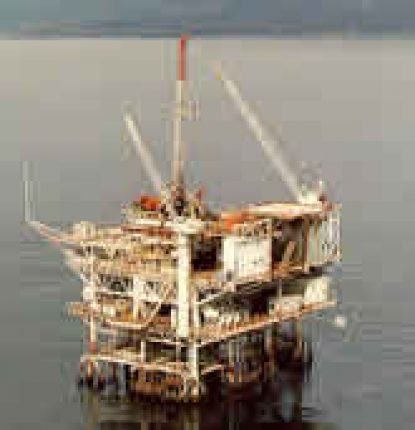
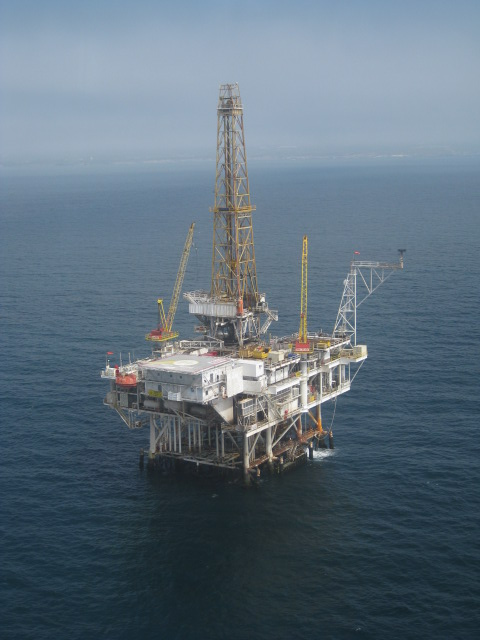
Platforms Hogan and Houchin: These platforms are currently being manned, monitored and maintained as part of an agreement between BSEE, BOEM, DOI Solicitors Office, and the three predecessor lessees as they await a decision on the predecessors’ appeal to the IBLA. BSEE estimates an approximately $5 million deficit in financial assurance to decommission 21 orphaned sidetrack wells associated with these platforms.
Although the status of the decommissioning account for these platforms has not been disclosed, permanently abandoning these 21 wells will be costly. if the over/under is an additional $5 million, bet on the over.
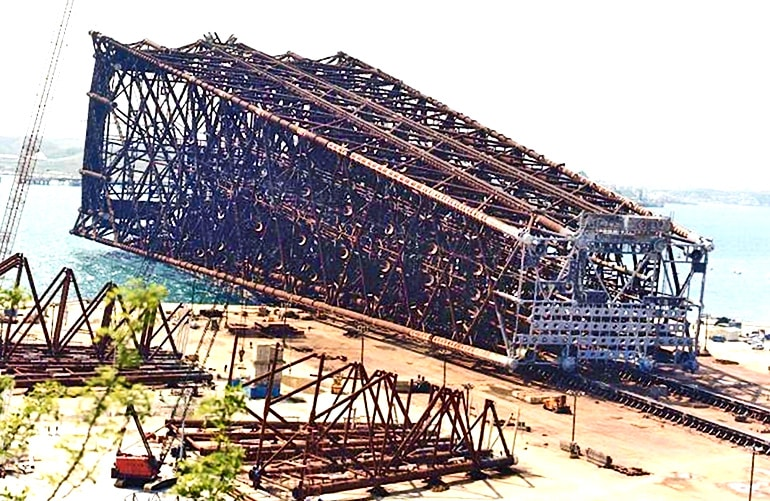
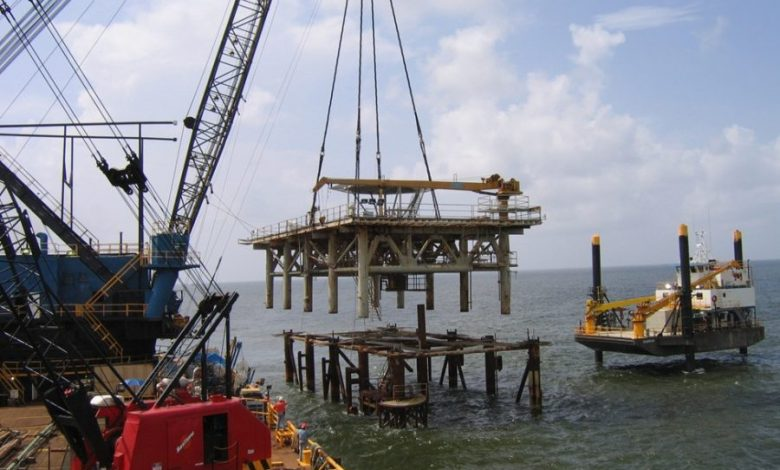
After the wells are plugged, the platforms have to be removed at great cost to someone (hopefully not the taxpayer), and when will the matter of who pays finally be resolved?
When will the 9/20/2020 Inspector General report that found significant irregularities in the use of the decommissioning escrow funds be made publicly available?
The data in the paper appear to be reasonably accurate. However, there is one glaring error regarding Pacific operations, and the reference to the Macondo blowout in the environmental discussion is rather provocative and misleading.
Per the authors:
California wells are drilled in relatively shallow water—mostly less than 100 feet—while GoM wells can be in up to 10,000 feet of water.
With regard to the environmental risks, the Nature Energy paper’s reference to the Macondo blowout, while muted, is what some media outlets embraced. Per the authors:
Releases from improperly abandoned wells will probably be chronic and small compared with Macondo, but the underlying biochemical and ecological processes that influence the ecological impacts have many similarities.
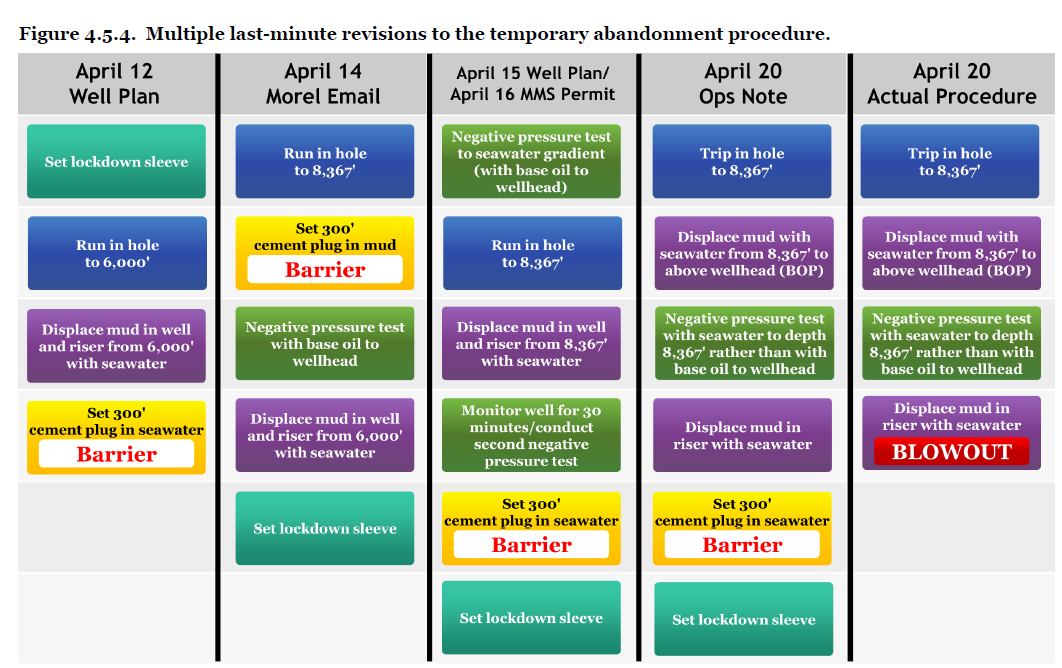
The Macondo well blew out while it was being suspended in preparation for subsequent completion operations. Ill advised changes to the well suspension plan were among the primary contributing factors to the blowout (see diagram below). The Macondo well was entirely different from the depleted end-of-life wells that are the subject of the paper.
Some media outlets ran with the Macondo angle, weak as it was. This ABC news piece featured numerous Macondo pictures. Other outlets noted that Macondo was a temporarily abandoned well, which it was not. The Macondo well never got to that point.
National Commission, Chief Counsel’s Report, p. 132
“BSEE will continue to evaluate the process for issuing decommissioning orders and will continue to issue decommissioning orders to jointly and severally liable parties on a case-by-case basis.“
Although the news release for BSEE’s final decommissioning rule asserts that the regulations “provide the certainty requested by industry,” that does not seem to be the case. The main change in the final rule was to delete the reverse chronological order (RCO) provision which called for issuing decommissioning orders to the most recent predecessor first. Instead, BSEE may continue to issue decommissioning orders arbitrarily.
While deleting the RCO provision may be advantageous for the regulator, and in some cases for the public, claiming that the decision provides certainty for industry is quite a stretch. BSEE may continue to issue a decommissioning order to anyone in the ownership chain, whether the company was a recent lessee or one that had owned the lease decades ago. Original or early lessees may be held liable for decommissioning old facilities regardless of subsequent damage, modifications, or neglected maintenance.
The absence of a defined procedure for issuing decommissioning orders may also expose BSEE to new legal challenges, particularly in cases where a company has not held the lease for decades. A 1988 letter from the Director of the Minerals Management Service to Amoco (attached below) explicitly relieves the assignor (predecessor) of decommissioning liability after the lease has been assigned. A revised bonding rule published on May 22, 1997 reversed that policy, but decommissioning liability for leases assigned prior to the 1997 rule may still be very much in question.
Another concern is the split jurisdiction for decommissioning between BSEE and BOEM. The financial, land management, operational, and environmental aspects of decommissioning are inextricably intertwined and attempts to divide these responsibilities between two bureaus with separate regulations is a prescription for gaps, overlap, inconsistency, inefficiency, disputes, and confusion. Decommissioning should be regulated holistically, not with separate “BOEM-only” and “BSEE-only” regulations.
Finally, wind facility decommissioning may prove to be even more challenging given the higher facility density and economic uncertainties. The regulatory regime needs to be clearly established early in the development phase.
My former colleague John Smith, an expert on Pacific Region decommissioning, advises me that production has ceased at Platform Irene in the Santa Maria Basin offshore California. Irene, the first platform installed in the Santa Maria District in 1985, was a milestone in Pacific OCS development.
Only 7 of the 23 Pacific OCS platforms are still producing. Attached is an updated summary table that John prepared for an upcoming SPE event in Alaska.
Carbon-Zero US LLC of Dallas (a Cox Oil affiliate) has applied for up to $12 million in U.S. Department of Energy funds to develop a pilot sequestration hub in offshore storage fields about 20 miles from Grand Isle, according to officials from Cox Operating LLC, the Dallas operator that owns some of the storage fields.
Cox Operating LLC will “repurpose facilities and equipment” for the carbon storage project, according to a news release.
Should this company be authorized to repurpose Gulf of Mexico facilities for carbon sequestration?
Per BSEE Incident of Non-Compliance (INC) data for 2022, Cox had more component shut-in INCs (132) than any other company. Cox was second to the Fieldwood companies in the number of warning and facility shut-in INCs, and in the total number of INCs. 48% of the Cox INCs required either a component or facility shut-in.
Cox had an INC/facility-inspection ratio of 0.77, nearly 50% higher than the GoM average of 0.53.
Per the posted BSEE district investigation reports for 2022, Cox was responsible for 9 of the 30 incidents that were significant enough to require investigation. That is more than twice as many as any other company (next highest was 4).
The incidents included 3 serious injuries, 2 fires, a large gas leak, and oil spills of 114, 129, and 660 gallons. Per the posted reports, only one other company had an oil spill of >1 bbl. (Note: Only spills of > 1 bbl are routinely investigated by BSEE. One bbl = 42 gallons.)
While INCs were issued for only 3 of the 9 Cox incidents, a review of the reports suggests that INCs should have been issued for at least 4 of the other incidents.
Cox operates 375 platforms with installation dates as early as 1949. 134 of their platforms are > 50 years old. Only 66 were installed in the last 20 years and only 6 in the last 10 years (most recent December 2014). How will the carbon sequestration plans affect their massive decommissioning obligations?
Many of the Cox platforms were assigned by predecessor lessees. Those predecessors can only be held responsible for the decommissioning of facilities they installed, not for more recent wells or platforms and not for facilities that are repurposed for carbon sequestration.
Also, as noted in the discussion of Exxon’s 94 Sale 257 oil and gas leases, a competitively issued alternate use RUE is required (30 CFR § 585.1007) before sequestration operations may be conducted on an oil and gas lease.
1 well to be checked to confirm temporary abandonment
Well depths: 2359′ to 11934′
Water depths: 70′ to 477′
11 gas wells, 3 oil wells
Well completion dates: 2006-2008
Last production: 2010-2013 (Presumably, the short productive life of these wells either contributed to or was because of the lessees’ bankruptcies.)
$25,000😀 minimum to $100,000,000 maximum contract guarantee
If I was an offshore contractor, I wouldn’t touch this work without:
Ironclad liability protection after the work is completed and inspected. A contractor should not inherit the perpetual liability that the lessees knowingly and willfully accepted when they purchased the leases and conducted operations; nor is the contractor responsible for the failure of industry and government to establish a financial assurance framework that protects the taxpayer from such liabilities.
Protection against likely cost overruns related to the uncertain downhole condition of the wells.
Where is the leadership? Offshore decommissioning costs should never fall on the taxpayer. See the attached notice (excerpt below) and a previous post on this topic.
BSEE intends to execute a multi-award IDIQ Quantity Contract inclusive of a Base Year and Four (4) Option Years; however, the government reserves the right to award the IDIQ contract to a single firm. Time & Material, Labor Hour, and/or firm-fixed price task orders will be awarded for Decommissioning Services necessary to take nine (9) orphaned facilities, located in the OCS of the Gulf of Mexico, to the point of Temporary Abandonment (TA). The estimated decommissioning cost for temporary abandonment is $10,000,000 to $20,000,000.
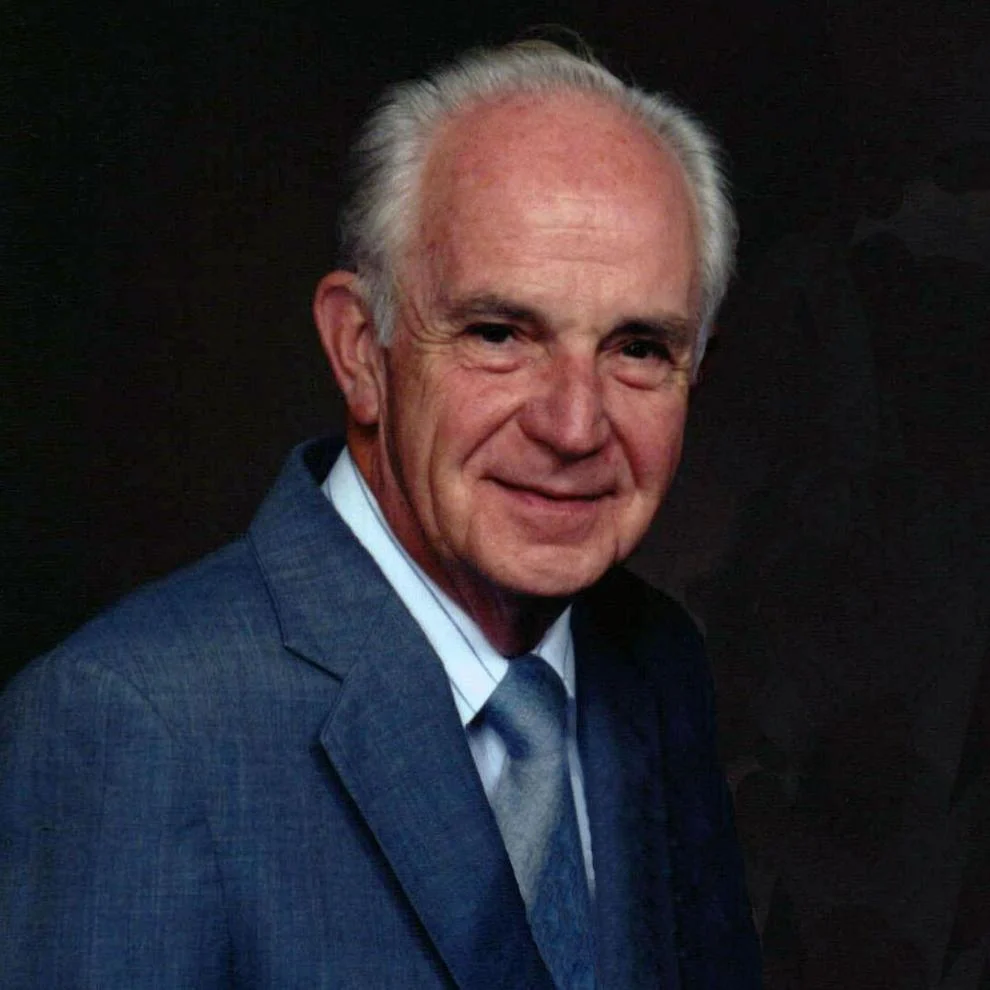
An important figure in the history of the US offshore program passed away last week. Gerry Rhodes was a petroleum engineer with an attorney’s gift for understanding laws and regulations. Among other leadership roles in the offshore regulatory program, Gerry was Chief of the Minerals Management Service’s Branch of Rules, Orders, and Standards in the 1990’s.
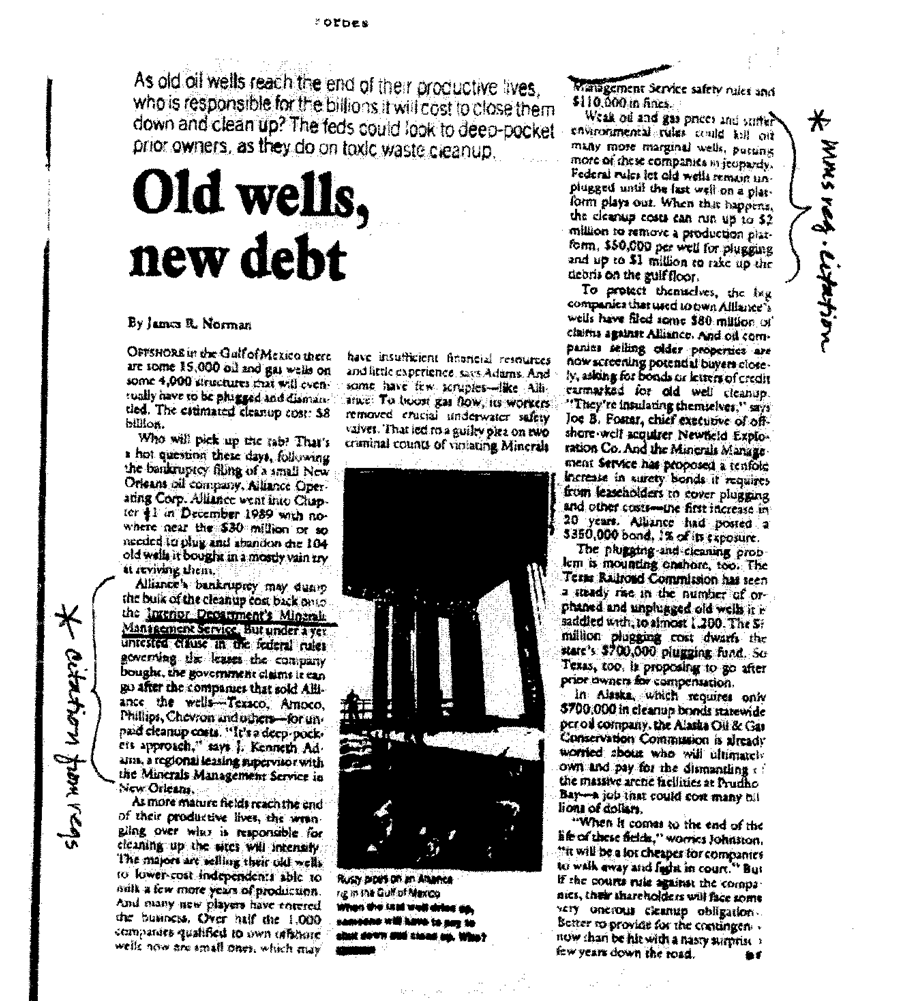
Gerry was among the first in the Federal government to fully understand the financial responsibility risks associated with the decommissioning of offshore facilities and the urgent need to update requirements for the plugging of wells and removal of platforms. The enormity of this challenge is described in the 1991 Forbes article pasted below. Despite sharp divisions within the offshore industry and the resulting political pressure, Gerry succeeded in finalizing regulations (including this 1995 rule) that are the basis for the current financial responsibility programs in BOEM and BSEE. Without Gerry’s resolve, subsequent financial assurance challenges and government outlays would have been far greater.
RIP Gerry. You were a true gentleman, a dedicated father and grandfather, and a diligent and highly accomplished colleague.
This Montecito Journal article explains the ecological importance of California offshore platforms and summarizes the challenging regulatory issues associated with their decommissioning.
According to a paper published in 2014 by marine ecologist Dr. Jeremy Claisse of Cal Poly Pomona, the oil and gas platforms off the coast of California are the most productive marine habitats per unit area in the world. “Even the least productive platform was more productive than Chesapeake Bay or a coral reef in Moorea,” said Dr. Love. (Milt Love, UCSB biologist)