Feeds:
Posts
Comments

Posts Tagged ‘California’

California Senate Bill 237, the compromise oil legislation supported by Gov. Newsom, Assembly Speaker Rivas, and Senate President McGuire, opens up Kern Co. drilling in exchange for pipeline safety measures that will doom the Santa Ynez Unit (SYU) if Sable fails to restart production by Jan. 1.

Particularly intriguing is the the list (below) of SB 237 supporters and opponents. The Western States Petroleum Assoc. (WSPA), is aligned with the unions for onshore drilling and against the SYU. Note that Exxon is a prominent WSPA members! Exxon assigned the SYU to Sable and is on the hook for massive decommissioning costs if production is not resumed. Perhaps Exxon has a backup plan for the SYU?

Also note that all of the environmental groups are aligned against SB 237. Compromise is not in their playbook.

John Smith’s highlighted summary of SB 237 is attached. Here is the provision that would seem to doom Sable:

Clarifies in the Coastal Act that development associated with the repair, reactivation, or maintenance of an oil pipeline that has been idled, inactive, or out of service for five years or more requires a new CDP, as provided.

REGISTERED SUPPORT / OPPOSITION:
Support
Associated Builders and Contractors of California
Berry Petroleum Company, LLC
California Conference of Carpenters
California Independent Petroleum Association
California Resources Corporation and Subsidiaries
California state Pipe Trades Council
California State Association of Electrical Workers
City of Bakersfield
Consumer Watchdog
County of Kern
State Building & Construction Trades Council of California
Western States Petroleum Association

Opposition
Asian Pacific Environmental Network Action
California Environmental Justice Alliance Action
California Environmental Voters
Campaign for a Safe and Healthy California

Center for Biological Diversity
Center on Race, Poverty & the Environment
Central California Environmental Justice Network
Clean Water Action
Climate First: Replacing Oil & Gas
Communities for a Better Environment
Earthjustice
Leadership Council for Justice and Accountability
Physicians for Social Responsibility Los Angeles

Read Full Post »

John Smith has highlighted the attached bill that could, if passed, further derail Sable’s plans to restart Santa Ynez Unit (SYU) production.

This provision appears to target Sable:

Section 3(b)(2): Repair, reactivation, and maintenance of an oil and gas facility facility, including an oil pipeline, that has been idled, inactive, or out of service for five years or more shall be considered a new or expanded development requiring a new coastal development permit consistent with this section.

The legislation would be effective on 1/1/2026 so perhaps Sable will already be producing. Sable may also explore the jurisdictional and interstate commerce issues touched on in this post.

This LA Times update adds to the confusion as to the implications for Sable.

Read Full Post »

John Smith’s excellent decommissioning presentation at the recent Western States Petroleum Assoc. luncheon in Santa Barbara is attached. John used an amended version of Bob Byrd’s OTC powerpoint, adding slides on the proposed California Marine Legacy Act amendments.

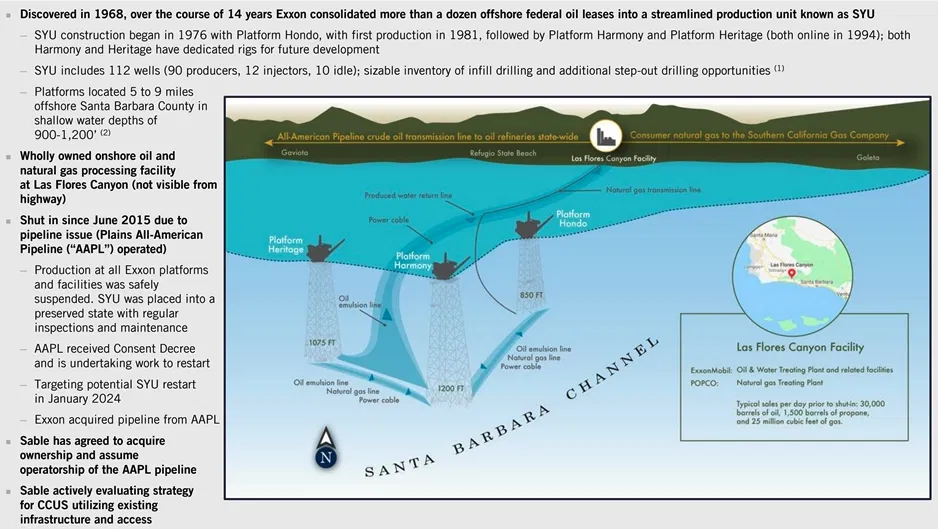
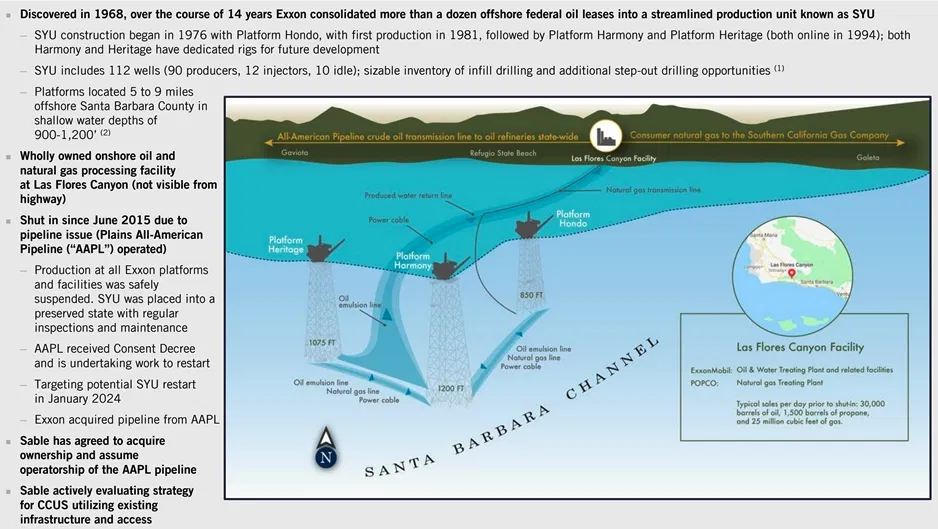
For those who have been following the Santa Ynez Unit story, Harmony, Heritage, and Hondo are the platforms in that unit. Platform Harmony, where production resumed on the date of John’s presentation (5/15), is in 1198′ of water and is one of the world’s largest offshore structures.

Read Full Post »

John Smith shared an outstanding paper (attached) that was presented by co-author Robert Byrd at the SPE Regional Meeting in Garden Grove, CA last week.  


John Smith: “My objective in writing the paper is to hopefully spur legislators to recognize the benefits of reefing and the legislative fixes required to facilitate reefing and the removal of aging infrastructure.  The California Department of Fish and Wildlife Habitat Lead was very complimentary of the paper and has distributed it to the Interagency Team which is developing a California Artificial Reefing Plan.”  

John adds: “They are in the process of creating a statewide artificial reef plan and you can sign up for updates and get more information. The California Artificial Reef Program (CARP) Plan won’t discuss the specifics of Rigs-to-Reefs but will be compliant with the National Fisheries Enhancement Act and National Artificial Reef Plan and meet the BSEE requirement of having an adopted state artificial reef plan. The intent is to add an addendum to the plan when resources become available to move Rigs-to-Reefs forward in California. You can check out the latest program update that further discusses the CARP Plan and Rigs-to-Reefs.”

Read Full Post »

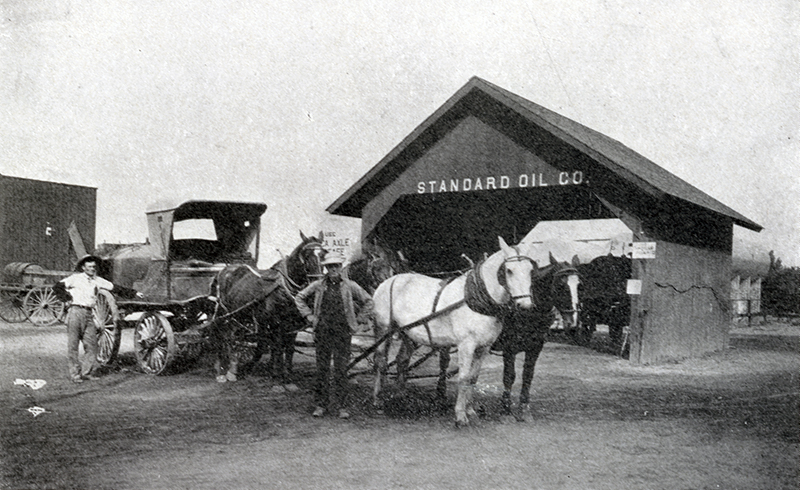
the early years

Remember that Chevron was once Standard Oil of California. The attached WSJ article discusses the ugly divorce after all these years.

Chevron tired of California’s attempts to dictate corporate strategy. Per Chevron CEO Mike Wirth:

“Putting bureaucrats in charge of centrally planning key segments of the economy hasn’t worked in other socialist states,” Wirth said in a Nov. 1 call with investors. “I doubt it will be any different in California.”

California wanted Chevron to commit to the State’s energy agenda:

Chevron has a future in clean energy in California. They can join us in our steady, long-term transition to a state powered by clean energy,” said Daniel Villaseñor, a spokesman for the governor’s office.

California wanted the interests of shareholders to be subordinate to the State’s carbon goals:

Newsom said Wirth had invested far more in shareholder payouts than in developing low-carbon energy.

Other State actions that contributed to the divorce:

  • accused Chevron and other companies of price gouging
  • accused Chevron, as a fossil fuel producer, of indirectly causing tragic fires
  • banning the sale of gasoline-powered cars by 2035
  • rules that increased gasoline prices
  • lawsuit alleging climate change deception

Not mentioned in the article are the costly challenges Chevron and others are experiencing in decommissioning offshore platforms.

Read Full Post »

Attached is an excellent Scientific American article featuring BOE contributor and decommissioning specialist John Smith, former colleague and marine biologist Dr. Ann Bull, and Dr. Milton Love, the leading authority on California’s offshore platform ecosystems.

I had the pleasure of taking a highly informative boat tour around Platform Holly with Dr. Love and a group of international visitors. Holly, which is pictured at sunset in the BOE header, is among the platforms awaiting decommissioning.

Dr. Love on the total removal of California offshore platforms:

“As a biologist, I just give people facts,” he says. “But I have my own view as a citizen, which is: I just think it’s criminal to kill huge numbers of animals because they settled on a piece of steel instead of a rock.”

Read Full Post »

Hywind Scotland, Equinor

Equinor reports that all 5 Hywind turbines have been returned to service after being towed to Norway as part of a 4-month maintenance campaign.

Even though the turbines had only been in operation since 2017, Equinor puts a positive spin on the 4-month maintenance outage, declaring total victory:

“The successful completion of the maintenance campaign on Hywind Scotland is a testament to the collaborative efforts of our teams and partners. As the world’s first floating offshore wind farm, Hywind Scotland has demonstrated the immense potential of floating wind. Through this maintenance campaign, we’ve gained valuable insights that will help us refine maintenance practices and optimise this technology for the future. By sharing our learnings, we aim to contribute to the growth and development of the floating wind industry.”

Some of the folks in Scotland have a different take as evidenced in this video:

Meanwhile, the turbines planned for offshore Central California will also have to be towed to shore for major maintenance. Nearby harbor areas like Morro Bay (pictured below) would be overwhelmed by the large structures and the maintenance and repair operations. Central Coast residents are not enamored with “another attempt to industrialize the coast.” Towing the towers to LA/Long Beach, albeit rather distant from the leases, would seem to be the preferred option for such work.

Looking forward, the first power generation from floating wind turbines on the Central Coast is forecast for 2034. Betters may want to take the over!

Read Full Post »

In the attached supplement to his comments on BOEM’s financial assurance rule for offshore oil and gas facilities, decommissioning specialist John Smith raises concerns about reliance on cost data submitted by operators. John contrasts operator estimates for platforms in California state waters with estimates provided by independent consultants.

As summarized below and explained in the attachment, the more realistic independent estimates were 2-3 times higher than the operators’ “high end” estimates.

Read Full Post »

The Fraser Institute’s 2023 Canada-US Energy Sector Survey of senior executives in the upstream oil and gas sector provided data for assessing the competitiveness of US and Canadian jurisdictions. The resulting perception index (below) ranked Wyoming at the top with a score of 100.0 and California at the bottom with a score of 0.0. Perhaps one or more of the respondents have been mired in the California decommissioning quagmire. ☹

Read Full Post »

John Smith, a decommissioning specialist who retired from BOEM, has published numerous professional papers on the topic. He has kindly shared his comments (below) on the new GAO report.

The Appeal Process is Broken – The GAO should have emphasized this point.  Companies routinely appeal orders to decommission platforms to forestall having to spend money on plugging wells and removing platforms, pipelines and other facilities. The appeal process commonly takes 5 or more years to reolove (e.g., DCOR appeal of BSEE order to decommission Platform Habitat).

Well P&A – BSEE has been negligent in requiring operators to plug and abandon wells no longer useful for operations. I’m shocked BSEE has curtailed or stopped issuing Inc’s for the failure of operators to P&A wells.  That’s a major failure on the part of BSEE management. That may explain why operator performance criteria was proposed to be eliminated for financial assurance.

Failure to Issue Civil Penalties for Well P&A – From GAO Report “BSEE officials explained that their reluctance to pursue civil penalties stems in part from concerns about whether inducing financial harm against an operator is an effective approach to compel decommissioning. They expressed reservations about taking actions—such as issuing civil penalties—that might strain the financial resources of operators to the point of pushing them into bankruptcy.”   This attitude underscores a real problem – an abrogation of regulatory and enforcement responsibility by BSEE. 

POCS Well P&A –  More than 700 wells have been drilled from the 23 California OCS platforms. The GAO report notes that approximately 200 are in the process of being plugged and abandoned – about 50% of those are probably associated with Gail, Grace, Harvest, Hermosa, Hidalgo, where P&A work has largely been completed by Chevron and Freeport McMoRan.  The vast majority of the remaining 500 wells are no longer useful for operations and have been idle for several decades.  Note POCS was never part of the Idle Well and Idle Iron Program, which was exclusive to the GOM. GAO gave POCS BSEE a pass by not highlighting that problem in POCS. It would have been interesting to know how many of the remaining 500 POCS wells are considered no longer useful for operations, and how many of those have been temporarily plugged and abandoned pursuant to regulations.  The GAO report broke that down for the GOM.

Footnote 46 of GAO Report – “Two of the eight platforms due for decommissioning in the Pacific—platforms Hogan and Houchin—have posed serious safety, environmental, and financial risks, including poor safety compliance records, severe corrosion, and ongoing disputes about who will assume decommissioning liabilities for the platforms and their associated wells, according to BSEE officials and documentation. According to BSEE, these platforms are currently being attended, monitored, and maintained as part of an agreement between BSEE, BOEM, Interior’s Office of the Solicitor, and the three predecessor operators pending a decision from the Interior Board of Land Appeals on the predecessors’ appeal. BSEE estimates that approximately $5 million of the estimated costs to decommission 21 orphaned sidetrack wells associated with these platforms are uncovered by financial assurances.”    $5 million divide 21 = $238,000 per well  – extremely conservative cost estimate given age of wells, likely collapsed casing, and downwhole equipment that needs to be removed.  The cost could easily be 3-4 times higher and there is no bonding so the federal government and taxpayers are on the hook for those costs.

Platform Hogan and Houchin Wells – approximately 75 wells were drilled from the platforms.  It would be interesting to know the status of those wells.  How many have been properly temporarily plugged and abandoned with long-term barriers installed to prevent leaks before decommissioning pursuant to OCS regulations?  Are the 21 orphaned wells mentioned above the Signal wells?  What about the other 54 wells?  Have the predecessor lessees agreed they are responsible for plugging and abandoning those wells?  

Platform Habitat – GAO could have noted this is another example of the broken appeal process. It would be interesting to know whether the 21 wells (primarily if not all gas wells) on Habitat have been temporarily abandoned. There are likely to be significant fugitive emission levels at the platform.  Hopefully the APCD is on top of that.  Note – the platform is unmanned and as I previously mentioned a potential catastrophe was avoided several years ago when a fire broke out on the platform.

Read Full Post »

« Newer Posts - Older Posts »