Feeds:
Posts
Comments

Posts Tagged ‘BSEE’

Last month (12/2021), BSEE finally posted the 2020 incident statistics. Unfortunately, no details or incident summaries are provided for the 6 fatalities. The fatalities are simply classified as “occupational” (4) or “non-occupational” (2). As a result, we still know very little about these fatal incidents 13 – 24 months after they occurred.

The BSEE spreadsheet advises that 3 of the 4 “non-occupational” fatalities are being investigated, but the reports are still “pending.” Why the long delay? The National Commission, BOEMRE-CG, and NAE investigations of the Macondo tragedy were completed (and reports published) in less time.

No explanation is provided as to why the 4th occupational fatality is not being investigated.

Also, investigations of the preparedness and response aspects of the 2 non-occupational fatalities would have been beneficial. What was the cause of death? What medical screening procedures were in place? What treatment capabilities were available at the facility? How much time was required to transport the workers to hospitals? These are important considerations for the offshore community.

Below is a summary of the publicly available information for the 6 fatalities:

  • 1/14/2020: A worker died on a Diamond drillship on a lease (Mississippi Canyon 822) operated by BP. According to BSEE this was a non-occupational fatality. Per the listing of investigations, no investigation was conducted.
  • 5/16/2020: A worker died on a Fieldwood platform (Ewing Bank 826 A). Per BSEE, this was an occupational fatality and the investigation is still pending. There were no media reports or company announcements.
  • 6/2/2020: A worker died on the Valaris DS-18 drillship working for EnVen Energy at Green Canyon 767. Per BSEE, this was a non-occupational fatality and no investigation was conducted.
  • 6/20/2020: A worker died on at the Green Canyon 18 A platform operated by Talos. Per BSEE, this was an occupational fatality but no investigation is indicated for this incident. No media reports or company announcements could be found.
  • 8/23/2020: A worker died on the Pacific Khamsin drillship working for Total at Garden Banks 1003. A month later, at an Investors’ Day presentation, Total announced that the incident occurred while the crew was preparing to move the rig to avoid Tropical Storm Laura. Total’s statement included this defensive statement: “This is a routine operation that was executed with no time pressure as the rig disconnection had been decided well in advance.” Per Total, the findings of their investigation were shared with the regulators in Sept. 2020, but BSEE advises that their investigation is still pending.
  • 12/2/2020: A worker died on DCOR’s Platform Gilda in the Santa Barbara Channel offshore California. The BSEE investigations update provides no information on the status of the investigation. Per local media, 3 men fell from the platform and others jumped into the water to assist. No information is provided on the reason why the 3 men fell.

The number of US OCS fatalities remains unacceptably high, and timely data sharing and investigations are needed to better assess causes and trends. In that regard, this recommendation from the 2016 National Academies report entitled “Strengthening the Safety Culture of the Offshore Oil and Gas Industry” merits further industry/government attention and action:

Recommendation 4.2.2: Because accident, incident, and inspection data all are needed to identify and understand safety risks and corrective actions, the committee recommends full transparency such that regulators make all these data readily available to the public in a timely way, taking into consideration applicable confidentiality requirements.
Read Full Post »

Observations and comments on the offshore findings and recommendations in the Dept. of the Interior’s report:

  • From an offshore perspective, this report is more moderate than expected. No major complaints.
  • The report was issued the Friday after Thanksgiving. Was there a desire to minimize attention?
  • The report does not include a recommendation on raising royalty rates. DOI will continue to study such actions (prudent decision).
  • BSEE estimates current liability for “orphaned infrastructure” at only $65 million. They must be using a very narrow definition of orphaned infrastructure.
  • “Financial assurance coverage should be strengthened.” (Few would argue with that statement.)
  • “BSEE and BOEM will carefully consider comments on the 2020 proposed financial assurance rule.” (Deja vu? Expect a long, slow process.)
  • BOEM will establish a “fitness to operate standard.” Comments: (1) This is an old concept that has proven to be difficult to execute. Hold companies accountable, make them demonstrate financial assurance, and don’t pander to bad actors (see the case of Hogan and Houchin) (2) Why is BOEM establishing this standard and not BSEE, the safety bureau? (The division of responsibilities between BOEM and BSEE has created serious overlap, inefficiency, and confusion and needs to be addressed.)
  • “BOEM should consider advancing alternatives to the practice of area-wide leasing.” Tract selection makes sense in frontier areas with little operational history. It would have been perfect for the Mid- or South Atlantic or the EGoM, all of which were cynically removed from future leasing consideration by the previous President just before the 2020 election. The Central and Western Gulf of Mexico is too mature for a return to tract selection; employing that approach after 40 years of area-wide leasing is likely to generate less revenue and production.

Read Full Post »

Among other provisions, EPA’s proposed rule, issued on 11/2/2021, specifies that associated gas be handled as follows:

Route associated gas to a sales line. If access to a sales line is not available, the gas can be used as an onsite fuel source, used for another useful purpose that a purchased fuel or raw material would serve, or routed to a flare or other control device that achieves at least 95 percent reduction in methane and VOC emissions.

Because the Dept. of the Interior has jurisdiction over air emissions on most of the Gulf of Mexico OCS, I assume this proposed rule does not apply to those facilities. However, the EPA proposal is not entirely clear in that regard. If the EPA proposal does not apply, will BOEM/BSEE be proposing similar restrictions in their regulations?

MMS/DOI considered prohibiting venting, but determined that adding flaring capability was not feasible for many shelf platforms, and for some platforms there would have been a net increase in emissions. That said, venting is not insignificant. A 2017 Argonne study indicated (table 2) that, for shelf platforms from 2011 through 2015, more than 3 times as much gas was vented as was flared. More recent data should be reviewed to get a better sense of the costs, benefits, and safety considerations associated with achieving further reductions in venting.

Current flaring/venting regulations for OCS facilities are here.

Read Full Post »

Aqueos 2020 external (ROV) inspection:

The 16” oil pipeline was found to be in good condition with no visible damage or anomalies.
One (1) CP test point that was installed in 2014 was found to be displaced from its location on the pipeline (this was also noted in the 2018 survey), and no damage was noted at the location (Fix #101).

Aqueos inspection report, May 2020

Pipe‐to‐electrolyte potential values recorded were:
 ‐ 921 millivolts (mV) on the 6” gas pipeline
 ‐ 910 millivolts (mV) on the 10” water pipeline
 ‐ 963 millivolts (mV) on the 10” gross fluids pipeline
 ‐ 906 millivolts (mV) on the 16” oil pipeline

As the NACE Standard SP0169‐2013 “Control of External Corrosion on Underground or Submerged Metallic Pipelines” criterion is ‐800 mV, all readings indicate that Cathodic Potential is within specifications.

Aqueos inspection report, May 2020

Metal loss data from Baker Hughes internal inspection (12/2019):

Depth of Metal LossExternal AnomaliesInternal Anomalies
30+%00
20-29%10
10-19%00
total10
Baker Hughes In-line Inspection Report, 12/30/2019

The metal loss findings are consistent with those reported in a previous internal inspection (Baker Hughes, 11/2017).

BSEE has general authority to require pipeline inspections under 30 CFR 250.1005. BSEE, the State Lands Commission, and the operator appear to have implemented an effective inspection program for the Beta Unit.

Read Full Post »

BSEE data indicate that the operator of the Beta Unit facilities (Platforms Ellen, Elly, and Eureka, and the associated pipelines) had a good compliance and safety record.

  • Since 1/1/2015 Beta facilities were inspected 262 times and 49 Incidents of Non-Compliance (INCs) were issued.
  • The ratio of 0.19 INCs/inspection was better than the average for the Pacific Region (0.29 INCs/inspection).
  • No facility shut-in orders were issued during that period.
  • BSEE assesses civil penalties for violations that constitute a serious threat to safety or the environment. Since 1/1/2015, Beta has not been assessed any civil penalties.
  • BSEE incident data are badly out-of-date (no data posted for 2020 or 2021), but the most recent incidents at the Beta Unit facilities were 2 minor injuries (no lost time) in 2019, a small dryer fire in 2018, a minor injury (no lost time) in 2017, and a lost time injury (fall) in 2016.
  • BSEE’s oil spill data are even more out-of-date (no data posted since 2013) so it is difficult to assess Beta’s performance in that category.

With regard to the Huntington Beach pipeline spill, the evidence to date seems to confirm that the pipeline damage was caused by anchor dragging. Beta’s response to the PHMSA preliminary finding on their delayed response to the low pressure alarm (see previous post) will be of great interest. Alarm issues are not always straightforward. PHMSA’s 12-page order was issued on Monday (10/4), only 2 days after the spill was reported. The investigation will no doubt carefully consider the pressure and alarm history for the pipeline, data for 10/1 and 10/2, and input from those working in the control room.

Read Full Post »

The evidence to date indicates that the leak was detected by visual observation of the oil slick. There are some reports that the slick and associated smell were evident on Friday night (10/1). The pipeline operator Amplify issued a statement advising that they first observed an oil sheen on Saturday morning (10/2), which is when the response was initiated. Nothing in Amplify’s statement suggests that a drop in pipeline pressure or a reduction in the flow rate at the onshore terminal was observed.

So, what do the regulations require with regard to leak detection? It depends whether the pipeline is regulated by the Department of Transportation (DOT) or the Department of the Interior (DOI/BSEE). This is how DOI authority is delineated:

DOI pipelines include:
(1) Producer-operated pipelines extending upstream (generally seaward) from each point on the OCS at which operating responsibility transfers from a producing operator to a transporting operator;
(2) Producer-operated pipelines extending upstream (generally seaward) of the last valve (including associated safety equipment) on the last production facility on the OCS that do not connect to a transporter-operated pipeline on the OCS before crossing into State waters;
(3) Producer-operated pipelines connecting production facilities on the OCS;
(4) Transporter-operated pipelines that DOI and DOT have agreed are to be regulated as DOI pipelines; and
(5) All OCS pipelines not subject to regulation under 49 CFR parts 192 and 195.

Unless provision (4) applies, the Elly to shore pipeline is either a producer or transporter-operated pipeline (depending on how the Amplify’s San Pedro Bay Pipeline Co. is classified) that falls under DOT jurisdiction. DOT leak detection requirements (49 CFR 195.134) are new as of 10/1/2019 and do not take effect until 10/1/2024. Unless DOI or similar leak detection requirements are being applied (by agreement, condition of approval, or some other administrative means), there are no such requirements for this pipeline.

Assuming the protection specified below for DOI pipelines is being required, why wasn’t the leak detected and production shut-in. This will be determined during the investigation, but the most probable explanation is that the pressure sensor was set too low, perhaps because the pipeline’s operating range is broad. With regard to a volumetric comparison system (250.1004 (5)), I don’t get the sense that such a capability was in place. If it was, the operator should be able to provide a good estimate of the amount of oil that was spilled (i.e. Elly output – onshore input – any oil recovered from the line after the leak was detected).

§ 250.1004 Safety equipment requirements for DOI pipelines.

(3) Departing pipelines receiving production from production facilities shall be protected by high- and low-pressure sensors (PSHL) to directly or indirectly shut in all production facilities. The PSHL shall be set not to exceed 15 percent above and below the normal operating pressure range. However, high pilots shall not be set above the pipeline’s MAOP.

(5) The Regional Supervisor may require that oil pipelines be equipped with a metering system to provide a continuous volumetric comparison between the input to the line at the structure(s) and the deliveries onshore. The system shall include an alarm system and shall be of adequate sensitivity to detect variations between input and discharge volumes. In lieu of the foregoing, a system capable of detecting leaks in the pipeline may be substituted with the approval of the Regional Supervisor.

One would hope that this major spill will lead to an independent review of the regulatory regime for offshore pipelines. Consideration should be given to designating a single regulator that is responsible and accountable for offshore pipeline safety (a joint authority approach might also merit consideration) and developing a single set of clear and consistent regulations.

Read Full Post »

Read Full Post »

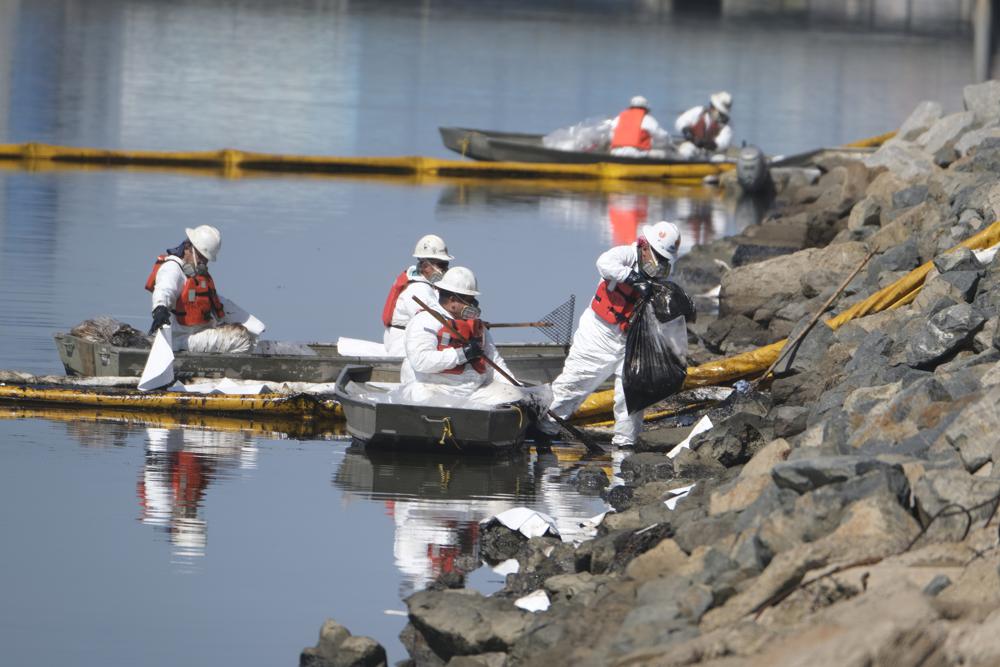
Cleanup contractors unload collected oil in plastic bags trying to stop further oil crude incursion into the Wetlands Talbert Marsh in Huntington Beach, Calif., Sunday, Oct. 3, 2021. One of the largest oil spills in recent Southern California history fouled popular beaches and killed wildlife while crews scrambled Sunday to contain the crude before it spread further into protected wetlands. (AP Photo/Ringo H.W. Chiu)
AP Photo/Ringo H.W. Chiu
  • Large, sudden pipeline spills are usually caused by external impacts (e.g. anchor dragging). If that was not the case, the spill was presumably caused by significant, undetected corrosion.
  • The internal (smart pig) and external inspection history of the pipeline will be an important part of the investigation.
  • Another important consideration is the extent to which pressure and volumetric monitoring systems were in place and functioning. Early reports imply that the leak was not discovered until the slick was observed on the water surface.
  • An excellent 2008 case study details the challenges that were experienced in internally inspecting this pipeline. This presentation provides good background information on the pipeline and the initial internal inspection efforts.
  • Why isn’t BSEE, the Federal bureau that inspects the Beta Unit facilities and approves the spill response plan, part of the Unified Command? BSEE is also a leader in spill response research.
  • Per the Unified Command, 1218 gallons of oil-water mix were recovered as of Sunday. This is pretty minimal – only 29 barrels (including water) and <1% of the estimated spill volume, but is not atypical for mechanical spill response operations. It may also be that the 3000 bbl spill estimate was overly conservative (i.e. high).
  • Also per the Unified Command: “One oiled Ruddy duck has been collected and is receiving veterinary care. Other reports of oiled wildlife are being investigated.” If this was the extent of wildlife impacts as of Sunday, some of the reporting on this spill has been hyperbolic.
  • A comprehensive review of the balkanized regulatory regime for offshore pipelines is long overdue, as is an update to Federal pipeline regulations.
  • This spill, Hurricane Ida, and offshore COVID issues have further demonstrated the importance of BSEE. Why has the Administration still not appointed a BSEE Director? Keep in mind that this appointment does not require Senate confirmation.

Read Full Post »

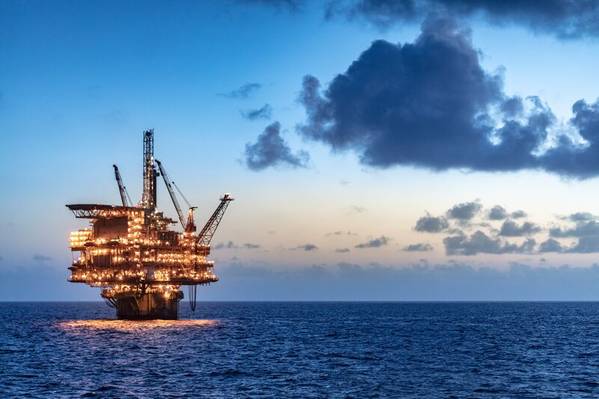
For illustration only - One of Shell's platforms in the U.S. Gulf of Mexico / Image by Stuart Conway - Photographic Services, Shell International Limited.

Attached is an outstanding presentation by Jason Mathews that reviews the latest Gulf of Mexico incident data and trends. The collection and analysis of incident data are critical to safety achievement and continuous improvement, and are among an offshore energy regulator’s most important functions. Kudos to BSEE’s Gulf of Mexico Region for their timely and comprehensive reviews and alerts.

Read Full Post »

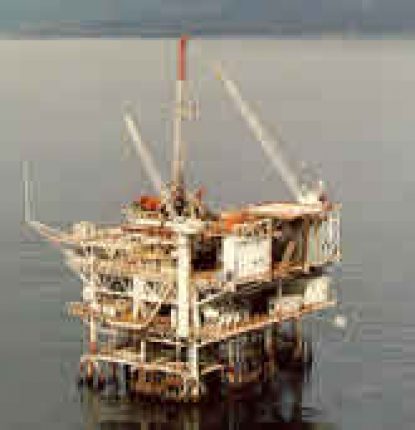
Platform Houchin, Santa Barbara Channel

Platforms Hogan and Houchin were installed 52 and 53 years ago respectively on Lease OCS P-0166 in the Santa Barbara Channel. The lease, which had initially been issued to Phillips Petroleum, Cities Service Oil Co., and Continental Oil Co., was assigned to Signal Hill Service effective 2/19/1991. The assignment was approved despite concerns within the Minerals Management Service (MMS) about the financial strength of Signal Hill and the technical competence of Pacific Operators Offshore Inc (POOI), the affiliate that would operate the facilities.

Three decades of frustration followed for MMS, BOEM, and BSEE regulators in the Pacific Region. Per the terms of the assignment, Signal Hill was required to establish an Abandonment Escrow Account, funded from oil production revenue, with a “target balance” equal to the abandonment cost, plus 25 percent. These payments were seldom made in a timely and consistent manner.

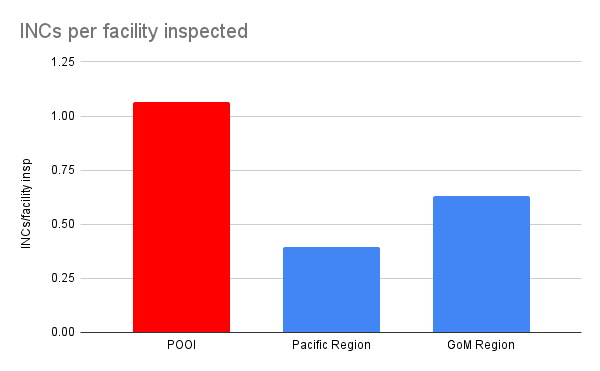
Compliance with safety regulations was also poor. In that regard, violations data are consistent with anecdotal reports from inspectors. POOI accounted for a high percentage of the regional Incidents of Noncompliance (INCs), and Platforms Hogan and Houchin had INC/inspection ratios that were far higher than Pacific or Gulf of Mexico platform averages (see inspection data below).

INC’sWarningsComponent
Shut-ins
Facility
Shut-ins
POOI48556246
All companies
(Pacific Region)
19653103281
POOI % of total24.618.116.4

INCs per facility inspected

A 9/20/2020 Inspector General report found significant irregularities in the use of funds from an offshore production company’s escrow account. While the IG’s summary (pasted below in its entirety) doesn’t say so, the company is assumed to be Signal Hill.

The OIG investigated allegations that an offshore oil and gas production company improperly paid operational expenses with money from an escrow account dedicated to paying expenses related to decommissioning offshore platforms in Federal waters.
We found that the company routinely used funds from its decommissioning account to pay what appeared to be various operating expenses. We also found instances where the company appeared to claim reimbursement for duplicate expenses.
Based on our findings, the company submitted credits and adjustments, totaling $1.9 million, to the decommissioning account to cover these expenses and other disbursements. In addition, we referred a number of unresolved expenses for non-decommissioning activities to the Bureau of Safety and Environmental Enforcement and the Bureau of Ocean Energy Management for resolution.
We referred this matter to the U.S. Department of Justice, which declined to pursue it.

DOI OIG, 9/20/2020

Questions:

  1. Why haven’t BOEM, BSEE, or the OIG released the full report? The public and the offshore industry certainly have a right to know given the potential costs to the taxpayer and the reputational damage to the industry.
  2. Why was a company with such a poor payment and compliance record allowed to withdraw funds from their decommissioning account to cover operating expenses?
  3. Signal Hill owes the State $287,000 in unpaid rentals. What unpaid royalties are owed to the Federal government?
  4. BSEE (2014) estimated decommissioning costs of $74.3 million. What is the current estimate? What is the remaining balance in the escrow account?
  5. How do the escrow account irregularities affect the decommissioning obligations of prior lessees?

Read Full Post »

« Newer Posts - Older Posts »