Feeds:
Posts
Comments

Posts Tagged ‘BSEE’

Important BSEE safety alert – barricades and fall protection

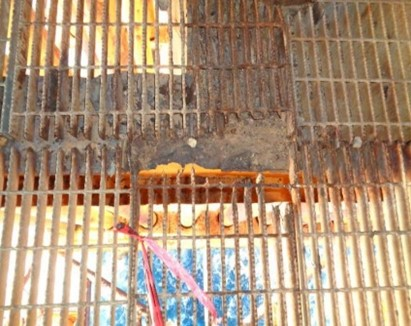
hazardous grating

I never liked the label “slips, trips, and falls” because it trivializes serious safety incidents. Falls don’t get headlines, but they kill workers. In the 10 years prior to Macondo, falls were the leading cause of Gulf of Mexico fatalities. 17 workers died from fall incidents during that period. Related incidents associated with falling or moving equipment (15) and lifting operations (5) accounted for another 20 fatalities. There was only one fire related fatality.

Unfortunately, BSEE’s posted incident data are incomplete, so more detailed, company specific analysis is difficult. No incident summaries whatsoever are posted for 2001-2012 and 2021, and 2020 fatalities are only described as “occupational” or “non-occupational.”

BSEE does do a very good job with their safety alert program, and has repeatedly expressed concerns about chronic grating and fall issues. 2022 Safety Alerts 438 and 427, and 8 other BSEE alerts issued within the last 3 years (nos. 353, 365, 378, 389, 399, 409, 416, 423) addressed grating and falls. BSEE has also conducted blitz inspections to identify problem facilities, and the Coast Guard has repeatedly raised concerns about grating and fall protection.

Per BSEE Safety Alert 365, grating, open hole, and fall prevention safety measures were seriously deficient at many of the facilities visited during their blitz inspections in 2019. The prevention of fall incidents requires the full commitment of management. Some companies are clearly not making that commitment.

Read Full Post »

MMS, the National Institute of Standards and Technology, and Environment Canada were leaders in developing and testing in situ burn spill response capabilities in the 1990’s. Tests at the MMS (now BSEE) Ohmsett facility and at sea offshore Newfoundland demonstrated this important spill response option.

BSEE has continued to advance the MMS spill response research program, and recently announced an exciting enhancement to in situ burn capabilities. BSEE and the Naval Research Laboratory invented a low-emissions atomizer burner designed to cleanly and quickly burn spilled oil, even after oil has been emulsified with water. See the video below.

The atomizer works by converting a stream of liquid, in this case, neat or emulsified crude oil, into a fine spray. The combustible spray is then able to completely burn without the plume of black smoke or residue, leaving the area safer for people, wildlife, and the environment. The burner interfaces with off-the-shelf pumps and air compressor equipment, so the collected fuel can be pumped to the burner. It can be mounted on a floating platform to stand freely in the water and has been successfully tested on waves.

NRL

Read Full Post »

Mr. Domangue began his career with BSEE in 1997 and has more than 30 years of experience in the oil and gas industry. He has served as the Deputy Regional Director for Districts, Investigations, Environmental, and Enforcement (DIEE), as Senior Technical Advisor for the BSEE Gulf of Mexico Region and was the Acting Chief of the National Offshore Training Center. Mr. Domangue also previously served as Office Supervisor for Regional Operations, and as District Manager for the Houma District Office of the BSEE Gulf of Mexico OCS Region. He holds a BS degree in petroleum engineering from Louisiana State University.

BSEE

Read Full Post »

The International Regulators’ Forum (IRF) does a good job of compiling safety performance data for offshore oil and gas operations in member countries. Because these data are collected by the respective regulators and compiled in accordance with established guidelines, we consider the IRF compilations to be the most credible international incident summary data for the offshore industry.

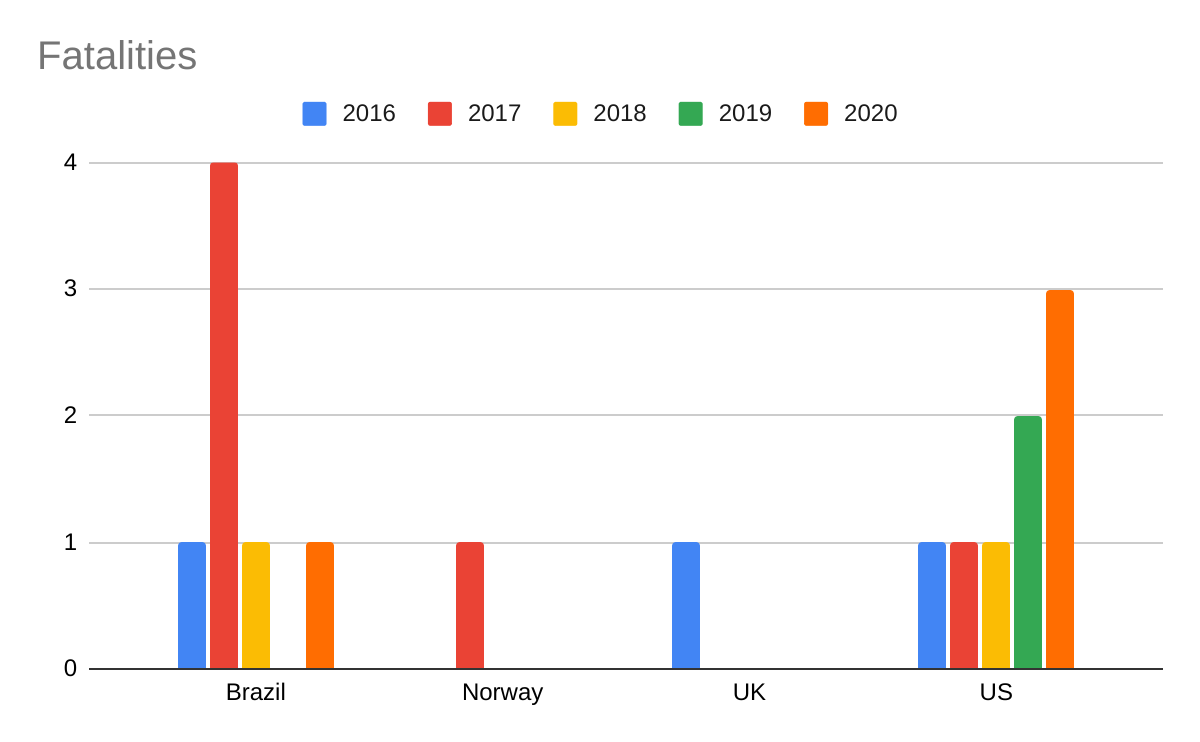
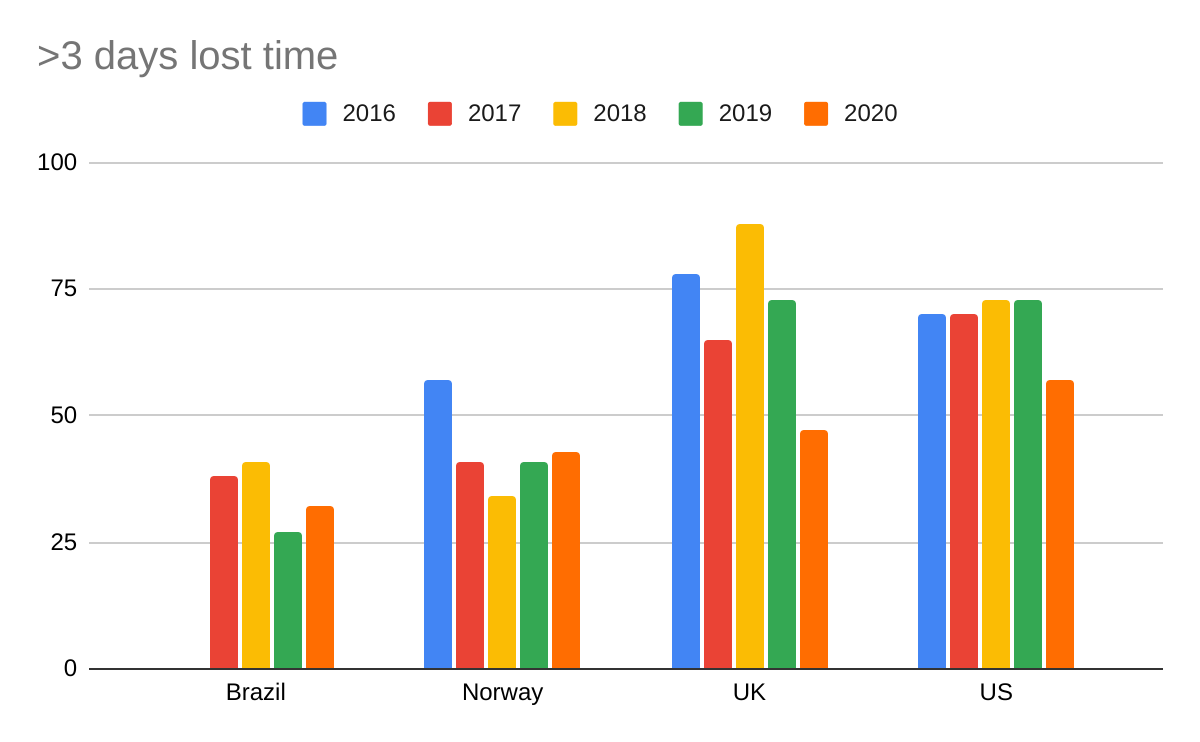
BOE looked at the numbers for the IRF countries with the highest level of activity in terms of hours worked – Brazil, Norway, UK, and US. These countries accounted for 90% of the total hours worked in 2020, the last year for which data are available. The 2020 hours worked (millions) were also relatively similar for the 4 countries: Norway – 41.2, UK – 42.4, US – 50.4, Brazil – 50.7. The differences in hours worked were somewhat greater in the prior years, but not dramatically so.

We charted the fatality and lost-time (>3 days) data (below). Our intent at this point is to draw attention to the IRF data sets, not to assess and compare performance. We do think the overall safety performance in these and other IRF countries, while far from perfect, is quite good given the hundreds of millions of hours worked, complexity of operations, logistical challenges, and difficult operating environments. We recommend that the IRF prioritize the timely posting of these data, and begin providing causation information so that companies and other interested parties can better identify performance issues and safety trends.

Read Full Post »

Linked below is an excellent compliance and incident data update by Jason Mathews. COVID-19 statistics are included. Kudos to BSEE’s Gulf of Mexico Region for their timely and comprehensive reviews and safety alerts.The collection, analysis, and timely publication of incident data are critical to safety achievement and continuous improvement.

Read Full Post »

The New York Times calls out the CDC for not releasing Covid data:

Kristen Nordlund, a spokeswoman for the C.D.C., said the agency has been slow to release the different streams of data “because basically, at the end of the day, it’s not yet ready for prime time.” She said the agency’s “priority when gathering any data is to ensure that it’s accurate and actionable.”

Another reason is fear that the information might be misinterpreted, Ms. Nordlund said.

“The C.D.C. is a political organization as much as it is a public health organization,” said Samuel Scarpino, managing director of pathogen surveillance at the Rockefeller Foundation’s Pandemic Prevention Institute. “The steps that it takes to get something like this released are often well outside of the control of many of the scientists that work at the C.D.C.”

BOE and others interested in offshore safety have expressed similar frustration over delays in the release of incident data and reports by BSEE and the Coast Guard, and the limited inspection data that are publicly available. As is the case with the CDC, we suspect these issues have more to do with bureaucratic obstacles than technical limitations or staff reluctance.

Read Full Post »

BSEE.gov
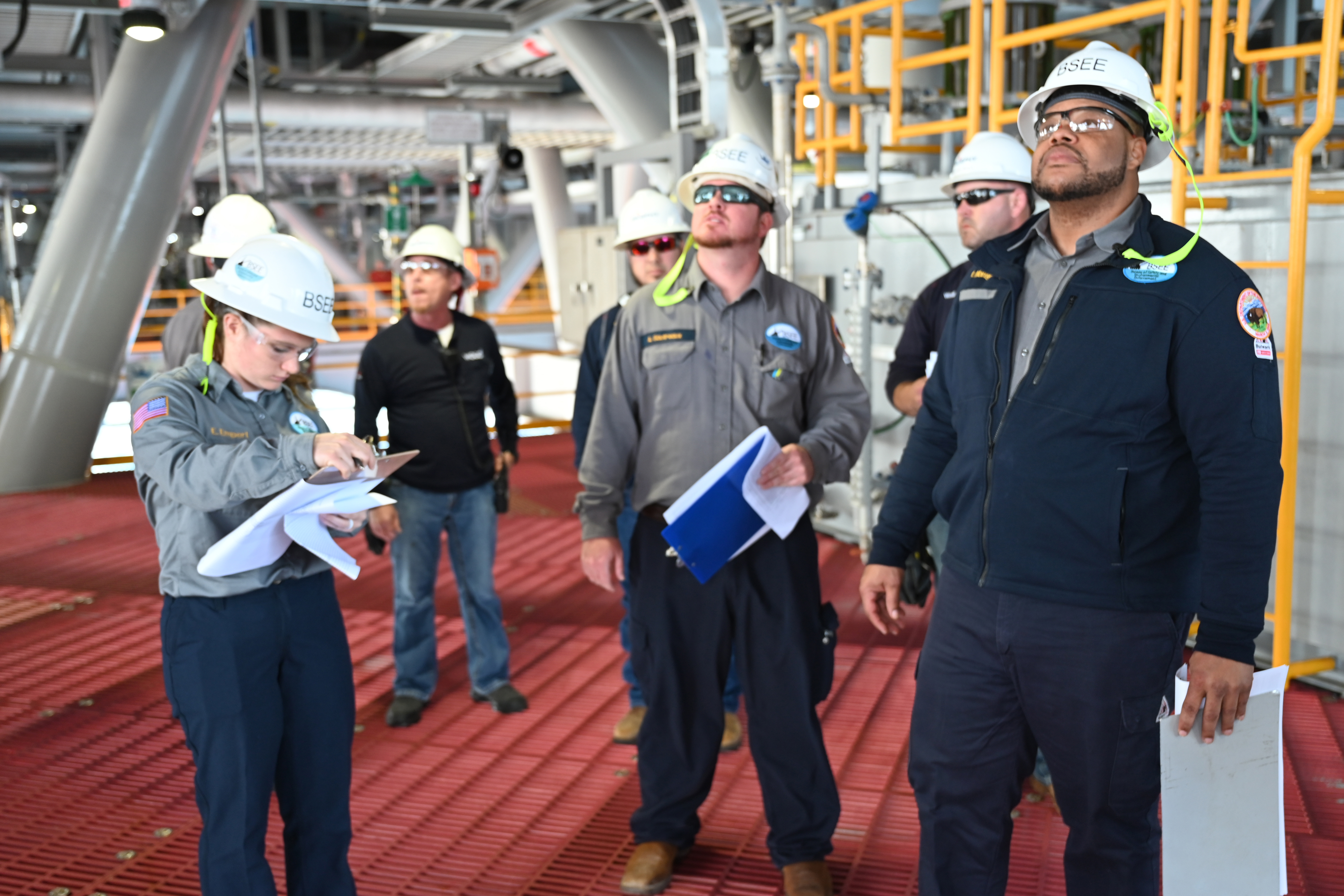
  1. Pictured above are BSEE inspectors from the famed Houma District conducting one of their (always) thorough pre-production inspections at Murphy’s King’s Quay semisubmersible production platform in the Gulf of Mexico. [Trivia question: Who was the first Houma District Supervisor?]
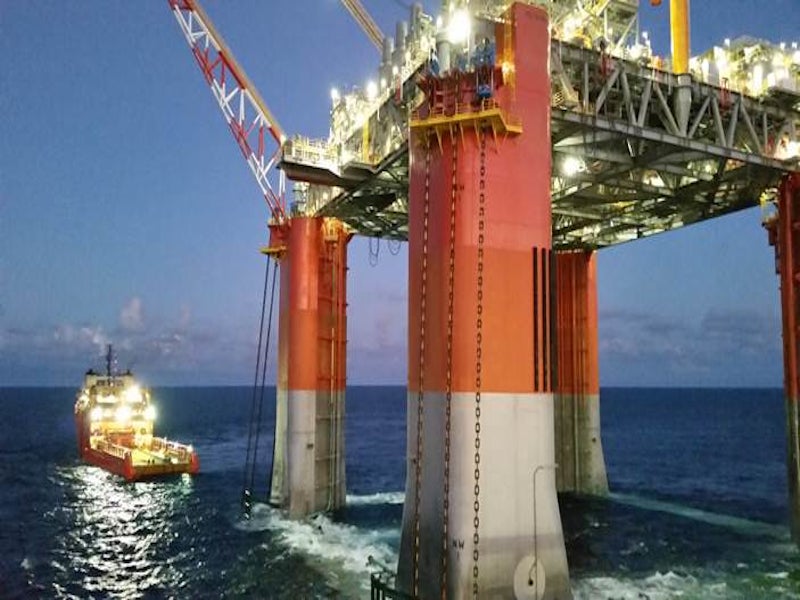
  2. King’s Quay is one of six deepwater platforms expected to begin production in the Gulf over the next several years. Others include Shell’s Vito and Whale, BP’s Argos, Chevron’s Anchor, and Beacon’s Shenadoah. All are semisubmersible platforms, the current design of choice for the deepwater Gulf. Production semis have become smaller and more efficient, greatly improving the economics of deepwater projects.
  3. These platforms feature efficient gas turbines and compression systems that should increase the GHG intensity advantage of deepwater Gulf production.
  4. These are the first deepwater production structures to be installed in the Gulf since Shell’s Appomattox in 2018. Per our previous post on this topic, current GoM production rates are not sustainable without regular, predictable lease sales and increased exploration.
King’s Quay under tow

Read Full Post »

The law suit makes reference to the aging offshore facilities and the Huntington Beach pipeline spill:

Oil companies have been drilling off California for more than 50 years. The first platforms were installed in 1968 and production continues today. Much of this infrastructure has outlived its expected lifespan and is well beyond the age scientists say significantly increase the risk of oil spills.

Indeed, just months ago a pipeline connected to a platform in federal waters off Huntington Beach ruptured and spilled tens of thousands of gallons of oil into the marine environment. The spill fouled sensitive marine, beach, and wetland habitat; forced closure of fisheries; and harmed and killed birds, fish, plants, invertebrates, and marine mammals.

CBD law suit

Read Full Post »

Last month (12/2021), BSEE finally posted the 2020 incident statistics. Unfortunately, no details or incident summaries are provided for the 6 fatalities. The fatalities are simply classified as “occupational” (4) or “non-occupational” (2). As a result, we still know very little about these fatal incidents 13 – 24 months after they occurred.

The BSEE spreadsheet advises that 3 of the 4 “non-occupational” fatalities are being investigated, but the reports are still “pending.” Why the long delay? The National Commission, BOEMRE-CG, and NAE investigations of the Macondo tragedy were completed (and reports published) in less time.

No explanation is provided as to why the 4th occupational fatality is not being investigated.

Also, investigations of the preparedness and response aspects of the 2 non-occupational fatalities would have been beneficial. What was the cause of death? What medical screening procedures were in place? What treatment capabilities were available at the facility? How much time was required to transport the workers to hospitals? These are important considerations for the offshore community.

Below is a summary of the publicly available information for the 6 fatalities:

  • 1/14/2020: A worker died on a Diamond drillship on a lease (Mississippi Canyon 822) operated by BP. According to BSEE this was a non-occupational fatality. Per the listing of investigations, no investigation was conducted.
  • 5/16/2020: A worker died on a Fieldwood platform (Ewing Bank 826 A). Per BSEE, this was an occupational fatality and the investigation is still pending. There were no media reports or company announcements.
  • 6/2/2020: A worker died on the Valaris DS-18 drillship working for EnVen Energy at Green Canyon 767. Per BSEE, this was a non-occupational fatality and no investigation was conducted.
  • 6/20/2020: A worker died on at the Green Canyon 18 A platform operated by Talos. Per BSEE, this was an occupational fatality but no investigation is indicated for this incident. No media reports or company announcements could be found.
  • 8/23/2020: A worker died on the Pacific Khamsin drillship working for Total at Garden Banks 1003. A month later, at an Investors’ Day presentation, Total announced that the incident occurred while the crew was preparing to move the rig to avoid Tropical Storm Laura. Total’s statement included this defensive statement: “This is a routine operation that was executed with no time pressure as the rig disconnection had been decided well in advance.” Per Total, the findings of their investigation were shared with the regulators in Sept. 2020, but BSEE advises that their investigation is still pending.
  • 12/2/2020: A worker died on DCOR’s Platform Gilda in the Santa Barbara Channel offshore California. The BSEE investigations update provides no information on the status of the investigation. Per local media, 3 men fell from the platform and others jumped into the water to assist. No information is provided on the reason why the 3 men fell.

The number of US OCS fatalities remains unacceptably high, and timely data sharing and investigations are needed to better assess causes and trends. In that regard, this recommendation from the 2016 National Academies report entitled “Strengthening the Safety Culture of the Offshore Oil and Gas Industry” merits further industry/government attention and action:

Recommendation 4.2.2: Because accident, incident, and inspection data all are needed to identify and understand safety risks and corrective actions, the committee recommends full transparency such that regulators make all these data readily available to the public in a timely way, taking into consideration applicable confidentiality requirements.

Read Full Post »
Observations and comments on the offshore findings and recommendations in the Dept. of the Interior’s report:

  • From an offshore perspective, this report is more moderate than expected. No major complaints.
  • The report was issued the Friday after Thanksgiving. Was there a desire to minimize attention?
  • The report does not include a recommendation on raising royalty rates. DOI will continue to study such actions (prudent decision).
  • BSEE estimates current liability for “orphaned infrastructure” at only $65 million. They must be using a very narrow definition of orphaned infrastructure.
  • “Financial assurance coverage should be strengthened.” (Few would argue with that statement.)
  • “BSEE and BOEM will carefully consider comments on the 2020 proposed financial assurance rule.” (Deja vu? Expect a long, slow process.)
  • BOEM will establish a “fitness to operate standard.” Comments: (1) This is an old concept that has proven to be difficult to execute. Hold companies accountable, make them demonstrate financial assurance, and don’t pander to bad actors (see the case of Hogan and Houchin) (2) Why is BOEM establishing this standard and not BSEE, the safety bureau? (The division of responsibilities between BOEM and BSEE has created serious overlap, inefficiency, and confusion and needs to be addressed.)
  • “BOEM should consider advancing alternatives to the practice of area-wide leasing.” Tract selection makes sense in frontier areas with little operational history. It would have been perfect for the Mid- or South Atlantic or the EGoM, all of which were cynically removed from future leasing consideration by the previous President just before the 2020 election. The Central and Western Gulf of Mexico is too mature for a return to tract selection; employing that approach after 40 years of area-wide leasing is likely to generate less revenue and production.

Read Full Post »

« Newer Posts - Older Posts »