Newfoundlander Howard Pike shared this interesting video.
Posts Tagged ‘bp’
Good video on bp’s Ephesus well, offshore Newfoundland
Posted in Canada, drilling, Offshore Energy - General, tagged bp, Ephesus well, Newfoundland, Trove on August 28, 2023| Leave a Comment »
Lease Sale 259: bid rejections and interesting outcomes
Posted in Gulf of Mexico, Offshore Energy - General, tagged bid rejections, BOEM, bp, Chevron, Lease Sale 257, Lease Sale 259, resource evaluation on July 20, 2023| Leave a Comment »
As previously posted, 14 of the 244 (not counting the 69 CCS bids) Sale 259 high bids were rejected. BOEM has published their bid evaluations for all of the tracts, and the 14 rejections are listed below.
| lease # | block | high bid ($) | BOEM MROV ($) | no. of bids |
| G37496 | DC 622 | 2,101,836 | 9,100,000 | 1 |
| G37515 | GC 173 | 307,107 | 1,300,000 | 1 |
| G37534 | GC 547 | 1,783,498 | 12,000,000 | 1 |
| G37538 | GC 591 | 1,291,993 | 5,200,000 | 1 |
| G37543 | GC 642 | 605,505 | 3,400,000 | 1 |
| G37548 | GC 777 | 583,103 | 4,200,000 | 1 |
| G37562 | AT 5 | 1,551,130 | 4,700,000 | 3 |
| G37565 | AT 133 | 607,107 | 2,600,000 | 1 |
| G37616 | KC 745 | 707,777 | 3,600,000 | 1 |
| G37617 | KC 789 | 707,777 | 2,100,000 | 1 |
| G37647 | WR 750 | 724,744 | 3,500,000 | 1 |
| G37646 | WR 794 | 724,744 | 3,200,000 | 1 |
| G37648 | WR 795 | 774,242 | 5,000,000 | 1 |
| G37649 | WR 796 | 774,242 | 4,000,000 | 1 |
Observations:
- Keathley Canyon (KC) Block 96, the tract receiving the highest bid in the entire sale ($15,911,947 by Chevron), had a BOEM MROV of only $576,000. Clearly, Chevron and the government have a very different view of the value of this tract. BP was the second bidder for KC 96, and their bid ($4,003,103) was also considerably higher than BOEM’s MROV. This one will very interesting to follow.
- The only bid that was rejected in Sale 257 was the BP/Talos bid of $1.8 million for Green Canyon Block 777. BOEM’s MROV in the Sale 257 evaluations was $4.4 million. BP again bid on GC 777 in Sale 259, but their bid was only $583,000 (even though BOEM’s Sale 257 evaluation was public information). BOEM’s MROV was reduced only slightly to $4.2 million, and they again rejected BP’s bid. We’ll see what happens in the next sale.
- 51 of the 230 accepted bids were >$1 million, all for deepwater tracts. All of the rejected bids were for deepwater tracts, and a higher percentage (4/14) were >$1 million. This makes sense given that the higher potential prospects are in deepwater.
- These results demonstrate again that resource evaluation is far from an exact science. BOEM is not selling barrels of oil and cubic feet of gas. BOEM is evaluating prospects, and companies are bidding on the opportunity to explore these prospects.
- Bidding strategies differ; the more companies participating, the better the long-term prospects for the OCS program.
Lease Sale 259: 14 high bids rejected!
Posted in Gulf of Mexico, Offshore Energy - General, tagged bid rejections, bp, Lease Sale 259, sequestration on July 5, 2023| Leave a Comment »

This is a surprisingly high number of rejections given that only one Sale 257 bid was rejected and all 69 of the carbon sequestration bids were accepted (even though such bidding was not authorized).
Specifics on the Sale 259 rejections have not yet been posted, but one of the rejections was bp’s bid for Green Canyon Block 777. This is not terribly surprising given that the bp/Talos GC 777 bid was the sole Sale 257 rejection, and bp’s sale 259 bid was less than 1/3 of their Sale 257 bid.
Guyana: Interesting oil spill liability battle
Posted in accidents, Guyana, Offshore Energy - General, oil spill response, Regulation, well control incidents, tagged bp, Exxon, Guyana, macondo, oil spill iiability, Supreme Court on May 10, 2023| 6 Comments »
There are a number of recent articles related to the Guyana Supreme Court ruling on Exxon’s financial assurance obligations. An Oil Now piece (quoted below) is the most informative. It seems that the Supreme Court decision is based on a provision of Exxon’s EPA permit and that EPA is siding with Exxon in this dispute.
The Guyana government and the Environmental Protection Agency (EPA) are set to appeal a recent Guyana Supreme Court ruling that determined that the EPA and ExxonMobil affiliate, Esso Exploration and Production Guyana Limited (EEPGL), breached the terms of the Liza 1 environmental permit. The permit was revised and granted to EEPGL last year for operations in the Stabroek Block, offshore Guyana.
Justice Sandil Kissoon granted several declarations, including that the EPA failed to enforce compliance by EEPGL of its Financial Assurance obligations to provide an unlimited Parent Company Guarantee Agreement and/or Affiliate Company Guarantee Agreement to indemnify and keep indemnified the EPA and the Government of Guyana against all environmental obligations of the Permit Holder (EEPGL) and Co-Venturers (Hess and CNOOC) within the Stabroek Block.
While acknowledging the court’s ruling, the Government of Guyana, as a major stakeholder, maintained in a statement that the Environmental Permit imposes no obligation on the Permit Holder to provide an unlimited Parent Company Guarantee Agreement and/or Affiliate Company Guarantee Agreement. The government believes that Justice Kissoon erred in his findings and that the ruling could have significant economic and other impacts on the public interest and national development.
OIlNow
Unlimited liability is a rather daunting and open-ended obligation that would trouble permittees in any industry.
In the US, the liability for oil spill cleanup costs is unlimited for offshore facilities, but there is a liability cap for the resulting damages. That cap is currently $167.8 million after a recent inflation adjustment. BP, of course, paid far more than that for damages associated with the Macondo blowout. BP’s costs, which amounted to an astounding $61.6 billion, were both voluntary and compulsory as a result of agreements and settlements. Keep in mind that the damage liability limit was only $75 million at the time. One can imagine what would have happened if a company with less financial strength or more inclination to fight had been responsible for the spill.
Gulf of Mexico rig count is showing some life
Posted in drilling, Gulf of Mexico, Offshore Energy - General, tagged Beacon, bp, Chevron, deepwater drilling, Diamond Offshore, Gulf of Mexico, Kosmos, LLOG, Murphy, Noble, Oxy, QuarterNorth, Shell, transocean, Valeris, Woodside on April 27, 2023| Leave a Comment »

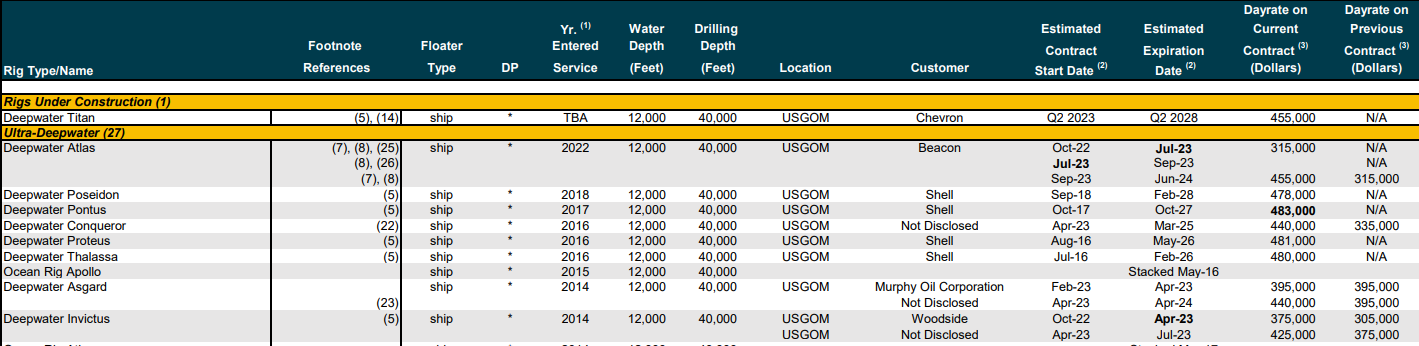
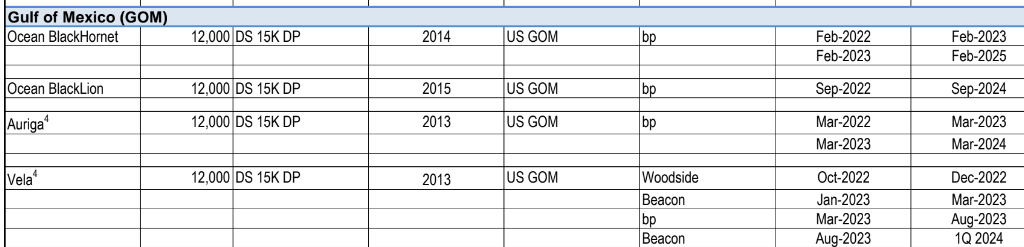
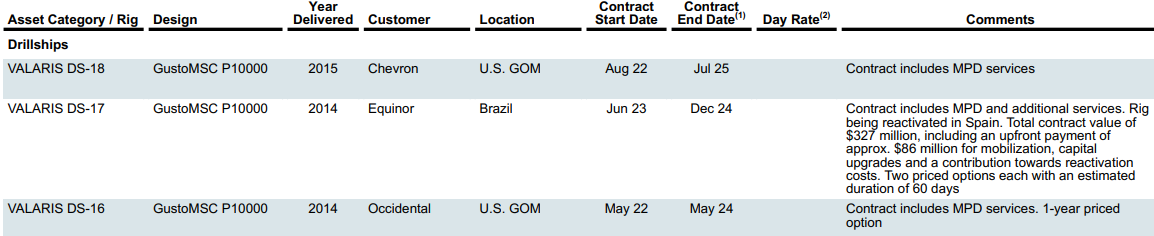
Based on drilling contractor rig activity reports, the table below lists 19 deepwater MODUs under or soon to begin contracts in the GoM. (Further details are pasted at the end of this post.) Per the Valeris report, platform rigs are operating on bp’s Thunder Horse and Mad Dog platforms. Per the BSEE borehole file, Arena and Cantium continue to drill development wells on the GoM shelf.
| Rig Name | Operator |
| Deepwater Titan | Chevron |
| Deepwater Atlas | Beacon |
| Deepwater Poseidon | Shell |
| Deepwater Pontus | Shell |
| Deepwater Proteus | Shell |
| Deepwater Conqueror | not disclosed |
| Deepwater Thalassa | Shell |
| Deepwater Asgard | Murphy |
| Deepwater Invictus | Woodside |
| Globetrotter I | Shell |
| Globetrotter II | Shell |
| Faye Kozack | QuarterNorth LLOG Kosmos |
| Stanley Lafosse | Murphy |
| Valaris DS-18 | Chevron |
| Valaris DS-16 | Oxy |
| Ocean BlackHornet | bp |
| Ocean Black Lion | bp |
| Auriga | bp |
| Vela | bp Beacon |
Excerpts from rig activity reports:




Deepwater GoM platforms: the next generation has arrived
Posted in Gulf of Mexico, Offshore Energy - General, tagged Anchor, Argos, bp, Chevron, King's Quay, Murphy, Shell, Vito, Whale on April 19, 2023| Leave a Comment »
With the announcement of first oil at Argos, 3 of the 5 next generation deepwater platforms (simpler, safer, and greener) are now producing oil and gas in the Gulf of Mexico. The other 2 platforms are expected to begin production in 2024.
Prior to the installation of these platforms, the last deepwater platform addition was Shell’s Appomattox in 2018. That gap in deepwater platform installations was the longest since Bullwinkle was installed in 1988.
The 5 new structures will increase the deepwater platform count by 9% from 56 to 61, and in the next few years should account for approximately 1/4 of GoM oil production.
| platform | operator | water depth (feet) | first production | design production (boe) |
| King’s Quay | Murphy | 3725 | April 2022 | 100,000 |
| Vito | Shell | 4000 | Feb 2023 | 100,000 |
| Argos | bp | 4500 | April 2023 | 140,000 |
| Anchor | Chevron | 5000 | 2024 (est.) | 80,000 |
| Whale | Shell | 8600 | 2024 (est.) | 100,000 |

Thunder Horse has an interesting history
Posted in accidents, Gulf of Mexico, Offshore Energy - General, tagged bp, Gulf of Mexico, listing, Thunder Horse on April 14, 2023| Leave a Comment »
This picture was posted by MaritmePhoto. The”Blue Marlin” heavy lift vessel is arriving in Texas (2005) with the massive semisubmersible production platform “Thunder Horse” on board.

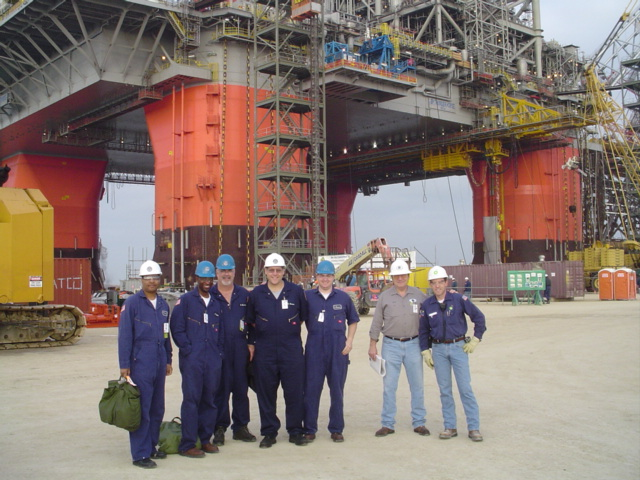
Above (from BOE archives): Pre-commissioning inspection of Thunder Horse
Thunder Horse has a most interesting history. The project was initially named Crazy Horse, but the name was changed out of respect for concerns raised by the Lakota nation. The massive structure is 136 m in length and 113 m in width, and is located in 6300′ of water in the Mississippi Canyon area of the Gulf of Mexico.
Many of you no doubt remember the near disaster during Hurricane Dennis (2005) when the platform was being commissioned. In light of the extensive pre-production hype for the “world’s largest production platform,” this was a costly and embarrassing incident for BP and the OCS program.

Per the findings of the MMS investigation team led by my former colleague David Dykes:
Findings indicate that failures associated with the hydraulic control system and its isolation on evacuation led to the partial opening of multiple hydraulically actuated valves in the ballast and bilge systems of the vessel. This allowed ballast water migration to take place, causing the initial listing (to approximately 16 degrees) of the vessel shortly after the hydraulic system was isolated.
The findings also indicate that ballast water migrated into manned spaces in the lower hull, via faulty and improperly installed check valves in the integrated ballast/bilge piping system. As the degree of list increased beyond the 16 degree mark, downflooding of seawater occurred, initially through overboard discharge lines and/or vents, and possibly later through the deck box as it entered the water. Since the PDQ was already listing at a 16 degree angle prior to the passage of Hurricane Dennis, wave action associated with the passage of the hurricane may also have contributed to the downflooding of seawater.
Although not an initiating event, failed Multiple Cable Transits (MCTs) and two unintended openings in the bulkheads allowed water transfer between watertight compartments, which led to extensive flooding and water damage in the lower hull.
Fortunately, there were no injuries. Repairs were made and production was finally initiated in June 2008.
After recent subsea tieback expansions, Thunder Horse is reported to be producing 200,000+ boe/d. OPEC’s Monthly Market Report for April 2023 cites the Thunder Horse expansion as a key driver in the January 2023 GoM production increase (see excerpt below).

2022 & Q1 2023 GoM well starts, plus a possible explanation for BP’s reduced bid for Green Canyon 777
Posted in drilling, Gulf of Mexico, Offshore Energy - General, tagged Arena Offshore, BOEM, bp, Cantium, deepwater drilling, Gulf of Mexico drilling, shelf drilling on April 6, 2023| Leave a Comment »
- Deepwater (>1000′) activity continues to dominate, accounting for 61% of the well starts.
- Not a single company drilled both shelf and deepwater wells.
- While shelf facilities currently account for only about 7% of GoM oil production, 1122 of the 1179 remaining platforms are on the shelf and they account for 24% of GoM gas production, most of which is environmentally favorable nonassociated gas.
- Two companies, Arena and Cantium, accounted for 75% of the shelf well starts. Excluding the CCS bids, Arena and Cantium were the most active shelf bidders in Sale 279. Arena bid alone on 7 blocks. Cantium was the high bidder on 5 blocks. (Focus Exploration was high bidder on 4 shelf blocks and was “outbid” by Exxon for High Island 177.)
- One company, Shell, accounted for 39% of the deepwater well starts
- One of BP’s exploratory wells (drilled subsequent to Sale 257) was in Green Canyon 821, immediately south of GC 777, the block that BP/Talos bid $1.8 million for in Sale 257. That bid was rejected by BOEM. In sale 259, BP was the sole bidder for GC 777, and their bid was only $583,000, less than 1/3 of their Sale 257 bid. Perhaps the GC 821 exploratory well reduced the value of GC 777? Will this lower bid now be accepted?
| DW expl | DW dev | shelf expl | shelf dev | |
| Anadarko | 5 | 1 | ||
| Arena | 22 | |||
| BOE | 1 | 4 | ||
| BP | 2 | 3 | ||
| Byron | 2 | |||
| Cantium | 20 | |||
| Chevron | 3 | |||
| Contango | 2 | |||
| Cox | 2 | |||
| Eni | 2 | 5 | ||
| EnVen | 5 | |||
| Greyhound | 2 | |||
| Hess | 2 | |||
| Kosmos | 1 | |||
| LLOG | 3 | 1 | ||
| Murphy | 4 | |||
| QuarterNorth | 2 | |||
| Shell | 25 | 9 | ||
| Talos | 2 | 8 | ||
| Walter | 1 | |||
| Woodside | 3 | 1 |
Lease Sale 259 Top Ten: Chevron’s surges, BP is bullish on the GoM, Shell steady, Equinor awakens, Beacon sees the light, OK for Oxy, Red Willow surprises, Hess rebounds, Woodside has BHP, Houston means Energy!
Posted in Gulf of Mexico, Offshore Energy - General, tagged Beacon, bp, Chevron, Equinor, Gulf of Mexico, Hess, Houston Energy, Lease Sale 259, Oxy, Red Willow, Shell, Top Ten, Woodside on March 31, 2023| Leave a Comment »
| company | no. of Sale 259 high bids (Sale 257 in parentheses) | total Sale 259 high bids ($ millions) |
| Chevron | 75 (34) | 108 |
| BP | 37 (46) | 46.7 |
| Shell | 21 (20) | 20.1 |
| Equinor | 16 (1) | 18.3 |
| Beacon | 13 (4) | 9.0 |
| Anadarko (Oxy) | 13 (30) | 8.6 |
| Red Willow | 13 (5) | 3.8 |
| Hess | 12 (2) | 8.3 |
| Woodside | 12 (8) | 6.3 |
| Houston Energy | 8 (5) | 11.6 |
Interesting Sale 259 items
Posted in CCS, Gulf of Mexico, Offshore Energy - General, tagged bp, Exxon, Focus Exploration, Gulf of Mexico, Lease Sale 257, Lease Sale 259 on March 30, 2023| Leave a Comment »
- In the previous Gulf of Mexico sale (257), the $1.8 million bid submitted by BP and Talos for Green Canyon Block 777 was rejected. BP bid again for this block in Sale 259, but their bid was only $583,000. One would assume that this bid will also be rejected, but perhaps there is more to the story (new geologic data?).
- Green Canyon 79 received a bid of $3.6 million at Sale 257, but no lease was ever issued. No explanation was provided and there were no bids for this block at Sale 259.
- There was actually a second bidder, Focus Exploration, for one of the 69 “CCS blocks,” that Exxon seeks to acquire (see below). Exxon’s bid was higher. Does this mean that Focus, a company that is presumably interested in exploring for oil and gas, will lose the block to a company that bid on the block for purposes not authorized in the Notice of Sale?

 Bud's Offshore Energy (BOE)