Feeds:
Posts
Comments

Posts Tagged ‘BOEM’

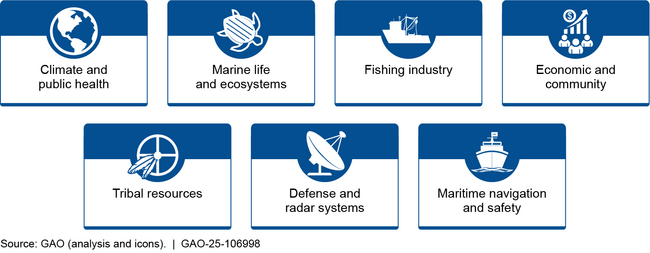
The Government Accountability Office report on Offshore Wind Energy (full report attached) does a good job of summarizing the potential impacts from offshore wind development. They are categorized in the report as follows:

  • Marine Life and Ecosystems (see table pasted below)
  • Fishing Industry and Fisheries Management
  • Economic Development and Community Impacts
  • Tribal Resources, Including Sacred Sites and Established Fishing Grounds
  • Defense and Radar Systems
  • Maritime Navigation and Safety

Unfortunately, GAO’s recommendations, which focus on consultation and staffing (perennial favorites), are rather meaningless. Does GAO really think more consultation will resolve the fundamental concerns of the tribes and fishing industry? Does GAO really think increasing BOEM/BSEE staff is a solution? Wind was the signature offshore energy program of the previous Administration, and it was well resourced.

When the legislation authorizing offshore wind energy development was drafted, we envisioned energy alternatives that could complement thermal energy sources like gas, coal, and nuclear plants. Natural gas plants are particularly important to intermittent energy sources, because their power can be readily dispatched on demand.

Never did we expect attempts to ban the dispatchable energy sources on which renewable energy goals were dependent. Policies that limit gas production, transportation, and consumption don’t boost offshore wind development, they doom it.

In a rush to achieve the Administration’s energy goals, the wind leasing program brushed aside important economic, safety, national security, and environmental issues. Coastal residents, tribes, fishing interests, power customers, and other affected parties have rebelled. Their concerns won’t be smoothed over by increasing consultation.

So now the wind program is in a dark and windless place (a regulatory dunkelflaute?). Five projects are under construction or in the early stages of operation. Construction has been authorized for 6 other projects. Five more projects are in various stages of permitting. What next?

Meanwhile, we still haven’t seen a report on the ugly and embarrassing Vineyard Wind blade failure offshore Nantucket last July. Shouldn’t that report be a precursor to further offshore wind development in the US Atlantic? Also of note, that same turbine was struck by lightning 2 months ago.

Should directed suspension orders be issued pending a complete review of the wind program? If so, for which leases and for how long? Suspension of projects still in the permitting phase would be relatively painless and maybe even attractive given the current state of the wind industry. However, financial impacts for projects in the construction phase would be significant. These important next-step decisions need to be made soon. Muddling along is not a strategy.

Table 2: Examples of Potential Impacts of Offshore Wind Development to Marine Life and Ecosystems

ImpactDescription
Acoustic disturbanceConstruction and survey activities produce underwater noise that can disturb sensitive marine species. Offshore wind projects take measures to mitigate underwater noise, including the use of bubble curtains to dampen pile driving sound and pausing operations if protected species are sighted.
Changes to marine habitatInstallation of infrastructure, such as turbine foundations and transmission cables, introduces new structures and causes changes to the ocean floor that can alter marine habitat and affect the distribution, abundance, and composition of marine life in the area. These new structures can create artificial habitat that may benefit some species while displacing others and could affect bottom-dwelling species through disturbing the seabed. Artificial habitat effects of wind turbines are well documented, but research is ongoing to monitor and understand impacts on marine life.
Hydrodynamic effectsOperation of wind turbines can affect hydrodynamics and ocean processes such as currents and wind wakes, but little is known about regional effects of widescale deployment on ecosystems.
Vessel disturbanceVessels can disturb some species and pose strike risks to large marine animals, but the increase in offshore wind vessels is projected to be small compared to the total volume of vessel traffic. Offshore wind vessels are required to take measures such as following speed restrictions and employing protected species observers.
Entanglement riskStructures, such as mooring cables from floating wind turbines, could snag fishing gear and other marine debris and create entanglement risk to marine animals. Wind projects employ measures to minimize entanglement (e.g., mooring systems designed to detect entanglement), but there is uncertainty about the extent of the risk from floating turbines because of limited deployment.a
Collision risk to birds and batsTurbine blades pose a collision risk to some sea birds, but little is known about offshore collision risk to bats. Research on collision risks and mitigation measures (e.g., lighting and curtailment) is ongoing.

Read Full Post »

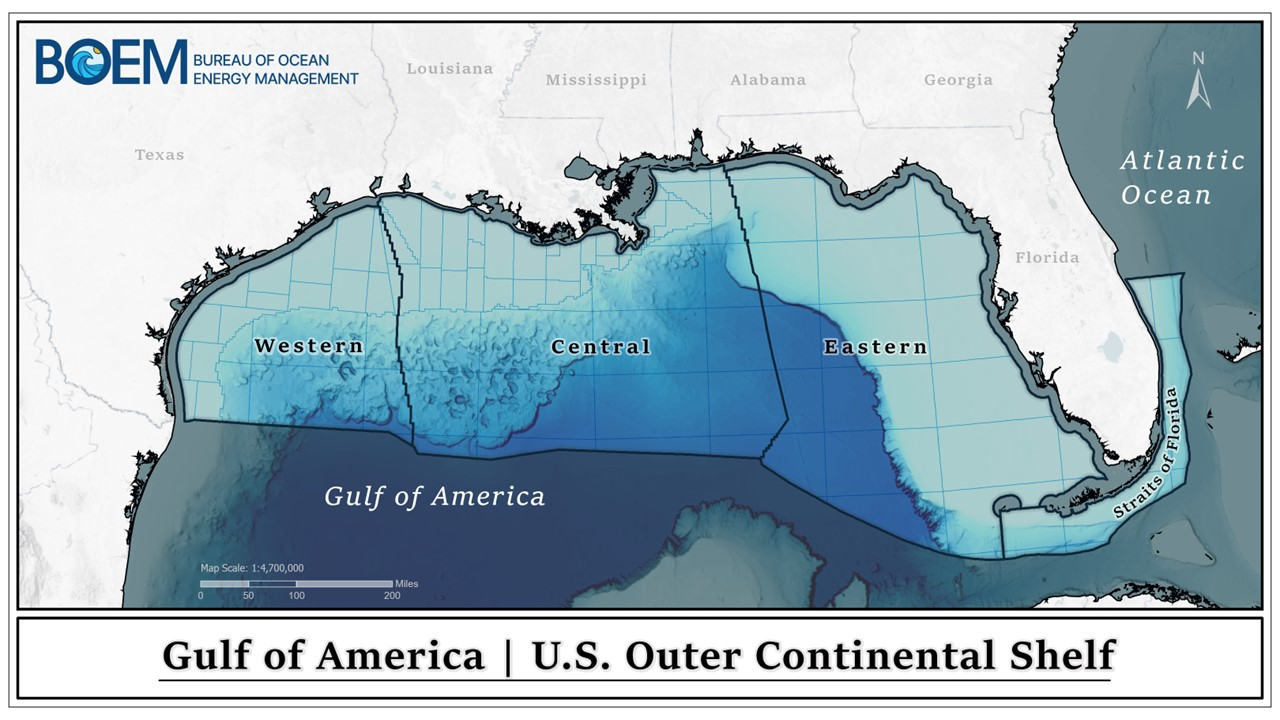
“The Bureau of Ocean Energy Management’s analysis reveals an additional 1.30 billion barrels of oil equivalent since 2021, bringing the total reserve estimate to 7.04 billion barrels of oil equivalent. This includes 5.77 billion barrels of oil and 7.15 trillion cubic feet of natural gas—a 22.6% increase in remaining recoverable reserves.” 

YearNumber of fieldsOriginal ReservesHistorical Cumulative ProductionReserves
Oil BbblGas TcfBOE BbblOil BbblGas TcfBOE BbblOil BbblGas TcfBOE Bbbl
19752556.6159.917.33.8227.28.662.7932.78.61
19804358.0488.923.94.9948.713.663.0540.210.20
198557510.63116.731.46.5871.119.234.0545.612.16
199078210.64129.933.88.1193.824.802.5336.18.95
199589912.01144.937.89.68117.430.572.3327.57.22
20001,05014.93167.344.711.93142.737.323.0024.67.38
20051,19619.80181.852.214.61163.943.775.1917.98.38
20101,28221.50191.155.517.11179.349.014.3911.86.49
20151,31223.06193.857.619.58186.552.783.487.34.78
20161,31523.73194.658.420.16187.553.583.576.84.79
20171,31924.65195.259.720.78188.954.213.876.35.00
20181,31924.86195.559.721.42189.855.213.445.74.45
20191,32526.77197.061.822.12190.956.094.656.15.74
20231,33630.43201.266.224.66194.059.195.777.27.04
Oil and gas reserves and cumulative production at end of year, 1975-2023, Gulf of America, Outer Continental Shelf and Slope. “Oil” includes crude oil and condensate; “gas” includes associated and non-associated gas. Reserves estimated as of December 31 each year.

This increase in reserves will not please those responsible for the current 5 Year Oil and Gas Leasing Plan. They told us that we don’t need more OCS lease sales and that our biggest concern is producing too much oil and gas for too long!

Page 6 of the Leasing Plan:

The long-term nature of OCS oil and gas development, such that production on a lease may not begin for a decade or more after lease issuance and can continue for decades, makes consideration of net-zero pathways relevant to the Secretary’s determinations on how the National OCS Program best meets the Nation’s energy needs.

Energy experts like Dan Yergin and Vicki Hollub have a much different view. Per Hollub:

Crude reserves are being found and developed at a much slower pace than they’ve been in the past. Specifically, she said the world has only newly identified less than half the amount of crude it’s consumed over the course of the past 10 years. Given the current trends, this means demand will exceed supply before the end of 2025.

A bit off-topic, but Jeff Walker, a former colleague and the MMS Regional Supervisor in Alaska, had the best quip about reserve numbers. In explaining an operator’s revised reserve numbers for a producing unit which had leases with different royalty rates, Jeff noted that “oil always migrates to the lower royalty leases.”😉

Read Full Post »

Santa Ynez Unit items (thanks to John Smith for the links):

Cuts in carbon capture spending coming? These are cuts that both climate activists and skeptics can support.

In a peer reviewed paper, AI (Grok-3) debunks the man-made climate crisis narrative.

Doug Burgum: Hydraulic fracturing technology is “one of the reasons why the U.S. shale revolution is a miracle. But that miracle keeps on getting better and better. It’s the thing that has literally turned around the economy.” Posted here 15 years ago: Natural Gas Bonanza – Why Aren’t We Celebrating?

Read Full Post »

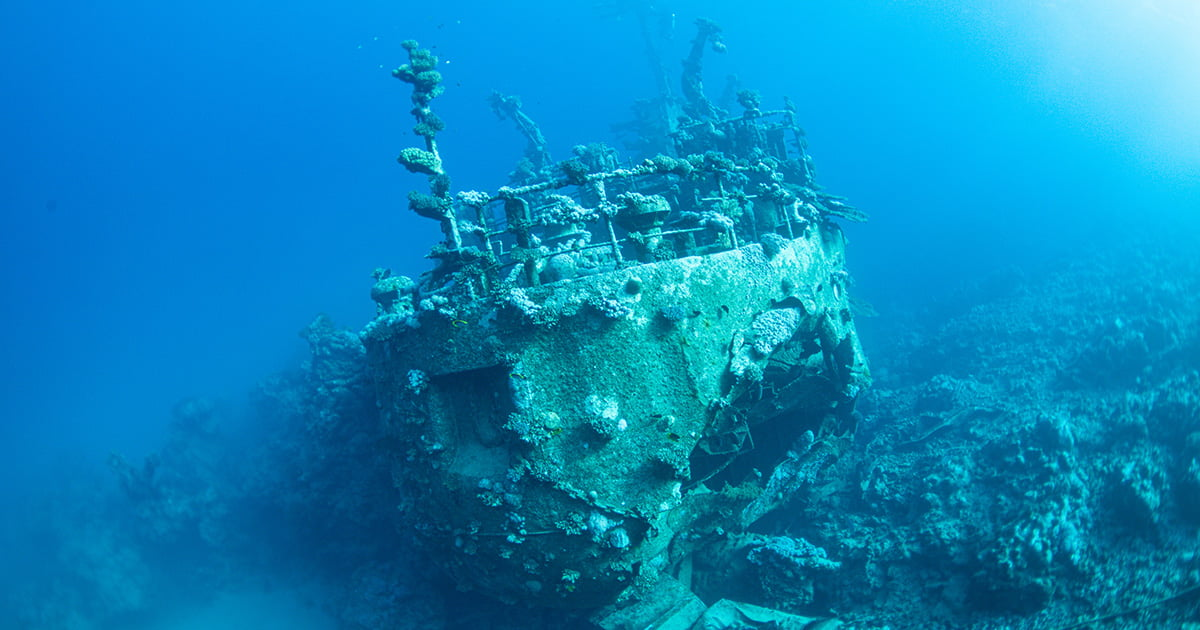
BOEM’s 2024 Marine Archaeology Rule

Exercising authority granted in the Congressional Review Act (Chapter 8 of Title 5 of the United States Code), Congress passed Joint Resolution 11 nullifying the Bureau of Ocean Energy Management rule titled “Protection of Marine Archaeological Resources” (Sept. 3, 2024).

Nullification of a final rule is not common. Since its Enactment in 1996, the CRA has been used to overturn only 20 rules. This is the first time an OCS energy rule has been nullified.

Enactment of a CRA resolution of disapproval is unlikely in most circumstances, because a President would be expected to veto a joint resolution disapproving a rule issued by the President’s own Administration.

There are also time limitations for nullifying a rule. The joint resolution must be introduced during a 60-days- of-continuous-session period beginning when the rule has been published in the Federal Register and been received by Congress. However, if within 60 session days after a rule is submitted, Congress adjourns its session, the periods to introduce and act on a disapproval resolution reoccur in their entirety in the next session of Congress.

It’s also noteworthy that a CRA resolution cannot be filibustered if the Senate acts on the resolution during a 60-days-of-Senate-session period beginning when the rule has been received by Congress.

Most of the 20 nullifications involved rules finalized at the end of a previous administration that were nullified at the beginning of a new administration with a majority in both chambers of Congress. That is the case for the Marine Archaeology Rule, which was published at the end of the Biden administration and nullified at the beginning of the Trump administration. .

The nullified OCS rule required operators to submit an archaeological report identifying potential archaeological resources with any exploration or development plan. The rule modified regulations that only required such a report only when a BOEM regional director had reason to believe that an archaeological resource may be present in the lease area. 

Archaeological survey requirements have been somewhat contentious since they were introduced in the 1970s. There were concerns about decisions to require the protection of speculative, low probability sites that could significantly alter operating plans.

A reasonable balance and an apparent consensus was achieved by limiting the report requirements to areas where studies and other information indicated the potential for such resources. BOEM’s new rule tightened the requirement considerably, which led to opposition and ultimately nullification.

Resolution Timeline

2/4/2025SenateResolution Introduced by Sen. Kennedy
2/25/2025SenatePassed by Yea-Nay Vote 54 – 44
3/6/2025HousePassed by Yea-Nay vote: 221 – 202, 1 Present
3/13/2025Presidentsigned

Read Full Post »

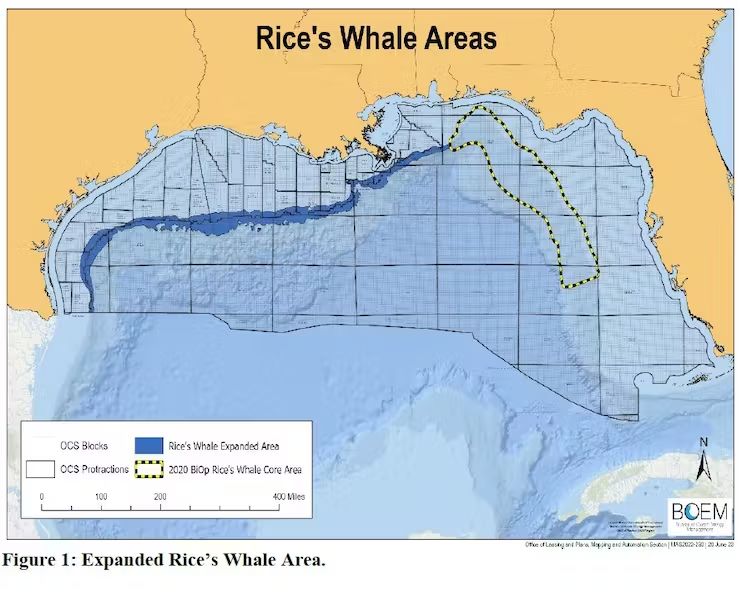
Although Rice’s Whale lease stipulations were deleted from Sale 261 leases by court order, similar NTL restrictions remained in effect for all oil and gas operations in the Gulf of America. Those NTL restrictions, some of which may be excessive and premature, have now been rescinded.

A previous post compared the Rice’s Whale restrictions applicable to Gulf oil and gas operations with the less onerous Right Whale restrictions for the Atlantic wind industry.

Of course, this is not the end of the Rice’s Whale dispute. A Federal judge in Maryland has ordered the National Marine Fisheries Service’s (NMFS) to prepare a new biological opinion that better protects the Rice’s whale. The deadline for the new biological opinion was extended to May 21, 2025. After that date, no new Gulf leases may be issued and no new operating plans may be approved pending a new biological opinion that is acceptable to the Court.

Stay tuned.

Read Full Post »

Not a single offshore wind turbine will be installed offshore New Jersey during the reign of Gov. Murphy, a leading proponent of offshore wind. How much did his wind advocacy cost NJ taxpayers?

Meanwhile, management of what is left of the Atlantic Shores partnership continues to deny the obvious – that there is no realistic path forward for their projects.

Finally, NJ Congressman Chris Smith is questioning any further action by BOEM on offshore wind projects. See the attached letter.

Read Full Post »

Career Minerals Management Service and BOEM stalwart Dr. Walter Cruickshank has been named Acting Secretary of the Interior pending the confirmation of Doug Burgum. Walter is a very bright guy with a balanced perspective on energy development. He has served capably on the senior management teams of both Democrat and Republican administrations. Bonus points for the Mineral Economics doctorate from Penn State and his keen interest in the Cape Cod Baseball League! 😉

Read Full Post »

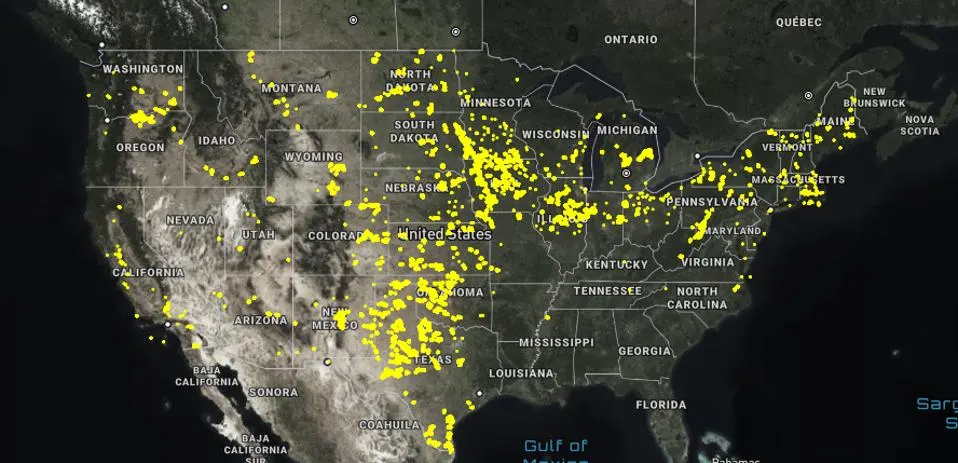
Forbes (USGS map of active wind turbines): “The U.S. Wind Turbine Database contains more than 74,695 wind turbines built since 1980, spread between 1,699 wind power projects in 45 states. However, thousands of wind turbines are reaching the end of their operational lifespan and need to be either repowered to make way for updated (often larger) turbines or entirely decommissioned to allow for new uses of the land they occupy. Unfortunately, there is no uniform legal framework to regulate the steps involved, nor is there an accepted industry-wide set of best practices, and the environmental costs are considerable.”

Forbes:As is often the case when new technologies come to market, unintended downstream consequences are not always immediately obvious to the players. Enthusiasm for clean energy initially pushed the first wind turbines into existence in the U.S. without considering the environmental and monetary costs that would be involved in either upgrading or bringing projects to a close later in their life cycle. “

Similarly, BOEM’s enthusiasm for offshore wind projects has increased decommissioning financial assurance risks for power customers and taxpayers. Their “Rule to Streamline and Modernize Offshore Renewable Energy Development” is intended to “make offshore renewable energy development more efficient, [and] save billions of dollars.” The savings associated with relaxed financial assurance requirements come at the expense of transferring decommissioning risks to those who have received little or no financial benefit from the projects.

Related story: “Osage Tribe Wins Again, Federal Judge Orders “Ejectment” Of 84 Wind Turbines By Next December”

Read Full Post »

Addressing regulatory fragmentation will improve efficiency and lower costs for industry and government while reducing safety and environmental risks.

Unfortunately, the regulatory regime for US offshore oil and gas operations is noteworthy for redundancy, uncertainty, and complexity that divert industry and governmental attention from safety and environmental protection objectives to administrative processes, interpretations, and jurisdictional boundaries.

“Poster Child” for regulatory fragmentation?

The 12 Federal entities that have some OCS regulatory responsibilities are identified in the above chart. The organizations with core regulatory roles are included in the overlapping circles. The responsibilities of BOEM and BSEE are so inextricably intertwined that those bureaus occupy the same circle.

Coastal states also have OCS regulatory roles through authority granted in the Coastal Zone Management Act.

When multiple agencies have jurisdiction over a facility, system, or procedure, the redundancy inevitably results in inconsistency, ambiguity, and gaps in oversight. The focus of operating companies and contractors is diverted from safety and risk management to understanding and satisfying the regulators. The inevitable result is a compliance mentality that weakens the safety culture.

Interagency agreements in the form of MOUs and MOAs, which are ostensibly for the purpose of managing redundancy, are often unclear or inconclusive. They tend to be more for the benefit of the agencies than the regulated industry. The interests of the regulators and protecting turf are paramount.

Regulatory fragmentation was a contributing factor to the two most fatal US OCS incidents in the past 35 years, the 2010 Macondo blowout and the South Pass 60 “B” fire and explosion in 1989.

Solutions:

  • Where legislation is not required (e.g. BOEM and BSEE), use executive orders to combine and streamline the regulatory functions.
  • Where agencies have separate legislative authority, establish a lead regulator by executive order pending corrective legislation. Under the EO, the agencies would function as a joint authority under the direction of the lead regulator.
  • A combined BOEM/BSEE would be the logical choice for leading the joint authority given that OCS energy is their sole focus and they are accountable for the success of OCS programs.
  • Use a management system regulatory approach that holistically considers all of the legislatively enacted regulatory objectives.
  • Increase the attention given to regulator and operator performance in terms of both outcomes and efficiency.
  • Reduce and simplify permitting requirements for operating companies that have demonstrated outstanding safety and environmental performance over a sustained period.
  • See the findings and recommendations from the 2010 Vancouver IRF Conference.


Read Full Post »

W&T (lease and facility map above) claims that insurers have colluded to damage the company by jointly demanding additional collateral and premiums.

Comments on excerpts from the W&T press release follow:

At the heart of the dispute are rules from the federal Bureau of Ocean Energy Management – BOEM – which require energy producers in the Outer Continental Shelf to provide a bond to pay for well, platform, pipeline and facilities cleanup if the operating company fails to do so.”

Comment: Despite disagreeing with aspects of the BOEM financial assurance rule, this blog has defended the rule against unfair criticism. Better solutions are achievable, but that will require industry leaders from all factions to come to the table with a commitment to reach a balanced agreement that protects the public interest.

“These insurance companies and their unreasonable demands for increased collateral pose an existential threat to independent operators like W&T.”

Comment: If insuring offshore decommissioning is so risk-free and lucrative, why aren’t other companies entering the market?

Several states, including Texas, are challenging the BOEM rule and in one case they specifically cite W&T as an example of how the rule could be misused to irreparably harm energy producers.

Comment: As previously posted, the concerned States should propose alternative solutions that would promote production while also protecting taxpayer interests. Arguing that decommissioning financial risks are not a problem is neither accurate nor a solution.

“In over 70 years of producer operations in the Gulf of Mexico, the federal government has never been forced to pay for any abandonment cleanup operations associated with well, platform facility, or pipeline operations.”

Comment: Shamefully, from the standpoints of both the offshore industry and the Federal government, that statement is no longer true. The taxpayer has now funded decommissioning operations in the Matagorda Island Area offshore Texas (BSEE photo below) and more significant decommissioning liabilities loom.

Other thoughts:

Read Full Post »

« Newer Posts - Older Posts »