Feeds:
Posts
Comments

Archive for the ‘Regulation’ Category

GAO’s report entitled “Opportunities to Reduce Potential Duplication in Government Programs, Save Tax Dollars, and Enhance Revenue” has just been released. The report identifies $billions in potential savings that could be realized by reducing program duplication.

Comments:

  1. Not only could taxpayer dollars be saved by reducing overlap and duplication, but greater efficiencies and safety benefits would be achieved.  As BOE has frequently noted, a single agency should be responsible and accountable for safety and pollution prevention at offshore facilities. For regulators, “overlap means underlap.” Important issues are sure to be overlooked, misunderstood, or confused. Jurisdictional redundancy inevitably results in unnecessary complexity, and regulatory and industry personnel are required to spend too much time resolving and coordinating administrative and procedural matters.  This time would be better spent focusing on mission critical safety issues.
  2. Much of the duplication among agencies is the result of the overlapping responsibilities of congressional committees, complex and poorly crafted legislation, and insufficient emphasis on function-based management.
  3. Program savings achieved by one government unit are immediately absorbed by another, discouraging cost-effective management practices. Senior and mid-level Federal managers should be able to transfer savings directly to a debt reduction fund that cannot be used for any other purpose. Federal managers should receive positive recognition for savings and efficiency, not criticism or immediate budget reductions.

Read Full Post »

The future pace of drilling approvals in the Gulf of Mexico might be slowed less by new laws or regulations stemming from last year’s massive spill but by a decades-old law that opens the door to longer environmental reviews and litigation. New York Times

We know the NEPA process is slow and repetitive, but how much value is added? NEPA reviews don’t improve well integrity, BOP performance, or safety management programs; nor do they even address these fundamental safety and pollution prevention considerations, at least not in a substantive way.  Why not publish a single, comprehensive online environmental review for drilling and production operations in the region?  The review would cover all possible impacts for every type of operation. This detailed “living document” would be continuously updated as new environmental information is acquired, technology advances, and regulations and standards are updated.  The public could comment on specific operations as they are proposed, and could otherwise comment on the document at any time. Periodic public meetings could be held as necessary and desirable.

Read Full Post »

Some post-Macondo commentary has characterized MMS employees as regulatory Neanderthals who couldn’t see beyond their checklists, had no understanding of operating systems and the associated process-safety risks, and were dreadfully behind their industry and regulatory peers. The reality is quite different, as those who worked with or for the MMS know. Someone who did both, Doug Morris, an engineer and attorney with extensive industry and regulatory experience, shared this excerpt from an April 1988 Federal Register notice. The Notice publishes the outcome of a 5-year regulatory review that updated and consolidated all MMS operating requirements for offshore oil and gas operations. One of objectives was to establish performance standards for all types of operations to encourage innovation and discourage a “compliance mentality.” Keep in mind that this Notice was published before Piper Alpha, the Cullen report, and the worldwide wave of regulatory reform that followed.

The following summarizes the major changes from current rules:

(1) Performance Standards. Performance standards were added which describe the safety, environmental, property, and resource protection goals intended to be achieved by specified design and engineering requirements. These additions are intended to identify the purpose of the detailed requirements and thus provide a basis for approving an alternative method for achievement of the stated purpose. New, different, better, and more efficient techniques and practices are intended to be available to lessees on the basis of these performance standards.

(a) Performance Requirements. A “Performance requirements” section was added. This section clarifies that the specific detailed requirements of the rule do not preclude the approval for use of alternate or new techniques, procedures, equipment, or activities when the lessee satisfies MMS that the proposed alternate approach provides equal or greater protection than that provided by the requirements specified in the rule. The establishment of performance standards in addition to specific detailed requirements is intended to remove obstacles to innovation and ensure that MMS’s regulations are not unnecessarily prescriptive.

Read Full Post »

Link

Salazar and Bromwich also announced that they are establishing a permanent advisory body through which the nation’s leading scientific, engineering, and technical experts will provide input on improving offshore drilling safety, well containment, and spill response. Secretary Salazar has asked former Sandia National Laboratory Director Tom Hunter to lead the body, which will be called the Offshore Energy Safety Advisory Committee (Safety Committee).

The new Bureau of Ocean Energy Management (BOEM) will be responsible for managing development of the nation’s offshore resources in an environmentally and economically responsible way. Functions will include: Leasing, Plan Administration, Environmental Studies, National Environmental Policy Act (NEPA) Analysis, Resource Evaluation, Economic Analysis and the Renewable Energy Program.

The new Bureau of Safety and Environmental Enforcement (BSEE) will enforce safety and environmental regulations. Functions will include: All field operations including Permitting and Research, Inspections, Offshore Regulatory Programs, Oil Spill Response, and newly formed Training and Environmental Compliance functions.


Read Full Post »

WA’s Mines and Petroleum Minister, Norman Moore, is firmly opposed to the Federal proposal for a single national regulator.

We are yet to be persuaded by this, or any other report, that a national regulator would be the way to go. Norman Moore


Read Full Post »

Judge Wells’ report is quite expansive in a way that may be unprecedented for a helicopter accident review.  His commission delves into cultural and organizational issues and regulatory philosophy. Consistent with the international trend, the commission recommends a separate safety authority (page 302):

It is recommended that a new, independent, and stand alone Safety Regulator be established to regulate safety in the C-NL offshore. Such a Safety Regulator would have to be established, mandated, and funded by both Governments by way of legislative amendment, regulation, or memorandum ofunderstanding, or other means.

In his background remarks, Judge Wells makes this comment on regulatory culuture:

I have come to believe that regulation to be effective must encompass more than a list of do’s and don’ts. It must set in place and lead an inclusive regime of many players, some very important, others less so. All the available knowledge, skills, and wisdom of all participant sshould be harnessed in the safety cause.

Read Full Post »

In conveying our deep condolences and solidarity to the United States Government and while sharing in the anguish of those whose livelihoods had been seriously affected, I asked that the report ofthe investigation into the accident be submitted to IMO as soon as possible after it has been concluded, so that we may move swiftly to introduce, into the regulatory regime of the Organization, whatever lessons may be learned from the incident in order to enhance safetyand environmental protection in the offshore industry and strengthen, should that prove necessary, the provisions of any relevant IMO instrument. Remarks by Secretary-General Efthimios Mitropoulos

The Secretary-General seems to be committed to an expanded role for IMO in regulating offshore oil and gas facilities.  Questions:

  1. Is an organization with a shipping history and culture the right body to be regulating drilling and production operations? While IMO has experience with mobile drilling units, primarily the vessel aspects, the organization has had little or no involvement with well construction and integrity, production operations or pipelines.
  2. What would an expanded IMO role  mean for existing offshore regulators and their cooperative efforts (primarily through the International Regulators’ Forum) to coordinate activities and improve safety performance?  Generally speaking, the principal safety regulators for offshore facilities have had a very limited role in IMO activities.

Read Full Post »

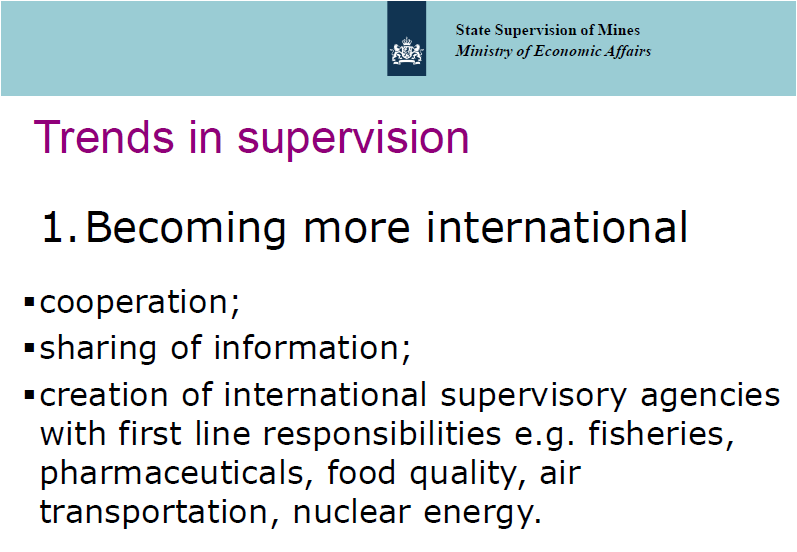
The above slide is from the excellent presentation that Jan de Jong (Inspector General, State Supervision of Mines, the Netherlands) never got to deliver in Vancouver. As session chair, Jan graciously yielded his time to his panelists.

Jan’s presentation notes the growing importance of international cooperation. This trend has the potential to improve regulatory capabilities, expand data availability and access, reduce regulatory costs through the sharing of resources, reduce costs for industry through greater international consistency and regulatory certainty, and improve international relations.  The Netherlands, Russia, Norway, Cuba, the US, and everyone else should be on the same team when it comes to offshore safety and pollution prevention.  Some near-term suggestions follow:

  • Except where regional conditions dictate otherwise, the same standards should be applied worldwide.  Government and industry should be collectively questioning, testing, and improving these standards. Remember that the goal is continuous improvement, not mere compliance.
  • An international information system should provide for the collection and verification of incident and performance data.
  • Using international data and expertise, a cooperative risk assessment program should be initiated.
  • An organized international audit capability should be established to evaluate operators and regulators.
  • To improve access to expertise and reduce costs, a network of specialists should assist regulators worldwide.
  • Industry training requirements should be uniform and consistently applied, and regulator training programs should be consolidated regionally or internationally.
  • The international research network should be expanded.
  • To ensure that accidents are investigated independently and to minimize the potential for political influences on the investigation process, an international accident investigation capability should be established.
  • The safety culture message should be promoted worldwide.  Successes and failures should be cooperatively examined.

Read Full Post »

From Western Australia Business News:

The gulf between the Western Australian government and Canberra continues to widen, with state mines and petroleum minister Norman Moore writing to local oil and gas companies for support to block plans for a single national oil regulator.

Comment: What is Mr. Moore offering the companies in return for their support? This “turf” battle shows why you can’t have multiple authorities regulating the same facilities.  Disputes, self-interest, conflicting agendas and priorities,  and “turf” issues drain too much energy from the regulators and the industry being regulated.  Concerns about critical operational risks are superseded by coordination activities and debates about who is in charge.

Read Full Post »


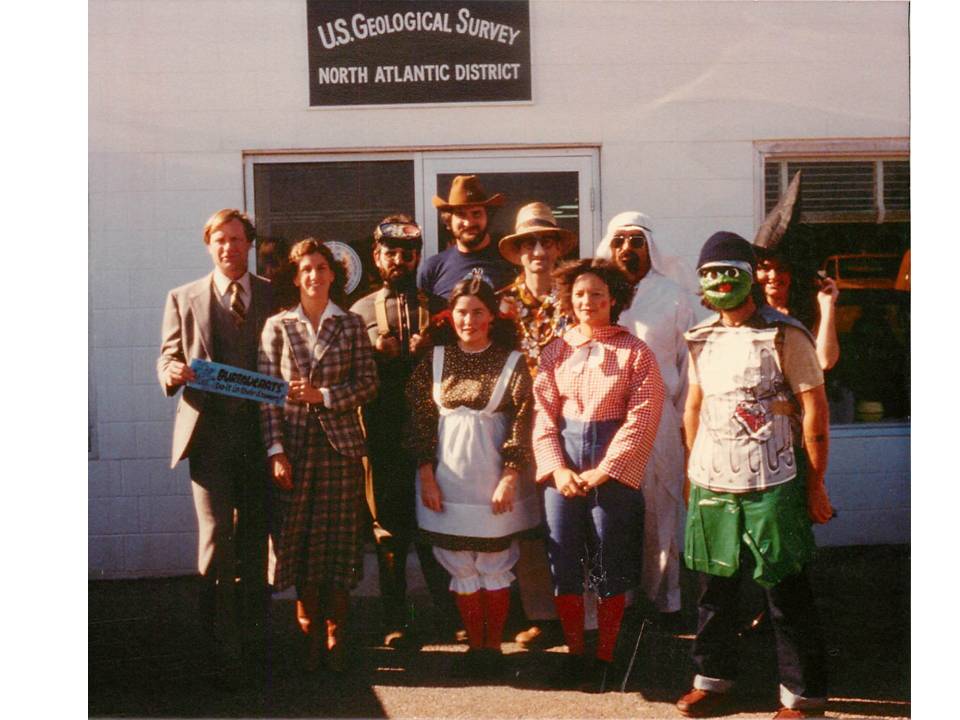
Hyannis Halloween - 1981


Note the sign (above) on our office at Barnstable Municipal Airport in Hyannis. Prior to 1982 when the Minerals Management Service was formed, the OCS regulatory program was part of the US Geological Survey (Conservation Division) and the leasing program was in the Bureau of Land Management. After a 28-year marriage, these functions are again being separated.

As one who worked in the OCS program for 10 years prior to the formation of MMS, I think the the pre-1982 framework is conceptually preferable. However, unless the separation is carefully executed, disruptive conflicts between the two organizations are guaranteed.  Such conflicts were common in the pre-MMS days, and the Department of the Interior had to set up a special office to coordinate activities and manage disputes.

In addition to being independent, the new regulatory authority must be fully responsible (without interference) for all regulatory actions from plan approval through abandonment.  Without such independence and authority, the separation will only add to the regulatory confusion that has handicapped the OCS program throughout its history.

Technical and scientific personnel in the OCS regulatory program must be freed from non-productive and time-consuming internal disputes and coordination responsibilities so they can concentrate on performance measurement, risk assessment, safety leadership, standards, and technical studies.

Read Full Post »

« Newer Posts - Older Posts »