Feeds:
Posts
Comments

Archive for the ‘Offshore Energy – General’ Category

In light of the TikTok drama in Washington, I thought I’d take another look at Chinese ownership of Gulf of Mexico oil and gas leases.

A year ago, it was reported that State owned China National Offshore Oil Corp. (CNOOC) was considering an exit from its operations in the US, Canada, and the UK because of sanctions concerns. That may still be the case for other properties, but CNOOC has retained its Gulf of Mexico lease interests.

Per BOEM lease data, CNOOC continues to own 25% and 21% interest respectively in the important Stampede (Green Canyon 468, 511, and 512) and Appomattox (Mississippi Canyon 391, 392, and 393) deepwater projects. CNOOC reports are positive on those operations, noting that the production wells have performed better than expected.

CNOOC also owns interest in five other GoM leases. No CNOOC lease interest has been assigned to other companies in the past two years.

As is the case with CNOOC’s position in Guyana’s Stabroek block, their GoM lease holdings were acquired as part of CNOOC’s takeover of Nexen in 2013.

I welcome foreign investment in our offshore program, and see little downside in Chinese entities owning minority shares of OCS leases. GoM lease ownership does advance CNOOC’s understanding of deepwater exploration and development technology, but that knowledge can also be acquired elsewhere, sometimes in partnership with US companies (as is the case in Guyana).

Read Full Post »

(2) the Secretary may not issue a lease for offshore wind development under section 8(p)(1)(C) of the Outer Continental Shelf Lands Act (43 U.S.C.1337(p)(1)(C)) unless
(A) an offshore lease sale has been held during the 1-year period ending on the date of the issuance of the lease for offshore wind development; and (B) the sum total of acres offered for lease in offshore lease sales during the 1-year period ending on the date of the issuance of the lease for offshore wind development is not less than 60,000,000 acres.

‘Inflation Reduction Act of 2022,” p. 646

Lease Sale 261 was held on 12/20/23. Absent legislative action, no wind leases may be issued after 12/20/24 unless another oil and gas lease sale is held prior to that date. Given that the minimalist 5 year oil and gas leasing plan, which is being challenged, does not propose a sale until 2025, wind lease issuance will likely be suspended at the end of the year. (Note: I wonder if the legislative restriction also applies to lease assignments from existing owners to new owners? Probably not, but that would be very significant given the current state of the offshore wind industry.)

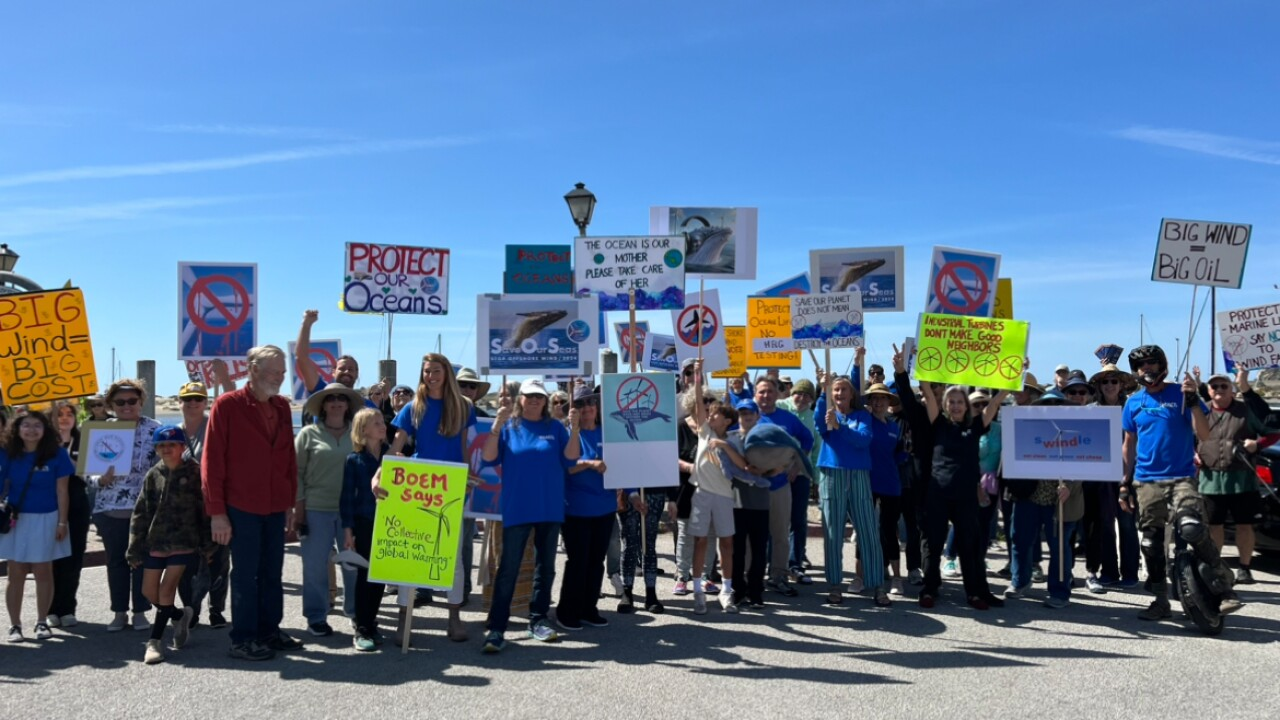
The legislative restriction may be a partial explanation for the apparent rush to issue wind leases. 16 new wind leases were issued in 2022 and 2023, bringing the total number of active leases to 36. The philosophy seems to be this: issue as many leases as you can, as fast as you can, wherever you can (ala James Watt’s failed strategy for the oil and gas program.) Coastal residents are not entirely thrilled.

Perhaps the wind program should be required to develop 5 year leasing plans, as is the case for the oil and gas program. This might facilitate a more holistic approach to wind energy development and ease concerns about cumulative impacts.

Morro Bay protest

Read Full Post »

Test results came back from the Office of Spill Prevention and Response – part of the Department of Fish and Wildlife – indicating the natural oil source, said Richard Uranga, US Coast Guard public affairs specialist.

“From the first initial stages, they were tracking that from the samples,” he said. “The oil rig samples were not the same as the oil that was gathered from the oil sheen.”

LA Daily News

So why did the LA Times report shortly after the sheen was detected that it was not from natural causes, and attribute that finding to the Coast Guard? It was too soon for the lab results to be back. Was a platform spill the desired narrative?

Keep in mind that up to several hundred barrels of oil per day seep naturally into Southern California waters.

Read Full Post »

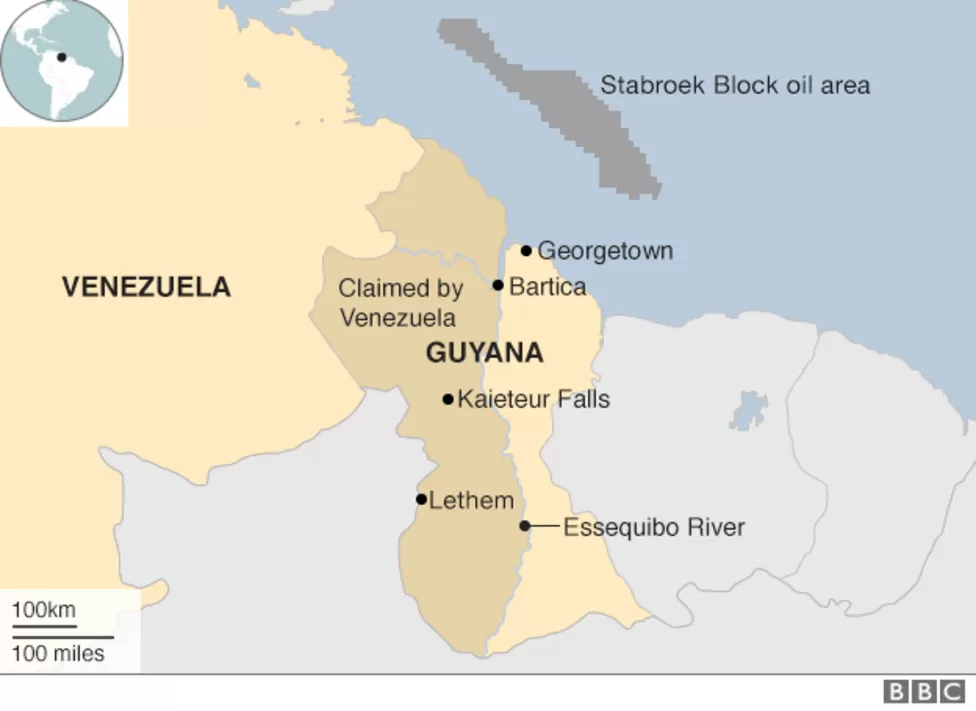
Exxon has filed for arbitration at the International Chamber of Commerce (ICC), the next step in the company’s attempt to derail or delay Chevron’s acquisition of Hess. Adding to the intrigue are the ambitions of neighboring Venezuela, which has claimed 2/3 of Guyana and the adjacent offshore territory.

Chevron continues to operate in Venezuela and is a beneficiary of the easing of US sanctions that facilitated the resumption of oil exports. Is the government of Guyana okay with Stabroek partners helping to support the regime that claims much of their offshore oil?

On the other hand, what about Exxon’s Stabroek partner, state-owned China National Offshore Oil Corp.? CNOOC has a 25% share of the Stabroek block (vs. 45% for Exxon and 30% for Hess) as a result of their takeover of (Canadian) Nexen in 2013. The CNOOC acquisition of Nexen was similar to Chevron’s acquisition of Hess. Was Exxon okay with that change in ownership?

CNOOC hasn’t released any public statements on the Stabroek dispute, but appears to be aligned with Exxon. Presumably, CNOOC also wants a larger share of the Stabroek pie. Is the Government of Guyana okay with an ally of Venezuela increasing their influence and having access to geologic, reservoir, and operational data for the Stabroek block? CNOOC is also partnered with Exxon on the block they acquired at the most recent licensing round.

Given the national security implications, is the Government of Guyana okay with leaving the resolution of this dispute to an ICC tribunal in Paris?

Read Full Post »

Bayou Bend CCS LLC commenced drilling an offshore (Texas State waters) and an onshore stratigraphic well for carbon sequestration in the first quarter 2024.

Talos

Is offshore carbon disposal ocean dumping? One of the provisions that was slipped into the “2021 Infrastructure Bill” exempted carbon sequestration from the Marine Protection, Research, and Sanctuaries Act of 1972 (Ocean Dumping Act). This exemption revises the OCS Lands Act and thus does not apply to State offshore lands. The Texas offshore wells must therefore be permitted by EPA as “Class VI wells,” as is the case for onshore disposal wells. However, Texas and Louisiana have asked the EPA for “primacy,” which would allow state agencies to approve and oversee these operations.

Meanwhile, the regulations for carbon disposal on the OCS, which the Infrastructure Bill mandated by November 2022, have yet to be published for comment. The latest Federal regulatory agenda indicates a publication date of 12/00/2023 for these regulations. Presumably the staff work has been completed and the rule is stalled in the review process.

Despite the absence of a regulatory framework, BOEM has accepted sequestration bids at the last three oil and gas lease sales. These bids were evaluated as if the leases were being acquired for oil and gas exploration and production, even though the bidders’ intentions were widely known. Why was BOEM a willing participant in this charade, not just at one sale, but at three sales in succession?

Given that the perceived carbon disposal bonanza is dependent on mandates and subsidies, one has to wonder about the massive revenue projections for this industry and raise concerns about the associated public and private financial risks. What is the long term business plan for this industry? Who will be monitoring the offshore wells (in perpetuity)? How will the public be protected from financial assurance and leakage risks? We will see how the myriad of carbon sequestration issues are addressed in the proposed regulations.

Read Full Post »

As we enter the third month of 2024, BSEE has finally updated the incident tables to include 2022 data.

The OCS program managers I was privileged to work for would never have accepted such delays in posting fundamental safety data. Carolita Kallaur (RIP) wouldn’t tolerate a delay of 14 days in publishing quarterly incident statistics, let alone a delay of 14 months for annual data with no quarterly updates. Transparency and timeliness in informing the public about offshore safety performance was her highest priority. Cynthia Quarterman, Tom Readinger, and other OCS program leaders were similarly insistent on timeliness and transparency in the reporting of incident data.

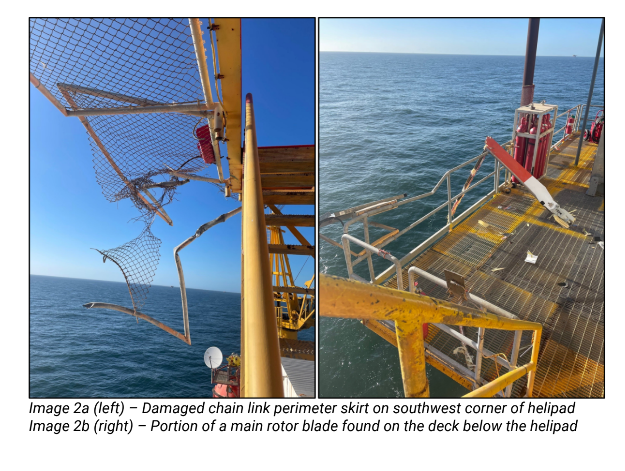
The belated 2022 BSEE tables also include a glaring error. The most important figure, the number of fatalities, is incorrect. Five workers died from US OCS incidents in 2022, not one. The fatal helicopter crash at the West Delta 106 A helideck on 12/29/2022 that killed four workers (photos below) is inexplicably not included. 

Is the failure to include this fatal incident a regulatory fragmentation issue? OCS safety data should be reported holistically and should not be parsed based on perceived regulatory jurisdiction? In any event, the tragic accident at the West Delta 106 A platform occurred at the helideck, which per the MOA with the Coast Guard is under BSEE jurisdiction.

It’s unfortunate that 2023 data are not available, even in summary form. At a minimum, BSEE should be proudly reporting that 2023 was the first zero fatality year on the US OCS since at least 1963! While acknowledging that this outstanding achievement will be difficult to repeat, it most certainly deserves public attention.

Lastly, what about incident data for the offshore wind program? When will these data be posted?

Read Full Post »

from EIA data

Reports in Nov. indicated that ~60,000 bopd were shut-in as a result of the presumed Main Pass Oil Gathering system pipeline leak. The Coast Guard subsequently reported that other pipelines in the area were shut-in as the search for a leak continued. The bulk of the Nov./Dec. production decline of ~80,000 bopd (from Oct. levels) was probably attributable to those pipeline system shut-ins.

Read Full Post »

Note that the Stabroek block is equivalent in size to 1,150 Gulf of Mexico lease blocks and contains multiple outstanding prospects.

Are Exxon and Chinese partner (CNOOC) attempting to use Chevron’s acquisition of Hess to improve their already lucrative position in Guyana’s prolific Stabroek block?

From OilNow Guyana:

  • The Stabroek operating agreement outlines terms for Hess, Exxon, and CNOOC to explore and develop the block.
  • This Stabroek agreement includes a right of first refusal (ROFR) provision which allows the parties to buy out the stake of one of them in the event of a ‘change of control’ transaction.
  • Chevron and Hess argue that the merger’s structure does not trigger the ROFR clause.
  • Exxon and CNOOC argue that the clause applies. This could force Hess to offer its stake in the Stabroek block to its partners first. 

The Exxon/CNOOC position seems to be a stretch. Chevron did not buy the Stabroek share; they bought the company that holds that share. Hess is to be part of Chevron and there would be no change of control from the standpoint of the partnership.

As an offshore operator, Exxon has been highly responsible from a safety standpoint. However, the company has a shown tendency to stretch the envelope when it comes to contract rights. The most recent example was their acquisition of 163 GoM oil and gas leases for carbon disposal purposes, contrary to the terms of the sale notice and lease contracts.

Read Full Post »

John Smith, a decommissioning specialist who retired from BOEM, has published numerous professional papers on the topic. He has kindly shared his comments (below) on the new GAO report.

The Appeal Process is Broken – The GAO should have emphasized this point.  Companies routinely appeal orders to decommission platforms to forestall having to spend money on plugging wells and removing platforms, pipelines and other facilities. The appeal process commonly takes 5 or more years to reolove (e.g., DCOR appeal of BSEE order to decommission Platform Habitat).

Well P&A – BSEE has been negligent in requiring operators to plug and abandon wells no longer useful for operations. I’m shocked BSEE has curtailed or stopped issuing Inc’s for the failure of operators to P&A wells.  That’s a major failure on the part of BSEE management. That may explain why operator performance criteria was proposed to be eliminated for financial assurance.

Failure to Issue Civil Penalties for Well P&A – From GAO Report “BSEE officials explained that their reluctance to pursue civil penalties stems in part from concerns about whether inducing financial harm against an operator is an effective approach to compel decommissioning. They expressed reservations about taking actions—such as issuing civil penalties—that might strain the financial resources of operators to the point of pushing them into bankruptcy.”   This attitude underscores a real problem – an abrogation of regulatory and enforcement responsibility by BSEE. 

POCS Well P&A –  More than 700 wells have been drilled from the 23 California OCS platforms. The GAO report notes that approximately 200 are in the process of being plugged and abandoned – about 50% of those are probably associated with Gail, Grace, Harvest, Hermosa, Hidalgo, where P&A work has largely been completed by Chevron and Freeport McMoRan.  The vast majority of the remaining 500 wells are no longer useful for operations and have been idle for several decades.  Note POCS was never part of the Idle Well and Idle Iron Program, which was exclusive to the GOM. GAO gave POCS BSEE a pass by not highlighting that problem in POCS. It would have been interesting to know how many of the remaining 500 POCS wells are considered no longer useful for operations, and how many of those have been temporarily plugged and abandoned pursuant to regulations.  The GAO report broke that down for the GOM.

Footnote 46 of GAO Report – “Two of the eight platforms due for decommissioning in the Pacific—platforms Hogan and Houchin—have posed serious safety, environmental, and financial risks, including poor safety compliance records, severe corrosion, and ongoing disputes about who will assume decommissioning liabilities for the platforms and their associated wells, according to BSEE officials and documentation. According to BSEE, these platforms are currently being attended, monitored, and maintained as part of an agreement between BSEE, BOEM, Interior’s Office of the Solicitor, and the three predecessor operators pending a decision from the Interior Board of Land Appeals on the predecessors’ appeal. BSEE estimates that approximately $5 million of the estimated costs to decommission 21 orphaned sidetrack wells associated with these platforms are uncovered by financial assurances.”    $5 million divide 21 = $238,000 per well  – extremely conservative cost estimate given age of wells, likely collapsed casing, and downwhole equipment that needs to be removed.  The cost could easily be 3-4 times higher and there is no bonding so the federal government and taxpayers are on the hook for those costs.

Platform Hogan and Houchin Wells – approximately 75 wells were drilled from the platforms.  It would be interesting to know the status of those wells.  How many have been properly temporarily plugged and abandoned with long-term barriers installed to prevent leaks before decommissioning pursuant to OCS regulations?  Are the 21 orphaned wells mentioned above the Signal wells?  What about the other 54 wells?  Have the predecessor lessees agreed they are responsible for plugging and abandoning those wells?  

Platform Habitat – GAO could have noted this is another example of the broken appeal process. It would be interesting to know whether the 21 wells (primarily if not all gas wells) on Habitat have been temporarily abandoned. There are likely to be significant fugitive emission levels at the platform.  Hopefully the APCD is on top of that.  Note – the platform is unmanned and as I previously mentioned a potential catastrophe was avoided several years ago when a fire broke out on the platform.

Read Full Post »
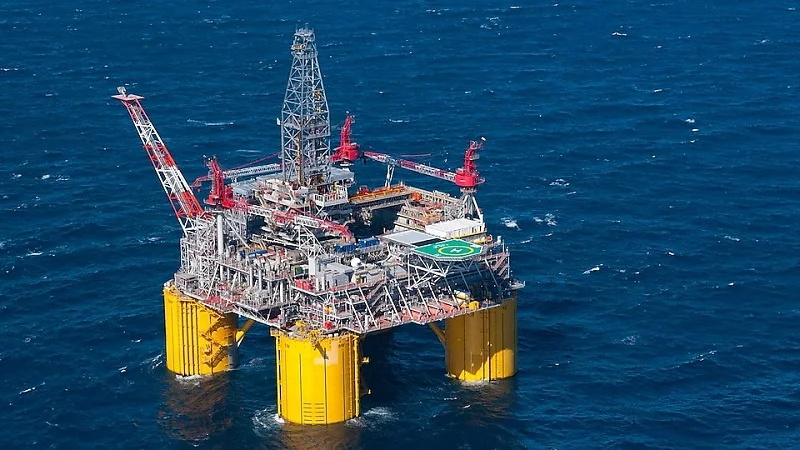
Offshore facility decommissioning is a frequent target of Federal auditors given the complex financial and regulatory challenges. Unfortunately, the reviews have done little to better protect the public interest. As have previous inquiries, the new GAO report (attached for your convenience) calls for improved regulations and enforcement practices. That, of course, has been the objective for decades, but the problems have only worsened.

While the GAO recommendations are unsurprising, the body of the report is informative. Most notably, GAO (p. 29) raises a significant inconsistency on a key provision in the proposed decommissioning financial assurance regulations published last year:

One of the five criteria BOEM would no longer use under the proposed rule is demonstrated reliability, as shown by record of compliance with laws, regulations, and lease terms, among other factors. BOEM’s June 2023 regulatory analysis concluded this criterion is not a good predictive indicator of default on decommissioning obligations. However, BOEM and BSEE officials we spoke with told us that poor compliance records—such as safety and maintenance issues or delayed decommissioning obligations—can be an indicator of potential decommissioning noncompliance or financial stress.

Why was there such a disconnect between the opinions of BOEM and BSEE officials (who are directly involved with decommissioning) and BOEM’s decision not to include a company’s compliance record among the factors to be considered in determining the need for supplemental financial assurance? As pointed out here and here, safety performance is arguably the most important predictor of financial failure and decommissioning noncompliance.

The GAO report correctly acknowledges the difficulties in disqualifying operating companies. However, the regulations at 30 CFR § 250.135 specifically provide for disqualification for poor performance. While the regulations could be tighter, enforcing disqualifications regulations is dependent on persistence and strong support from management and DOI attorneys. Given the political risks associated with disqualifying operators, that support is often lacking.

Disqualification difficulties make it imperative that BOEM carefully consider past performance before approving lease assignments or determining financial assurance amounts. Provisions in 30 CFR §585.408 and §585.107 could have been used to disapprove assignments to Signal Hill, Fieldwood, Cox, and other problem operators. The failure to do so has significantly delayed decommissioning and increased public exposure to financial risks.

In some cases, lease assignments to unqualified companies have not only been approved but they have been facilitated by BOEM/MMS. The case of Platforms Hogan and Houchin, in the Santa Barbara Channel, is a particularly good example. (Did GAO inquire about the Inspector General report on this matter or ask why that report has still not been released?)

Most operating companies are responsible about planning for and fulfilling their decommissioning obligations. The problem is the exceptions, and they are not difficult to identify if you look at compliance data and obtain input from BSEE inspection personnel.

Other important decommissioning questions that need to be considered:

Additional comments on the GAO report from decommissioning specialist John Smith will be posted tomorrow.

Read Full Post »

« Newer Posts - Older Posts »